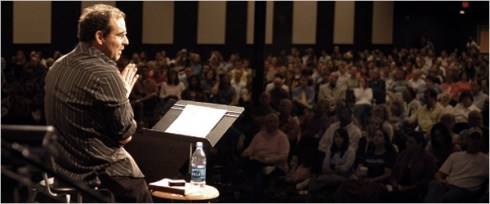
Greg Boyd is co-founder of Woodland Hills Church, an evangelical fellowship in St. Paul. He is also president of ReKnew.org. Greg is a pastor, theologian, and author of more than a dozen academic and popular books.
I have been personally challenged, encouraged, and inspired by Greg’s work for many years now. So, I asked Greg if he would share his Kingdom vision with my readers. He was gracious enough to answer some of my questions about his ministry at Woodland Hills and talk about his upcoming books.
It’s my desire that you will find Greg’s ministry intellectually honest and spiritually refreshing in today’s fractured and dry evangelicalism.
Did you read Q&A with Pastor Greg Boyd, Part I and Part II?
This is the final installment in a three-part interview.
___________________________________________________________________
Greg, before your massive Crucifixion of the Warrior God with IVP comes out, I’m told you have another smaller worker coming out with Baker called Benefit of the Doubt: Dismantling the Idol of Certainty.
What is the release date for this book?
Greg: I believe it’s scheduled for Spring of 2013.
What led you to write this book?
Greg: A number of factors led me to write this book. First, I find that most people today hold to a concept of faith that assumes that a person’s faith is as strong as they are certain and free of doubt.
So in this model, certainty is a supreme virtue and doubt is the enemy. This prevalent model is wreaking havoc with people’s heads and with the church!
For example, several months ago a lady came up to me after church and told me that, while she loves Jesus and believes the Bible is the Word of God, she struggles with some of its violent stories. They don’t seem to be something God would inspire. She was worried that her doubts were causing her to lose her salvation.
I met a couple last year who wondered if the reason their daughter wasn’t healed was because they “lacked faith” when they prayed — meaning, they couldn’t make themselves certain their daughter would for sure be healed when they prayed. Think what a burden that would be to carry around!
This idea that your faith is as strong as you are free of doubt is a form of psychological torture for some people!
On top of this, this model of faith encourages people to TRY to make themselves certain and to TRY not to doubt, which in turn creates a culture of closed-minded people who view challenges to their faith as threats and who are afraid of reading books or listening to speakers who might challenge their views. (With heaven and hell riding on how certain you remain, why would you risk being open-minded?).
I’m convinced this is one of the reasons Barna’s research shows that Evangelicals have a reputation for being intolerant and ignorant.
Another negative aspect of the equation of faith with feeling certain is that it presupposes a strange, if not malevolent, picture of God. I have always wondered what it was about “faith” (understood as striving for certainty) that made God value it so highly.
Why would God leverage salvation or a daughter’s healing on the degree to which a person can convince him or herself that something is true? What is virtuous about this? In fact, what is rational about this, for rational people usually allow the strength of evidence and the persuasiveness of arguments determine their degree of certainty for a particular belief?
The ability to make yourself feel certain about a belief for which there is insufficient evidence and argumentation is an ability that simple people and delusional people tend to possess while people who are rational or naturally skeptical tend to lack. This difference is natural because people simply possess different sorts of minds.
But why would God leverage everything in favor of simple and delusional people and be so prejudiced against grounded, inquisitive or skeptical people? And what kind of God would put parents in a position where the fate of their daughter is dependent on how certain they can make themselves feel that their daughter will be healed? It’s cruel!
Over the years I have grown increasingly suspicious that there was something “off” with this wide-spread model of faith. And my research over the years increasingly confirmed my suspicion.
As I argue in Benefit of the Doubt, the contemporary model of faith is very different from the way Scripture understands faith.
The modern concept of faith is a PSYCHOLOGICAL concept, while the biblical model is COVENANTAL.
Faith in Scripture isn’t about striving for certainty: it’s about being willing to commit to a course of action — to a way of living — in the face of uncertainty. And while the modern concept makes people run away from doubt, the biblical model encourages us to embrace it.
Another thing that motivated me to write this book is that I’m deeply grieved by the astounding number of young people — especially college kids — who are walking away from the faith because they become convinced that it is no longer tenable.
So far as I can see, the main reason this is happening is that young Evangelicals are taught to embrace their faith as a sort of “package deal.” To be a Christian means you have to hold a an assortment of different beliefs, as though each were equally important.
I call this way of embracing faith a “house of cards” model of theology. If one card gets knocked out, the whole edifice of faith comes crashing down.
This model was tenable in the past when a Christian could live most of their life and never confront sincere and informed people of other faiths or never have to confront serious objections to their faith. But it is no longer tenable in the world we live in today, a world that is much smaller, much more complex and much more ambiguous than the world people lived in up until fifty to a hundred years ago.
This is why the “house of cards” theology forces many to leave the faith.
I had a discussion on a plane with a guy several months ago who told me he was forced to conclude Christianity wasn’t true while taking a course on the Bible in a secular university. A book he was assigned to read presented archeological evidence that convinced him the story of God’s people conquering the promised land was not historical.
I asked him, “Why on earth did you reject a relationship with Jesus because of that?” His response was that he had always assumed that believing every story in Scripture was divinely inspired and historically accurate was simply part of what it meant to be a Christian.
I include a lot of personal stories in Benefit of the Doubt, one of which is my loss of faith in college. I had the same “house of cards” experience as this man. According to the teaching I’d been given in the Pentecostal Church I was “saved” in, the first two chapters of Genesis had to be scientifically accurate or, as one preacher put it, the whole Bible is a book of lies.
Unfortunately, my first course in college was a class on evolutionary biology. I fought hard to defend my faith by reading every book I could find on creationism, but it wasn’t long before I felt I had no choice but to concede there was at least some truth to the theory of evolution.
Consequently, I rejected the Christian faith and thereby embarked on the most existentially excruciating year of my life before I began to slowly work my way back into a much less rigid form of Christianity.
In Benefit of the Doubt, I offer people an alternative to the “house of cards” way of embracing faith. It’s a flexible model in which (among other things) our faith isn’t leveraged on the historicity of every particular story, or any particular story of the Bible.
In fact, in the model I propose, the intellectual foundation of our faith isn’t rooted in Scripture, but in the historical Jesus, based on what I believe are strong historical-critical considerations.
Hence, in the model I propose, one can feel comfortable entertaining doubts about every belief they have, so long as they are sufficiently convinced of the Lordship of Christ (based on considerations I prove in the book) to commit to acting in a certain way – viz. to living as though Jesus is Lord, which includes cultivating a relationship with him.
How is this book on faith and doubt different from other books on the subject?
Greg: At the risk of sounding immodest, I believe there are four things that sets Benefit of the Doubt apart from other books that address faith and doubt.
- Benefit of the Doubt exposes the unbiblical, irrational and idolatrous nature of the certainty-seeking faith that most people embrace today in a way that has not been done before.
- I am not aware of any book that fleshes out the biblical nature of faith the way I do in Benefit of the Doubt.
- This book is very unique in the way it empowers readers to cultivate an intellectually grounded, confident, vibrant relationship with Christ while embracing doubt about any number of beliefs.
- And finally, not only does Benefit of the Doubt help readers not be afraid of doubt; it empowers them to see how doubt can and should play a positive role in their life.
David: You have recently presented the basic message of this book to Woodland Hills as you finished the first draft.
How have the folks at Woodland Hills responded to this message?
Greg: The feedback I’ve gotten from both the attenders and the podritioners (our 10-15,000 weekly podcasters) of Woodland Hills Church has been simply overwhelming. Many have found my way of reframing faith and doubt to be absolutely liberating.
In fact, I’ve had a dozen or so people tell me that the way of embracing faith that I propose has been a life-line that has kept them from losing their faith.
From the feedback I’ve received, it seems the most important distinctive of my approach has been the way it shifts the intellectual foundation of the faith from the Bible to the historical Jesus.
I encourage people to not believe in Jesus because they believe in the Bible, but to believe in the Bible because they believe in Jesus.
In my view, the Bible is inspired to serve as the foundation for what we believe, but it was never intended to be the foundation for why we believe.
In my view, the Bible is far too vulnerable to serve as this foundation. That is, there are far too many problematic aspects to Scripture to make our faith dependent on this book.
It should never be the case that a person’s faith hangs in the balance on whether or not (for example) the conquest narratives are anchored in history, or whether or not the story about Samson is historical or legend (or a thousand other disputed aspects of Scripture).
By contrast, the case for believing that the historical Jesus is the ultimate revelation of God is very compelling (on this issue, see P. Eddy, G. Boyd, The Jesus Legend [Baker, 2007).
When a person’s faith depends on Scripture, every one of Scriptures problematic features becomes all-important and the foundation of their faith is constantly vulnerable as a result.
But when a person’s faith depends only on the historical Jesus, the problematic aspects of Scripture become irrelevant.
From the feedback I’ve gotten, this has been the most liberating aspect of my model of faith. My prayer is that many others will find that Benefit of the Doubt helps them cultivate a vibrant, Christ-centered faith in our increasing complex, ambiguous and doubt-filled world.
David: Thanks, Greg! I appreciate you taking the time to share.
___________________________________________________________________
If you would like to hear more from Greg Boyd, check out his website & blog and sermons! Interested in his books? See his collection of academic and popular writings at Amazon. Thanks for reading!
D.D. Flowers, 2012.

 Stuart Murray is the chair of the
  The Naked Anabaptist has been or is being translated into Spanish, Swedish, Indonesian, Korean, Japanese, German, French and possibly Portuguese.
 Josh Garrels is a singer-songwriter living in Portland, Oregon. He is the founder of independent label Small Voice Records. Garrels has released six albums, including the critically acclaimed, fan-financed 2011 release
 The Centrality and Supremacy of Jesus Christ