Category Archives: Deeper Christian Life

Q&A with Pastor Greg Boyd, Part III


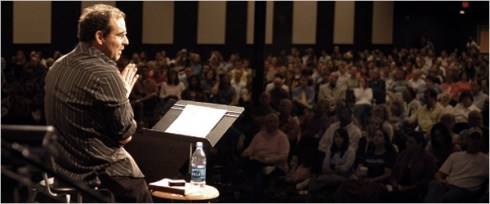
Greg Boyd is co-founder of Woodland Hills Church, an evangelical fellowship in St. Paul. He is also president of ReKnew.org. Greg is a pastor, theologian, and author of more than a dozen academic and popular books.

I have been personally challenged, encouraged, and inspired by Greg’s work for many years now. So, I asked Greg if he would share his Kingdom vision with my readers. He was gracious enough to answer some of my questions about his ministry at Woodland Hills and talk about his upcoming books.

It’s my desire that you will find Greg’s ministry intellectually honest and spiritually refreshing in today’s fractured and dry evangelicalism.

Did you read Q&A with Pastor Greg Boyd, Part I and Part II?

This is the final installment in a three-part interview.

___________________________________________________________________

Greg, before your massive Crucifixion of the Warrior God with IVP comes out, I’m told you have another smaller worker coming out with Baker called Benefit of the Doubt: Dismantling the Idol of Certainty.

What is the release date for this book?

Greg: I believe it’s scheduled for Spring of 2013.

What led you to write this book?

Greg: A number of factors led me to write this book. First, I find that most people today hold to a concept of faith that assumes that a person’s faith is as strong as they are certain and free of doubt.

So in this model, certainty is a supreme virtue and doubt is the enemy. This prevalent model is wreaking havoc with people’s heads and with the church!

For example, several months ago a lady came up to me after church and told me that, while she loves Jesus and believes the Bible is the Word of God, she struggles with some of its violent stories. They don’t seem to be something God would inspire. She was worried that her doubts were causing her to lose her salvation.

I met a couple last year who wondered if the reason their daughter wasn’t healed was because they “lacked faith” when they prayed — meaning, they couldn’t make themselves certain their daughter would for sure be healed when they prayed. Think what a burden that would be to carry around!

This idea that your faith is as strong as you are free of doubt is a form of psychological torture for some people!

On top of this, this model of faith encourages people to TRY to make themselves certain and to TRY not to doubt, which in turn creates a culture of closed-minded people who view challenges to their faith as threats and who are afraid of reading books or listening to speakers who might challenge their views. (With heaven and hell riding on how certain you remain, why would you risk being open-minded?).

I’m convinced this is one of the reasons Barna’s research shows that Evangelicals have a reputation for being intolerant and ignorant.

Another negative aspect of the equation of faith with feeling certain is that it presupposes a strange, if not malevolent, picture of God. I have always wondered what it was about “faith” (understood as striving for certainty) that made God value it so highly.

Why would God leverage salvation or a daughter’s healing on the degree to which a person can convince him or herself that something is true? What is virtuous about this? In fact, what is rational about this, for rational people usually allow the strength of evidence and the persuasiveness of arguments determine their degree of certainty for a particular belief?

The ability to make yourself feel certain about a belief for which there is insufficient evidence and argumentation is an ability that simple people and delusional people tend to possess while people who are rational or naturally skeptical tend to lack. This difference is natural because people simply possess different sorts of minds.

But why would God leverage everything in favor of simple and delusional people and be so prejudiced against grounded, inquisitive or skeptical people? And what kind of God would put parents in a position where the fate of their daughter is dependent on how certain they can make themselves feel that their daughter will be healed? It’s cruel!

Over the years I have grown increasingly suspicious that there was something “off” with this wide-spread model of faith. And my research over the years increasingly confirmed my suspicion.

As I argue in Benefit of the Doubt, the contemporary model of faith is very different from the way Scripture understands faith.

The modern concept of faith is a PSYCHOLOGICAL concept, while the biblical model is COVENANTAL.

Faith in Scripture isn’t about striving for certainty: it’s about being willing to commit to a course of action — to a way of living — in the face of uncertainty. And while the modern concept makes people run away from doubt, the biblical model encourages us to embrace it.

Another thing that motivated me to write this book is that I’m deeply grieved by the astounding number of young people — especially college kids —  who are walking away from the faith because they become convinced that it is no longer tenable.

So far as I can see, the main reason this is happening is that young Evangelicals are taught to embrace their faith as a sort of “package deal.” To be a Christian means you have to hold a an assortment of different beliefs, as though each were equally important.

I call this way of embracing faith a “house of cards” model of theology. If one card gets knocked out, the whole edifice of faith comes crashing down.

This model was tenable in the past when a Christian could live most of their life and never confront sincere and informed people of other faiths or never have to confront serious objections to their faith. But it is no longer tenable in the world we live in today, a world that is much smaller, much more complex and much more ambiguous than the world people lived in up until fifty to a hundred years ago.

This is why the “house of cards” theology forces many to leave the faith.

I had a discussion on a plane with a guy several months ago who told me he was forced to conclude Christianity wasn’t true while taking a course on the Bible in a secular university. A book he was assigned to read presented archeological evidence that convinced him the story of God’s people conquering the promised land was not historical.

I asked him, “Why on earth did you reject a relationship with Jesus because of that?” His response was that he had always assumed that believing every story in Scripture was divinely inspired and historically accurate was simply part of what it meant to be a Christian.

I include a lot of personal stories in Benefit of the Doubt, one of which is my loss of faith in college. I had the same “house of cards” experience as this man. According to the teaching I’d been given in the Pentecostal Church I was “saved” in,  the first two chapters of Genesis had to be scientifically accurate or, as one preacher put it, the whole Bible is a book of lies.

Unfortunately, my first course in college was a class on evolutionary biology. I fought hard to defend my faith by reading every book I could find on creationism, but it wasn’t long before I felt I had no choice but to concede there was at least some truth to the theory of evolution.

Consequently, I rejected the Christian faith and thereby embarked on the most existentially excruciating year of my life before I began to slowly work my way back into a much less rigid form of Christianity.

In Benefit of the Doubt, I offer people an alternative to the “house of cards” way of embracing faith. It’s a flexible model in which (among other things) our faith isn’t leveraged on the historicity of every particular story, or any particular story of the Bible.

In fact, in the model I propose, the intellectual foundation of our faith isn’t rooted in Scripture, but in the historical Jesus, based on what I believe are strong historical-critical considerations.

Hence, in the model I propose, one can feel comfortable entertaining doubts about every belief they have, so long as they are sufficiently convinced of the Lordship of Christ (based on considerations I prove in the book) to commit to acting in a certain way – viz. to living as though Jesus is Lord, which includes cultivating a relationship with him.

How is this book on faith and doubt different from other books on the subject?

Greg: At the risk of sounding immodest, I believe there are four things that sets Benefit of the Doubt apart from other books that address faith and doubt.

  1. Benefit of the Doubt exposes the unbiblical, irrational and idolatrous nature of the certainty-seeking faith that most people embrace today in a way that has not been done before.
  2. I am not aware of any book that fleshes out the biblical nature of faith the way I do in Benefit of the Doubt.
  3. This book is very unique in the way it empowers readers to cultivate an intellectually grounded, confident, vibrant relationship with Christ while embracing doubt about any number of beliefs.
  4. And finally, not only does Benefit of the Doubt help readers not be afraid of doubt; it empowers them to see how doubt can and should play a positive role in their life.

David: You have recently presented the basic message of this book to Woodland Hills as you finished the first draft.

How have the folks at Woodland Hills responded to this message?

Greg: The feedback I’ve gotten from both the attenders and the podritioners (our 10-15,000 weekly podcasters) of Woodland Hills Church has been simply overwhelming. Many have found my way of reframing faith and doubt to be absolutely liberating.

In fact, I’ve had a dozen or so people tell me that the way of embracing faith that I propose has been a life-line that has kept them from losing their faith.

From the feedback I’ve received, it seems the most important distinctive of my approach has been the way it shifts the intellectual foundation of the faith from the Bible to the historical Jesus.

I encourage people to not believe in Jesus because they believe in the Bible, but to believe in the Bible because they believe in Jesus.

In my view, the Bible is inspired to serve as the foundation for what we believe, but it was never intended to be the foundation for why we believe.

In my view, the Bible is far too vulnerable to serve as this foundation. That is, there are far too many problematic aspects to Scripture to make our faith dependent on this book.

It should never be the case that a person’s faith hangs in the balance on whether or not (for example) the conquest narratives are anchored in history, or whether or not the story about Samson is historical or legend (or a thousand other disputed aspects of Scripture).

By contrast, the case for believing that the historical Jesus is the ultimate revelation of God is very compelling (on this issue, see P. Eddy, G. Boyd, The Jesus Legend [Baker, 2007).

When a person’s faith depends on Scripture, every one of Scriptures problematic features becomes all-important and the foundation of their faith is constantly vulnerable as a result.

But when a person’s faith depends only on the historical Jesus, the problematic aspects of Scripture become irrelevant.

From the feedback I’ve gotten, this has been the most liberating aspect of my model of faith. My prayer is that many others will find that Benefit of the Doubt helps them cultivate a vibrant, Christ-centered faith in our increasing complex, ambiguous and doubt-filled world.

David: Thanks, Greg! I appreciate you taking the time to share.

___________________________________________________________________

If you would like to hear more from Greg Boyd, check out his website & blog and sermons! Interested in his books? See his collection of academic and popular writings at Amazon. Thanks for reading!

D.D. Flowers, 2012.


That’s My King

Today is Election Day here in the United States of America. Every four years American citizens proudly cast their vote for a new president. It’s the day when Americans are encouraged to vote and believe that democracy is still working.

While I do believe that the original ideals of the founding fathers were some of the best the world has ever seen (though far from being anything closely resembling a “Christian” nation), I have been thoroughly convinced that this country was bought and paid for a long time ago by powerful people who now control the direction of the state.

If you don’t believe me, just take a look at the major campaign contributors for both presidential candidates. That’s not conspiracy stuff… it’s right in front of us if we’ll rise above the racket and political banter.

For those that have been following me here at the blog or at Facebook and Twitter, you know that I have what I believe to be a healthy suspicion of all worldly kingdoms. I believe that Jesus very intentionally rejected the avenues of political power to bring the Kingdom of God (John 18:36).

The Kingdom of God is not of this world, but it is for this world.

You may choose to vote today, but you need to remember that there is nothing distinctively Kingdom about it. The issues of politics are so complex and complicated, while being filled with lies, corruption, and greedy men, that you should never label your way of voting as “Christian” or your candidate as the “clear” choice for the country.

The kingdoms of the world have been hijacked by the prince of the power of the air. We’re promised that Jesus will soon crush Satan under his feet and establish a Kingdom that will never end (Rom 16:20; Dan 7:14). This is the Kingdom of which we’ve been called to build.

This should serve as a reminder to us that we have been called to be Christ in our own communities through the methods that Jesus himself laid down for us. Real change happens on the local level by the church being the hands and feet of Jesus through creative Gospel living.

When the church is being the church, she is not preoccupied with politics. She discovers that real lasting change happens another way. And it doesn’t look like legislating sin or using power-over people to enforce morality.

I urge, then, first of all, that petitions, prayers, intercession and thanksgiving be made for all people—for kings and all those in authority, that we may live peaceful and quiet lives in all godliness and holiness. This is good, and pleases God our Savior…”   1 Timothy 2:1-3 (NIV)

If the government asks for your opinion every four years and you can give it in good conscience, then by all means vote. But do so under no illusions that you’re doing the pure work of Kingdom building.

If you get a tingly feeling or sense some level of euphoria after voting, you may need to rethink where you’ve placed your hope and trust. This also includes you proudly sporting your voting banners and pictures.

Think about what you’re doing. Does it look like Jesus in the world?

We have a King whose Kingdom is present in this world, though not fully known in the earth. You and I have been called to make it known and further it in the way of Jesus. Are we doing that calvary-style?

If you’re a Christian, remember your King today. Rejoice in the reality that he is ruling from heaven and will soon bring heaven and earth together.

Put your hope and trust in Jesus, and say with me, “That’s My King!”

Why do you think that evangelicals have become so entangled in politics today? How has political involvement distorted the Gospel of the Kingdom that Jesus proclaimed? What does “King of Kings” mean to you? What encourages you most about the message of Jesus in this video?

D.D. Flowers, 2012.


Have You Checked Your Filters Lately?

I remember reading a story where a student sitting next to Albert Einstein turned to him and asked, “What do you do?” Einstein replied, “I am a student of physics. What do you do?” The student replied, “Oh, I finished studying physics last year.”

I think it’s important to be reminded that as followers of Christ, and as believers of the Scriptures that reveal Christ, we ought to see ourselves as students on a continual journey of learning and enlightenment unto Jesus—the true source of all wisdom and knowledge (Col 2:2-4).

“Disciple” means one who is a student and a learner.

The Journey of Life & Death

The Christian journey is one of multi-lane freeways, straightaway interstates, winding single-lane roads through hills and valleys, and the occasional hike off the beaten path into the mysterious unknown.

It’s a journey that recognizes that need for constant change and evolution of thought and practice. It’s characteristic of life itself. It’s built into all of creation. It shouldn’t surprise us that it’s also common to our spiritual life.

And now that Christ has promised us resurrection life, we know that death is only a part of the journey. It’s even a necessary part of our spiritual growth. Remember what Jesus said to his disciples:

“If anyone would come after me, he must deny himself and take up his cross and follow me. For whoever wants to save his life will lose it, but whoever loses his life for me will find it.” Matt 16:24-25

If we’re going to grow on this journey with Christ, we must be willing to revise, adjust, and sometimes change our views and our living based on new insights into the Lord. We’re going to have to deny ourselves.

We may even need to give up what we discover to be broken, sometimes even idolatrous, theological and biblical frameworks, and allow the Lord to give us a new vision and understanding altogether.

Are You Willing to Grow?

I’ve met many evangelicals who dislike theological challenges, even seeing them as an evil intruder seeking to demolish their faith or the faith of others. This shouldn’t be if we’re on a true journey with Christ.

I will go so far to say that if there hasn’t been a change in you and your beliefs for some time now, you’re probably not growing in the Lord to the extent he desires. Change is a part of “growing” up into Christ.

As followers of Christ, we should welcome challenges. When we’re challenged and honestly receive that challenge, it causes us to rethink and reexamine our previous beliefs and living. It’s characteristic of a living faith that is always moving forward in the Lord.

I see this as a win-win for us. You will ultimately discover that either you were on the right track with your previous belief, thereby strengthening it all the more, or you will find that your belief and practice were wrong, and correct it according to new light and understanding.

And we should never let the consequences of that change deter us from making the necessary moves toward truth that sets us free to faithfully follow Christ. If we’re out of our minds, it’s for Christ’s sake.

Check Your Filters

I have found that one of the greatest hindrances to our spiritual growth are the filters by which we perceive and judge ideas that are new to us, or that we’ve simply been told are bad for us by people in our group that we trust.

Filters are meant to screen things out that don’t belong. But the more threads or restrictions to the settings on those filters, they can actually work against you.

What happens when our filters end up collecting valuable items that are perceived as trash by the filter?

Have you ever had an important email unknowingly get collected in your SPAM box? Have you ever found a diamond ring or some other valuable item in those filters of yours? It happens.

I believe this sort of thing happens quite regularly to Christians on journey with the Lord. How does this happen to us when it comes to theological challenges? And what can be done about it?

Preunderstanding & Presuppositions

Our spiritual growth is stunted when we do not recognize how much our own cultural context and situation in life has shaped our theological perspectives. Please stop and think about this with me.

Consider this…

I’m a white Southerner. I was raised in a small East Texas town with no black people in a dry (no alcohol) county. I grew up in a fundamentalist Southern Baptist church that pledged to the Bible and the American flag during Vacation Bible School. This theological upbringing forged a commitment to reformed theology, Left Behind eschatology, and that women can’t be ministers in the church. And that’s just the beginning of it.

My wife grew up in a “King James only” congregation. This means that they only believe the “authorized” English version of the Bible should be read by Christians. Her tradition was even more dogmatic than my own. They forced girls to wear culottes at their church camps! (In case you don’t know, “culottes” are knee breeches first worn by men in the 16th century.)

Do you think these things impacted (and still impact) the way we think? Of course! And your own upbringing has shaped you as well. You need to acknowledge this if you wish to grow.

Our preunderstandings and preconceived notions that we bring to the biblical text and the Christian faith, (both consciously and unconsciously) greatly impact the way we think and live.

This preconditioning causes us to think that we already know and understand something about the Scriptures, making it harder to face the challenges that the Lord may be bringing our way to grow us spiritually.

Cultural Christianity

Our own cultural context and formation is a subtle aspect of our preunderstanding. We can easily attempt to interpret Scripture according to our cultural norms, and miss the real meaning.

For example, if Jesus said, “love your enemies” (Matt 5:38-48) but our culture has already shaped our thinking on the matter, we must immediately interpret Jesus in such a way that does not conflict with our cultural norms.

What is the norm here in America? Well, some killing and violence is acceptable as it promotes security, democracy, freedom, etc. Therefore, your filters force you to privatize and dilute the teachings of Jesus. As a result, the Bill of Rights often ends up trumping the real Jesus and the rest of the New Testament.

So much for serving two masters (Matt 6:24).

Regardless of how Jesus lives this teaching out, and the indisputable fact that for the first three hundred years of church history Christians refused military service and rejected all forms of violence, we are tempted to conform Christ to our cultural Christianity.

Duvall and Hays write in their book, Grasping God’s Word: A Hands-On Approach to Reading, Interpreting, and Applying the Bible:

Our culture is a combination of family and national heritage. You learn it from your Mom at breakfast, from the kids on the playground at school, and from television. It is a mix of language, customs, stories, movies, jokes, literature, and national habits. For Americans it is comprised of Big Macs, Barbie Dolls, Tiger Woods, and the Back Street Boys all mixed-in with George Washington, Babe Ruth, the Mississippi River, Walmart, and the space shuttle. (pg. 89)

Did you grow up in a big city or a small town? Did you grow up Protestant, Catholic, or some other tradition? Were you exposed to other cultural and theological viewpoints growing up? Have you ever spent any time outside of North America? Did you grow up in a healthy family? Were you rich or poor? Was your dad around? Did he show you love?

As it pertains to “love your enemies”… how often were you taught the teachings of Jesus in his historical context and shown how to live them out in your own? And I don’t mean the American Jesus version.

All of these things (and much more) matter when it comes to our cultural Christianity and learning how to navigate in the world on our faith journey. They add to the prefiguring of the settings on our filters.

For better or worse, our cultural context shapes our biblical worldview.

I don’t believe that everything we’ve ever been taught is entirely wrong, but we do need to recognize that our traditions and influences (good or bad) have added to the settings on our own filters.

Our preconceived ideas and our cultural baggage often keep us from knowing the first-century, olive-skinned, Palestinian, construction worker from Nazareth, that believed he was the Messiah foretold by the prophets. 

Remaining Objectively Honest

It is true that being totally objective in biblical interpretation and in our Christian walk is impossible. However, simply being aware of our cultural upbringing and the filters that our own traditions have prefigured for us will help us to look afresh at the ancient Scriptures and consider how we might better follow the counter-cultural Christ in our own context.

I do believe that some basic historic presuppositions and settings on our filters should be used when choosing to walk the Jesus way. I recommend the historic Christian creeds, like the Apostles Creed.

This confession leads us to embrace the Scriptures as inspired testimony about God’s work in the world through Jesus of Nazareth.

Beyond this general confession of our faith in Christ, we ought to be open and honest with other brothers and sisters in pursuit of Jesus. In fact, Christians ought to be leading the world in exploration of wisdom and knowledge. We know the Source. What are we afraid of anyway?

This is only possible by being mindful of the filters guarding our hearts and minds. And adjusting those filters when it’s necessary for further growth.

Let’s be honest with ourselves and with one another. We have all been conditioned to read the Scriptures and follow Christ according to our own traditions and cultural norms. Have you checked your filters lately?

How have your filters been prefigured for the Christian life? What is stopping you from reconsidering certain challenges to your theological and biblical worldview? Pray the Lord will help you grow.

D.D. Flowers, 2012.


Josh Garrels on Believing

Josh Garrels is a singer-songwriter living in Portland, Oregon. He is the founder of independent label Small Voice Records.           Garrels has released six albums, including the critically acclaimed, fan-financed 2011 release      Love & War & the Sea In Between.

The making of Love & War & the Sea In Between was completely funded through the support of listeners and offered as a free download for one year, garnering 125,000 downloads in the first year after its release.

Named the number one album of 2011 by Christianity Today, the magazine described the recording as, “prophetic, incisive, achingly human, and longingly spiritual.”

From joshgarrels.com:

Garrels has spent more than a decade crafting music that cuts clean through. Resting in the space between accessibility and honesty, Garrels’ songs wrestle with and celebrate the mystery of faith with authenticity and heart. Cultivating a genre-blending mix of folk and hip hop, Garrels’ music explores themes of compassion, hope, longing, and liberation.

I believe that Garrels’ music is boldly prophetic, yet creatively introspective and mystical. His provocative lyrics are deeply theological and refreshingly honest. In many ways, Garrels’ courage personally reminds me of Keith Green and Rich Mullins, who were both pioneers as Christian artists.

Like Green and Mullins, Garrels’ music comes from deep within his soul, and you feel it. If you haven’t heard his music, I encourage you to check him out and see if Christ doesn’t minister to you in his rhythms.

In the following video, Garrels talks about believing in the one who created you, following the Christ who gives you the Kingdom, and committing for the long haul… “because not many people are ending well.”

Is this the first time you’ve heard of Garrels, or are you already a fan of his music? If you’re already familiar with him, what do you think about his unique style of music ministry? Do you find his words on believing inspirational? Why do you think so many people are not ending well?

D.D. Flowers, 2012.