Category Archives: Church

Creeds & the Local Church

I’ve been doing some thinking about the difference(s) between dogma, doctrine, and opinion when it comes to the local church.

Simply put… it looks like this.

  • Dogma — Irreducible beliefs of the Christian faith. What do we say about Jesus?
  • Doctrine — Historical or traditional beliefs on a plethora of theological issues. What sets us apart?
  • Opinion — Debatable issues that you’re free to agree or disagree upon. What do you think?

I agree with these three distinctions (leaving room for some overlap), but how do you determine what belief goes where in these categories? And is it possible for a local church (pastors & elders) to proclaim a certain view as “doctrine” but leave room for members to disagree? I think so.

One thing is for certain, this is a task for folks in community together and those who are willing to wrestle with it. That’s an invitation.

Two Ways of Dealing With It

Let me first address two common ways of dealing with these issues, and then I’ll share my working thoughts.

Group One — “Give me Jesus, not your divisive doctrine.”

Some of you know that I spent about five years meeting in homes and interacting with a network of “organic” churches. I had some great experiences. However, many of the folks I ran into sought to downplay the role of theology and creeds (statement of beliefs) for fear that it is divisive and characteristic of the beastly institutional church.

They have a point. Beliefs can be divisive. But I don’t think the answer is to avoid the need for a creed, or set Jesus against doctrine.

So, I’m saying that I know people that don’t seem to think that worrying about dogma, doctrine, and opinion really matters. In their “opinion” (catch that?), we should just wander about in nebulous fashion and refrain from any organization—church practice and theology included.

This group is imagining that there is not a systematic theology at work in the members of their group or church. It doesn’t need to be posted on a church website or posted on the wall of their meeting place, it’s alive in the hearts and minds of the saints there.

A fellowship may not discuss what they believe openly or form a statement of faith by consensus, but it’s at work among them.  Avoiding the obvious need for a creed of theology, mission, and vision will lead to a certain death. That’s if the church even gets off the ground in the first place.

You can’t escape a “theology of the people” who have decided to band together for Kingdom purposes.

Trying to do so will lead to division of another sort. Once more proving that reactionary thinking and practice is not the answer.

I suppose this groups believes that if you stay away from labels and systems of thought that there will not be any division or controversy. They must think this reflects a purer stage of the NT church.

Back when there weren’t any problems, right?

I respect the desire to not be needlessly building walls of separation between saints. I’m all for that. But I can’t espouse the idea that having a statement of belief (creed) is damaging to the church.

In fact, I believe it is healthy and necessary.

Group Two — “Let’s get back to the basics… of the 4th century.”

Then there are other folks who are rightfully fed up with sectarianism in the church but believe that we must stand firm on some basic theological truths about Christ. They believe we should only stick to the ancient creeds in our attempts to articulate the essentials of our faith.

I grew up a Southern Baptist. The SBC has a very lengthy confession (Baptist Faith & Message) dealing with just about every issue under the sun (OK, I’m exaggerating a little bit). Needless to say, I didn’t grow up reciting the Apostles or Nicene Creed. I regret that.

My wife and I attended a Methodist church for a year and we deeply benefited from the recitation of these ancient creedal statements. The recitation of creeds in worship is a healthy way of reminding everyone in attendance of what brings them together and is forming their new identity as members of the universal church.

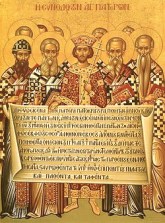
Hear me out. I like reciting the ancient creeds, but I do think it’s important to remember that the Apostles & Nicene Creeds (4th cent) were written against their own contextual issues of heresy and debated ideas of Christology in the church from ages ago.

Let’s remember the ancient creeds and recite them together in our churches. I’m cool with that. I think there is something deeply beneficial that comes with this practice. But I submit to you that a healthy church will continue to wrestle with dogma, doctrine, and opinion in every age and culture.

The local church can do this by amending the ancient creeds to better address our 21st century issues and challenges.

It’s necessary for a church that wishes to be a relevant organism seeking to make a Kingdom impact in every culture and context. Our evolving world demands it. We must not be afraid to speak to, for, and against issues of our time. We must move forward with courage.

Finding a Third Way

If you follow this blog regularly, you know that I have intentions to plant a church in the near future. I do this with fear and trembling. It’s not gonna be easy, but I’m convinced the Lord wants it.

The church today is fragmented in many ways. And I don’t wish to add to the problem by doing more of the same. But a new church plant is gonna require some line-drawing when it comes to dogma, doctrine, and opinion.

For example, some issues of “classical” theology, especially as it relates to our view of God in Christ, need to be revisited in order to reflect a change in the 21st cent church—a church that presently finds herself forced to accept views about God which contradict the revelation of God in Christ, or leave behind belief in a good God altogether.

The church that humbly professes the better view of God in Christ is being a faithful church, not a divisive or dogmatic church.

If we don’t speak up about these matters and courageously hold our ground against competing views that undermine the revelation of God in Christ… what good are we? What Gospel are we proclaiming?

There are other issues related to our culture and context that should be addressed in our creeds. We can’t afford to avoid these issues.

Some positions will need to be taken in response to culture, most others in response to misguided Christians propagating views about God and his sovereignty that don’t look like Jesus. It will require us hold positions that may not be popular, but are necessary to maintain the centrality and supremacy of Christ for authentic faith and practice.

Here’s what I’m saying… what may have been considered “opinion” or a non-essential in one generation can move into the realm of accepted doctrine worthy to be included in a church’s creed and statement of faith if it is needed in our response to bad theology and pagan culture.

The creeds of the local church should move forward in every cultural context, though never away from Christ who is eternal in the heavens.

The way forward affirms the importance of beliefs, expands on matters critical to our confession of Christ, and is willing to draw necessary lines in order to be faithful to the Kingdom.

This third way looks like Jesus Christ of Nazareth—Truth for the church and culture, saturated in love and grace for every age.

D.D. Flowers, 2013.


What’s Keeping You?

As an early teenager and a young Christian, following the Lord wasn’t easy. I found it so difficult that I eventually rebelled against my upbringing and sank deep into a world of sex, drugs, and rock-n-roll. It’s by God’s grace that I found healing and restoration.

There were several reasons for the hardships I experienced as I tried to live out my faith among my peers. I won’t list them all here.

But I will tell you that I believe my biggest frustration was due to an incomplete, even downright detestable, view of God.

Of course I was taught that Jesus was kind, loving, and able to save us from our sins, but it sure seemed like the major thrust of the preaching and the general attitude I picked up along the way was that God was capricious, ready to condemn, and demanded constant sacrifice to appease his insatiable thirst for more of our blood, sweat, and tears.

I could never pray enough, read enough Scripture, or do enough ministry to find favor with God. Over time I became resentful and bitter in my journey. So, I quit. I told God he could keep his religion. I wanted out.

Several years later the Lord reached down and revealed himself to me in the midst of my rebellion and sin. I had an encounter with Jesus and his love that forever changed my life. I’ll never forget it.

The Lord kindly whispered that I was wrong about him and that he would like us to start over. That was the beginning of something new.

Learning to Say “Abba, Father”

When I was in college the Lord began to reveal the origins of my earlier frustrations as a young person.

I must confess that growing up I didn’t feel very close to my dad. Also, several older male influences were insensitive, angry, and antagonistic. I longed to be affirmed at an early age, but suffered a deficit.

Thus began my mad pursuit of numbing the pain and filling the void.

I eventually discovered that a fundamentalist presentation of a bicep-flexing, bully-God combined with a dysfunctional relationship with my earthly father (and other male leaders) resulted in a deep inability to view God as a loving heavenly Father. Something I couldn’t see at the time.

I see it more clearly everyday now. I think at some level we’re always fighting against false images of God. Our hope is only found in a fresh revelation of the God revealed in Jesus of Nazareth.

As Jesus told his disciples, “Anyone who has seen me has seen the Father” (Jn 14:9).

What’s keeping you? Really. What’s keeping you from following the Lord in freedom? Have you seen the Father rightly in Jesus?

This is the greatest need of the church. The only way of revolution.

I believe the Lord wants us to call him “Abba, Father” and feel it from the depth of our soul. I’m learning that the more I come to know God fully revealed in Christ, this great term of endearment is born from the heart and rolls off the tongue naturally in prayer.

And since we have a loving Father, Jesus says we may ask of him whatever we like for the sake of the Kingdom.

Very truly I tell you, whoever believes in me will do the works I have been doing, and they will do even greater things than these, because I am going to the Father. And I will do whatever you ask in my name, so that the Father may be glorified in the Son. You may ask me for anything in my name, and I will do it.  John 14:12-14

Let’s ask the Lord for the “greater” things this year, expecting that he will do it. He wants to do it. Believe it.

Abba, Father. Free us from the old familiar. Remove the scales of dead faith and putrid theology from our eyes that so often obscures our vision of your glorious Son, and keeps us from believing in greater things.

Holy Spirit, move across the earth like a mighty rushing wind.

Thy Kingdom come, thy will be done, on earth as it is in heaven. Amen.

D.D. Flowers, 2013.


Support ReKnew

As many of you know, I did a Q&A with Pastor Greg Boyd about his ministry and upcoming books back in November 2012. I have followed Greg for a few years now (2006?). His theology has influenced me on multiple levels. I have often found his work to confirm much of my own study.

If I’m being gleefully honest… Greg has brought about a paradigm shift in my understanding of the nature of God in Christ, the complexities of the universe, and the beauty of the Kingdom of God.

Several weeks ago I had the opportunity to Skype with Greg. We talked for an hour about our lives and how they have converged in pursuit of the Kingdom. I told him of my desire to plant a church in Texas that appreciates real theological inquiry and engenders creative mission.

The sort of thing he is leading at Woodland Hills in St. Paul.

BTW: In case you’re wondering, I’ve been in conversation with friends and in serious prayer about how to move forward. We’ve been in Houston for almost six years, but we have been considering the possibility of making a move and doing something new in Austin—where the culture and environment is much different than our own.

I appreciate your continued prayers as we seek the Lord.

As I told Greg, I feel that my place is in leading a church sometime in the near future. But not just another evangelical church. I’m not sure where that will be or what it will look like yet, but in the meantime I’m believing that… as I’ve said to my friends… God is doing stuff.

And I believe God is doing stuff through ReKnew. I’m excited about the work these guys are doing!

Here’s what Greg posted at his blog a couple weeks back:

We are living at a very important, and very exciting, juncture of history. The old religion of Christendom that has been identified with “Christianity” the last 1600 years is dying, and out of its ruins is arising a new tribe of kingdom revolutionaries. All around the globe people are getting the revelation that the kingdom is all about a God a looks like Jesus transforming a people to look like JesusReKnew was launched six months ago to serve as a catalyst for this revolution and to help mobilize this revolution. If you are among those who want to be part of this new movement that God is raising up, I ask you to please give me 9 minutes of your time to listen to the vision I cast in this talk and to prayerfully consider how God might call you to join us in this important endeavor.

I’m committed to Greg’s vision because I believe in his ministry and the tremendous resource that ReKnew will become in the days ahead. If you’re looking for something worthwhile to invest in this year, please consider supporting ReKnew in the coming Kingdom revolution.

Viva La Revolution!

D.D. Flowers, 2013.


Heaven is Not Our Home

There has recently been a great deal of hype stirred up by those claiming to have had out-of-body experiences of heaven. Bookstore shelves are filling up with them, and all of the media outlets are reporting on them.

I don’t want to speculate on the claims made by the kid who met Jesus or the agnostic neurosurgeon who has confessed to having experienced another dimension of reality. Maybe they did experience these things for real, or maybe neurons were simply misfiring in their brain. I’ll let you decide.

It’s not that I’m entirely skeptical of these subjective claims. I believe in heaven as a present reality. I also believe that the apostle John experienced something of this heaven, as he records in Revelation 4-5. So, I do believe in that realm the Scripture calls heaven—God’s space.

What concerns me is that many Christians have made more of these contemporary claims than they ought. We’ve allowed folk religion to shape enough of our theology as it is. And this infatuation with heaven says we have a ways to go in understanding the Gospel and the biblical future God has planned for heaven and earth.

Is heaven is for real? Well, of course it is. It doesn’t appear that the NT church had any doubts about it. They clearly believed in the present reality of heaven, but they were far more interested in something greater.

What fascinated the early church—driving the entire Gospel mission—was the biblical hope that God would bring heaven to earth. The Messiah was to be the one to make this happen, at least to initiate it and complete it. The Kingdom of God is all about this marriage of heaven and earth.

It’s God’s idea of new creation.

“Behold, I will create new heavens and a new earth. The former things will not be remembered, nor will they come to mind.” Isaiah 65:17

The creation of a “new heavens and a new earth” is a transformation of the former things. It is a world transfigured like unto the physical body of the Lord Jesus (Matt. 17:1-9). Think about it.

The resurrected body of Christ was of its own kind. There is continuity with the old body and there is discontinuity as well (Lk. 24: 13-35, 36-49; Jn. 20:1-18, 24-31; 21:1-14). The resurrected body of Christ is heaven intersecting with earth. Therefore, the resurrected Jesus is proof of what God plans to do with the spiritual and physical dimensions of reality.

In Rev. 21-22 we do not see believers flying off to a disembodied spiritual existence on the other side of the cosmos. No, we see heaven coming to earth. We see heaven, God’s realm, breaking through and fully consummating with the physical realm we call earth.

We must rid ourselves of this mantra that speaks of going to heaven when we die, as if we will have come to the end of our journey.

Heaven is indeed where the Lord is presently, but it is not our final home (Ps. 14:2; 20:6; 33:13; Ecc. 5:2; Is. 66:1; Dan. 2:44; 7:27; Rev. 11:15).

If anything, heaven is only a temporal dwelling for those awaiting the resurrection of the dead. Jesus said there are “many dwelling places” in his Father’s house (Jn 14:2). The Greek word for “dwelling places” used here, monai, has regularly been used to refer to a temporary stop on an extended journey. Don’t merge this verse with Rev 21.

Even when Christ was on the cross, he told the thief on his left that “today” he would be with him in “paradise” (Lk. 23:43). This too doesn’t speak of a final destination, but of a temporal garden of rest.

All of the saints, past and present, still await the return of the King and the establishment of heaven on earth (Heb. 11:13-16; Rev. 6:10-11).

God’s desire has always been to complete his good work in the created world upon which every human being has ever lived.

For the Jew, there was a firm belief that God would restore creation and fulfill his covenant with his people. The Lord of heaven and earth would finally merge the two into one unified reality.

This resurrected world is called the “New Jerusalem” and the “Holy City” (Rev. 21:2). This newly remade world is our final destination. It is the Kingdom of God fully realized. In Revelation 21:5, Christ says:

“Behold, I am making all things new!”

And it is Christ that has the authority to say such things, for he was the first to be resurrected and be clothed with the imperishable.

Our hope is in a future resurrected existence in the “new heavens and earth.” The finished work of Christ is not fully realized until God makes his home on this earth. This should be our great obsession.

It is on this earth that Jesus prayed, “your kingdom come, your will be done on earth as it is in heaven” (Matt. 6:10). Heaven is indeed coming to earth. Jesus has called for its renewal and resurrection!

“Heaven, in the Bible, is not a future destiny but the other, hidden, dimension of our ordinary life—God’s dimension, if you like. God made heaven and earth; at the last he will remake both and join them together forever.” N.T. Wright, Surprised by Hope, 19

Give some serious thought to N.T. Wright’s description of this future reality.

Does your language about the future reflect this biblical hope? How do you think the pop-culture confusion on this theological issue impacts the way in which we live out the Kingdom on the earth?

D.D. Flowers, 2012.