Tag Archives: gregory boyd

An Open Theism Theodicy

Gregory Boyd on the Problem of Evil

Where is God when a seven-year-old child is kidnapped, viciously raped, and her decapitated body is left in a plastic bag beside a cold riverbed?[1] Gregory Boyd believes that evil “cannot be captured in abstract definitions”[2] but must be known in concrete experiences, like that of seven-year-old Greta, before any serious answers may be given to the problem of evil—lest “abstractions… distract us from that immediate reality [of evil] and reduce evil to a statistic,” as suggested by Jeffery Burton Russell.[3]

Traditionally, classical theism has largely conditioned her adherents to accept that God, who is omnipotent, must allow Greta’s brutal murder for some good purpose and that Christians should accept this as being a part of God’s secret plan—often expressed in the popular cliché: “There is a reason for everything.”

Gregory Boyd, who previously taught theology at Bethel College in St. Paul Minnesota, where he is now a pastor of Woodland Hills Church, has in the last decade, encroached upon many long-held doctrines and traditions that Christians, particularly in America, hold dear.

His book, Myth of a Christian Nation: How the Quest for Political Power is Destroying the Church (Zondervan 2006) is an example of his willingness to confront issues within cultural Christianity.

Boyd is a strong proponent of “open theism,” perhaps the most controversial of his challenges directed at classical theism. It is within Boyd’s open view of God’s sovereignty that he finds satisfactory solutions for the problem of evil and the way by which he constructs his “Trinitarian Warfare Theodicy.”[4]

The purpose of this article is to give reasonable consideration of the theodicy espoused by Gregory Boyd. The theodicy of Gregory Boyd will be appraised as a sensitive engagement of the issues pertaining to the problem of evil as it relates to the Christian life, showing the strengths of contemporary open theism, and thereby arguing for a respected position within evangelicalism.

This article will begin by briefly examining classical theism and will then direct full attention to the open theism of Gregory Boyd. How then does Boyd’s doctrine of God deal with the problem of evil and suffering in the world? What practical implications might his view have on Christians living in the present, as well as their hope for the future?

Finally, in what ways do Boyd’s theodicy enhance our understanding of God and the Gospel of Jesus Christ?[5]

THE CLASSICAL DOCTRINE OF GOD

A Synopsis of Classical Theism

What does “classical theism” mean? Classical theism generally describes the way the Christian theological tradition handles the doctrine of God.[6] In other words, it describes the traditional or “classic” way in which Christians have answered the question, “Who is God?” or “What is God like?” Classical theists focus on certain attributes of God and build a systematic theology from what they have decided about God’s attributes.

For the sake of this article, it is only necessary that a few of those attributes be briefly addressed.[7]

According to classical theism, God is “immutable” and “impassible.” Immutability says that God is unchanging in nature. However, the tradition has gone as far as God being inert and unmoved. Impassibility, an attribute often closely associated with the former, suggests that God does not experience true sorrow, sadness, or pain. Therefore, any emotions attributed to God are purely metaphorical.

Classical theism also upholds the belief that God is “omnipotent” and “omniscient.” These attributes have been historically central to the Christian doctrine of God. Omnipotence says that God is “all powerful” and capable, within the limits of his attributes, of doing whatever he pleases. Omniscience means that God is “all knowing” and that there is nothing beyond his knowledge; this would include God’s foreknowing all things in the future.

It should be noted that these attributes have been largely expounded upon and articulated in Hellenic philosophical terminology, and more popularly defined by the likes of Augustine, Aquinas, and John Calvin.[8]

Rethinking Classical Theism

There are a growing number of evangelical theologians who are finding themselves dissatisfied with classical theism, and they propose an alternative to the traditional doctrine of God.[9] This controversial movement, and contemporary trend in the doctrine of God, has been dubbed “open theism”—a term coined by Richard Rice in his 1980 book, The Openness of God: The Relationship of Divine Foreknowledge and Human Free Will.[10]

Open theism calls into question the way in which the divine attributes have been traditionally defined. Language about God in the Scripture, according to open theists, is not always intended to be anthropological or metaphorical. If God is “immutable” and never changes, then how, for example, is God sorry that he made humankind (Gen. 6:5)? How does God change his mind (Exod. 32:14)? And what about the incarnation (Jn. 1:14)?

Clark Pinnock, a major proponent of open theism, says, “God is unchanging in nature and essence but not in experience, knowledge and action.”[11] Open theists also call for a redefining of God’s sovereignty and his foreknowledge; if God already knows the future exhaustively, and the future is predetermined, then free will is merely an illusion.

Finally, open theists say that if God is in complete control of the cosmos, as proposed by classical theism, then he must be behind evil. Therefore, God could have done something about seven-year old Greta, but simply chose to “allow” it for his good purposes.

Open theists suggest that maybe it is time for evangelicals to rethink classical theism and realign their views with Scripture.

THE OPEN THEISM OF GREGORY BOYD

Free Will, Foreknowledge, & the Problem of Evil

Gregory Boyd believes that true freedom is incompatible with determinism.[12] The belief that God can foreknow all things, and that man can at the same time operate out of free will, is logically incoherent. This is a major point of contention for open theists. For Boyd, the future is partly open and full of possibilities. Only the past can be known exhaustively—for the past is gone, the present is ongoing, and the future is yet to come.

If the relational Triune God is love, then the very nature of love involves a certain level of risk.[13] Classical theists believe that this undermines God’s sovereignty.[14] Boyd argues, a God “who knows all possibilities, experiences novelty, and is willing to engage in an appropriate level of risk is more exalted than a God who faces an eternally settled future.”[15] And Boyd believes that this is the God presented in the Bible.

According to Boyd, God knows the future as “unsettled possibilities” (e.g. Gen. 23:12; Jer. 3:6-7; 2 Pet. 3:12) and “settled certainties” (e.g. Gen. 15:13-15; Matt. 24:1-32; Eph. 1:3-10) where God invites human beings, made in his image, to join him as agents of new creation.[16] God perfectly anticipates the actions of free creatures and knows all that is knowable about the future. Boyd says, it’s really about the nature of the future.

In this way God is truly immanent and operates within his creation according to its laws and nature. Since God’s knowledge is perfect in knowing possibilities, as if they were all certainties, he will forever be a step ahead of his creatures. However, those creatures are always given an “appropriate degree of freedom” to operate within creation and shape the future.[17]

Boyd believes the cross best speaks to the open view of the future, God’s sovereignty, and how God has judged evil once and for all in the death of Jesus:

The cross refutes the traditional notion that omnipotence means God always gets his way. Rather, the cross reveals God’s omnipotence as a power that empowers others—to the point of giving others the ability, if they so choose, to nail him to the cross. The cross reveals that God’s omnipotence is displayed in self-sacrificial love, not sheer might. God conquers sin and the devil not by a sovereign decree but by a wise and humble submission to crucifixion. In doing this, the cross reveals that God’s omnipotence is not primarily about control but about his compelling love. God conquers evil and wins the heart of people by self-sacrificial love, not by coercive force.[18]

Jesus taught his disciples to pray, “your kingdom come, your will be done, on earth as it is in heaven” (Matt. 6:10 NIV). According to Boyd, this presupposes that God’s will is not always done. Therefore, in Boyd’s view, genuine free will affords mankind the choice to align with God’s good intentions for creation and say, “not my will be done, but thine” or otherwise join the forces of evil that fight against God.

Boyd is convinced that there is a real war being waged between human and angelic agents of free will. He rejects what he calls the “blueprint worldview” where God ordains everything that comes to pass—which in the end makes God responsible for evil.[19]

Therefore, he says, “The blueprint worldview intensifies the problem of evil, and it is rooted in fundamental philosophical assumptions that are highly questionable.”[20] Instead, Boyd offers the “warfare worldview” as a way of making sense of the problem of evil within the doctrine of God. He calls it his “Trinitarian Warfare Theodicy.”

A Trinitarian Warfare Theodicy

Gregory Boyd says, “This intellectual problem of evil constitutes the single most difficult challenge to classical-philosophical Christian theism.” He continues, “Indeed, it is not overstating the case to claim that no single theological problem has occupied more intellectual energy, time, and ink than this one.”[21]

As Clark Pinnock has pointed out, modern atheism is largely due to philosophical distortions that have entered into the doctrine of God.[22] Boyd is determined to clear up these distortions with his “philosophical theology” set forth in his book, Satan and the Problem of Evil: Constructing a Trinitarian Warfare Theodicy.[23] Boyd says:

I call it a trinitarian warfare theodicy for two reasons. First, I want clearly to distinguish the warfare worldview I espouse and defend from the warfare worldview that most other cultures in history have in some form espoused. The biblical warfare worldview is unique in that it has at its foundation the belief in a triune Creator God who is all-powerful and all-good. This is why the trinitarian warfare worldview is unique: it must reconcile the reality of spiritual war with the belief in an all-powerful and all-good God.[24]

Boyd says he is motivated by his encounter with Scripture, not philosophy.[25] However, because his theodicy is a work in philosophical theology, Boyd says that reason will play a more dominant role than it would in a biblical theology. He states, “Scriptural revelation goes beyond reason, but I do not believe it ever goes against reason.”[26]

Boyd explains his methodology:

The method I employ to arrive at the six theses that constitute the core of the trinitarian warfare worldview is based on Wesley’s methodological quadrangle of Scripture, reason, experience, and tradition as the criteria for theological truth.[27]

These six theses form the core of his position and perspective:

  1. Love must be freely chosen. This entails that creatures possessing the capacity to love, must also have self-determining freedom.
  2. Love involves risk. There is no way God could have created beings with self-determining freedom without suffering some losses.
  3. Love and freedom mean that creatures are to some degree “morally responsible for one another.”
  4. The ability an agent has to do good is roughly proportionate to the ability that creature has to do evil.
  5. Freedom must be, within limits, irrevocable. For Boyd, this explains why God cannot always prevent evil or interfere in human affairs.
  6. The capacity to choose love is not endless. Human beings are finite and their choices only extend so far. This means that self-determined creatures have a limited capacity to accept or reject God’s purposes.[28]

Boyd says that the final theses, “renders intelligible why God must genuinely war against rebellious creatures at the present time, though he is certain to overcome them in the future.”[29] In fact, Boyd believes that the entire narrative of Scripture is the telling of one great spiritual war.

In his book, God At War: The Bible and Spiritual Conflict, Boyd first laid out the framework for his warfare worldview.[30] He examined both the Old and New Testaments in order to prove that behind the scenes of human history there has been an ongoing battle of cosmic forces. Satan and his angels began a war against the God of heaven some time in the primordial past and brought their rebellion to earth.[31]

What began in the Garden of Eden (Gen. 3:1-15), continued through the trials of Job (1:6-12), warred against the prayers of Daniel (10:1-21), and demonized the man along the Sea of Galilee (Mk. 5:1-20), was finally confronted by Jesus with spiritual and physical “acts of war.”
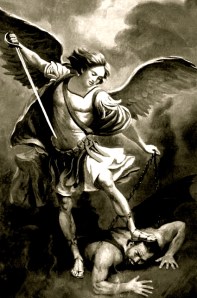
According to Boyd, even “natural evils” (e.g. earthquakes, floods, birth defects, mental illness etc.) are a result of these evil powers and they should be attributed to Satan, “the god of this world” (2 Cor. 4:4; Eph. 2:2) and his fallen angels that have turned against God.[32]

Boyd believes that every evil act or event is a result of free agents choosing to oppose God’s will. Whether that is humans or angels, all evil comes to us because of acts of defiance against God.[33]

Boyd says, “Evil is a mystery, but it is not a mystery concerning Yahweh’s character… the mystery of evil is not located in the heart of God but in the heart of humanity and in the hidden world between humans and God.”[34] God is not to blame for evil in his world.

Boyd contends that the early Christians were well aware of this spiritual war and it constituted “the only ‘problem of evil’ they knew or cared about.” It was a matter of aligning their lives with God’s will in Jesus. Boyd says, “It was a problem solved by spiritual activism, not by intellectual contemplation and pious resignation.”[35] The early believers were urged to join the angelic forces of God, in spiritual battle, with spiritual armor, through prayer (Eph. 6:10-18).

As Paul said, “For our struggle is not against flesh and blood, but against the rulers, against the authorities, against the powers of this dark world and against the spiritual forces of evil in the heavenly realms” (Eph. 6:12 NIV).

There was no need for the early Christians to ponder “why bad things happen to good people,” because they were ever mindful of the war that rages on until Christ comes to establish his kingdom forever on the earth (Rev. 20-21). They were at war with evil—fighting with weapons not of this world (2 Cor. 10:4)! They resonated with the words of Paul: “The God of peace will soon crush Satan under your feet” (Rom. 16:20).

Practical Implications

So what then can be said about seven-year old Greta who was abducted and raped before being brutally murdered? Where was God in this wretched evil?

In this light we must conclude that it is at least as true to say that God could not prevent Greta’s abduction as it is to say that God chose not to prevent it.  God chose not to prevent this abduction in the sense that he alone chose to create the kind of risky world where this kind of evil could happen. Moreover, because God made this choice, he now could not guarantee that this evil would be prevented. Where free agents are involved, God’s omnipotent will can at times be thwarted (Lk. 7:30).[36]

Gregory Boyd’s “Trinitarian Warfare Theodicy” does more than somehow let God off the hook for evil. His theodicy implies that both humans and angels are in a real war with God. Therefore, human and angelic actions really do matter in this world. Free agents can choose to join the Lord in works of the kingdom to resist evil and “speed his coming” (2 Peter 3:8-13) in the world, or capitulate to evil through actions that are antithetical to the new heaven and earth.

Boyd says, “If we believe that possibilities are not real, we will be more inclined to accept things that we could, and should, revolt against.”[37] Boyd calls for a proactive stance toward evil.

How then should Christians revolt? Boyd suggests that followers of Christ ought to understand prayer as “morally responsible behavior” in confronting evil in the world.[38] He believes that many Christians do not pray passionately against evil because somewhere deep down they don’t believe it can make any real difference.

People often pray out of obligation without any sense of urgency.[39] Boyd is convinced that if Christians get their minds right about what’s really going on, they will then see God opposed to all evil and join him in that opposition.

Embracing this “open” warfare worldview may not entirely solve the problem of evil, but Boyd believes that “it offers a more plausible way out of the dilemma of assuming God has a purpose for allowing particular evils.”[40] It is then necessary to reject the blueprint worldview.

Jesus taught his followers to align themselves with the Father’s will in prayer in order that he might have his way in them and the world (Matt. 6:10). Prayer joins heaven and earth. It moves people, angels, and all of creation to action against evil in order that God’s forces advance in the universe.

So when evil momentarily gets the upper hand, Boyd reminds Christians that God’s power is so great that he can use evil for the good of those who are concerned with kingdom alignment (Rom. 8:28). God weeps for Greta and others like her that have suffered at the hands of Satan. God is not sitting idly by doing nothing—and neither should his people.

It is plain that Boyd’s theodicy is a serious treatment of spiritual warfare. It implies that Christian living really does matter for kingdom’s sake. Boyd’s theodicy also reminds believers that God is for his people, always. He comes alongside his people and suffers with them (Heb. 4:15-16).

The cross of Christ reminds God’s people that he has himself experienced the full weight of evil. The resurrection says that God has conquered and that he is recreating the world in Jesus. Sin and death are on the way out. Boyd’s warfare worldview assures believers of God’s certain triumph, but in the meantime, there is a real battle being fought in heaven and earth.

Most importantly, Christians are reminded that Jesus reveals the God of Scripture. Jesus shows us that God is not behind evil, but instead, he stands utterly opposed to it. Boyd suggests that this also means that believers should see Jesus’ own actions as God’s way of rebuking evil.[41]

Where there is hate, let there be love. Where there is darkness, let there be light. Where there is unrest, let there be peace. And where there exists the most horrendous evils in the world, let God’s people overcome that evil with the good of Christ—for he has given us the victory.

CONCLUSION—A PLEA FOR OPEN DIALOGUE WITHIN EVANGELICALISM

Clark Pinnock has said, “No doctrine can be more important than the doctrine of God.”[42] Pinnock stands as a great testimony to evangelicals of what semper reformanda truly means. As an evangelical, he knew what it was like to be on a theological journey of discovery.

Pinnock (1937-2010) went from being a fundamentalist to ending his days as a respected open theist. He was familiar with the turmoil that comes from having his views challenged and making adjustments when needed.

Pinnock said:

After the initial anxiety of rethinking, one will find God again in a fresh way around the next bend in the reflective road. Rather than worry about our discomfort, perhaps we should be concerned about God’s reputation. Does it not concern us that God’s name is often dishonored because of poor theologies of God? How can we expect Christians to delight in God or outsiders to seek God if we portray God in biblically flawed, rationally suspect and existentially repugnant ways? We cannot expect it.[43]

As long as men let their guiding light be Christ and the Scriptures, how can another brother or sister stifle the growth and discovery of perceived truths? It goes to the heart of what it means to be an evangelical. There is room for open theists at the table of Christian orthodoxy.[44]

The challenge facing classical theism is not one that undermines biblical Christianity. Open theism is no doubt a perceived threat to classical theists, but this is because there are fundamental philosophical nuances between the two positions.[45]

After having examined the theodicy of Gregory Boyd, it should be clear that the conclusions he has drawn are biblically founded and Christ honoring. Who can deny open theists a place in serious evangelical discussion and debate?

May evangelicalism be enriched by the contributions of open theists.

D.D. Flowers, 2010.

Listen to Gregory Boyd give an intro lecture on open theism.


[1] Gregory A. Boyd, Satan and the Problem of Evil: Constructing a Trinitarian Warfare Theodicy (Downers Grove: InterVarsity Press, 2001), 214-215.

[2] Boyd, God at War: The Bible and Spiritual Conflict (Downers Grove: InterVarsity Press, 1997), 34.

[3] Jeffrey Burton Russell, The Prince of Darkness (Ithaca, NY: Cornell University Press, 1988), 257.

[4] Boyd sets forth his “Trinitarian Warfare Theodicy” in his book, Satan and the Problem of Evil. His open theism theodicy will be discussed in detail later in the third section of this article, The Open Theism of Gregory Boyd.

[5] As an open theist, Gregory Boyd is especially concerned with evil and what God is doing about it. Therefore, this article will focus primarily on his “open” perspective to the problem of evil. He has made a great effort to address his concerns with classical theism and present his theodicy as the “warfare worldview” in the following books: God at War: The Bible and Spiritual Conflict (Downers Grove: InterVarsity Press, 1997); Satan and the Problem of Evil: Constructing a Trinitarian Warfare Theodicy (Downers Grove: InterVarsity Press, 2001); Is God to Blame? Beyond Pat Answers to the Problem of Suffering (Downers Grove: InterVarsity Press, 2003).

[6] Veli-Matti Kärkkäinen, The Doctrine of God: A Global Introduction (Grand Rapids: Baker Academic, 2004), 53.

[7] For a full discussion, see Stanley Grenz, Theology for the Community of God (Grand Rapids: Eerdmans, 1994), 78-97; and Wayne Grudem, Systematic Theology (Grand Rapids: Zondervan, 1994), 156-184.

[8] Robert M. Grant, The Early Christian Doctrine of God (Charlottesville, VA: Univ. of Virginia, 1966), 12; also Charles Hartshorne and W. Reese, Philosophers Speak of God, 2nd ed. (Amherst, NY: Humanity Books, 2000).

[9] Richard Rice, God’s Foreknowledge and Man’s Free Will (Minneapolis: Bethany, 1985); John Sanders, The God Who Risks: A Theology of Providence (Downers Grove: InterVarsity Press, 1998); William Hasker, God, Time, and Knowledge (Ithaca, NY: Cornell University Press, 1989); David Basinger, The Case for Freewill Theism: A Philosophical Assessment (Downers Grove: InterVarsity, 1986); and Gregory Boyd, God of the Possible: A Biblical Introduction to the Open View of God (Grand Rapids: Baker Books, 2000); also R. Nash’s, The Concept of God: An Exploration of Contemporary Difficulties with the Attributes of God (Grand Rapids: Zondervan, 1983).

[10] The book was so controversial that publication was halted. Due to the efforts of Clark Pinnock, the book was later republished as, God’s Foreknowledge and Man’s Free Will (Minneapolis: Bethany, 1985).

[11] Clark Pinnock, The Openness of God: A Biblical Challenge to the Traditional Understanding of God (Downers Grove: InterVarsity Press, 1994), 118.

[12] Boyd, Satan and the Problem of Evil, 419. Boyd says, “compatibilism and the problem of evil are inextricably connected” (p.61).

[13] Sanders, The God Who Risks: A Theology of Providence (Downers Grove: InterVarsity Press, 1998).

[14] As John Piper argues in his book: Beyond the Bounds: Open Theism and the Undermining of Biblical Christianity (Wheaton: Crossway Books, 2003); also in Millard Erickson’s, What Does God Know and When Does He Know It? (Grand Rapids: Zondervan, 2003).

[15] Boyd, God of the Possible, 15.

[16] Ibid., 16. Boyd says, “I see no way to know for certain what is and is not open” (p. 146).

[17] Ibid., 68.

[18] Ibid., 49.

[19] Boyd, Is God to Blame?, 41.

[20] Ibid., 55.

[21] Boyd, God At War, 43.

[22] Pinnock, The Openness of God, 102.

[23] Boyd, Satan and the Problem of Evil, 18.

[24] Ibid.

[25] Boyd, God of the Possible, 12-13.

[26] Boyd, Satan and the Problem of Evil, 21.

[27] Ibid., 20

[28] Ibid., 24.

[29] Ibid.

[30] Boyd, God At War.

[31] Ibid., 93-113. Boyd entertains the “gap theory” or what he calls the “restoration theory.” This theory proposes that there was a cosmic battle between Genesis 1:1-2; see Jon Levenson, Creation and the Persistence of Evil: The Jewish Drama of Divine Omnipotence (San Francisco: Harper & Row, 1988), 121-122.

[32] Ibid., 206. Boyd says that we can’t possibly know the exact cause of every evil act or event, but it is safe to assume that the activity belongs to Satan and his forces of evil that continue to rebel against their Creator.

[33] Boyd, Satan and the Problem of Evil, 49.

[34] Boyd, God At War, 149.

[35] Ibid., 283.

[36] Boyd, Satan and the Problem of Evil, 215.

[37] Boyd, God of the Possible, 93.

[38] Boyd, Satan and the Problem of Evil, 229.

[39] Boyd, God of the Possible, 95. Boyd believes the blueprint worldview propagates this idea.

[40] Ibid., 99.

[41] Boyd, Is God to Blame?, 72.

[42] Pinnock, The Openness of God, 102.

[43] Ibid., 104.

[44] Clark Pinnock, “There is room for us: a reply to Bruce Ware.” Journal of the Evangelical Theological Society 45, no. 2 (June 1, 2002): 213-219. * Other notable open theists include: Adrio Konig, Jürgen Moltmann, Thomas Finger, Terence Fretheim, Keith Ward, John Goldingay, Kenneth Archer, Winkie Pratney, and H. Berkhof.

[45] See, Gregory Boyd, “Christian love and academic dialogue: a reply to Bruce Ware.” Journal of the Evangelical Theological Society 45, no. 2 (June 1, 2002): 233-243.


Jesus Manifesto

Moving Forward in Exploration of Christ

A Book Review of “Jesus Manifesto: Restoring the Supremacy and Sovereignty of Jesus Christ” by Leonard Sweet & Frank Viola

I can hear it now, “Do we really need another book about Jesus?” Apparently so, considering that as we entered the twenty-first century only 4 books out of the top 100 were about Jesus (Christian Book Association).

In Jesus Manifesto, Leonard Sweet and Frank Viola combine their voices to trumpet a resounding reminder that we never “graduate beyond Christ” in the Christian faith. And Christ isn’t found only in the center of things, but along the “corners and on the edges” as well.

Sweet and Viola believe we have created a “narcissistic” and a “best-seller” Christianity which is “self-centeredness wrapped up as ‘spirituality,’ which has become the latest fashion accessory for the person who has everything” (p. 100).

There is indeed much to be disheartened with in Christianity today. Yet, there is a growing number of evangelicals that are discovering that pop-culture Christianity is leaving them high and dry. “Whether they realize it or not,” says Sweet and Viola, “people are looking for a fresh alternative—a third way” (p. xiii).

As I look across the present post-modern landscape of Christianity, I see several camps of believers pushing their way through the crowd to stand on the rooftop of evangelicalism with their megaphone in hand (i.e. books, magazines, blogs, etc.) proclaiming the “real” gospel.

There are several current groups and “movements” that are all trying to highlight the neglected sides of historic Christianity. We have the reformed “defenders of orthodoxy,” the emerging brand, the missional-minded, and the organic house church folk, just to name a few.

I do believe that most of the people in these groups truly love the Lord and his church, but many of them are in danger of becoming preoccupied with some thing else other than Christ.

Sweet and Viola believe there are three features present in every spiritual awakening in the Christian church: (1) a rediscovery of the “living Word,” or the Scriptures and its authority; (2) a rediscovery of the living Christ and His supremacy; and (3) a rediscovery of the living Spirit and the Spirit’s gifts and power to manifest Christ in the context of that culture.  (p. xvii)

We’re living in some hot times economically, politically, and socially. Christians are engaging in an exchange of ideas (not without some name-calling and finger-pointing). It’s evident that even those who have been the most outspoken for the “supremacy of Christ” and right “doctrine” have succumbed to rhetorically burning people at the stake in the name of Jesus.

Where is Christ in word and deed? Sweet and Viola write, “Whatever you are occupied with comes out of your mouth. It’s what you talk about most of the time” (p.19). And we should not just be hearers of Jesus only, but doers of Him.

Is “mission” our center?  Is it community? Some say it’s preaching and others… ministry. If we say that Christ is central and supreme, what does that mean concerning justice? What does His universe look like when we are first seeking Christ and His Kingdom?

When Christ is not central and supreme in our lives, everything about life shifts out of orbit and moves out of kilter. So for Christians, our first task is to know Jesus. And out of that knowing, we will come to love Him, adore Him, proclaim Him, and manifest Him. (p. 2)

That’s why this book has been written. It addresses the present challenges we face as many “things” compete for the centrality and supremacy of the person Jesus Christ. We are called to be “living epistles” or “Jesus Manifestos” in our world. It’s about being true to Christianity.

So what is Christianity? It is Christ. Nothing more. Nothing less. Christianity is not an ideology or a philosophy. Neither is it a new type of morality, social ethic, or worldview. Christianity is the ‘good news’ that beauty, truth, and goodness are found in a person. And true humanity and community are founded on and experienced by connection to that person. (p. xvi)

Finally, Jesus Manifesto has been purposely written in an “ancient devotional tone” of writing. In the spirit of Watchman Nee, Jeanne Guyon, Andrew Murray, and T. Austin-Sparks, this book is a fresh call to the post-modern church: “Let us fix our eyes on Jesus, the author and finisher of our faith…” (Heb. 12:2).

And let us move forward in exploration of Christ Jesus our Lord.

“So then, just as you received Christ Jesus as Lord, continue to live in him, rooted and built up in him, strengthened in the faith as you were taught, and overflowing with thankfulness.”   Paul, Colossians 2:6,7

Can we, as the Christian church, agree upon the person of Christ? “Receiving Christ also means receiving all who belong to Him” (p. 147).

Will you sign the Jesus Manifesto?

Others who have signed

“One more sign of a Christianity that is beginning to look like Jesus again. Our great challenge over the past few decades has not been one of right believing but of right living. Viola and Sweet create a harmony here that invites you to give the world a Christianity worth believing in … after all they will know we are Christians, not by our bumper stickers and t-shirts — but by our love.” 
Shane Claiborne—author, activist, and recovering sinner    http://www.simpleway.org

“From beginning to end, authentic Christianity is all about Jesus and, ultimately, nothing but Jesus. No one has proclaimed this more clearly and persuasively than Viola and Sweet. Jesus Manifesto is an important and powerful prophetic call for the Martha-like Church to get back to doing “the one thing that is needful.” 
Gregory A. Boyd—Senior Pastor, Woodland Hills Church, Maplewood, MN; Author, Present Perfect, The Myth of a Christian Nation, and The Jesus Legend.

“This is a really exhilarating reintroduction to a Jesus who seems sometimes to have become a stranger to the Church; a passionate and joyful celebration of God with us, which cuts right through churchy quarrelling and brings us back to wonder, love and praise – and the urgent desire to make Him known to all.”  Rowan Williams—Archbishop of Canterbury

“I look for books that call us to love Jesus and make His name more widely known. In Jesus Manifesto, Sweet and Viola ask us to step away out of the “Youniverse” (their word) of narcissistic religion and away from the pop-culture Jesus who is just a nice man. Throughout the book, they exalt Jesus as the divine Savior and ask the church to do the same. I believe this book will spark a renewed love for Christ by pointing us to the deep mystery of His person. You will be motivated to love and serve more deeply as your life is focused on Jesus the Messiah.”
 Ed Stetzer—President of LifeWay Research http://www.edstetzer.com

Read more endorsements at:  www.thejesusmanifesto.org

Buy Jesus Manifesto: Restoring the Supremacy & Sovereignty of Jesus Christ (Thomas Nelson Publishing, 2010) on discount today (6/1/10) at: www.amazon.com

And please take a few seconds to give this review a helpful vote at amazon.  Thanks!

Len Sweet & Frank Viola

Leonard Sweet occupies the Chair of Evangelism at Drew University in New Jersey and contributes weekly to sermons.com and a podcast, “Napkin Scribbles.” He has authored numerous articles, sermons, and forty books.   www.LeonardSweet.com

Frank Viola is a best-selling author, international conference speaker, and a personal friend. His books include Finding Organic Church, Reimagining Church, The Untold Story of the New Testament Church, and the best-selling From Eternity to Here.   www.FrankViola.com


Heaven to Earth: The Christian Hope in the Resurrection, Part III

It has grown increasingly apparent to me that pop-culture Christianity was birthed, and is being maintained, by a steady diet of sloppy hermeneutics and a distorted view of Jesus. It has opened the church up to demonic deceptions and has made her susceptible to the pagan powers seeking to undermine our hope in the finished work of Christ.

Because of this onslaught upon Christian orthodoxy and years of propagating a view of God that more closely resembles Greco-Roman mythology than the Abba of Jesus, it is necessary that we adopt the Berean spirit and be reconciled to an apostolic view of God that looks like Christ and is consistent with the eternal purpose (Eph. 1-3; Col. 1:15-23).

Let’s stop and reconsider what the Scripture teaches concerning heaven, hell, and the resurrection of the dead. For what we believe about the future has a profound effect on how we live in this present evil age.

Heaven: Our Final Home?

“Behold, I will create new heavens and a new earth. The former things will not be remembered, nor will they come to mind.” Isaiah 65:17

The creation of a “new heavens and a new earth” is a transformation of the former things. It is a world transfigured like unto the physical body of the Lord Jesus (Matt. 17:1-9). The resurrected body of Christ was of its own kind. There is continuity with the old body and there is discontinuity as well (Lk. 24: 13-35, 36-49; Jn. 20:1-18, 24-31; 21:1-14).

In Rev. 21-22 we do not see believers flying off to a disembodied spiritual existence on the other side of the cosmos. No, we see heaven coming to earth. We see heaven, God’s realm, breaking through and fully consummating with the physical realm we call earth. We can see this in the resurrected body of Christ: heaven intersecting with earth.

We must rid ourselves of this mantra that speaks of going to heaven when we die, as if we will have come to the end of our journey. Heaven is indeed where the Lord is presently, but it is not our final home (Ps. 14:2; 20:6; 33:13; Ecc. 5:2; Is. 66:1; Dan. 2:44; 7:27; Rev. 11:15). The finished work of Christ is not fully realized until God makes his home on this earth.

If anything, heaven is only a temporal dwelling for those awaiting the resurrection of the dead. Jesus said there are “many dwelling places” in his Father’s house (Jn 14:2). The Greek word for “dwelling places” used here, monai, has regularly been used to refer to a temporary stop on an extended journey.

Even when Christ was on the cross, he told the thief on his left that “today” he would be with him in “paradise” (Lk. 23:43). This too doesn’t speak of a final destination, but of a temporal garden of rest. All of the saints, past and present, still await the return of the King and the establishment of heaven on earth (Heb. 11:13-16; Rev. 6:10-11).

God’s desire has always been to complete his good work in the created world upon which every human being has ever lived. For the Jew, there was a firm belief that God would restore creation and fulfill his covenant with his people. The Lord of heaven and earth would finally merge the two into one unified reality.

This resurrected world is called the “New Jerusalem” and the “Holy City” (Rev. 21:2). This newly remade world is our final destination. It is the Kingdom of God fully realized. In Revelation 21:5, Christ says:

“Behold, I am making all things new!”

And it is Christ that has the authority to say such things, for he was the first to be resurrected and be clothed with the imperishable.

Our hope is in a future resurrected existence in the “new heavens and earth.” It is on this earth that Jesus prayed, “your kingdom come, your will be done on earth as it is in heaven” (Matt. 6:10). Heaven is indeed coming to earth. Jesus has called for its renewal and resurrection!

“Heaven, in the Bible, is not a future destiny but the other, hidden, dimension of our ordinary life—God’s dimension, if you like. God made heaven and earth; at the last he will remake both and join them together forever.” N.T. Wright, Surprised by Hope, 19

NOTE: The original section Hell: Eternal Torture? was removed and expanded into a single article.

Resurrection Future

“I declare to you, brothers, that flesh and blood cannot inherit the kingdom of God, nor does the perishable inherit the imperishable… for the perishable must clothe itself with the imperishable, and the mortal with immortality.Paul, 1 Cor. 15:50, 53

Some folks would have you believe that the resurrection has already taken place in the spiritual sense and there is therefore no need for a physical resurrection of our bodies. This view highlights the work of the cross but overlooks the importance and power of a physical resurrection in order to maintain its toxic eschatology.

We can’t afford to ignore the earliest Jewish meaning of the word resurrection. Resurrection always refers to a new bodily existence. Paul’s emphasis on Christ’s bodily resurrection in 1 Cor. 15:12-58 is to assure the saints that we too shall receive the same.

It should be equally accepted as his purpose for addressing those believers in Thessalonica (1 Thess. 4:13-18). The believers there were dealing with the deaths of loved ones around them. They had “fallen asleep” before the coming of Christ.

Concerning the Christian hope at death, Stanley Grenz writes:

“As Christians, however, our hope does not focus on any conception of life after death. On the contrary, our hope is directed toward the promise of resurrection. Therefore, anything we say about the status of the dead must arise out of our hope for resurrection.” Created for Community, p.271

It is by Christ’s death on the cross that we died. But it is through Christ’s resurrection that we may live. “We were therefore buried with him through baptism into death in order that, just as Christ was raised from the dead through the glory of the Father, we too may live a new life.”

Paul continues, “If we have been united with him in his death, we will certainly also be united with him in his resurrection” (Rom. 6:4-5).

Without the physical resurrection of our bodies, we may not enter into the fullness of the new creation. When heaven comes to earth and “the dwelling of God is with men,” we shall receive a body that is clothed imperishable and raised in immortality; a resurrected body for a resurrected world.

It is in the physical resurrection of the dead and the judgment that the “last enemy” is destroyed (1 Cor. 15:26). Death shall be no more!

“I am the resurrection and the life. He who believes in me will live, even though he dies; and whoever lives and believes in me will never die.” Jesus, John 11:25-26

Resurrection Now

Does the resurrection of Christ on the third day have any effect on us in the present? Paul believed we could know the power of Christ’s resurrection even now.

“I want to know Christ and the power of his resurrection and the fellowship of sharing in his sufferings, becoming like him in his death, and so, somehow, to attain to the resurrection from the dead. Paul, Philippians 3:10-11

Paul wrote, “outwardly we are wasting away, yet inwardly we are being renewed day by day” (2 Cor. 4:16). How is it that resurrection has already begun in an inward way? It has happened by the death, burial, and resurrection of Christ. As N.T. Wright has written, it is in the resurrection of Christ that the world is already now “being born with Jesus” (SH, 73).

Jesus said, “I am the resurrection and the life…” and receiving his indwelling Spirit is receiving resurrection life (Jn. 12:24; 14:15-31; 16:5-16; Acts 1:8). The Kingdom of God has broken through into the old order of things and has already begun the work of resurrection in the here and now. It is doing a work within the hearts of men.

“The Kingdom of God belongs to the future, and yet the blessings of the Kingdom of God have entered into the present Age to deliver men from bondage to Satan and sin. Eternal life belongs to the Kingdom of God, to The Age to Come; but it, too, has entered into the present evil Age that men may experience eternal life in the midst of death and decay. We may enter into this experience of life by the new birth, by being born again.” George Eldon Ladd, The Gospel of the Kingdom, p. 71

We are able to stand firm and give ourselves fully to the work of the Lord because of our hope that soon Christ’s victory over death will become a reality for all of creation (1 Cor. 15:54-58). Resurrection is now working in the spiritual order of things.

The Kingdom of God is already here now and it is yet to come (Matt. 12:28; Mk. 1:15). It is working behind the scenes to destroy the sovereignty of Satan and is restoring the creation in every act of Christian love.

The Kingdom of God is breaking though into this present evil age because of Christ’s resurrection and it is testifying of the age to come when God will bring heaven to earth. The two-stage coming of the Kingdom should not be overlooked any longer (Lk. 19:11). The Lord is advancing his Kingdom even as I write this article. Heaven is invading earth in a covert operation of love.

How is the resurrection impacting our world today? What does the Kingdom look like in action? I believe Gregory Boyd very simply describes its nature and power.

He says, the Kingdom of God “always looks like Jesus—loving, serving, and sacrificing himself for all people, including his enemies. To the extent that an individual, church, or movement looks like that, it manifests the Kingdom of God. To the extent that it doesn’t look like that, it doesn’t.” The Myth of a Christian Religion, p. 14

If we are not willing to bleed like Jesus, we shall not know the power of his resurrection life. There is always a cross before there is a burst of light coming from the empty tomb. We must return to Christ and the foolishness of his cross if we wish to exhibit resurrection. For his Kingdom is not a matter of talk, but of power (1 Cor. 4:20).

This power does not come through utilizing the power-over structures of man to baptize the culture into the Christian religion. It is a spiritual authority that is earned by sharing the suffering of mankind. It happens when we see our neighbors as objects of God’s love instead of souls to conquer for our work-centered faith.

Resurrection happens in the here and now when the church is reflecting life as it will be in the new heavens and earth.

And that life always looks like Jesus Christ of Nazareth.

“For, as I have often told you before and now say again with tears, many live as enemies of the cross of Christ. Their destiny is destruction, their god is their stomach, and their glory is in their shame. Their mind is on earthly things. But our citizenship is in heaven. And we eagerly await a Savior from there, the Lord Jesus Christ, who, by the power that enables him to bring everything under his control, will transform our lowly bodies so that they will be like his glorious body.” Philippians3:1821

Suggested Reading:

The Bible & the Future by Anthony Hoekema Breaking the Code: Understanding the Book of Revelation by Bruce Metzger Created for Community: Connecting Christian Belief with Christian Living by S. Grenz The Eclipse of Christ in Eschatology: Toward a Christ-Centered Approach by Adrio Koenig An Evening in Ephesus: A Dramatic Commentary on Revelation by Bob Emery Gospel of the Kingdom: Scriptural Studies in the Kingdom of God by George Eldon Ladd IMMORTALITY OF THE SOUL OR RESURRECTION OF THE DEAD? by Oscar Cullmann The Myth of a Christian Religion: Losing Your Religion for the Beauty of a Revolution by Gregory Boyd Surprised by Hope: Rethinking Heaven, the Resurrection, and the Mission of the Church by N.T. Wright Dispensationalism: An Inquiry Into Its Leading Figures & Features by Jon Zens


When Kingdoms Collide

jesuspilate1

“Pilate then went back inside the palace, summoned Jesus and asked him, “Are you the king of the Jews?” “Is that your own idea,” Jesus asked, “or did others talk to you about me?”  “Am I a Jew?” Pilate replied. “It was your people and your chief priests who handed you over to me. What is it you have done?”

Jesus said, “My kingdom is not of this world. If it were, my servants would fight to prevent my arrest by the Jews. But now my kingdom is from another place.” “You are a king, then!” said Pilate. Jesus answered, “You are right in saying I am a king. In fact, for this reason I was born, and for this I came into the world, to testify to the truth. Everyone on the side of truth listens to me.”  John 18:33-37 NIV

The conversation between Pilate and Jesus is the most personal point of collision between the Kingdom of God and the kingdoms of the world.

In the past, I’m afraid we have read this text and seen its drama play out in such a way that is totally disconnected from everything Jesus had been teaching three years prior to his arrest. He has not merely used political language here to speak of heavenly things.

Jesus is not using political rhetoric here to simply ensure his brutal death on a cross for the forgiveness of sins. Jesus doesn’t whisper in Pilate’s ear, “Do me a favor, would you? I have to die for the sins of the world. I would appreciate it if you could crucify me for no reason.”  No, nothing of the sort!

Jesus was proclaiming an end to the power and glory of worldly kingdoms and the rise of a new order. The only way to miss this is to revel in ignorance of first century Palestine.

“And having disarmed the powers and authorities, he made a public spectacle of them, triumphing over them by the cross.”  Paul, Colossians 2:15

Unfortunately, the American version of the story is what we have been told. We have removed most (if not all) earthly implications of Christ’s words to his church concerning her relationship to worldly powers.

We have stripped the New Testament of all immediate implications on faith as it pertains to worldly politics. Where we find the Scripture opposes our own personal paradigms we must ignore its instruction, change its meaning, or compartmentalize it to fit our dichotomized faith.

This belief system promotes the idea that our discipleship does not carry over to all aspects of life. And when a person wants to meddle in worldly affairs that Christ himself did not concern himself with, out come the excuses as to why our situations and circumstances are different than those of Jesus.

“Perhaps in our well-intentioned efforts to bring all things under the lordship of Christ, American Christian culture has been guilty of baptizing unrepentant social systems and structures… Has American Christianity too often shelved its discipleship, compartmentalized its faith, and thus been blinded by unredeemed cultural forces that leave us prey to the principalities and powers of this world?”  Lee Camp, Mere Discipleship: Radical Christianity in a Rebellious World, p.18

There is no denying this is indeed what has happened among the church today. The answer to our present dilemma is not to continue down the path of castrating the Gospel of Jesus with insistency upon getting our hands on the mantle of political power. It is to return to the way of the Master.

It is by renewing our Christology in a zealous pursuit of his heart. It can only come by taking another look at Jesus and rethinking the doctrine of the two kingdoms. It will call for a fresh interpretation of Scripture within its historical-grammatical context and a discovery of the indwelling Christ.

And it will come with great sacrifice.

Donald Kraybill writes:

“Kingdom ethics, taught and lived by Jesus, can be transported over the bridge linking the first century with our own… The Gospels don’t offer a full-blown system of formal ethics for every conceivable situation… Jesus, does however, clearly introduce us to basic principles of the right and good for the collective life of the Kingdom.  Making specific applications, of course, is the task of believers guided by the Holy Spirit.” The Upside-Down Kingdom, p.31

It is only the Person and the work of Christ that our entire faith is built upon. No level of human wisdom and ingenuity is relevant to issues that faced us yesterday, face us today, and will be facing us tomorrow.

If we want to understand the heart of Christ who is God, we must be willing to abandon human reasoning that is not first captivated by the words of Jesus. Are we willing to lay aside our preconceived notions and our cultural conditioning in order that we might receive the word of Christ?

Would we be so bold as to allow the Holy Spirit of Christ to invade our space and reveal to us the “foolishness” of the Gospel that Paul wrote about (1 Cor. 1:18-20)?

May the Spirit give us the ability to say, “Yes!” to Christ.

Baptism: Initiation into the Kingdom of God

“Therefore go and make disciples of all nations, baptizing them in the name of the Father and of the Son and of the Holy Spirit, and teaching them to obey everything I have commanded you. And surely I am with you always, to the very end of the age.”  ~ Jesus, Matthew 28:19-20 NIV

Baptism is symbolic for entrance into the Kingdom of God that Christ proclaimed. It is an outward picture of an inward reality. And it stands for much more than the forgiveness of sin.

Other religious groups practiced forms of baptism as sort of an initiation into that community of belief. For the Christian, it meant that a person was now dead to the things of the world. They were forsaking all systems and kingdoms of the world for new life in a Kingdom not of this world.

“The Kingdom of God is at hand!  Repent and be baptized!” was the cry of John the Baptist, cousin of Jesus.

Baptism was a call to enter in to a new order of living. In Jesus’ day, this most certainly would have been calling for a denial of Roman domination and a pledge to another existence in God’s rightful reign upon the earth. This was a proclamation that the Messiah was about to establish his law and politics that opposes those of the world.

The “Way of the Lord” was being prepared by John. And then Jesus steps into the waters of the Jordan. The Spirit anoints him as King, and the rest is history. Or is it that simple?

Is this all that can be gathered from this text? Is this just a neat story of Jesus dipping himself in a river so that people can reenact the ritual in baptistries everywhere? Could there be more?

Maybe history proves this rite of passage into the Kingdom of God is very much alive today. And I submit to you its power and its significance can’t be contained in a nice religious ceremony.

“As new believers confessed their faith and entered the community through baptism, they reconsidered and redefined everything about themselves… Some people left their jobs when their old lives collided with their new ones, when their allegiance to Rome collided with their new allegiance to God’s Kingdom.”  Shane Claiborne, Jesus For President, p.144.

What kind of people does Baptism call us to be? What sort of new living will result in our initiation into the Kingdom of God? I don’t believe that this baptism makes all things in the world sacred. (As many “emerging” theologians suggest.)  It makes only our lives sacred.

Once our entire lives have become consecrated unto the Lord, then we may perceive with heavenly wisdom what is redeemable in the world. All things become new through our own sanctification. Then and only then may we determine what Christ has called us to sprinkle our salt upon.

“You are the salt of the earth. But if the salt loses its saltiness, how can it be made salty again? It is no longer good for anything, except to be thrown out and trampled by men.”  Jesus, Matthew 5:13 NIV

Will we allow something in our lives to not pass through the waters of the Kingdom? Will this repentance be complete or only partial? Will we push the Kingdom aside for another passionate agenda?

We must examine all aspects of our lives and ask, “Have all things in my life been eternally effected by the Kingdom of God?”

It is time to recognize that the Kingdom of God takes precedence over all issues facing us today. It was at the forefront of the secret message of Jesus. And Christ coming in his Kingdom ought to be at the core of our own.

“I must preach the good news of the kingdom of God to the other towns also, because that is why I was sent.” Jesus, Luke 4:43 NIV

Not of this World

I have to believe that Pilate was a bit confused and curious as to the meaning of Jesus’ words, “my Kingdom is not of this world.” Perhaps, he believed Jesus was a few fries short of a happy meal.

It’s very possible he was only thinking of solving the matter without rousing a riot in the streets of Jerusalem.

This is for certain, Jesus’ words were treasonous. Pilate responds, “You are a king then.” It doesn’t matter what sort of king Jesus claimed to be. Caesar was a god in the flesh. Caesar rules the cosmos, not an unimpressive Jewish carpenter who has a death wish. There is no room in the world for two kings demanding ultimate allegiance.

pilatePilate understood that if he didn’t deal with this enemy of the state, word might get back to Rome. History proves that Pontius Pilate had no qualms with crucifying folks. Critics of the Gospels believe this portrayal of Pilate is not true to history.

No doubt, Pilate is unclear as to what to do with this strange prophet who speaks of “truth” and treason but shows complete serenity in his predicament.

So why the uncertainty? Did his wife’s dream faze him that much (Matt. 27:19)? There is clearly something out of the ordinary taking place here. He faces a major dilemma.

Dealing with the insubordinate Jews was no easy task. He needed to maintain the peace and the crowd was furiously chanting for Jesus’ blood. He knows his duty as procurator. His reason tells him he must kill this Jesus of Nazareth.

“In the time of those kings, the God of heaven will set up a kingdom that will never be destroyed, nor will it be left to another people. It will crush all those kingdoms and bring them to an end, but it will itself endure forever.” Daniel 2:44 NIV

We don’t have a hard time recognizing that most first-century Jews clearly missed the Kingdom that was foretold by the prophet Daniel. They were expecting a political king that would establish a worldly kingdom rule and release them from their Roman captors.

“If you are the Messiah, come down off that cross!” they cried.

No, Jesus of Nazareth didn’t even come close to what they wanted in a ruler. But before we scrutinize the Jews for their rejection of a suffering Messiah (Isaiah 53), we should take a look in the mirror.

For we too have a difficult time choosing a king whose Kingdom calls for power-under people instead of power-over them.

The church has been guilty of rejecting the upside-down Kingdom of God that demands a rejection of the methods of the kingdoms of this world. We have not understood that the nature of the Gospel is to win by dying, not by killing.

We simply can’t imagine the advancement of God’s Kingdom without the aid of the nations and their politics. We refuse to trust in the power of the Gospel that Christ proclaimed.

We would rather trust in “necessary evils” and all manner of ungodliness than in the way of the cross.

We are guilty of resorting to methods that Jesus and the apostles taught against. We would rather address our personal feelings of passivity and “duty” with picking up the sword instead of the cross. This should not be.

“The crucial distinction between the two kingdoms is how they provide antithetical answers to the questions of what power one should trust to change ourselves and others: Do you trust “power over” or “power under”?  Do you trust the power of the sword, the power of external force, or do you trust the influential but noncoercive power of Calvary-like love?… The Kingdom of God consists of all those who choose the latter rather than the former who act accordingly.” Gregory Boyd, The Myth of a Christian Nation, p.33

Jesus responds to the disciples and their request to have a form of leadership like the systems of the world. You can almost hear the same cry that you heard from Israel a thousand years before, “Give us a king to lead us!” (1 Sam. 8:6)  In other words, “We want the same order that we see in the world.”

Christ replies to their confusion and leaves no ambiguity as to how we too should view this matter.

“Jesus called them together and said, “You know that those who are regarded as rulers of the Gentiles lord it over them, and their high officials exercise authority over them.  Not so with you. Instead, whoever wants to become great among you must be your servant, and whoever wants to be first must be slave of all.  For even the Son of Man did not come to be served, but to serve, and to give his life as a ransom for many.”  Mark 10:42-45 NIV

Not only does this beg to question our desire to rule with power-over others in the world, but in the church as well. Much of American Christianity has evolved from years of ignoring the teachings of Jesus and pragmatically applying methods and systems of the world upon those things that are supposed to be “not of this world”.

We are guilty of adopting methods of the world to advance the Kingdom of God and have not seen how our efforts are self-defeating. We can’t see how we have mixed the two kingdoms and corrupted our salt by choosing methods Jesus rejected.  We apparently see ourselves in the role of Pilate instead of Jesus. But there is no way of escaping Christ’s words…

“I am not an earthly king… my Kingdom is not of this world.”  Jesus, John 18:36 NLT

What does Jesus mean when he says, “my Kingdom is not of this world”? I’m afraid his words have been reduced to a memory verse with little to no power whatsoever. Judging by our actions, it has nothing to do with this world; as if Jesus is gazing off into the cosmos dreaming of some distant galaxy far removed from the pain and suffering of mankind.

It’s time to rethink all of these passages that have become common Christian clichés and a meaningless regurgitation of words when we have nothing else better to say.

I believe the first place to start in understanding Christ’s Kingdom that is “not of this world” is in a fresh look at the first event following Jesus’ baptism at the Jordan.

The Temptations of Christ: Defining the Kingdom

In Matthew 4:1-11, we immediately see Jesus led by the Spirit into the Judean wilderness to be tempted by the devil. The Lord has wasted no time in beginning his work.

But before he can begin his ministry in his proclamation of the Kingdom of God, Jesus must first undergo a trial and confrontation that will forever define his Kingdom. He must decide in his own heart and for the testimony of his followers what kind of Messiah he will be.

What kind of king and kingdom will Jesus choose? His choices then become our choices if we wish to follow him.

“Whoever claims to live in him must walk as Jesus did.”  John, 1 John 2:6 NIV

temptationsIn order to understand the temptations, we must see them in conjunction with the previous events. They should not be isolated from Christ’s recent baptism and his inauguration as the King of the Kingdom of God that John was preaching; the Kingdom that Jesus will continue to proclaim throughout his ministry.

The temptations of Christ are not merely examples of Jesus overcoming sin. They were not meant to be read as three accounts of Jesus facing opposition so that you can face opposition with confidence. For we know that Jesus faces opposition and endless temptations throughout his ministry.

No my friends, this isn’t just good sermon material for us to use to condemn others and warm our souls when the days are dark. The true purpose of this record is understood when we accept that there is one story that is building to the conversation with Pilate, and ultimately to the cross.

Will you join me in rejecting this belief that the Bible is a collection of disjointed stories that we can yank from its context to affirm our American Christianity?

“The synoptic writers report that three right-side-up options lured Jesus before he launched the upside-down kingdom… The temptation points to a right-side-up kingdom encompassing the three big social institutions of his day: political, religious, and economic.”  Donald Kraybill, The Upside-Down Kingdom, p.33

After fasting forty days and forty nights, of course Jesus was tired and hungry. This clearly would have made any proposal appealing to the flesh. We all know how much our physical state affects our spiritual focus.

And this was the point of the fasting. Jesus makes himself completely vulnerable to opposition. It would have certainly been a time of closeness with the Father and a time of great challenge in his humanity against Satan.

The devil came to him and said, “If you are the Son of God, tell these stones to become bread.” Jesus replies, “It is written, “Man does not live on bread alone, but on every word that comes from the mouth of God” (Matt.4:3,4).

Hmm… OK, is that it?  Jesus was tempted to eat some bread. Is there more? I have always sensed much more is going on here that meets the eye. What about you? Are you content with this event seemingly being disconnected from the preaching of the Kingdom of God in the previous chapter?

I was taught this temptation communicates the importance of God’s Word. That’s all great and I agree that God’s Word is important. But there is obviously something more going on here that we can connect to Matthew’s account in the previous episode.

To those familiar with Hebrew history and the economic problems of Christ’s day, you should recognize a few details. Forty days? How many times have we seen forty days used as a complete time of trial and tribulation? And what about the “wilderness” and “bread”? Recognize these things?

Jesus embodies Israel and reveals his divine mission as well as the mission for those who wish to follow him. The connection to Israel’s history and Christ’s words of total submission to God is obvious. But what does this have to do with Jesus’ recent baptism and the proclamation of the Kingdom of God?

We see that Christ is speaking to the past through his resistance to the first temptation. But what is he saying to the present and the future of his people? In order to answer that question we first must acknowledge that this account has everything to do with the ministry Christ is about to embark upon.

Secondly, we have to learn about the oppression of the people under Rome’s heavy hand.  There were two classes of people in the Roman Empire: upper and lower class. Evidence suggests that 90% of the citizens were of the lower class.

Bread represents provision. God provided bread for the Israelites. Jesus will later say, “I am the bread of life.” Bread was an essential part of their diet. Therefore, in light of the context, we begin to see the real “temptation” come to the surface. How are you going to provide for the people?

Since he is the Messiah, the devil tempts Jesus to be a welfare king. “Turn these stones to bread” he said. How will Christ deal with the economic problems of the world? This is the question Christ answers. It is a question every king must consider.

Jesus’ response ought to be seen as a rejection of solving the problem as an earthly king would. He doesn’t ignore the physical needs of the world; he simply chooses to address the matter in a way that seems foolish. He relates to the hunger of people all over the world, but he doesn’t choose to alleviate the pain and suffering. He embraces it.

The Kingdom of God is much bigger than a loaf of bread—it is more than food.

Jesus deals with poverty in a different way. This becomes clear as we see Jesus refuse to simply feed the people and ease their temporary suffering. And when he did do these things, he called them into the Kingdom of God. Yes, the Gospel is social, but not in the way some in the “emergent” church would have you believe.

Then the devil took Jesus to the highest point of the Temple in the “holy city” Jerusalem. Satan says, “If (since) you are the Son of God, throw yourself down.” The devil then proceeds to quote Scripture (Psalm 91), twisting it to tempt Jesus to action. Is Jesus going to swoop in and gain the approval of the religious establishment? He very easily could have removed all doubt to who he was.

A grand entrance would certainly gain recognition that he was indeed the Messiah. Yet, he resists the temptation to gain approval of those religious folk. If Christ was going to convince the religious leaders, the “Doctors of the Law,” this was the time to do it. And there would be no better way to convince them of his true identity.

But Jesus chooses not to parachute in and remove all doubt. He will make his presence known in the Temple, but right after he drives out those making a profit off of God. This is quite different than the entrance he was tempted with by the devil.

Jesus storms in to the heart of Jewish religion, and turns it upside-down. The Temple is no longer the place of worship and symbol of God’s presence. For the Spirit of God has come to dwell in men. There is now something greater than the Temple. Immanuel, God with us.

Again, to understand this temptation, we must read it in light of what has already been presented. The devil challenges Jesus, as Messiah, to confront the economic issues of the world in keeping with the expected provision of a savior. And now… he tempts Jesus to embrace institutional religion.

He rejects the secular concept of Messiah in both the way he confronts social injustices and the way he deals with religion.

This was totally unexpected and intolerable.  Jesus does not come in and paint the heroes as villains and get away with it.  No sir. This idea is not only opposed by the religious leaders, they demand its death.

Jesus overcomes this temptation and once again rests on the Word of God, saying, “Do not put the Lord your God to the test.”

Now Jesus faces his most difficult challenge yet. Jesus is taken to a high mountain. Mountains were seen as places where deities come to earth. From the pagan “high places” to the receiving of the Ten Commandments, God chose to work within this Eastern mindset. And this final temptation should be seen as an offer of divine importance.

Jesus has already rejected two powerful offers to play by the world’s rules and give the people the Messiah that was expected: a Messiah that fixes this present age by methods characteristic of this world.

“Again, the devil took him to a very high mountain and showed him all the kingdoms of the world and their splendor.  “All this I will give you,” he said, “if you will bow down and worship me.”  Matthew 4:8,9 NIV

This one has always puzzled me in the past. Is the temptation here to worship the devil? Let’s see if you can figure out what is really facing Jesus in this final bout with Satan.

The devil has already tempted Jesus in this way, “So you are the Messiah are you? Well, feed the people!  You are aware of their suffering and their deep need to eat. You feel their hunger even now.  What are you going to do about it?” Jesus answers.

“Only as we see what Jesus rejected, can we know what he has affirmed.”           Donald Kraybill, The Upside-Down Kingdom, 34

Again the devil comes at Christ, saying, “OK, Messiah, what are you going to do about their religion? I have an idea, why don’t you save yourself some trouble and just prove to them you are who you say you are?”

Christ chooses the Messianic secret and opposes them instead.

Jesus is faced with three major social institutions: economic (bread), religious (temple), and now the political (mountain).  Christ is shown all the kingdoms of the world. The devil has power over them, which Jesus does not deny. The Messiah will crush these kingdoms as Daniel prophesied.  But how will he crush them?

Will he take the world by force and use violence? Will he succumb to the way of the present evil age, and the prince of the air, by putting his hand to the plow of political power? Will he be an Alexander, an Augustus, or better yet… a King David?  This would not be the last time he is faced with this temptation (Matt. 16:23; 26:51,52; Jn. 6:15).

Christ redefines power in his rejection of earthly kingship. He rejects the avenue of earthly politics to advance the Kingdom of God. He is not simply choosing power-under because it was the nice thing to do or it was the only way people could see love. By no means, the methods of Christ represent the very character of God.

Jesus embodies God’s will for his people and all those who seek to enter in to the rightful reign and rule of God on earth.  Do not pass by this temptation and miss the foolishness of the Kingdom of God, for therein is power that we have not known in our day.

If we desire to follow Christ, we must embrace the suffering Messiah. Please notice that each time Christ rejects the devil’s ideas of Messiah, he accepts the way of suffering. He knowingly is choosing the way of the cross. And his choosing to resist the temptations are not for the sole purpose of dying a horrible death for the sins of the world.

This is a presentation of the Kingdom of God. For those that want to be baptized into this Kingdom you must count the cost and undergo the same trial of Jesus. If we are not willing to reject what Christ rejects, we are enemies of the cross.

We must be willing to say to the prince of the power of the air and the kingdoms he controls, “Away from me!  For it is written: ‘Worship the Lord your God, and serve him only.’” (Matt. 4:10)

“To this you were called, because Christ suffered for you, leaving you an example, that you should follow in his steps.  “He committed no sin, and no deceit was found in his mouth.”  When they hurled their insults at him, he did not retaliate; when he suffered, he made no threats. Instead, he entrusted himself to him who judges justly.  He himself bore our sins in his body on the tree, so that we might die to sins and live for righteousness; by his wounds you have been healed.  For you were like sheep going astray, but now you have returned to the Shepherd and Overseer of your souls.”  Peter, 1 Peter 2:21-25

The Nature of the Kingdom of God

“The Kingdom of God is here; but instead of destroying human sovereignty, it has attacked the sovereignty of Satan.  The Kingdom of God is here; but instead of making changes in the external, political order of things, it is making changes in the spiritual order and in the lives of men and women.”  George Eldon Ladd, The Gospel of the Kingdom, 55.

The doctrine of the two kingdoms reveals to us that they are contrary in nature. Let’s take a brief look at how they oppose one another. I do hope it will become clear as to why the Christian should not think they can use methods of the world to advance Christ’s agenda, especially in matters of the state. Paul has written of this contrast in Romans 12 and 13.

  • The Christian is called to love (12:9,10); the state is called to be “agents of wrath” (13:3).
  • The Christian is not to avenge (12:19); the state is a revenger of evil (13:4).
  • The Christian is to overcome evil with good (12:21); the state suppresses evil with wrath (13:4).
  • The Christian uses the sword of the Spirit (Eph.6:17); the state uses a sword of steel (13:4).

I want to focus in on the contrary nature of the two kingdoms by looking specifically at the worldly kingdoms (i.e. governments). It is from this system that all other power-over systems flow.

The kingdoms of the world represent a mock Kingdom of God. This is why Jesus chose to not utilize the avenues of politics and power to build his Kingdom. These kingdoms of the world, no matter what form of government exists, stand in opposition to the upside-down Kingdom of Christ.

When Jesus surveyed the landscape of the worldly kingdoms from that high mountain, there he saw all worldly kingdoms past, present, and future. And he says to them, “No, my kingdom is not of this world. I have made a spectacle of them by triumphing over them by the way of usurping their methods of power and domination.”

Jesus calls for the demise of the never-ending cycle of violence (Matt. 5:44). He represents a Kingdom that advances by serving people in love without strings attached (23:11). He does not rely upon or even address the social injustices of his day as being the responsibility of the state. This is not his concern. There is another way. This way is in sacrificial living.

It says that in order to win, you must die. If you want to gain, you must lose.

If you want to be successful in this life, you must prepare for the one to come. This way doesn’t call us to rule over men by restraining them with human law. The way of the cross submits itself to human law where it can, but rises above it and surpasses it in peaceful living.

Don’t be fooled into thinking Christ is an idealist. Jesus lived the Kingdom in power and he was fully connected to reality.  We should not think that what appears as silence on certain matters of the state means we have the freedom to pick up the sword. Christ’s Kingdom is subversive. If we look closely, we will see him tearing down the kingdoms of the world and rejecting their methods of restraining evil.

Was Jesus a terrorist? It depends on how you look at it I guess. One thing is very clear, he did not resort to violence or any method of the state to advance the Kingdom of God. In fact, he kept a healthy distance from it.

Recently, I was engaged in a discussion on these matters. I was asked, “Aren’t we supposed to work for peace and justice?  Doesn’t that mean we should use politics to do good in the world?” You would think so, yes. This is partly why the gate is narrow that leads to life. We would rather place our trust in the world’s methods than in the foolish ways of Christ.

If worldly politics are an acceptable way to advance the Kingdom of God, then every believer should be striving for power.  Be done with trying to keep a foot in both kingdoms!

Pragmatism has pervaded the church in more ways than one. It has based a great deal of its decisions on human reasoning that is represented in the question above. Consider for a moment what we communicate when we say these things. We say Christ does not show us how to live and the Sermon on the Mount (Matt. 5-7) is not for real life.

We then do what we can to follow Jesus where it does not conflict with our own cultural crusading. We compartmentalize our faith and push Jesus off into the corner. It is no wonder that Ghandi rejected Christ. The Christians he saw made no attempt to live like their Christ. Ghandi learned a few things from Christians alright, how to manipulate the teachings of Jesus in order to change the politics of his day.

I firmly believe that Christians in America are more aware of the Bill of Rights than the New Testament. They are so filled with clichés and heretical doctrines from the demons of nationalism, they can’t hear the pure words of Jesus without mixing them with apple pie, baseball, and images of Sergeant York learning how to chop up his faith. It’s time to wake up and rid ourselves of this corrupted American gospel of greed!

I want to end this final section with a challenge to rethink the two kingdoms.Jesus has spoken. The problem is just that we have a hard time hearing it.

Empire: A Home for Demons

In Luke 8:29-37, we read one account of the demon-possessed man by the seashore. Here is another story that must be read with the Kingdom of God in mind. Do you remember what the demon told Jesus when he asked him for his name? The demon said, “Legion.” Why Legion? You probably know that a “legion” was anywhere from two-thousand to six-thousand Roman soldiers. Now, if you see this from a Kingdom perspective, there is more going on here than meets the eye.

I am left thinking, “Why Legion?  Why not ‘Bob’… or ‘Emily Rose’?  Why ‘Legion’?”

Well, I am not satisfied with the idea that this was just some random name this naked demon-possessed man came up with during his stay in the nearby tombs. I am persuaded to believe that Jesus casting “Legion” out is an indirect attack on Rome. This episode represents what the Kingdom of God is doing now.

It speaks to what we should be doing now. Our concern is the spiritual order of things—bringing life to those who have empty souls—souls so empty the demons come in to set up house and stay a while.

angry-jesusWhat happens after this exorcism? Jesus casts “Legion” into the pigs (unclean animal) that run into the sea. This reminds me of Pharaoh and his legions. They were swallowed up in the sea.

“Then I saw the beast and the kings of the earth and their armies gathered together to make war against the rider on the horse and his army.  But the beast was captured, and with him the false prophet who had performed the miraculous signs on his behalf. With these signs he had deluded those who had received the mark of the beast and worshiped his image. The two of them were thrown alive into the fiery lake of burning sulfur.  The rest of them were killed with the sword that came out of the mouth of the rider on the horse, and all the birds gorged themselves on their flesh.”  John, Revelation 19:19-21

John was exiled to the island of Patmos due to his radical views. And the only way to write a final word of encouragement to Christians with the vision he received was to write in code. A right view of this text shows the “Beast” or “Babylon” to be Rome. Rome represents the power of the kingdoms of the world in every generation. This “Beast” is cast into a sea of fire along with the rest of those who worship him.

I don’t think I would go to sleep tonight without giving this passage some thought.

“Fallen! Fallen is Babylon the Great!  She has become a home for demons… for all the nations have drunk the maddening wine of her adulteries… Come out of her, my people, so that you will not share in her sins, so that you will not receive any of her plagues; for her sins are piled up to heaven, and God has remembered her crimes.” John, Revelation 18:2-5

At last, how will we respond? The people in Luke 8 were fearful. Why were they so fearful? Jesus had performed many exorcisms and miracles before, none of them freaked out the people as much as this group of country bumpkins.

Could it be they were “worshippers of the Beast”? Could it be that they understood this action but we have missed it? Who did they fear here? Maybe they connected the dots. The Kingdom of God had come to town.

“But if I drive out demons by the Spirit of God, then the kingdom of God has come upon you.”  Jesus, Matthew 12:28

Conclusion

As I have written already, the Kingdom of God is at the forefront of Christ’s message. It is the Gospel message. It can’t be reduced to heaven and hell and having your sins forgiven. The Lord may use this version in a person’s life, but it is most certainly not the full Gospel of Christ.

It is important that we recognize the serious implications of Jesus’ actions. Before he ever chose any of his disciples or set out to preaching and healing people, Jesus defined his Kingdom and settled, at least in his own heart and mind, that the Kingdom of God would come in two stages: the already, but not yet.

“While they were listening to this, he went on to tell them a parable, because he was near Jerusalem and the people thought that the kingdom of God was going to appear at once.”  Luke 19:11 NIV

The Kingdom of God is already here in every action of a believer that is participating in  “thy Kingdom come” and joining God where he is overcoming evil with good. This calls for lives marked by estrangement and great patience in the face of social injustices.

The “not yet” aspect reminds us of our hope to stand firm, for our labor is not in vain. Christ will crush all the kingdoms of the world and he will, as N.T. Wright puts it, “set the world to rights”.

In the meantime, we trust in the power of the upside-down Kingdom. We come alongside those who are suffering and we suffer with them. We make sure we are overcoming evil with good and not suppressing evil with more evil.  Our safeguard against this temptation to pick up the sword, is Christ himself.

“Christianity without the living Christ is inevitably Christianity without discipleship, and Christianity without discipleship is always Christianity without Christ.”  Dietrich Bonhoeffer, The Cost of Discipleship, p.59