Tag Archives: frank viola

Jesus Manifesto

Moving Forward in Exploration of Christ

A Book Review of “Jesus Manifesto: Restoring the Supremacy and Sovereignty of Jesus Christ” by Leonard Sweet & Frank Viola

I can hear it now, “Do we really need another book about Jesus?” Apparently so, considering that as we entered the twenty-first century only 4 books out of the top 100 were about Jesus (Christian Book Association).

In Jesus Manifesto, Leonard Sweet and Frank Viola combine their voices to trumpet a resounding reminder that we never “graduate beyond Christ” in the Christian faith. And Christ isn’t found only in the center of things, but along the “corners and on the edges” as well.

Sweet and Viola believe we have created a “narcissistic” and a “best-seller” Christianity which is “self-centeredness wrapped up as ‘spirituality,’ which has become the latest fashion accessory for the person who has everything” (p. 100).

There is indeed much to be disheartened with in Christianity today. Yet, there is a growing number of evangelicals that are discovering that pop-culture Christianity is leaving them high and dry. “Whether they realize it or not,” says Sweet and Viola, “people are looking for a fresh alternative—a third way” (p. xiii).

As I look across the present post-modern landscape of Christianity, I see several camps of believers pushing their way through the crowd to stand on the rooftop of evangelicalism with their megaphone in hand (i.e. books, magazines, blogs, etc.) proclaiming the “real” gospel.

There are several current groups and “movements” that are all trying to highlight the neglected sides of historic Christianity. We have the reformed “defenders of orthodoxy,” the emerging brand, the missional-minded, and the organic house church folk, just to name a few.

I do believe that most of the people in these groups truly love the Lord and his church, but many of them are in danger of becoming preoccupied with some thing else other than Christ.

Sweet and Viola believe there are three features present in every spiritual awakening in the Christian church: (1) a rediscovery of the “living Word,” or the Scriptures and its authority; (2) a rediscovery of the living Christ and His supremacy; and (3) a rediscovery of the living Spirit and the Spirit’s gifts and power to manifest Christ in the context of that culture.  (p. xvii)

We’re living in some hot times economically, politically, and socially. Christians are engaging in an exchange of ideas (not without some name-calling and finger-pointing). It’s evident that even those who have been the most outspoken for the “supremacy of Christ” and right “doctrine” have succumbed to rhetorically burning people at the stake in the name of Jesus.

Where is Christ in word and deed? Sweet and Viola write, “Whatever you are occupied with comes out of your mouth. It’s what you talk about most of the time” (p.19). And we should not just be hearers of Jesus only, but doers of Him.

Is “mission” our center?  Is it community? Some say it’s preaching and others… ministry. If we say that Christ is central and supreme, what does that mean concerning justice? What does His universe look like when we are first seeking Christ and His Kingdom?

When Christ is not central and supreme in our lives, everything about life shifts out of orbit and moves out of kilter. So for Christians, our first task is to know Jesus. And out of that knowing, we will come to love Him, adore Him, proclaim Him, and manifest Him. (p. 2)

That’s why this book has been written. It addresses the present challenges we face as many “things” compete for the centrality and supremacy of the person Jesus Christ. We are called to be “living epistles” or “Jesus Manifestos” in our world. It’s about being true to Christianity.

So what is Christianity? It is Christ. Nothing more. Nothing less. Christianity is not an ideology or a philosophy. Neither is it a new type of morality, social ethic, or worldview. Christianity is the ‘good news’ that beauty, truth, and goodness are found in a person. And true humanity and community are founded on and experienced by connection to that person. (p. xvi)

Finally, Jesus Manifesto has been purposely written in an “ancient devotional tone” of writing. In the spirit of Watchman Nee, Jeanne Guyon, Andrew Murray, and T. Austin-Sparks, this book is a fresh call to the post-modern church: “Let us fix our eyes on Jesus, the author and finisher of our faith…” (Heb. 12:2).

And let us move forward in exploration of Christ Jesus our Lord.

“So then, just as you received Christ Jesus as Lord, continue to live in him, rooted and built up in him, strengthened in the faith as you were taught, and overflowing with thankfulness.”   Paul, Colossians 2:6,7

Can we, as the Christian church, agree upon the person of Christ? “Receiving Christ also means receiving all who belong to Him” (p. 147).

Will you sign the Jesus Manifesto?

Others who have signed

“One more sign of a Christianity that is beginning to look like Jesus again. Our great challenge over the past few decades has not been one of right believing but of right living. Viola and Sweet create a harmony here that invites you to give the world a Christianity worth believing in … after all they will know we are Christians, not by our bumper stickers and t-shirts — but by our love.” 
Shane Claiborne—author, activist, and recovering sinner    http://www.simpleway.org

“From beginning to end, authentic Christianity is all about Jesus and, ultimately, nothing but Jesus. No one has proclaimed this more clearly and persuasively than Viola and Sweet. Jesus Manifesto is an important and powerful prophetic call for the Martha-like Church to get back to doing “the one thing that is needful.” 
Gregory A. Boyd—Senior Pastor, Woodland Hills Church, Maplewood, MN; Author, Present Perfect, The Myth of a Christian Nation, and The Jesus Legend.

“This is a really exhilarating reintroduction to a Jesus who seems sometimes to have become a stranger to the Church; a passionate and joyful celebration of God with us, which cuts right through churchy quarrelling and brings us back to wonder, love and praise – and the urgent desire to make Him known to all.”  Rowan Williams—Archbishop of Canterbury

“I look for books that call us to love Jesus and make His name more widely known. In Jesus Manifesto, Sweet and Viola ask us to step away out of the “Youniverse” (their word) of narcissistic religion and away from the pop-culture Jesus who is just a nice man. Throughout the book, they exalt Jesus as the divine Savior and ask the church to do the same. I believe this book will spark a renewed love for Christ by pointing us to the deep mystery of His person. You will be motivated to love and serve more deeply as your life is focused on Jesus the Messiah.”
 Ed Stetzer—President of LifeWay Research http://www.edstetzer.com

Read more endorsements at:  www.thejesusmanifesto.org

Buy Jesus Manifesto: Restoring the Supremacy & Sovereignty of Jesus Christ (Thomas Nelson Publishing, 2010) on discount today (6/1/10) at: www.amazon.com

And please take a few seconds to give this review a helpful vote at amazon.  Thanks!

Len Sweet & Frank Viola

Leonard Sweet occupies the Chair of Evangelism at Drew University in New Jersey and contributes weekly to sermons.com and a podcast, “Napkin Scribbles.” He has authored numerous articles, sermons, and forty books.   www.LeonardSweet.com

Frank Viola is a best-selling author, international conference speaker, and a personal friend. His books include Finding Organic Church, Reimagining Church, The Untold Story of the New Testament Church, and the best-selling From Eternity to Here.   www.FrankViola.com
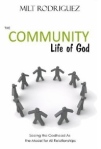

The Community Life of God (Book Review)

The God Who Is Relationship

A Book Review of “The Community Life of God: Seeing the Godhead As the Model for All Relationships” by Milt Rodriguez

“God is not an individual” says Milt Rodriguez.  “He is a fellowship of three Persons; the Father, the Son, and the Holy Spirit” (p.14).

In The Community Life of God, Milt Rodriguez weaves together the story of God’s desire to plant himself in His people.  God’s image is a “communal” image.  The Lord created man in His image of community.  And taking from the Tree of Life (i.e. Christ) is to take from the relational God.

It was in the Garden of Eden that the serpent sought to keep God’s image from becoming a reality in the hearts of men.  The enemy of God presented man with individual living out of his own soul-life (i.e. will, emotions, intellect).  Instead of man pursuing spiritual living after taking from the communal life of God, he experiences separation from God and other men.

Rodriguez proposes that much of Christian activity today is spent furthering the individualistic mindset that is so popular in our culture.  Even when believers come together corporately there is not an understanding of God’s image among us.  Church life ought to be more than socializing and individual Christian ministries.

Milt writes, “Personhood and identity can only be defined by relating to others. You will never truly “find yourself” until you are living in the community life of God” (p.62)

What is the sort of fellowship the Lord desires among his ekklesia?

“This fellowship is the place where there is nothing to hide. Complete truthfulness and complete honesty rule here.  The Father, Son, and Spirit do not hold back anything from one another… there is no fear of loss” (p. 116).

As Christian Smith has written, “Community means more than having lots of meetings. It means jointly building a way of life, a group memory, and a common anticipated future.” (Going to the Root: Nine Proposals for Radical Church Renewal, p.2)

In order for us to experience the community life of God, we must embrace the cross.  Rodriguez says there “will be one brother or sister who rubs you the wrong way.”  It is there we embrace the cross and learn “they are part of the same body as you. You belong to them and they belong to you” (p.152).

Finally, this community life of God cannot work in meeting once a week.  We all know this to be true, but still we place other things before God’s heart.  We sacrifice the church on the altar of family, jobs, and personal ministries.

Milt says, “He (God) wants you and me and every other believer to be actively involved on a daily basis. This is why we were born.  This is why we live on this planet” (p.170).

Brothers and sisters, if we are going to participate in God’s eternal purpose, we must be intentional about our relationships within the local ekklesia of Christ.  We must give and receive sacrificially in order that we might know the God who is within Himself, relationship.

There have been many books written on the church being rooted in the Triune image of God, but this one delivers in a simple and easy-to-read presentation.  I recommend this book to all of those who are longing to discover that the church is born out of the very heart of the relational God.

What others are saying?

“This little book provides a clear window into the ultimate source of authentic body life. Delve into its pages and meet the God who is beyond what most of us have imagined, the God in whose collective voice all genuine churches echo.” –Frank Viola, author of Pagan Christianity, From Eternity to Here, and Finding Organic Church, www.frankviola.com

“I was deeply blessed, refreshed and challenged by this book. The author casts the spotlight on the reality and wonder that “God” is really the community life of three persons – a fact virtually untouched in traditional theology. Milt shows from various angles how the community life of God is the foundation of our organic ekklesia life together in Christ.”–Jon Zens, Editor, Searching Together; author of A Church Building Every ½ Mile and “What’s With Paul & Women? www.searchingtogether.org

Milt Rodriguez

Milt Rodriguez has been living in and planting organic expressions of church since 1990. He has also authored several books including The Butterfly in You and The Temple Within.  He currently lives with his wife Mary in Gainesville, Flordia.  He is a dear brother in the Lord and I am happy to call him my friend.


New Year’s ReVolution

There is a great deal of talk about renewal, revival, transformation, and mission these days. I don’t see that any lasting change will come from focusing on any of these good things. Primarily, because I think there is something that is better.

I don’t see a return to “mission” and having a big pep rally for Jesus within pop-culture Christianity is the answer. Maybe the Lord doesn’t want a pep-rally. I tend to believe He is tired of all the things we DO in his name and would like us to sit down, be still, and listen.

And yes… even “organic church” can become a substitute for the Lord Himself.

I see all of this as more evidence that many people are still looking for fulfillment outside of knowing the Person of Christ in simple community. They do not see that every good thing comes out of this one thing: being built together as living stones into the centrality and supremacy of Christ.

The Lord moves forward and brings His Kingdom in this way.

This takes time and it calls for us to deny our insistent desire to “do something” for the Lord. It calls for us to wait. And that isn’t something many of us like to do. Especially in this day and age.

We finally come upon the Lord in a new way… and before we know what we really have… before we’ve allowed time for some learning of the Lord’s Person and work… we’re rushing out to convert everyone to a new way of church and trying to convince them to join the “movement.”

Movements can be good for a time, but movements eventually come to an end. Revolutions, on the other hand, permanently change the landscape of the world.

Revolutions are bigger than a few men spearheading a tour that celebrates a new way to do church. A “spiritual” revolution is led by the Spirit and moves in the Lord’s own way and time.  And this way seems foolish at first.

Spiritual revolutions are not due to the organizing of men or even to the publication of a few books. They largely move forward underground by a Power quietly working inside the hearts of unknown revolutionaries who are drawing the attention of heaven instead of men.

These revolutionaries recognize that the invitation is open to others, but it is not a revolution that uses coercion. When folks are touching Jesus… He will bring them in to His glorious work in His time.

Outreach is the Lord’s doing by us first doing our in-reach… touching the Lord’s Spirit with our own. When we are doing this… what follows will look much different than the organizing and “evangelizing” of man.

It’s not man’s revolution. It’s the Lord’s reign and rule upon the earth. The Lord’s revolution and His renewing of creation will come by patient endurance in the face of much opposition… letting the Lord have HIS way with folks.

A spiritual revolution doesn’t need the approval of the established institutions. It moves forward with the approval of the Lord and cares not for the observations of the religious.

I see the Lord leading a mighty revolution. But this revolution runs deeper than the surface hype and momentum of man’s organizing and endless scheming for Jesus.

The Lord’s revolutionaries are not distracted by the hype of movements. They are concerned for the Lord’s work in the world, but they see this as first living peaceably with their own community of saints. They know, in time, the Lord will reach out and build his Body in due season.

For those who see the need for spiritual revolution instead of religious reformation… my prayer in 2010 is that you will join the quite revolution and find satisfaction in being discipled by Jesus in a local expression of God’s Kingdom on the earth.

And leave the hype, the movements, and the mission to the Lord.


Radical Church Restoration

Radical Church Restoration–A Review of the Book Series Helping Others to Catch the Vision of Organic Church Life

Frank Viola says, “The church is a living organism.”

Many Christians would concur with Viola that the true nature of Christ’s church is born out of the soil of His finished work and moves forward in the power of the Holy Spirit.

However, as Viola has pointed out in his radical church restoration series, many believers have no problem speaking of the church as organism, but they are quite content to go on practicing the church as an organization.

untold2The series begins with The Untold Story of the New Testament Church: An Extraordinary Guide to Understanding the New Testament Church. Viola relies on some of the best New Testament scholarship to vividly retell the story of the first-century church in Acts. The New Testament comes alive in one sweeping narrative to give us a clear picture of the life and nature of those first Christian communities.

Pagan Christianity? Exploring the Roots of Our Church PracticesPagan Christianity? Exploring the Roots of Our Church Practices is the second book in the series, but the first to really capture the attention of Christians across the country. Frank Viola and George Barna team up to give their readers a critical examination of the last 1700 years of church history.

Does the institutional church have any biblical and historical right to exist? Viola asks, “Are the practices of the institutional church God-approved developments to the church that the New Testament envisions? Or are they an unhealthy departure from it?”

As I stated in my review of PC in January 08, this book “may very well be the most important book written on the Christian church in the last two millennia.” I still stand by this statement as it speaks a great challenge to the organized church. I believe we have yet to see the full impact of this book. In the coming days, I think you can expect to see it nailed to the door of an organized church near you.

reimaginingReimagining Church: Pursuing the Dream of Organic Christianity is the follow-up to the controversial PC. It is in this book that Viola offers a new vision, which is truthfully an old vision, of the church as organism.

RC is a proposal that the church of Jesus Christ mirror the very image of God: Father, Son, and Holy Spirit. If you agreed with PC and it left you clueless as to the alternative of the organized church, RC paints a new picture of a church that looks like the community of the Triune God and can truly be characterized as every-member functioning, familial, and organic.

from eternity picIt is in From Eternity to Here: Rediscovering the Ageless Purpose of God, the fourth book in the series, that Viola takes a step back to show us the bigger picture. It is in this book that he communicates the driving passion behind the work of planting organic churches.

Viola simplifies church life as an act of gathering around Jesus Christ. Yet, much of the Body of Christ has been forced into an institution and she has forgotten God’s eternal purpose. She has lost sight of the grand narrative and the great landscape of God’s love story. She has been preoccupied and polluted by an ecclesiology that leaves out the ageless purpose of God.

If you’re more right-brained and you just can’t seem to sit down to read a book on the church, then read From Eternity to Here and have your eyes opened to God’s eternal purpose. This book is bound to be a favorite among many readers.

Finding Organic Church: A Comprehensive Guide to Starting and Sustaining Authentic Christian Communities is the final book, and probably the most anticipated, in the radical church restoration series. It is in this book that Viola offers up a practical guide to understanding and implementing organic church life.

Viola writes this book for three different audiences. First, for those who desire to meet organically and would like some practical help. Second, it is written for all those already involved in alternatives to the traditional church (missional, emerging, house church movements, etc.). Third, it has been written for everyone interested in planting churches.

What is an organic church? Viola says…

“By organic church, I mean a church that is born out of spiritual life instead of being constructed by human institutions and held together by religious programs. Organic church life is a grassroots experience that is marked by face-to-face community, every-member functioning, open-participatory meetings (as opposed to pastor-to-pew services), nonhierarchical leadership, and the centrality and supremacy of Jesus Christ as the functional Leader and Head of the gathering” (p. 20).

There are four models of church planting in the New Testament. Viola begins by discussing these models and also addresses the spontaneous expressions of church life that spring up without the work of a church-planter. Viola thoroughly covers the New Testament pattern of church planting and church growth in the first half of the book.

There are four parts to this book. Throughout the first two parts of the book, Viola helps us to rediscover the purpose and function of the itinerant worker. He deals with questions concerning this largely discarded and often controversial role of the itinerant worker. He has even devoted a chapter to the book entitled “Wasn’t Paul the Last Apostle?”

He skillfully presents his case for the restoration of traveling church planters (i.e. apostles) and their task in empowering and equipping the church to function organically by the indwelling Christ. Can the New Testament model work today? Viola believes so. And he testifies to experiencing it personally over the last 20 years.

In the third part of the book, Viola discusses how to gather and gives practical steps for beginning to meet organically. Maybe you are presently meeting in an organized church but would like to begin meeting organically. It could be that you have left the institutional church and would like to begin meeting with others who are interested. And there are those who are already meeting in homes but are in need of some guidance. You will find this book a great help in moving forward.

How do you sing without a “leader” to direct you? What about teaching? What about giving? What about evangelism? What does it all look like in this new paradigm? And the most often asked question of all, “What about the children?” Viola addresses these concerns and so much more. He gives practical exercises and suggestions in getting started.

In the final part of the book, Viola discusses the seasons and stages of growth within organic church life. He also mentions the diseases and pitfalls of gathering around Christ. His descriptions of these periods no doubt come from his own personal experiences.

Finally, Viola gives a call out to his readers.

“I believe the need of the hour is for Christian who are called by God to raise up the church as a living, breathing experience. Christians who are broken and tested. Christians who refuse to take shortcuts but who have first lived in an organic expression of body life as brothers and sisters before they ever dare plant a church.”

He continues…

“The need of the hour is for such a people to wait on God until they are properly prepared and then sent. And once sent, to plant the church in the same way that all first-century workers did: by equipping it and then abandoning it to the Holy Spirit” (p. 306).

And to those pastors who wish to make the transition, Viola writes…

“As I have said elsewhere, transitioning from an institutional church to an organic church is not cosmetic surgery. It’s a complete overhaul” (p. 311).

For pastors, he closes with three steps to take in moving your church to functioning organically.  But you’re gonna have to get the book to see what those steps call for.

Are you satisfied with shoulder-to-shoulder religion or are you looking for face-to-face community?  It’s not for those that aren’t willing to endure the cross.  Are you ready to dive in to an exciting journey of experiencing the indwelling Christ in familial community?

Then take a bold step outside the walls of institutionalized religion and recline at the table with others who hunger for more of Jesus.

D.D. Flowers, 2009.