
 I’ve been doing some thinking about the difference(s) between dogma, doctrine, and opinion when it comes to the local church.
Simply put… it looks like this.
- Dogma — Irreducible beliefs of the Christian faith. What do we say about Jesus?
- Doctrine — Historical or traditional beliefs on a plethora of theological issues. What sets us apart?
- Opinion — Debatable issues that you’re free to agree or disagree upon. What do you think?
I agree with these three distinctions (leaving room for some overlap), but how do you determine what belief goes where in these categories? And is it possible for a local church (pastors & elders) to proclaim a certain view as “doctrine” but leave room for members to disagree? I think so.
One thing is for certain, this is a task for folks in community together and those who are willing to wrestle with it. That’s an invitation.
Two Ways of Dealing With It
Let me first address two common ways of dealing with these issues, and then I’ll share my working thoughts.
Group One — “Give me Jesus, not your divisive doctrine.”
Some of you know that I spent about five years meeting in homes and interacting with a network of “organic” churches. I had some great experiences. However, many of the folks I ran into sought to downplay the role of theology and creeds (statement of beliefs) for fear that it is divisive and characteristic of the beastly institutional church.
They have a point. Beliefs can be divisive. But I don’t think the answer is to avoid the need for a creed, or set Jesus against doctrine.
So, I’m saying that I know people that don’t seem to think that worrying about dogma, doctrine, and opinion really matters. In their “opinion” (catch that?), we should just wander about in nebulous fashion and refrain from any organization—church practice and theology included.
This group is imagining that there is not a systematic theology at work in the members of their group or church. It doesn’t need to be posted on a church website or posted on the wall of their meeting place, it’s alive in the hearts and minds of the saints there.
A fellowship may not discuss what they believe openly or form a statement of faith by consensus, but it’s at work among them. Avoiding the obvious need for a creed of theology, mission, and vision will lead to a certain death. That’s if the church even gets off the ground in the first place.
You can’t escape a “theology of the people” who have decided to band together for Kingdom purposes.
Trying to do so will lead to division of another sort. Once more proving that reactionary thinking and practice is not the answer.
I suppose this groups believes that if you stay away from labels and systems of thought that there will not be any division or controversy. They must think this reflects a purer stage of the NT church.
Back when there weren’t any problems, right?
I respect the desire to not be needlessly building walls of separation between saints. I’m all for that. But I can’t espouse the idea that having a statement of belief (creed) is damaging to the church.
In fact, I believe it is healthy and necessary.
Group Two — “Let’s get back to the basics… of the 4th century.”
Then there are other folks who are rightfully fed up with sectarianism in the church but believe that we must stand firm on some basic theological truths about Christ. They believe we should only stick to the ancient creeds in our attempts to articulate the essentials of our faith.
I grew up a Southern Baptist. The SBC has a very lengthy confession (Baptist Faith & Message) dealing with just about every issue under the sun (OK, I’m exaggerating a little bit). Needless to say, I didn’t grow up reciting the Apostles or Nicene Creed. I regret that.
My wife and I attended a Methodist church for a year and we deeply benefited from the recitation of these ancient creedal statements. The recitation of creeds in worship is a healthy way of reminding everyone in attendance of what brings them together and is forming their new identity as members of the universal church.
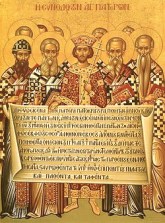
Hear me out. I like reciting the ancient creeds, but I do think it’s important to remember that the Apostles & Nicene Creeds (4th cent) were written against their own contextual issues of heresy and debated ideas of Christology in the church from ages ago.
Let’s remember the ancient creeds and recite them together in our churches. I’m cool with that. I think there is something deeply beneficial that comes with this practice. But I submit to you that a healthy church will continue to wrestle with dogma, doctrine, and opinion in every age and culture.
The local church can do this by amending the ancient creeds to better address our 21st century issues and challenges.
It’s necessary for a church that wishes to be a relevant organism seeking to make a Kingdom impact in every culture and context. Our evolving world demands it. We must not be afraid to speak to, for, and against issues of our time. We must move forward with courage.
Finding a Third Way
If you follow this blog regularly, you know that I have intentions to plant a church in the near future. I do this with fear and trembling. It’s not gonna be easy, but I’m convinced the Lord wants it.
The church today is fragmented in many ways. And I don’t wish to add to the problem by doing more of the same. But a new church plant is gonna require some line-drawing when it comes to dogma, doctrine, and opinion.
For example, some issues of “classical” theology, especially as it relates to our view of God in Christ, need to be revisited in order to reflect a change in the 21st cent church—a church that presently finds herself forced to accept views about God which contradict the revelation of God in Christ, or leave behind belief in a good God altogether.
The church that humbly professes the better view of God in Christ is being a faithful church, not a divisive or dogmatic church.
If we don’t speak up about these matters and courageously hold our ground against competing views that undermine the revelation of God in Christ… what good are we? What Gospel are we proclaiming?
There are other issues related to our culture and context that should be addressed in our creeds. We can’t afford to avoid these issues.
Some positions will need to be taken in response to culture, most others in response to misguided Christians propagating views about God and his sovereignty that don’t look like Jesus. It will require us hold positions that may not be popular, but are necessary to maintain the centrality and supremacy of Christ for authentic faith and practice.
Here’s what I’m saying… what may have been considered “opinion” or a non-essential in one generation can move into the realm of accepted doctrine worthy to be included in a church’s creed and statement of faith if it is needed in our response to bad theology and pagan culture.
The creeds of the local church should move forward in every cultural context, though never away from Christ who is eternal in the heavens.
The way forward affirms the importance of beliefs, expands on matters critical to our confession of Christ, and is willing to draw necessary lines in order to be faithful to the Kingdom.
This third way looks like Jesus Christ of Nazareth—Truth for the church and culture, saturated in love and grace for every age.
D.D. Flowers, 2013.
 Is God good? If so, then why is there evil and suffering in the world? Have you heard this before? If you’re like me, you’ve wrestled with it yourself.
 I’m sort of a nerd. I haven’t always been that way. I grew into it. I’m not ashamed of the fact.
 As an early teenager and a young Christian, following the Lord wasn’t easy. I found it so difficult that I eventually rebelled against my upbringing and sank deep into a world of sex, drugs, and rock-n-roll. It’s by God’s grace that I found healing and restoration.
 The Centrality and Supremacy of Jesus Christ