Category Archives: Religion & Spirituality

The Jewish Religious World of Jesus

The Jewish Religious World of Jesus—A Brief Overview

There is a great deal of misunderstanding that often derives from a reading of the New Testament when the modern reader does not consider the religious matrix of the first-century.

Ultimately, proper application to our own situation suffers tremendously.

In the last 20 years, biblical scholars have taken great strides in discovering the world of Second-Temple Judaism. This new wealth of information has made it possible for the church to better understand the religious world of Jesus. Placing Jesus within his own context, helps us to see him in our own.

Scholars are learning that the Jewish Religious landscape was much more multi-faceted than previously imagined.

N.T. Wright has written, “the one thing we can safely say about first-century Judaism is that there is no such thing as first-century Judaism, and that it may be best to speak of ‘Judaisms,’ plural” (Wright, 244).

In the previous two centuries before Jesus, political and religious strife created a tumultuous climate, especially in the region of Palestine.

The successful Maccabean Revolt, and then the people’s utter disgust with the failure of the Hasmonean Dynasty, had largely brought about an apocalyptic worldview, deep longings for a Jewish Messiah to establish the kingdom of God on the earth, and a hope in the imminent restoration of Israel according to God’s covenantal faithfulness.

There were several religious parties and sects that grew up during this period, and they were in full bloom during the ministry of Jesus.

This article will briefly examine what is currently known about those Jewish Religious groups that existed in the time of Jesus, and beckon the reader to consider what Jesus’ relationship was to them.

Pharisees

The Pharisees emerge as the most popular of all religious groups in the first-century. The etymology of the name Pharisee is uncertain, but some scholars believe the name is derived from the Hebrew word parush, which means “separation” or “consecration.”

This religious sect has commonly been labeled as strict legalists who were bent on oppressing people with burdensome rules for their own self-righteous pleasure. But that may not be an entirely accurate portrayal.

Jesus did indeed speak harsh words to these religious leaders, calling them hypocrites and “white washed tombs” (Matt. 23). His words of rebuke were certainly the strongest with the Pharisees.

However, it appears that Jesus may have had more in common with the Pharisees than any other religious group in the first-century.

So, who were these teachers of the law? Who were the “scribes” and Pharisees? And why was Jesus so bothered by this religious group?

The Pharisees were deeply concerned about Torah and they actively sought ways to find fresh interpretions and apply the Scripture to a world on the move. The “scribes” were those specifically trained in interpreting Torah. Although the scribes did not belong to any one specific party, it seems that they resonated with the Pharisees.

The Pharisees believed in the resurrection of the dead and eternal life and punishment. They also were accepting of other more recent theological developments regarding angels and demons. The Pharisees were not only concerned about proper biblical interpretation, but also with proving their covenant faithfulness in ritual purity.

For the most part, the people trusted the guidance of the Pharisees as they influenced the life of the nation at the local level and showed great devotion to God. The Pharisees believed that Torah was for all people, and they made a concerted effort to keep the Law of Moses fresh and alive.

“Woe to you, blind guides!”

Why then does Jesus rebuke the Pharisees throughout the Gospels? It is because the Pharisees believed that rabbinical oral-interpretive traditions (i.e. “traditions of the elders”) were just as authoritative as the Torah itself.

Also, the Pharisaical purity practices led them to erect social distinctions between themselves and fellow Jews. It became rather difficult for Pharisees to maneuver in life after adhering to extra human-laws and traditions.

Jesus simply would not allow the accumulation of the petty Pharisaical traditions deter him from the divine law. Jesus was deeply troubled by the “yeast” of the Pharisees (Matt. 16:12).

It was a disregard for the Pharisaical traditions that placed Jesus at odds with this popular sect. The Pharisees were unwilling to depart from those interpretive traditions that they felt were the greatest display of God’s covenant faithfulness. For this, they sought to trap and kill him.

Had the Pharisees not been so fond of their own teachings, and had instead been open to the teachings of the Galilean rabbi, they may have possibly recognized Jesus of Nazareth as the Messiah promised in the Scriptures.

Sadducees

The Sadducees are remembered as the smaller aristocratic party that “combined conservative religious attitudes with power politics” (Ferguson, 519). Unlike the Pharisees, the Sadducees adhered to stricter interpretations, claiming only Torah as authoritative—even rejecting the Prophets and the Writings. They were the Religious Right of Jesus’ day.

What scholars learn about the Sadducees comes mainly from their opponents. The Sadducees are mostly remembered for their denial of the resurrection from the dead (Matt. 22:23). They had no use for the theological developments of the intertestamental period.

Their primary role as a priestly party was controlling the temple ritual. The Sadducees appear to be mostly interested in maintaining the status quo. Where most Jews detested the Roman imperial occupation of Palestine, the Sadducees enjoyed the peace, power, and influence that Rome was able to give them. They preferred the Pax Romana over the peace of Jesus.

They were only interested in serving God in so far as it didn’t require them to give up their secure position of prosperity or progress in their theology. It is worth noting that there is evidence of several Pharisees who followed Jesus, but there is not a single record of a Sadducee convert.

The Sadducees drop off the religious radar soon after the destruction of the temple in AD 70. These conservatives fade with the shifting of their world.

Essenes

The monastic sect that lived at Qumran, which is located on the northwest shore of the Dead Sea, were called the “Essenes.” The Essenes, according to Philo and Josephus, numbered over 4,000 men. This religious group believed they were the rightful heirs of God’s promises.

The Essenes communicated this belief by withdrawing from temple life in Jerusalem, believing the entire religious system was corrupt. They practiced extreme frugality, celibacy, and ritual purity.

Ritual purity was central to the Essene way of life as they began their day with a purification bath before dressing in standard white outer garments.

There were ritual morning prayers, communal meals, and daily agrarian duties. They may have also worked as shepherds, beekeepers, and craftsmen.

The Essenes held an apocalyptic worldview. They believed they were living in the last days and that the prophets pointed to their times. This can be seen throughout Qumran literature. The Essenes were anticipating a conquering Messiah and they believed that they were saving themselves as the faithful keepers of the covenant. All others were just religious pretenders.

They intensely studied and copied the Scriptures. Since the discovery of the Dead Sea Scrolls, scholars have learned that the Essene community believed they were “sons of light” and the last remnant of God’s covenant.

Some scholars have suggested that John the Baptist may have emerged from the Qumran community.

Zealots, Sicarii, and Herodians

The Zealots are known as the extreme anti-Roman party with violent tendencies. Scholars point out that it is likely that these revolutionaries only differed from the Pharisees in their willingness to use violent force and sacrifice themselves for the sake of Jewish liberty.

The Zealots held a biblical hermeneutic that encouraged violent revolt against the enemies of God. Josephus has written, they were Jews expressing their conviction: “No lord, but God” (Jospehus, Ant. 18.1.6). Simon the Zealot was one of the Twelve disciples of Jesus (Matt. 10:4).

Another branch of the Zealots were the Sicarii, or “dagger men” (Acts 21:38). These terrorists would mingle among the crowds of people, especially during Jewish festivals, and strike down prominent Roman officials, only to quickly disappear back into the crowd undetected.

These were the men that held Herod’s wilderness compound, Masada, during the Jewish revolt which first began in AD 66. It was in this military fortress that hundreds of Sicarii, along with their families, would take their own lives in order to avoid capture by the Romans in AD 73. The Romans were impressed by the honor and bravery of these freedom fighters.

The Herodians were another political and religious group that carried great influence among the people of Palestine. They are mentioned only three times in the New Testament. As their name suggests, the Herodians were clearly partisan to the Herodian dynasty, but they are still seen joining with the Pharisees in their opposition to Jesus (Mk. 3:6).

This is significant, since the Herodians were politically affiliated with Herod’s house, but religiously and economically in agreement with the Sadducees. The testimony of Matthew and Mark reveal that the Herodians were willing to work alongside their rivals to oppose Jesus of Nazareth.

Samaritans

Samaria was the hill country located between Galilee to the north and Judea to the south. Jesus told a parable of a Good Samaritan who helped a man that was beaten and left for dead on the side of the road (Lk. 10:25-37). Several pious travelers walk right on by the helpless man, but it is the Samaritan that reflects the kingdom of God.

This story cuts to the heart of Jewish prejudices towards this religious and ethnic group. For the religious Jews living in the first-century, it is impossible to miss Jesus’ provocative challenge to reconsider popular opinion about a religious neighbor and fellow keeper of the covenant.

So who were the Samaritans? Why were they disliked among many Jews?

The Samaritans were considered an unclean and illegitimate “half-breed race” that was neither Jew nor Gentile. This was due to their practice of intermarrying with pagans, being descendants of the northern tribes that split from Judah after the time of Solomon, and their establishment of a rival temple on Mt. Gerizim.

The woman at the well discusses this point of contention with Jesus in John 4:1-42. Jesus proposes that the religious feud of temple worship is no longer relevant because the Messiah has come to set the world to rights.

Jesus indicates that God has something else in mind which goes beyond what was being anticipated and practiced by all religious Jews.

What Religious Brand Was Jesus?

It is worthy of careful consideration that Jesus did not entirely agree with any Jewish Religious group of his own day. Jesus rebuked representatives and ideologies from each group in an effort to reform their ideas of covenant faithfulness, ritual purity, and Messianic expectations.

For some of these religious folk, he did affirm that certain points of their theology were correct, still they needed to be refined through his own divine interpretation of Scripture (Jn. 5:39). Jesus claimed to be the only one able to interpret and teach without any blind spots or lapse in judgment.

Jesus refused to affiliate himself with any of the Jewish denominations of his day. He would not allow himself to be pigeonholed, and he was angered by the efforts other Jews made to place God in a box, constrained by their own theological and philosophical paradigms.

No, Jesus kept a healthy distance from these religious groups and he refused to weigh in on the hot political and religious debates of the day.

Jesus turned the tables on his opponents. He shocked his audience by challenging their view of the Father’s love, teaching the inclusion of all those that welcomed him as Messiah, and proclaiming himself savior of the world.

Instead of joining these religious groups, Jesus gave a clear and resounding call, “Come, follow me” (Mk. 1:17). And the invitation still stands today.

Suggested Reading

  • DeSilva, David. An Introduction to the New Testament: Contexts, Methods & Ministry Formation. Downer’s Grove: InterVarsity Press, 2004.
  • Evans, Craig, and Stanley Porter. Dictionary of New Testament Background. Downer’s Grove: InterVarsity Press, 2000.
  • Ferguson, Everett. Backgrounds of Early Christianity, 3rd ed. Grand Rapids: Wm. B. Eerdmans, 2003.
  • VanderKam, James. An Introduction to Early Judaism. Grand Rapids: Wm. B. Eerdmans, 2001.
  • Wright, N.T. The New Testament and the People of God, Vol. 1: Christian Origins and the Question of God. Minneapolis: Fortress Press, 1992.

The Woman & the Dragon

The Woman & the Dragon—Christmas in the Book of Revelation

In Luke 2:1-21, we read about the baby Jesus being born in a lowly manger in Bethlehem. The angel announces to nearby shepherds, “Do not be afraid, for behold, I bring you good tidings of great joy which will be to all people. For there is born to you this day in the city of David a Savior, who is Christ the Lord.” And the angels sang, “Glory to God in the highest, and on earth peace, goodwill toward men!”

I believe it is often forgotten how scandalous this announcement was to the powers. In fact, if the message is understood against the other rival political gospels of Jesus’ day, and those worldly kingdoms that still parody the kingdom of God today, we shall hear a clear declaration of war.

That’s how Herod understood this event.

After Jesus was born in Bethlehem in Judea, during the time of King Herod, Magi from the east came to Jerusalem and asked, “Where is the one who has been born king of the Jews? We saw his star when it rose and have come to worship him.” When King Herod heard this he was disturbed, and all Jerusalem with him.  Matthew 2:1-3

Once again, angels are at work in the advent of Messiah Jesus.

When they had gone, an angel of the Lord appeared to Joseph in a dream. “Get up,” he said, “take the child and his mother and escape to Egypt. Stay there until I tell you, for Herod is going to search for the child to kill him.” So he got up, took the child and his mother during the night and left for Egypt, where he stayed until the death of Herod.  Matthew 2:13-14

Herod, the wicked King of the Jews, is determined to stop any competitor that threatens his rule on the earth—even to the extent of killing all the little boys of Bethlehem.

When Herod realized that he had been outwitted by the Magi, he was furious, and he gave orders to kill all the boys in Bethlehem and its vicinity who were two years old and under, in accordance with the time he had learned from the Magi.  Matthew 2:16

Can the evil on this day be attributed merely to human kings and their minions?  The book of Revelation suggests that there are evil forces at work behind human agents.

The Dragon that Almost Stole Christmas

In the book of Revelation, the apostle John retells the Christmas story in apocalyptic fashion.

A great sign appeared in heaven: a woman clothed with the sun, with the moon under her feet and a crown of twelve stars on her head. She was pregnant and cried out in pain as she was about to give birth. Then another sign appeared in heaven: an enormous red dragon with seven heads and ten horns and seven crowns on its heads. Its tail swept a third of the stars out of the sky and flung them to the earth. The dragon stood in front of the woman who was about to give birth, so that it might devour her child the moment he was born. She gave birth to a son, a male child, who “will rule all the nations with an iron scepter.” And her child was snatched up to God and to his throne. The woman fled into the wilderness to a place prepared for her by God, where she might be taken care of for 1,260 days.  Revelation 12:1-6

John indicates that the dragon is Satan. The “third of the stars” swept out of the sky are fallen angels who have chosen to rebel against the Lord along with the devil. John is telling us that the dragon and the stars have gone out to destroy the child born to the woman.

When the dragon saw that he had been hurled to the earth, he pursued the woman who had given birth to the male child. The woman was given the two wings of a great eagle, so that she might fly to the place prepared for her in the wilderness, where she would be taken care of for a time, times and half a time, out of the serpent’s reach.  Revelation 12:13-14

From John’s perspective, King Herod is not the real threat. There was a sinister evil at work behind the scenes of human experience. Through Herod, the devil sought to snuff out the incarnation and bring an end to God’s salvific plan for the world. This means war!

Then war broke out in heaven. Michael and his angels fought against the dragon, and the dragon and his angels fought back. But he was not strong enough, and they lost their place in heaven. The great dragon was hurled down—that ancient serpent called the devil, or Satan, who leads the whole world astray. He was hurled to the earth, and his angels with him.  Revelation 12:7-9

John sees the escape from Herod due to spiritual warfare. God overcomes the cosmic forces of evil in a real battle between heaven and earth.

For John this isn’t just some bizarre way of retelling the story—it’s what really happened. And the outcome of this war was beginning to be made certain in the incarnation of God on the earth.

“Now have come the salvation and the power and the kingdom of our God, and the authority of his Messiah. For the accuser of our brothers and sisters, who accuses them before our God day and night, has been hurled down” (v.10).

The war continues…

“Then the dragon was enraged at the woman and went off to wage war against the rest of her offspring—those who keep God’s commands and hold fast their testimony about Jesus” (v.17).

John jumps ahead to the future triumph of Christ over the forces of evil. How do the saints overcome the dragon? John says, “They triumphed over him by the blood of the Lamb and by the word of their testimony; they did not love their lives so much as to shrink from death” (v.11).

That is what the triumph looks like on earth. John has not turned a blind eye to the evil that continues to threaten God’s kingdom—the war being fought is a real one. And Christ has determined that the battle belongs to the Lord.

The birth of Christ marks the beginning of the end for evil.

It is because of this that we may rejoice. For unto us a child has been born!

“Therefore rejoice, you heavens and you who dwell in them! But woe to the earth and the sea, because the devil has gone down to you! 
He is filled with fury, because he knows that his time is short” (v.12).

Conclusion—O Come, O Come, Emmanuel

Finally, John testifies of the judgment to come for the dragon that almost devoured the child, and that still wages war against the offspring of the woman–the faithful in Christ.

“And the devil, who had deceived them, was thrown into the lake of burning sulfur” (Rev. 20:10).

The birth of Christ gives us reason to celebrate God’s victory over that ole serpent, the devil. I pray that this Christmas you will have a renewed sense of that salvation that has been given to us. In Christ, we have overcome.

Emmanuel has come into the world to declare an end to evil.

Dear saints, the tides have turned. Evil is being cast out as we prepare for the second advent of our Lord—when heaven comes to earth (Rev. 21).

John’s remembering of the Christmas story beckons us to rejoice in the present for the future triumph over Satan and the powers of darkness.

God rest ye merry, gentlemen

Let nothing you dismay

Remember, Christ, our Savior

Was born on Christmas day

To save us all from Satan’s power

When we were gone astray

O tidings of comfort and joy,

Comfort and joy

O tidings of comfort and joy

D.D. Flowers, 2010.


An Open Theism Theodicy

Gregory Boyd on the Problem of Evil

Where is God when a seven-year-old child is kidnapped, viciously raped, and her decapitated body is left in a plastic bag beside a cold riverbed?[1] Gregory Boyd believes that evil “cannot be captured in abstract definitions”[2] but must be known in concrete experiences, like that of seven-year-old Greta, before any serious answers may be given to the problem of evil—lest “abstractions… distract us from that immediate reality [of evil] and reduce evil to a statistic,” as suggested by Jeffery Burton Russell.[3]

Traditionally, classical theism has largely conditioned her adherents to accept that God, who is omnipotent, must allow Greta’s brutal murder for some good purpose and that Christians should accept this as being a part of God’s secret plan—often expressed in the popular cliché: “There is a reason for everything.”

Gregory Boyd, who previously taught theology at Bethel College in St. Paul Minnesota, where he is now a pastor of Woodland Hills Church, has in the last decade, encroached upon many long-held doctrines and traditions that Christians, particularly in America, hold dear.

His book, Myth of a Christian Nation: How the Quest for Political Power is Destroying the Church (Zondervan 2006) is an example of his willingness to confront issues within cultural Christianity.

Boyd is a strong proponent of “open theism,” perhaps the most controversial of his challenges directed at classical theism. It is within Boyd’s open view of God’s sovereignty that he finds satisfactory solutions for the problem of evil and the way by which he constructs his “Trinitarian Warfare Theodicy.”[4]

The purpose of this article is to give reasonable consideration of the theodicy espoused by Gregory Boyd. The theodicy of Gregory Boyd will be appraised as a sensitive engagement of the issues pertaining to the problem of evil as it relates to the Christian life, showing the strengths of contemporary open theism, and thereby arguing for a respected position within evangelicalism.

This article will begin by briefly examining classical theism and will then direct full attention to the open theism of Gregory Boyd. How then does Boyd’s doctrine of God deal with the problem of evil and suffering in the world? What practical implications might his view have on Christians living in the present, as well as their hope for the future?

Finally, in what ways do Boyd’s theodicy enhance our understanding of God and the Gospel of Jesus Christ?[5]

THE CLASSICAL DOCTRINE OF GOD

A Synopsis of Classical Theism

What does “classical theism” mean? Classical theism generally describes the way the Christian theological tradition handles the doctrine of God.[6] In other words, it describes the traditional or “classic” way in which Christians have answered the question, “Who is God?” or “What is God like?” Classical theists focus on certain attributes of God and build a systematic theology from what they have decided about God’s attributes.

For the sake of this article, it is only necessary that a few of those attributes be briefly addressed.[7]

According to classical theism, God is “immutable” and “impassible.” Immutability says that God is unchanging in nature. However, the tradition has gone as far as God being inert and unmoved. Impassibility, an attribute often closely associated with the former, suggests that God does not experience true sorrow, sadness, or pain. Therefore, any emotions attributed to God are purely metaphorical.

Classical theism also upholds the belief that God is “omnipotent” and “omniscient.” These attributes have been historically central to the Christian doctrine of God. Omnipotence says that God is “all powerful” and capable, within the limits of his attributes, of doing whatever he pleases. Omniscience means that God is “all knowing” and that there is nothing beyond his knowledge; this would include God’s foreknowing all things in the future.

It should be noted that these attributes have been largely expounded upon and articulated in Hellenic philosophical terminology, and more popularly defined by the likes of Augustine, Aquinas, and John Calvin.[8]

Rethinking Classical Theism

There are a growing number of evangelical theologians who are finding themselves dissatisfied with classical theism, and they propose an alternative to the traditional doctrine of God.[9] This controversial movement, and contemporary trend in the doctrine of God, has been dubbed “open theism”—a term coined by Richard Rice in his 1980 book, The Openness of God: The Relationship of Divine Foreknowledge and Human Free Will.[10]

Open theism calls into question the way in which the divine attributes have been traditionally defined. Language about God in the Scripture, according to open theists, is not always intended to be anthropological or metaphorical. If God is “immutable” and never changes, then how, for example, is God sorry that he made humankind (Gen. 6:5)? How does God change his mind (Exod. 32:14)? And what about the incarnation (Jn. 1:14)?

Clark Pinnock, a major proponent of open theism, says, “God is unchanging in nature and essence but not in experience, knowledge and action.”[11] Open theists also call for a redefining of God’s sovereignty and his foreknowledge; if God already knows the future exhaustively, and the future is predetermined, then free will is merely an illusion.

Finally, open theists say that if God is in complete control of the cosmos, as proposed by classical theism, then he must be behind evil. Therefore, God could have done something about seven-year old Greta, but simply chose to “allow” it for his good purposes.

Open theists suggest that maybe it is time for evangelicals to rethink classical theism and realign their views with Scripture.

THE OPEN THEISM OF GREGORY BOYD

Free Will, Foreknowledge, & the Problem of Evil

Gregory Boyd believes that true freedom is incompatible with determinism.[12] The belief that God can foreknow all things, and that man can at the same time operate out of free will, is logically incoherent. This is a major point of contention for open theists. For Boyd, the future is partly open and full of possibilities. Only the past can be known exhaustively—for the past is gone, the present is ongoing, and the future is yet to come.

If the relational Triune God is love, then the very nature of love involves a certain level of risk.[13] Classical theists believe that this undermines God’s sovereignty.[14] Boyd argues, a God “who knows all possibilities, experiences novelty, and is willing to engage in an appropriate level of risk is more exalted than a God who faces an eternally settled future.”[15] And Boyd believes that this is the God presented in the Bible.

According to Boyd, God knows the future as “unsettled possibilities” (e.g. Gen. 23:12; Jer. 3:6-7; 2 Pet. 3:12) and “settled certainties” (e.g. Gen. 15:13-15; Matt. 24:1-32; Eph. 1:3-10) where God invites human beings, made in his image, to join him as agents of new creation.[16] God perfectly anticipates the actions of free creatures and knows all that is knowable about the future. Boyd says, it’s really about the nature of the future.

In this way God is truly immanent and operates within his creation according to its laws and nature. Since God’s knowledge is perfect in knowing possibilities, as if they were all certainties, he will forever be a step ahead of his creatures. However, those creatures are always given an “appropriate degree of freedom” to operate within creation and shape the future.[17]

Boyd believes the cross best speaks to the open view of the future, God’s sovereignty, and how God has judged evil once and for all in the death of Jesus:

The cross refutes the traditional notion that omnipotence means God always gets his way. Rather, the cross reveals God’s omnipotence as a power that empowers others—to the point of giving others the ability, if they so choose, to nail him to the cross. The cross reveals that God’s omnipotence is displayed in self-sacrificial love, not sheer might. God conquers sin and the devil not by a sovereign decree but by a wise and humble submission to crucifixion. In doing this, the cross reveals that God’s omnipotence is not primarily about control but about his compelling love. God conquers evil and wins the heart of people by self-sacrificial love, not by coercive force.[18]

Jesus taught his disciples to pray, “your kingdom come, your will be done, on earth as it is in heaven” (Matt. 6:10 NIV). According to Boyd, this presupposes that God’s will is not always done. Therefore, in Boyd’s view, genuine free will affords mankind the choice to align with God’s good intentions for creation and say, “not my will be done, but thine” or otherwise join the forces of evil that fight against God.

Boyd is convinced that there is a real war being waged between human and angelic agents of free will. He rejects what he calls the “blueprint worldview” where God ordains everything that comes to pass—which in the end makes God responsible for evil.[19]

Therefore, he says, “The blueprint worldview intensifies the problem of evil, and it is rooted in fundamental philosophical assumptions that are highly questionable.”[20] Instead, Boyd offers the “warfare worldview” as a way of making sense of the problem of evil within the doctrine of God. He calls it his “Trinitarian Warfare Theodicy.”

A Trinitarian Warfare Theodicy

Gregory Boyd says, “This intellectual problem of evil constitutes the single most difficult challenge to classical-philosophical Christian theism.” He continues, “Indeed, it is not overstating the case to claim that no single theological problem has occupied more intellectual energy, time, and ink than this one.”[21]

As Clark Pinnock has pointed out, modern atheism is largely due to philosophical distortions that have entered into the doctrine of God.[22] Boyd is determined to clear up these distortions with his “philosophical theology” set forth in his book, Satan and the Problem of Evil: Constructing a Trinitarian Warfare Theodicy.[23] Boyd says:

I call it a trinitarian warfare theodicy for two reasons. First, I want clearly to distinguish the warfare worldview I espouse and defend from the warfare worldview that most other cultures in history have in some form espoused. The biblical warfare worldview is unique in that it has at its foundation the belief in a triune Creator God who is all-powerful and all-good. This is why the trinitarian warfare worldview is unique: it must reconcile the reality of spiritual war with the belief in an all-powerful and all-good God.[24]

Boyd says he is motivated by his encounter with Scripture, not philosophy.[25] However, because his theodicy is a work in philosophical theology, Boyd says that reason will play a more dominant role than it would in a biblical theology. He states, “Scriptural revelation goes beyond reason, but I do not believe it ever goes against reason.”[26]

Boyd explains his methodology:

The method I employ to arrive at the six theses that constitute the core of the trinitarian warfare worldview is based on Wesley’s methodological quadrangle of Scripture, reason, experience, and tradition as the criteria for theological truth.[27]

These six theses form the core of his position and perspective:

  1. Love must be freely chosen. This entails that creatures possessing the capacity to love, must also have self-determining freedom.
  2. Love involves risk. There is no way God could have created beings with self-determining freedom without suffering some losses.
  3. Love and freedom mean that creatures are to some degree “morally responsible for one another.”
  4. The ability an agent has to do good is roughly proportionate to the ability that creature has to do evil.
  5. Freedom must be, within limits, irrevocable. For Boyd, this explains why God cannot always prevent evil or interfere in human affairs.
  6. The capacity to choose love is not endless. Human beings are finite and their choices only extend so far. This means that self-determined creatures have a limited capacity to accept or reject God’s purposes.[28]

Boyd says that the final theses, “renders intelligible why God must genuinely war against rebellious creatures at the present time, though he is certain to overcome them in the future.”[29] In fact, Boyd believes that the entire narrative of Scripture is the telling of one great spiritual war.

In his book, God At War: The Bible and Spiritual Conflict, Boyd first laid out the framework for his warfare worldview.[30] He examined both the Old and New Testaments in order to prove that behind the scenes of human history there has been an ongoing battle of cosmic forces. Satan and his angels began a war against the God of heaven some time in the primordial past and brought their rebellion to earth.[31]

What began in the Garden of Eden (Gen. 3:1-15), continued through the trials of Job (1:6-12), warred against the prayers of Daniel (10:1-21), and demonized the man along the Sea of Galilee (Mk. 5:1-20), was finally confronted by Jesus with spiritual and physical “acts of war.”
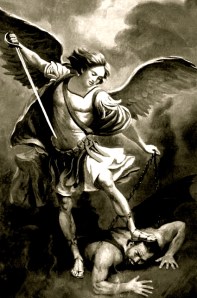
According to Boyd, even “natural evils” (e.g. earthquakes, floods, birth defects, mental illness etc.) are a result of these evil powers and they should be attributed to Satan, “the god of this world” (2 Cor. 4:4; Eph. 2:2) and his fallen angels that have turned against God.[32]

Boyd believes that every evil act or event is a result of free agents choosing to oppose God’s will. Whether that is humans or angels, all evil comes to us because of acts of defiance against God.[33]

Boyd says, “Evil is a mystery, but it is not a mystery concerning Yahweh’s character… the mystery of evil is not located in the heart of God but in the heart of humanity and in the hidden world between humans and God.”[34] God is not to blame for evil in his world.

Boyd contends that the early Christians were well aware of this spiritual war and it constituted “the only ‘problem of evil’ they knew or cared about.” It was a matter of aligning their lives with God’s will in Jesus. Boyd says, “It was a problem solved by spiritual activism, not by intellectual contemplation and pious resignation.”[35] The early believers were urged to join the angelic forces of God, in spiritual battle, with spiritual armor, through prayer (Eph. 6:10-18).

As Paul said, “For our struggle is not against flesh and blood, but against the rulers, against the authorities, against the powers of this dark world and against the spiritual forces of evil in the heavenly realms” (Eph. 6:12 NIV).

There was no need for the early Christians to ponder “why bad things happen to good people,” because they were ever mindful of the war that rages on until Christ comes to establish his kingdom forever on the earth (Rev. 20-21). They were at war with evil—fighting with weapons not of this world (2 Cor. 10:4)! They resonated with the words of Paul: “The God of peace will soon crush Satan under your feet” (Rom. 16:20).

Practical Implications

So what then can be said about seven-year old Greta who was abducted and raped before being brutally murdered? Where was God in this wretched evil?

In this light we must conclude that it is at least as true to say that God could not prevent Greta’s abduction as it is to say that God chose not to prevent it.  God chose not to prevent this abduction in the sense that he alone chose to create the kind of risky world where this kind of evil could happen. Moreover, because God made this choice, he now could not guarantee that this evil would be prevented. Where free agents are involved, God’s omnipotent will can at times be thwarted (Lk. 7:30).[36]

Gregory Boyd’s “Trinitarian Warfare Theodicy” does more than somehow let God off the hook for evil. His theodicy implies that both humans and angels are in a real war with God. Therefore, human and angelic actions really do matter in this world. Free agents can choose to join the Lord in works of the kingdom to resist evil and “speed his coming” (2 Peter 3:8-13) in the world, or capitulate to evil through actions that are antithetical to the new heaven and earth.

Boyd says, “If we believe that possibilities are not real, we will be more inclined to accept things that we could, and should, revolt against.”[37] Boyd calls for a proactive stance toward evil.

How then should Christians revolt? Boyd suggests that followers of Christ ought to understand prayer as “morally responsible behavior” in confronting evil in the world.[38] He believes that many Christians do not pray passionately against evil because somewhere deep down they don’t believe it can make any real difference.

People often pray out of obligation without any sense of urgency.[39] Boyd is convinced that if Christians get their minds right about what’s really going on, they will then see God opposed to all evil and join him in that opposition.

Embracing this “open” warfare worldview may not entirely solve the problem of evil, but Boyd believes that “it offers a more plausible way out of the dilemma of assuming God has a purpose for allowing particular evils.”[40] It is then necessary to reject the blueprint worldview.

Jesus taught his followers to align themselves with the Father’s will in prayer in order that he might have his way in them and the world (Matt. 6:10). Prayer joins heaven and earth. It moves people, angels, and all of creation to action against evil in order that God’s forces advance in the universe.

So when evil momentarily gets the upper hand, Boyd reminds Christians that God’s power is so great that he can use evil for the good of those who are concerned with kingdom alignment (Rom. 8:28). God weeps for Greta and others like her that have suffered at the hands of Satan. God is not sitting idly by doing nothing—and neither should his people.

It is plain that Boyd’s theodicy is a serious treatment of spiritual warfare. It implies that Christian living really does matter for kingdom’s sake. Boyd’s theodicy also reminds believers that God is for his people, always. He comes alongside his people and suffers with them (Heb. 4:15-16).

The cross of Christ reminds God’s people that he has himself experienced the full weight of evil. The resurrection says that God has conquered and that he is recreating the world in Jesus. Sin and death are on the way out. Boyd’s warfare worldview assures believers of God’s certain triumph, but in the meantime, there is a real battle being fought in heaven and earth.

Most importantly, Christians are reminded that Jesus reveals the God of Scripture. Jesus shows us that God is not behind evil, but instead, he stands utterly opposed to it. Boyd suggests that this also means that believers should see Jesus’ own actions as God’s way of rebuking evil.[41]

Where there is hate, let there be love. Where there is darkness, let there be light. Where there is unrest, let there be peace. And where there exists the most horrendous evils in the world, let God’s people overcome that evil with the good of Christ—for he has given us the victory.

CONCLUSION—A PLEA FOR OPEN DIALOGUE WITHIN EVANGELICALISM

Clark Pinnock has said, “No doctrine can be more important than the doctrine of God.”[42] Pinnock stands as a great testimony to evangelicals of what semper reformanda truly means. As an evangelical, he knew what it was like to be on a theological journey of discovery.

Pinnock (1937-2010) went from being a fundamentalist to ending his days as a respected open theist. He was familiar with the turmoil that comes from having his views challenged and making adjustments when needed.

Pinnock said:

After the initial anxiety of rethinking, one will find God again in a fresh way around the next bend in the reflective road. Rather than worry about our discomfort, perhaps we should be concerned about God’s reputation. Does it not concern us that God’s name is often dishonored because of poor theologies of God? How can we expect Christians to delight in God or outsiders to seek God if we portray God in biblically flawed, rationally suspect and existentially repugnant ways? We cannot expect it.[43]

As long as men let their guiding light be Christ and the Scriptures, how can another brother or sister stifle the growth and discovery of perceived truths? It goes to the heart of what it means to be an evangelical. There is room for open theists at the table of Christian orthodoxy.[44]

The challenge facing classical theism is not one that undermines biblical Christianity. Open theism is no doubt a perceived threat to classical theists, but this is because there are fundamental philosophical nuances between the two positions.[45]

After having examined the theodicy of Gregory Boyd, it should be clear that the conclusions he has drawn are biblically founded and Christ honoring. Who can deny open theists a place in serious evangelical discussion and debate?

May evangelicalism be enriched by the contributions of open theists.

D.D. Flowers, 2010.

Listen to Gregory Boyd give an intro lecture on open theism.


[1] Gregory A. Boyd, Satan and the Problem of Evil: Constructing a Trinitarian Warfare Theodicy (Downers Grove: InterVarsity Press, 2001), 214-215.

[2] Boyd, God at War: The Bible and Spiritual Conflict (Downers Grove: InterVarsity Press, 1997), 34.

[3] Jeffrey Burton Russell, The Prince of Darkness (Ithaca, NY: Cornell University Press, 1988), 257.

[4] Boyd sets forth his “Trinitarian Warfare Theodicy” in his book, Satan and the Problem of Evil. His open theism theodicy will be discussed in detail later in the third section of this article, The Open Theism of Gregory Boyd.

[5] As an open theist, Gregory Boyd is especially concerned with evil and what God is doing about it. Therefore, this article will focus primarily on his “open” perspective to the problem of evil. He has made a great effort to address his concerns with classical theism and present his theodicy as the “warfare worldview” in the following books: God at War: The Bible and Spiritual Conflict (Downers Grove: InterVarsity Press, 1997); Satan and the Problem of Evil: Constructing a Trinitarian Warfare Theodicy (Downers Grove: InterVarsity Press, 2001); Is God to Blame? Beyond Pat Answers to the Problem of Suffering (Downers Grove: InterVarsity Press, 2003).

[6] Veli-Matti Kärkkäinen, The Doctrine of God: A Global Introduction (Grand Rapids: Baker Academic, 2004), 53.

[7] For a full discussion, see Stanley Grenz, Theology for the Community of God (Grand Rapids: Eerdmans, 1994), 78-97; and Wayne Grudem, Systematic Theology (Grand Rapids: Zondervan, 1994), 156-184.

[8] Robert M. Grant, The Early Christian Doctrine of God (Charlottesville, VA: Univ. of Virginia, 1966), 12; also Charles Hartshorne and W. Reese, Philosophers Speak of God, 2nd ed. (Amherst, NY: Humanity Books, 2000).

[9] Richard Rice, God’s Foreknowledge and Man’s Free Will (Minneapolis: Bethany, 1985); John Sanders, The God Who Risks: A Theology of Providence (Downers Grove: InterVarsity Press, 1998); William Hasker, God, Time, and Knowledge (Ithaca, NY: Cornell University Press, 1989); David Basinger, The Case for Freewill Theism: A Philosophical Assessment (Downers Grove: InterVarsity, 1986); and Gregory Boyd, God of the Possible: A Biblical Introduction to the Open View of God (Grand Rapids: Baker Books, 2000); also R. Nash’s, The Concept of God: An Exploration of Contemporary Difficulties with the Attributes of God (Grand Rapids: Zondervan, 1983).

[10] The book was so controversial that publication was halted. Due to the efforts of Clark Pinnock, the book was later republished as, God’s Foreknowledge and Man’s Free Will (Minneapolis: Bethany, 1985).

[11] Clark Pinnock, The Openness of God: A Biblical Challenge to the Traditional Understanding of God (Downers Grove: InterVarsity Press, 1994), 118.

[12] Boyd, Satan and the Problem of Evil, 419. Boyd says, “compatibilism and the problem of evil are inextricably connected” (p.61).

[13] Sanders, The God Who Risks: A Theology of Providence (Downers Grove: InterVarsity Press, 1998).

[14] As John Piper argues in his book: Beyond the Bounds: Open Theism and the Undermining of Biblical Christianity (Wheaton: Crossway Books, 2003); also in Millard Erickson’s, What Does God Know and When Does He Know It? (Grand Rapids: Zondervan, 2003).

[15] Boyd, God of the Possible, 15.

[16] Ibid., 16. Boyd says, “I see no way to know for certain what is and is not open” (p. 146).

[17] Ibid., 68.

[18] Ibid., 49.

[19] Boyd, Is God to Blame?, 41.

[20] Ibid., 55.

[21] Boyd, God At War, 43.

[22] Pinnock, The Openness of God, 102.

[23] Boyd, Satan and the Problem of Evil, 18.

[24] Ibid.

[25] Boyd, God of the Possible, 12-13.

[26] Boyd, Satan and the Problem of Evil, 21.

[27] Ibid., 20

[28] Ibid., 24.

[29] Ibid.

[30] Boyd, God At War.

[31] Ibid., 93-113. Boyd entertains the “gap theory” or what he calls the “restoration theory.” This theory proposes that there was a cosmic battle between Genesis 1:1-2; see Jon Levenson, Creation and the Persistence of Evil: The Jewish Drama of Divine Omnipotence (San Francisco: Harper & Row, 1988), 121-122.

[32] Ibid., 206. Boyd says that we can’t possibly know the exact cause of every evil act or event, but it is safe to assume that the activity belongs to Satan and his forces of evil that continue to rebel against their Creator.

[33] Boyd, Satan and the Problem of Evil, 49.

[34] Boyd, God At War, 149.

[35] Ibid., 283.

[36] Boyd, Satan and the Problem of Evil, 215.

[37] Boyd, God of the Possible, 93.

[38] Boyd, Satan and the Problem of Evil, 229.

[39] Boyd, God of the Possible, 95. Boyd believes the blueprint worldview propagates this idea.

[40] Ibid., 99.

[41] Boyd, Is God to Blame?, 72.

[42] Pinnock, The Openness of God, 102.

[43] Ibid., 104.

[44] Clark Pinnock, “There is room for us: a reply to Bruce Ware.” Journal of the Evangelical Theological Society 45, no. 2 (June 1, 2002): 213-219. * Other notable open theists include: Adrio Konig, Jürgen Moltmann, Thomas Finger, Terence Fretheim, Keith Ward, John Goldingay, Kenneth Archer, Winkie Pratney, and H. Berkhof.

[45] See, Gregory Boyd, “Christian love and academic dialogue: a reply to Bruce Ware.” Journal of the Evangelical Theological Society 45, no. 2 (June 1, 2002): 233-243.


Q&A with Becky Garrison

Christian Satirist Tired of Fast Food Faith

Becky Garrison is fed up with pop-culture Christianity.  She contends that humor enables her to trek on through the circus of sycophantic religion that is so prevelant today.

Becky invites us all to laugh at some of the Christian lifestyles and traditions she observed on her travels from the US to the Holy Land in her most recent book, Jesus Died for This?: A Satirist’s Search for the Risen Christ (Zondervan, 2010).

I caught up with Becky and asked her to share a little bit about herself and her perspective on Christian faith and culture.

So what’s the life of a full-time satirist like anyway?

Since the demise of The Wittenburg Door at the end of 2006, I’ve been moving away from jokey type humor. Let’s face it, how many times can one pen goofy bits like “top signs you aren’t going to be ordained” or “The Bible According to [Insert name of the latest politician or pastor who got caught with his pants down]” before one goes on autopilot and starts to dial it in?

I still conduct interviews both for a podcast I did for Jesus Died For This? and interested media outlets, as well as writing non-satirical pieces as requested. Recently, I’ve been exploring the role of the writer as storyteller and different ways one can use technology (e.g., print, web, podcast, You Tube) to convey stories.

I talk about this transition in a bit more detail in an Iconocast podcast that I did with co-hosts Mark and Sarah.

Also, like every other creative, I’m still reeling post-financial crisis regarding how to proceed in the rapidly changing publishing world. I’ve been chatting with a range of creative types including Nicholas Fielder, Ed Cyzewski, Joan Ball, Caleb Seeling, and Spencer Burke, as well as exploring via workshops how we can all communicate theological change without becoming a crass marketing machine.

Currently, I’m embarking on a long-term listening tour where I’m trying to explore other ways of communicating about my work without falling into the Christian branding BS that I deconstruct in Jesus Died For This?. In 2008, Andrew Jones declared the Christian carnival over and it’s crystal clear that  author/speaker model is no longer sustainable especially given this current financial climate.

I reflect in a video I did with Travis Reed for Alter Video Magazine how it breaks my heart when Christian leaders won’t say what’s on their heart out of fear for losing street cred and book sales. Once the focus shifts to crafting a message that’s memorable and marketable, a writer may be rich (see Joel Osteen) but in the process, they lost whatever original voice they had that drew people to them in the first place.

In addition to talking up the themes I raise in Jesus Died for This?, I’m connecting with Episcopal folks about my book Starting from Zero with O$ (Seabury Books, 2010), researching another book for Church Publishing and some other projects. Also, I’m gleaning ideas regarding where the global spirit is heading moving forward so my work can accurately reflect what’s happening on the ground.

Why did you write this book? What is different about your critique of Christianity in today’s society?

I explore this over at Religion Dispatches for those looking for more detail on this topic. In a nutshell, over the past few years, I’ve had a rather unique window into what religion scholar Phyllis Tickle terms the Great Emergence, a period of massive societal upheaval impacting technology, science, politics, religion, and the global culture at large. So decided to chronicle my travels to help others navigate this sea change so that we all don’t become seasick, spiritually speaking.

The unique lens I take to all my work is that I have a satirical world view – humor became my saving grace that helped me to survive as my nuclear family slowly deteriorated and then detonated. I view life as a tragic comedy but in the end, I see the glass as half-filled with hope instead of half-empty dripped in despair.

What have you learned most from emerging church leaders like Brian McLaren, Shane Claiborne, Andrew Jones, etc.?

I chose Andrew Jones and Jonny Baker as the two expert guides during those times in the book when I’m exploring new forms of church. In reading their blogs and then traveling with them to places like Greenbelt and Slot, I’ve observed how they both have a global perspective that far transcends the commercialized US evangelical/emergent model that dominates the discussion here in the States.

Jonny and Andrew like most of the practitioners I meet don’t pimp themselves on the unbiblically branded author/speaker circuit claiming to be experts. Instead, they look for more horizontal approaches that enable all to have a voice in this ongoing global conversation. Take for example, Proost UK, an artists collective co-founded by Jonny Baker, Jon Birch and Aad Vermeyden that highlights the works of a range of artistic communities instead of elevating a few misisonal males as religious rock stars.

In your book, you say N.T. Wright should be “savored and sipped.” Can you explain? Why should the church listen to this preeminent New Testament scholar?

When I was at Soularize 2007 listening to N.T. Wright deliver some lectures, I found it amusing how this bevy of bloggers had their eyes glued to their laptop screens and their fingers going so fast that  they seemed to be on autopilot. They were so busy trying to blog about what NT Wright was saying that they didn’t seem to have any time to contemplate his message and how they could apply his teachings to their ministries. I’m a writer, so I get the need to record what’s happening. But when I get too narrowly focused on note taking, I tend miss the larger story that’s happening around me.

In NT. Wright, the church has an international treasure. Like C.S.. Lewis, he’s one of those rare academics who can write both for the academy and the person in the pew. Unlike most Christian author/speakers, he doesn’t dial it in by continuing to repackage the same idea ad infinitum (or until people catch wind of this ungodly game and quit buying their product).  While one will find the threads of Anglican theology woven through his work, each book either presents new ideas or revised spins on his earlier works.

Check out Wright’s ongoing debates with fellow theologian Marcus Borg for an excellent example of how two scholars with an Anglican backgrounds can engage in rigorous scholarly debates without resorting to the mean spiritedness that all too often dominates today’s blog battles. Even when Wright takes on taking on the far more crankier John Piper in his book Justification, he rises above this Reformed rancor and presents the most compelling refutation of Piper that I’ve seen to date.

You shared a few personal things about your dad in this book. What would you say to others who have been let down by spiritual leaders?

I tell bits of my story and will continue to share as appropriate so that others can realize they are not alone when they find themselves emerging from faith fights feeling more bloodied than biblical. I had done a lot of recovery work relating to growing up as an adult child of an alcoholic but Jesus Died for This? marked the first time I really explored the dark side of my father’s ministry as an Episcopal priest and sociology professor.

In the beginning, his charismatic personality drew others to him as he championed for civil rights in the Deep South circa 1950s. His ministry with young adults dovetailed with his sociological research exploring why students were drawn to fringe groups like the Jesus People or Students for a Democratic Society (SDS).

Unfortunately, his narcissism natures coupled with his alcoholism created a cult of personality that ran roughshod over the Gospel. Armed with this self-awareness, I can see a pattern in my life where I’ve been drawn to helping narcissistic geniuses who are filled with potential and promise.

I share in my book how I need to learn to walk away when their talk of “community” sounds more self-centered than Christlike. My hope is that others will learn to do likewise and like me discover find healthier spiritual places to play.

What signs of the “Risen Christ” do you believe are most evident today? What encourages you to press on in Christ through the church?

For as long as I can remember, I’ve always felt connected to the divine whenever I’m exploring nature albeit hiking, fly-fishing, sailing, or kayaking. However, it wasn’t until I actually set foot on Irish soil I found my spiritual home in Celtic Christianity. Towards the end of the book, I describe how I went out west and finally connected with Kurt Neilson, my pilgrim guide for my ongoing pilgrimage and his partner in Celtic crime Karen Ward. In the Pacific Northwest, I discovered the same thin line imagery that connects this world to the next that I encountered in Ireland.

As I continue my travels, I keep meeting other souls from around the world, many of whom might not call themselves Christian for a host of very legitimate reasons. But we can still meet in this thin space as we all seek to make some kind of a spiritual connection outside of ourselves.

As I document throughout the book, once one steps away from Americana Branded™ Christianity, one can find ample signs that the spirit is alive and kicking.

“So I’d encourage folks to stop consuming fast food faith and embark on their own pilgrimage to see where the spirit might be speaking to them.”

What’s next for Becky Garrison? Any upcoming projects? What’s on your mind?

I share some of my reflections regarding possible future projects on Religion Dispatches. Jesus Died for This? marks the end of my critique of the US evangelicalism/emergent scene. I’ve said all I care to say about a form of a historical Christianity that keeps chasing after the next new shiny theological toy. All signs indicate that publishers latest quests to rebrand emergent as organic, missional, outlaw preacher, holy hipster and the like are repelling far more folks than they’re attracting.

Over the past few years I’ve been writing for more secular markets such as Killing the Buddha, The Revealer, Religion Dispatches and On Faith. These ventures broaden my perspective considerably as I continue to explore ways to critique Christian Reconstructionism and other bastardizations of the faith without resorting to the Nazi-name calling between religious progressives and conservatives that has come to define faith-based politics.

And speaking from my own faith tradition, how can the teachings of Christ offer hope in a world dominated by religious leaders spouting forth a fear based rhetoric? Along those lines, I’m interested in connecting with this growing number of people who call themselves “spiritual but not religious” as we seek out ways to create spaces where religious progressives and humanists can come together to explore what we have in common with our shared humanity.

Becky Garrison is a Contributing Editor for Sojourners. Her books include The New Atheist Crusaders and Their Unholy Grail, Rising from the Ashes: Rethinking Church, and Red and Blue God, Black and Blue Church. Her additional writing credits include work for The Wittenburg Door, Geez, Killing the Buddha, and Religion Dispatches, as well as various other odd and sundry publications.

Learn more about Becky @ www.beckygarrison.com