Tag Archives: organic church

Visiting an Organic Church

I have been meeting in homes pursuing Christ in an organic way for a few years now. In that time, we have had many people visit our gatherings. I have also visited other organic churches.

I have discovered that visiting an organic church fellowship is likely to be disappointing to the visitor if they do not understand the nature of organic church life.

I am continually reminded that people will likely not see the power of Christ in a short visit for the following reasons:

1.) The visitor has not given up on their attempts to “do” church and be satisfied with “knowing” Christ in familial community.

It is often the case that a person comes into a gathering and they are looking for a church experience that is more “biblical” and fills an immediate void of some kind. Maybe they are fed up with organized religion and believe that a house church will make up for all their trouble in days past.

My experience is that this is the most common reason for folks visiting an organic fellowship.

Seeking a church life that reflects New Testament practice is laudable, but this search must quickly surrender itself to Christ.  If a person doesn’t soon trust that the church comes out of Christ, they are indeed headed for even more frustration.

New Testament church practice comes by us making Christ our only concern. The moment we trade knowing and living Christ together for a method of doing church that we can reproduce by following some formula, we prolong growth in Christ and we forfeit his eternal purpose.

Even if it were possible to obtain a perfect church practice, it would never bring about a utopian church experience. Unfortunately, a desire for some sort of blissful experience is what drives most of us. We think if we build it the Lord will come. The mature believer will recognize that this is foolish thinking and itself stands contrary to New Testament practice.

The road with Christ is one of hills and valleys for the individual and the church. It’s all a part of the sanctification process and the building up of his Body. The Lord builds the church in His time as long as we continue to offer up ourselves as stones to be fitted together for His own dwelling.

Everything we see as a necessary element of church life within the New Testament is born out of time, lots of time. The Lord is the builder and He builds according to His own time.

There is only one way to know the Lord’s heart for the individual and the church: commit yourself to Christ and His Bride by accepting the good, the bad, and the ugly. If you don’t do this, it’s only a short while before you decide that organic church life is not for you. You will move on because it didn’t fit your expectations or your timetable.

You will keep searching until you have made knowing Christ in a shared life the central concern of your heart.

It’s all for the building up of the Body. We must learn to look beyond these momentary trials and tribulations and accept them as a necessary part of the journey. A glorious vision of God’s eternal purpose will hold our feet to the narrow path of Christ.

My advice is to give up on doing church and lay aside everything to know Christ with other Jesus Freaks in simple community!

2.) Every organic church is a unique expression and every meeting takes on a life of its own. Visitors can’t know Christ in community and experience Body life in a short visit.

Visiting an organic church one or two times can in no way be used as a barometer for what the Lord is doing among that particular fellowship.

In the organized church, a person could “check out” a church by sitting in on a service and reading a pamphlet. After a couple of visits they could get a good idea of what that organization is all about. And maybe after a conversation or two they might decide if they want to join it.

Notice that these decisions are largely based off first impressions of worship services and those leading them (shoulder-to-shoulder events). You can’t do this with organic church life. The most obvious reason: it’s an organism not an organization. It’s not about meetings, but about sharing life together in face-to-face community.

We don’t have services with professionals leading them. We don’t have pamphlets with doctrinal statements and a list of our ministries. We have no bulletins that tell you how we prefer the Spirit move. We don’t offer bios of our elders or an interactive website for the consumer to learn about us from a distance.

You simply cannot use the same criterion to judge our fellowship.

An organic church is always changing and the freedom we embrace in Christ keeps us in a constant state of growth and change.  Depending on the season an organic church is presently in and when you happen to visit, there’s just no telling what you will see when you visit!

I believe a person would need to spend at least a few months consistently sharing life (not just meetings) with a fellowship before they could appropriately put into words what the Lord is doing among them.

Until a person has done this, they can’t say they have experienced organic church life. With that in mind, I wonder how many are willing to “visit” an organic church.

People make judgments about organic church life by using the same ole surface standards all the time.  But it never serves as a sound form of accurately describing what the Lord is doing in an organic fellowship.

One or two visits are simply not enough to say, “I have experienced organic church life.”

Organic church life is not about one or two meetings during the week. It is about sharing life with each other. It is not meeting-driven, it is life-driven!

3.) The Lord opens the eyes of those whom He chooses. Visitors will see the power of Christ in simple community only if the Lord reveals Himself to them.

We have had folks visit us and we have seen the Lord reveal Himself to them in that first meeting. Others have seen the Lord after gathering with us for a time. We have also seen others walk away unimpressed with what we’re doing.

There can be two complete strangers visiting us in a gathering. One person will rejoice that they have seen Jesus lifted up among us and that they see the Lord’s pleasure in what we’re doing. This person has seen the Lord in a powerful way and is captivated by knowing Christ. They are excited about discovering Christ with others who seek Him with a pure heart.

Another person in the same meeting may only see a group of people reading their favorite Scriptures, praying, and trying to sing without a leader. For whatever reason, this person walks away dissatisfied with their experience. The Lord is showing us that it is all His doing and He alone is responsible for this unveiling.

We understand that everyone is on his or her own journey with the Lord.

People may visit our gatherings and come to different conclusions regarding organic church life. Our obedience to Christ and our purpose in gathering organically does not waver when people don’t see the Lord in our gatherings. Not everyone is at the place for the Lord to reveal Himself in this way.

We must remember that it is the Lord who gives revelation.

Finally, our hope is that we would be a true reflection of Christ to every visitor. Folks will come and go, and many will leave. Be encouraged for our Lord is constant. Guard your hearts and remember to always think the best of others. Accept everyone as you were accepting the Lord himself.

Never lose sight of Christ and His bride set free. And never forget that organic church life is a journey, not a destination.


Radical Church Restoration

Radical Church Restoration–A Review of the Book Series Helping Others to Catch the Vision of Organic Church Life

Frank Viola says, “The church is a living organism.”

Many Christians would concur with Viola that the true nature of Christ’s church is born out of the soil of His finished work and moves forward in the power of the Holy Spirit.

However, as Viola has pointed out in his radical church restoration series, many believers have no problem speaking of the church as organism, but they are quite content to go on practicing the church as an organization.

untold2The series begins with The Untold Story of the New Testament Church: An Extraordinary Guide to Understanding the New Testament Church. Viola relies on some of the best New Testament scholarship to vividly retell the story of the first-century church in Acts. The New Testament comes alive in one sweeping narrative to give us a clear picture of the life and nature of those first Christian communities.

Pagan Christianity? Exploring the Roots of Our Church PracticesPagan Christianity? Exploring the Roots of Our Church Practices is the second book in the series, but the first to really capture the attention of Christians across the country. Frank Viola and George Barna team up to give their readers a critical examination of the last 1700 years of church history.

Does the institutional church have any biblical and historical right to exist? Viola asks, “Are the practices of the institutional church God-approved developments to the church that the New Testament envisions? Or are they an unhealthy departure from it?”

As I stated in my review of PC in January 08, this book “may very well be the most important book written on the Christian church in the last two millennia.” I still stand by this statement as it speaks a great challenge to the organized church. I believe we have yet to see the full impact of this book. In the coming days, I think you can expect to see it nailed to the door of an organized church near you.

reimaginingReimagining Church: Pursuing the Dream of Organic Christianity is the follow-up to the controversial PC. It is in this book that Viola offers a new vision, which is truthfully an old vision, of the church as organism.

RC is a proposal that the church of Jesus Christ mirror the very image of God: Father, Son, and Holy Spirit. If you agreed with PC and it left you clueless as to the alternative of the organized church, RC paints a new picture of a church that looks like the community of the Triune God and can truly be characterized as every-member functioning, familial, and organic.

from eternity picIt is in From Eternity to Here: Rediscovering the Ageless Purpose of God, the fourth book in the series, that Viola takes a step back to show us the bigger picture. It is in this book that he communicates the driving passion behind the work of planting organic churches.

Viola simplifies church life as an act of gathering around Jesus Christ. Yet, much of the Body of Christ has been forced into an institution and she has forgotten God’s eternal purpose. She has lost sight of the grand narrative and the great landscape of God’s love story. She has been preoccupied and polluted by an ecclesiology that leaves out the ageless purpose of God.

If you’re more right-brained and you just can’t seem to sit down to read a book on the church, then read From Eternity to Here and have your eyes opened to God’s eternal purpose. This book is bound to be a favorite among many readers.

Finding Organic Church: A Comprehensive Guide to Starting and Sustaining Authentic Christian Communities is the final book, and probably the most anticipated, in the radical church restoration series. It is in this book that Viola offers up a practical guide to understanding and implementing organic church life.
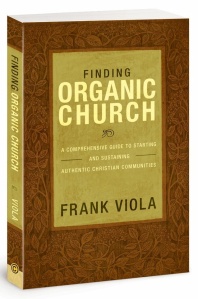
Viola writes this book for three different audiences. First, for those who desire to meet organically and would like some practical help. Second, it is written for all those already involved in alternatives to the traditional church (missional, emerging, house church movements, etc.). Third, it has been written for everyone interested in planting churches.

What is an organic church? Viola says…

“By organic church, I mean a church that is born out of spiritual life instead of being constructed by human institutions and held together by religious programs. Organic church life is a grassroots experience that is marked by face-to-face community, every-member functioning, open-participatory meetings (as opposed to pastor-to-pew services), nonhierarchical leadership, and the centrality and supremacy of Jesus Christ as the functional Leader and Head of the gathering” (p. 20).

There are four models of church planting in the New Testament. Viola begins by discussing these models and also addresses the spontaneous expressions of church life that spring up without the work of a church-planter. Viola thoroughly covers the New Testament pattern of church planting and church growth in the first half of the book.

There are four parts to this book. Throughout the first two parts of the book, Viola helps us to rediscover the purpose and function of the itinerant worker. He deals with questions concerning this largely discarded and often controversial role of the itinerant worker. He has even devoted a chapter to the book entitled “Wasn’t Paul the Last Apostle?”

He skillfully presents his case for the restoration of traveling church planters (i.e. apostles) and their task in empowering and equipping the church to function organically by the indwelling Christ. Can the New Testament model work today? Viola believes so. And he testifies to experiencing it personally over the last 20 years.

In the third part of the book, Viola discusses how to gather and gives practical steps for beginning to meet organically. Maybe you are presently meeting in an organized church but would like to begin meeting organically. It could be that you have left the institutional church and would like to begin meeting with others who are interested. And there are those who are already meeting in homes but are in need of some guidance. You will find this book a great help in moving forward.

How do you sing without a “leader” to direct you? What about teaching? What about giving? What about evangelism? What does it all look like in this new paradigm? And the most often asked question of all, “What about the children?” Viola addresses these concerns and so much more. He gives practical exercises and suggestions in getting started.

In the final part of the book, Viola discusses the seasons and stages of growth within organic church life. He also mentions the diseases and pitfalls of gathering around Christ. His descriptions of these periods no doubt come from his own personal experiences.

Finally, Viola gives a call out to his readers.

“I believe the need of the hour is for Christian who are called by God to raise up the church as a living, breathing experience. Christians who are broken and tested. Christians who refuse to take shortcuts but who have first lived in an organic expression of body life as brothers and sisters before they ever dare plant a church.”

He continues…

“The need of the hour is for such a people to wait on God until they are properly prepared and then sent. And once sent, to plant the church in the same way that all first-century workers did: by equipping it and then abandoning it to the Holy Spirit” (p. 306).

And to those pastors who wish to make the transition, Viola writes…

“As I have said elsewhere, transitioning from an institutional church to an organic church is not cosmetic surgery. It’s a complete overhaul” (p. 311).

For pastors, he closes with three steps to take in moving your church to functioning organically.  But you’re gonna have to get the book to see what those steps call for.

Are you satisfied with shoulder-to-shoulder religion or are you looking for face-to-face community?  It’s not for those that aren’t willing to endure the cross.  Are you ready to dive in to an exciting journey of experiencing the indwelling Christ in familial community?

Then take a bold step outside the walls of institutionalized religion and recline at the table with others who hunger for more of Jesus.

D.D. Flowers, 2009.


Organic Church Life: Sunday Gathering

Organic church life is expressed in many different ways, in different seasons, at different times of the week. It  is life born out Christ, moves forward in freedom, and is mutually dependent upon each other in Trinitarian love.

Hence the term “organic.”

From our experience, the Sunday gathering is a unique time of worship that is unlike any other communal event we practice (except for the Lord’s Meal of course). This time is set aside for the most divine expression of Christ among the saints.

As folks are coming into Christ and joining the organic expression of the church, we find that the saints must learn what it truly means to “gather around Christ.” It takes time, lots of time, to let go of many things (e.g. ill-feelings toward the organized church, old ideas of worship, an awareness of our thoughts about “doing” church, the uncomfortable silence, etc.).

Those of us who have been meeting outside the organized church for a little while now are by the Lord’s grace  beginning to learn how to know the Lord with the saints free of having to fight through the junk.

Even after a person begins to let these things go and throw off that dead weight into the deep chasm of death, there arise other challenges that face the saints as they seek the Lord’s heart in the gathering.

Whether it is a concern about the children in the church meetings, giving into the temptation to speak whatever is on your mind in worship, forcing something spiritual to happen when you meet, or following the occasional bunny trails leading to a lot of talk about the organized church, I believe the Lord has helped to discern these challenges with a question:

What is the purpose of the Sunday gathering?

The kind of gathering we seek to have around the Lord on Sunday is best described by Paul in 1 Cor. 14:26. (Note: This type of gathering could take place on any other day of the week, e.g. Saturday evening.) What is the purpose of “each one” sharing and giving their portion of Christ?

Generally, it is for the building up of the Body, of course. But to be more specific, it is a time where we are corporately, in spiritual unison and in open participation, seeking the Lord’s heart for his church.

We are reaching out to touch the Lord together. He is reclining with us and we want to hear from him.

This kind of meeting requires a sensitivity to the Spirit that has never been taught to us in the past and comes through purposely setting our hearts upon Christ. Sure, we have heard a lot of talk about it, but we have seldom experienced it in a context of real community.

We may have known him in private, but the Lord is longing for us to be a spiritual dwelling and experience him in community (1 Pet. 2:5).  For this reflects the Triune God.

Here is a brief description of the spiritual life and that Life we share as believers in this type of meeting:

  • Worship in spirit (Jn 4:24)
  • Waiting “be still and know” (Ps. 46:10)
  • Listening (Ps. 85:8; 1 Cor. 14:30)
  • Psalms, hymns, and spiritual songs (Eph. 5:19)
  • Teach and admonish (Col. 3:16)
  • Prayer (Lk. 19:46; Phil. 4:6)

As we enter into a time of worship on Sunday, we are meeting like the believers in the village of Bethany (Mk. 14:3). As friends of God, we are reclining at the feet of Jesus to hear what he might speak to us.

The Lord is spirit. To touch (worship, lit. “to kiss”) the Lord we must worship him in spirit. This does not come natural for us. Therefore, as we seek the Lord together and reach out to touch him through the things mentioned above, we can easily be distracted.

Any distraction, whatever that might be, can make it very difficult for us to know the Lord’s heart together. It will be a challenge to bind our spirits together in love when we are not sensitive to what Christ wants to speak to us, and in moments of stillness there are noise and chatter.

There are those table times of fellowship where we are very much sharing like any natural family event (e.g. kids running around, noise, multiple conversations, etc.). But, what I am referring to, what I believe the Lord is calling us to in this meeting, is a supernatural experience that can only be entered in through deep spirit-filled prayer and concentration.

There is order within this sort of meeting (1 Cor. 12).

The Sunday gathering is the only time where we meet this way around Christ as an entire church fellowship. Anything we can do to accommodate for this unique once-a-week meeting is well worth the effort.

I personally have conversed with Frank Viola for three years now. Frank is a wonderful gift to the church. As an outside worker, his calling is to stir up Christ in us and help us press on in the Lord.

I have read quite a bit on the organic expression of the church and have experienced a couple of years of church life centered on Christ. I have visited several other organic expressions on this journey.

In that short time, we have learned a great deal. We are so very blessed to have gleaned from Frank and others who have helped us along the way. I believe this equipping has helped us to see the uniqueness of the Sunday gathering that may elude many who seek to gather around Christ in the New Testament fashion.

“It’s all too common for Christians to know Christ’s lordship and yet know nothing of His headship.”  Frank Viola, Reimagining Church, p.67

Lord, keep us close to you.  As we seek your headship, remind us that we are all learners.

FOCGet Frank’s new book Finding Organic Church: A Comprehensive Guide to Starting and Sustaining Authentic Christian Communities today!  In this final book on radical church restoration, Viola addresses all the practical questions a person might have about organic church life.  Of course, if you really want to understand an organic church… join one!


From Eternity to Here (Book Review)

from eternity picGod’s Love Story

A Book Review of “From Eternity to Here: Rediscovering the Ageless Purpose of God” by Frank Viola Reviewed by David D. Flowers

Growing up I remember hearing folks call the church the “Bride of Christ.” I only believed it to be one more way to speak of “heavenly” things.

Like many things within institutional Christianity, it was nothing more than a metaphor in a line of many metaphors that were used to talk of God’s love for his children. Viola explains in his book that it is more than a fanciful, nice way to speak of the church… it is “God’s central purpose.” Paul called it “the eternal purpose” (Eph. 3:11).

From Eternity to Here is the fourth book in a five-book series on radical church restoration. (Fifth book is set to be released Sept. 09)  Out of all the books Viola has written, this volume reveals the driving passion behind his life and all of his work. He writes, “in beholding God’s central purpose, I found my own purpose. In touching His passion, I found my own passion” (p.13).

Viola effectively communicates this passion in three parts. The first part is entitled “A Forgotten Woman: The Bride of Christ.” Viola begins by pointing his readers to the “hidden romance” between the great lover (God) and his beloved (the church).

This story begins with Adam and Eve and continues throughout all of Scripture as the true lover is seen through foreshadowing. Viola beautifully describes in detail this great love story between the lover and the beloved that will one day be the wife of God. The story of Adam and Eve is a picture of a greater story. Eve came out of Adam after creation… she was a “new creation.”

Viola says, “There was a woman inside of God before time” (p.41).

Viola is a master storyteller. He has been captivated by God’s love story and is able to wonderfully reveal “the mystery” of Christ to a new generation. “The Holy Spirit must open the eyes of His people in every generation for them to grasp it” (p.25).

“Now Adam is a symbol, a representation of Christ, who was yet to come” (Rom. 5:14).

Out of Christ comes his Bride! Finally, a woman for the Lord to love. Viola writes, “All love stories, whether intentional or unintentional, are patterned after this heavenly romance” (p.91).

It is not that God was lonely or that the Trinitarian community was inadequate. It is because “God is love” that he is not content to keep this love to himself. Viola states that the “superabundance of God’s love required a receptacle that was not within the Trinity” (p.40).

God always intended to share his community with his creation. The nature of God’s love is that is given, received, and returned to him. Without God’s creation, he is a “frustrated lover” (p.58). God is sovereign and in control of the future, but indeed frustrated.

Part II is entitled “An Eternal Quest: The House of God.” The chapters within this section look at the divine passion from another perspective. God is homeless and he desires a house that he and his Bride may have a family.

Viola traces God’s quest for a house throughout the Scriptures. As he traces God’s search from Adam to Jesus, he says, “The house of God is not a thing… it is the Lord Jesus Christ” (p.155).

The last half of this section gets personal and compares our own journey to being like that of Israel’s history. Like Israel, as members of the Body of Christ, we must make a choice as to which house we will dwell in. Put another way… what kind of house are we going to be for God?

Egypt: the world system that is driven by pleasures and places earthly pursuits above pursuits of our heavenly home and King.

Babylon: organized religion that is a mixture of fallen humanity and the divine; characterized best by hypocrisy and described best as the “counterfeit of the New Jerusalem.” Babylon can be compared to the institutional church of today. Many of God’s people live there and they will only find themselves building a community centered on man and not Christ and his purposes.

The Wilderness: this is the place where those who leave the world and organized religion will find themselves. It is a place of transition. “To sift us, to reduce us, and to strip us down to Christ alone” (p.191). This is a time of detox. Yet… it is not our home!

The old wineskin must be done away with so that the new can come. The home for which we were made is a land of freedom and one that flows with “milk and honey.”

Part III is entitled “A New Species: The Body of Christ & The Family of God.” This section speaks of Christians being resident aliens. The Bride of Christ is to remain pure and holy as she awaits her bridegroom.

The church is a “new species.” Viola traces this language through the New Testament. A language that many Christians have failed to recognize and apply to their lives.

Viola simplifies Body life as an act of gathering around Jesus Christ. This is our purpose. Likewise, it should be our passion. Yet, the Body of Christ has been forced into an institution and she has forgotten God’s eternal purpose. She has lost sight of the bigger picture and the great landscape of God’s love story. She has been preoccupied and polluted by a theology that leaves out the ageless purpose of God.

How does the church live out the ageless purpose of God? Viola writes, “Very simply: by loving the Lord Jesus as His bride and learning to live by His indwelling life” (p.288).

The book closes with a brief glimpse into Viola’s journey and a call to return to the Headship of Christ in the church that is reflective of the divine image and God’s eternal purpose.

frank-violaViola writes, “Recognizing that Jesus Christ is the incarnation of all spiritual things will change your prayer life. It will change your vocabulary and the way you think and talk about spiritual things. And it will ultimately change your practice of the church” (p.303).

If we seek the centrality and supremacy of Christ and know that our riches are in a Person and not in things meant to further our individual pursuits… we shall be fashioned into that beautiful Bride and usher in the Kingdom. At last… God will dwell with his people when heaven comes to earth at the marriage of the Great Lover and his Beloved.

I recommend this book, especially for those who have been lost in our narcissistic evangelical ecclesiology.

For the brave… I suggest:  Pagan Christianity?: Exploring the Roots of Our Church Practices

For those who know there must be more to Body Life than you are experiencing… I encourage you to read:  Reimagining Church: Pursuing the Dream of Organic Christianity

I also recommend reading:

Going to the Root: Nine Proposals for Radical Church Renewal
Paul’s Idea of Community: The Early House Churches in Their Cultural Setting, Revised Edition

OTHER BLOGS PARTICIPATING IN THE “FROM ETERNITY TO HERE” BLOG CIRCUIT

Today (June 9th), the following blogs are discussing Frank Viola’s new bestselling book “From Eternity to Here” (David C. Cook, 2009). The book just hit the May CBA Bestseller List. Some are posting Q & A with Frank; others are posting full reviews of the book. To read more reviews and order a copy at a 33% discount, go to Amazon.com: From Eternity to Here: Rediscovering the Ageless Purpose of God

For more resources, such as downloadable audios, the free Discussion Guide, the Facebook Group page, etc. go to the official website: http://www.FromEternitytoHere.org

Enjoy the reviews and the Q and A:

Out of Ur
Shapevine (June newsletter)
Brian Eberly
DashHouse.com
Greg Boyd
Vision 2 Advance
David D. Flowers
kingdom grace
Captain’s Blog
Christine Sine
Darin Hufford – The Free Believers Network
zoecarnate
Church Planting Novice
Staying Focused
Take Your Vitamin Z
Jeff Goins
Bunny Trails
Matt Cleaver
Jason T. Berggren
Simple Church
Emerging from Montana
Parable Life
Oikos Australia
West Coast Witness
Keith Giles
Consuming Worship
Tasha Via
Andrew Courtright
ShowMeTheMooneys!
Leaving Salem, Blog of Ronnie McBrayer
Jason Coker
From Knowledge to Wisdom
Home Brewed Christianity
Dispossessed
Dandelion Seeds
David Brodsky’s Blog- “Flip the tape Deck”
Chaordic Journey
Renee Martin
Bob Kuhn
Living with Freaks
Real Worship
Fervent Worship
Julie Ferwerda
What’s With Christina?!
On Now to the Third Level
Irreligious Canuck
This day on the journey
Live and Move: Thoughts on Authentic Christianity
Spiritual Journey With God
echurch
The Jesus Feed
Book Disciple
My Journey – With Others
On Now to the Third Level
Christine Moers
Breaking Point
Hand to the Plough
Jon Reid
Weblight
D.L. Webster
Searching for the Whole-Hearted Life