Christ the Center– The Journey from Religion to Relationship
“This is what we speak, not in words taught us by human wisdom but in words taught us by the Spirit, expressing spiritual truths in spiritual words.” Paul, First Letter to the Corinthians
It was a few years ago that I first began realizing that American Christianity does a fine job of polishing its rhetoric to reflect a Christ-centered creed, but its practices are far from resembling Jesus of Nazareth in the Gospels. It speaks of spiritual things and words that have not been taught by the Spirit.
Human wisdom has produced a religion founded on doctrines and teachings about Christ, and we are continually being diverted from knowing Christ by way of relationship.
Having spent seven years in vocational ministry within the institutional church, I can personally attest to the constant struggles that come by attempting to implement a New Testament church life in the present model of institutional Christianity. I learned all the right words, memorized all of the correct doctrines, and made the Bible the passion of my life.
I (like so many others) believed that the more Bible I could master the sooner we would see “revival” and a restoration of the church. If this passion for the Bible became contagious throughout the entire church (I thought), then the church will be what she was created to be. Everything will come together, right? Quite the opposite for me.
This is when everything fell apart.
Leaving Religion
I left vocational ministry in September of 2006 to follow Jesus in search of a religionless Christianity. In a relentless pursuit of the Person of Jesus in the Gospels, I found that I could no longer be faithful to Christ within a system that makes a nice living off of talking a great deal about Jesus, but seemingly unwilling to follow him beyond the boundaries of tradition and empty clichés.
I had my fill of religion and felt like I was only spinning my wheels. I was exhausted in my efforts to see any kind of resemblance to the simple yet powerful church life described in the book of Acts. I was tired of feeling that all my efforts were self-defeating. I was burnout and more than willing to rethink everything I knew about Christ and his church.
I have only Jesus to thank when it comes to the strength it took to leave this burdensome life behind. It was a little scary, but my knowledge of the Scripture told me there must come an exodus and an exile before there can be a restoration.
As religion becomes smaller and smaller in the rearview mirror of this vehicle called “my faith.” I am finding the call of Jesus a satisfying cross to embrace.
I am finding that my past burdens were largely brought on by self. I had a work-centered faith that I passed off as “Christ-centered” while living amongst many folks that were largely self-centered and disinterested in knowing Jesus beyond the Sunday school quarterly.
All of this produced in me an experience of extreme highs and lows. Everything about the way we taught and practiced our faith kept God at a distance it seemed. This was my greatest frustration.
I am happy to say that the Prozac popping Santa Claus god is now dying a slow death. I am learning of a Lord that loves me beyond anything I have ever known. And this love attracts me to his Person. It calls to me and tells me there is more. It tells me that I will never be able to experience the full depths of his being, but that I should continue trying evermore.
The Word Became… Ink?
“Bible instruction can easily be diverted from its God-intended purpose: love of God and fellow human beings. In its place is a new, lesser purpose: the Bible as an object of curiosity and fruitless spiritual debate.”
Tom Hovestol, Extreme Righteousness: Seeing Ourselves in the Pharisees
As I look back on my journey with the Lord, I see his wonderful patience with me. My spiritual birth began with an intimate knowledge of him in my spirit. How else would any of us receive eternal life without this engagement with Christ? Yet, this relationship, this intimate knowledge of the Person of Christ, quickly became secondary to the things I could learn about him with my mind.
I didn’t understand Paul’s words, “just as you received Christ Jesus as Lord, continue to live in him…” (Col. 2:6).
I do not mean to present some false dichotomy between me learning about Christ with my mind and knowing him in my spirit, but let’s be honest, you can easily do one without the other. And I would venture to say that most people confuse the first with the later.
The Pharisees did this and Jesus called them out for it. They studied the Scripture, but did not know the Lord. They did not recognize God in the flesh. They were zealous for the written word but rejected the Word made flesh.
Despite their expectations about Messiah, they were given ample opportunity to embrace the living Word, but instead chose a religion filled with human rules and regulations. What was intended for life only brought death. It enslaved the people and kept them from knowing the Lord (Matt. 23:13-39).
“You diligently study the Scriptures because you think that by them you possess eternal life. These are the Scriptures that testify about me, yet you refuse to come to me to have life.” Jesus, The Gospel of John
I have found that we can still read the Scriptures like these infamous Pharisees. I obtained a degree and spent years studying the Bible. Like the Pharisees, I believed that a strict orthodoxy was the key to revolution.
Like so many popular reformed theologians today, it is believed that correct doctrine and defending the “truth” in the culture is the secret to God’s Kingdom coming to earth. These men boldly rebuke “heretics” and don’t mind offending you for the sake of their personality. And of course, all of this is done in the name of Christ. This is what so many believe to be “Christ-centered.”
When Sola Scriptura (i.e. Scripture alone) is your war cry, you have no choice to make for yourselves a Bible-centered life that is disconnected from Christ the living Word. A faith built on a passion for doctrine demands the same attitude that put Jesus on the cross.
In this kind of life, the Bible becomes an end unto itself. And whatever a person needs to do to further “correct” doctrine and defend the Bible is permissible in certain circles of evangelicals today. They are quick to denounce the sincere pursuit of others who seek a Christ that is more than a few theological bullet points and sin-centered sermons littered with meaningless clichés.
The least we can do is question the approach of these modern-day Pharisees who are Christ-centered in their language, but only promote teachings that disregard the way of Jesus. These men use the Scriptures to defend Christ, but do so in a manner that offends the heart of God.
“The holy writings are valuable for those who use them right,” testified one Anabaptist at the Regensburg trials in Bavaria. “But their misuse is the source of all heresy and unbelief. To the scribes and the Pharisees the holy writings were not a guide to Christ, but a hindrance and eventually a punishment.” Peter Hoover, The Secret of the Strength: What Would the Anabaptists Tell This Generation
Wait! Isn’t doctrine important? Yes, but right doctrine comes from a close examination of the Person and work of Christ in the Gospels. It comes from an intimate knowledge of the indwelling Christ. From my own personal experience, I believe it is because of our failure to give attention to Jesus in the Gospels that we have interpreted the letters of Paul as merely instructions on doctrine instead of an exposition of Jesus and his Kingdom come on earth as it is in heaven.
“My purpose is that they may be encouraged in heart and united in love, so that they may have the full riches of complete understanding, in order that they may know the mystery of God, namely Christ, in whom are hidden all the treasures of wisdom and knowledge.” Paul, Letter to the Colossians
I don’t know what I did with verses like the one above before the Lord gave me eyes to see and ears to hear. It wasn’t until I became intrigued with Christ as Person that I began to see a spiritual revolution in my own life. When I made Christ my only doctrine and concerned myself with the fact that his very Person lives within me, I was then able to begin a journey from religion to relationship; from rhetoric to revelation; from intellect to indwelling; from academia to apprehension.
I was trained in the historical-grammatical approach to studying the Scriptures. Mostly due to immaturity, I had not learned to bridge my intellect with my spirit. Bible study was simply an intellectual exercise.
Sure, there were many times I had some sort of spiritual encounter and sensed the Lord working in my life through it all, but I now see that the written word of God had become a substitute for actually knowing Jesus in spirit and in truth. The Scripture was not ushering me in to knowing Christ in personal experience. Therefore, my transformation was slow and my strength was limited to what I could do on my own. The Lord allowed this for a time.
This Bible-centered life was evident in my passion for doctrinal purity. I was not yet aware of the full measure of the indwelling Christ and how to study the Scripture out of that life. It was like living with someone in your house but rarely speaking to them.
I was learning a great deal “about” Jesus, but had a difficult time making it to the couch to sit and chat with the lover of my soul. I allowed my analytical mind to be entertained by theology, but my spirit was desperately longing to kiss the face of God.
“The word of God states that the truth shall make us free, but how many times truth is merely a doctrine to us. Our eyes have not been opened to see Christ.” Watchman Nee, Christ: The Sum of All Spiritual Things
I did not feel free in my spirit. My soul was restless. I believed that all I could aspire to was to be filled with more Bible and great theological ideas. I constantly struggled with a distorted view of God. I knew what the Scriptures said about the closeness of God in Christ, but I didn’t have the experience to go along with it.
I just kept yearning after the Lord and seeking to find him in one teaching after another. And when the Lord is a teaching instead of a Person, you die for teachings (believing them to be Christ) and you attempt to rid the church of all who disagree with you. I don’t believe I ever gave myself over to that completely, but I did see plenty of older folks that had.
When the Lord is found in a teaching and you have no working knowledge of Christ, you are not content to let the Person of Jesus deal with the shortcomings of others and the errors of the church. When your God is restrained to paper and ink, you can’t know him in the flesh. And you must know, the Word “became flesh” (Jn. 1:14).
The incarnation of God is mankind’s only hope. This is becoming less and less something to simply “Amen!” and move on about your business. It is for me, becoming everything.
Bible-Centered or Christ-Centered?
“The cumulative effect of all parts of the Word of God is to bring you to Christ.”
T. Austin-Sparks, The Centrality and Supremacy of the Lord Jesus Christ
Is there a need for proper interpretation of the Scriptures? Most definitely! However, we must understand that this interpretation does not end in a study of the context of Paul’s letters to the Corinthians. It ends in a dazzling display of Jesus! It culminates into a spiritual apprehension of Christ. And this is something only he can give you when the “Divine quest” for the Person of Jesus is at the center of your being.
Until Christ is all that you desire, you will continue to know frustration and heartache.
We can’t gain knowledge of Jesus and an inward apprehension of him and receive shady theology in return. It is in knowing Christ that we understand what birthed the writings of the apostles. It is only then that we may receive proper instruction on worship and how the believer is to relate to a world marked by estrangement.
Christ is not a teaching or a “Bible-study”, he is a person to be cultivated in human experience. This may begin out of a sincere longing to know Christ in our mind and much study of him with our intellects. But in the end it ought to lead us to a knowing him in the depths of our spirit. It is only then that we partake of the bread of life. It is only then that everything finds its proper place.
This is where evangelical Christianity has fallen to its greatest depths. Since the Protestant Reformation, it is the written word of God that has become the highest attainable goal. The Anabaptists believed this to be the mightiest error of Luther and company.
The “Reformers” of the Catholic Church clung to Scripture, not to Christ. They rested in doctrines alone and thought it strange to speak of Christ as your closest friend. Folks that talk this way, these “mystics”, were burnt alive and met their end in martyrdom. And they are still to this day read with caution and some with disdain.
According to the testimony of those they persecuted, the Protestants rested in grace and did not live in the power of the resurrection. Their strict interpretations of the Scripture and their zeal for orthodoxy actually led them down a path of anti-Christ. Their failure to let go entirely of the church that Constantine built produced in them a deception that can only be matched by the men that cried out for the death of Jesus.
Knowledge that comes to us apart from the indwelling Christ will puff up the most sincere of men (1 Cor. 8:1). Knowledge obtained without first having passed through the cross of Jesus will always lead to sin. It is here where many believers find themselves. They have learned the appropriate rhetoric of Christ-centeredness, but their words are not born out of a revelation from the Lord himself. They easily find themselves continuing on with right speech, but their actions actually begin to prove that something else is at work.
It is not long and this person finds that their faith is filled with all kinds of contradictions and empty clichés that have no practical meaning for their lives. They sound holy, their words reflect a sort of biblical Christology, but their spirits are not governed by the life of Christ. They have not experienced the faith that is continually being born from above. What they have has not been given to them by Jesus in their spirit.
There is no inward reality of the indwelling Christ shaping them and molding them. The Person of Christ is not guiding their every step and speaking to their hearts. They have a few momentary spiritual glimpses into the Lord but the rest is just adrenaline and good intentions.
What is the Bible? Simply stated, it is the Spirit-inspired written testimony of men about the living God coming to earth and revealing himself in Jesus Christ of Nazareth. How has this collection of writings we call “The Bible” become the object of so much division among believers? “Is Christ divided?” What have we done with Paul’s warnings of division in the Body of Christ? We have celebrated them in what we call “denominations” and we treat this as a good thing.
Our passion for doctrine has blinded us to the many contradictions we have embraced. And we continue to find reasons not to abandon 1700 years of institutional Christianity founded on the ideas of men that can’t be justified by the Scriptures.
This is another piece of twisted evidence that the Bible is not being read as a testimony of the Christ presented in the Gospels. It is not being studied and read for the purpose of apprehending Christ in community, but for the mere propagating of a doctrine, a mission, a program, a ministry or a movement. We are guilty of worshipping the biblical text instead of the One it reveals.
We can know we have done this by the many ways we have violated the Person of Jesus and contradicted his example left in the Gospels. Having lived this way, we may only say that we are “Bible-centered” or “Paul-centered” or better yet, “Mission-centered.” But we dare not say we are Christ-centered when Jesus is not our only concern. If the Lord has not yet revealed to us that out of Christ comes the church, then we must wander a little while longer.
“I consider everything a loss compared to the surpassing greatness of knowing Christ Jesus my Lord, for whose sake I have lost all things. I consider them rubbish, that I may gain Christ and be found in him…” Paul, Letter to the Philippians
Conclusion—Christ the Center
We may say Christ is central and supreme in our lives, the church, the world, and the cosmos, only after we have put our hand to the plow of his Person and work; after we have forsaken all others for his namesake. Once we are willing to lay all else aside to experience the depths of who he is, we may call him “Lord” with complete assurance that he is indeed the Lord.
Brothers and sisters, it is in these things that the Lord says, “Yes!” The Son has been exalted that we might know him “in whom are hidden all the treasures of wisdom and knowledge” (Col. 2:3). He has become flesh that we might know that “in Christ all the fullness of the Deity lives” (2:9). It is not a method we seek, we seek Christ. Any “good” thing outside of Christ is dead! It is not a thing we desire, it is a Person. Will we continue running after dead things in Jesus’ name?
On this journey from dead religion to a living relationship, I have occasionally asked myself, “Am I making too much of Jesus? Is it all really this simple?” And I hear the Lord speak, “Come to me, all you who are weary and burdened, and I will give you rest… for my yoke is easy and my burden is light” (Matt. 11:28; 30).
Well, I must say I am finding that “yoke” much easier than before. But, could I be oversimplifying things and reducing the Gospel message? (I smile with a faint chuckle) What else is there but Jesus? Very confidently I reply, “Nothing of any worth.”
Let us press on in the journey of experiencing the depths and riches of Christ Jesus our Lord. No other purpose will satisfy the heart of God or our own groaning for a savior. May we give up our Christ-less “Bible studies” and our foolish church practices that not only hinder, but replace our Center.
Through the power of his resurrection we may break free from religion’s chains and discover a truly Christ-centered faith.
Suggested Reading:
“The Centrality and Supremacy of the Lord Jesus Christ” by T. Austin-Sparks
“Christ: The Sum of All Spiritual Things” by Watchman Nee
“The Secret of the Strength” by Peter Hoover
“The School of Christ” by T. Austin-Sparks
“Extreme Righteousness: Seeing Ourselves in the Pharisees” by Tom Hovestol
“Christ the Center” by Dietrich Bonhoeffer
“The Normal Christian Life” by Watchman Nee
“Bethany: The Lord’s Heart for His Church” by Frank Viola

 Note: This little poem “Sanctorum Communio” (Community of the Saints) was written in my personal journal of prayers and meditations on February 4, 2007. It represents for me a song of victory in my own personal exodus from institutionalized Christianity.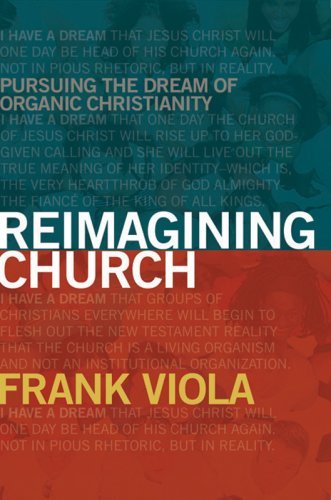

 The Centrality and Supremacy of Jesus Christ