A Brief Survey of the Historical Evidence
Christians celebrate the death of Jesus on what is known as Good Friday. It is a rather odd thing to celebrate someone’s death, especially when it was such a brutal and barbaric execution. Some skeptics today have written believers off as sick delusional people. No doubt, it is an old charge. It was even strange to Pliny the Younger who investigated the early church’s worship of the crucified Jesus—those who sang “a hymn to Christ as to a god” (Pliny, Letters 10.96-97).
But for those who are Christians, Good Friday is a time of deep theological reflection. The biblical narrative from creation to fall, from exilic despair to salvific hope, from sinner’s debt to atoning sacrifice, has reached its climax in the life and death of Christ—the true Israelite, the promised Messiah who takes away the sins of the world.
It is a beautiful death because it is the first and only death in the history of mankind that has the power to save—the Creator God becomes human flesh and displays boundless love to his broken creation. The idea of it is too good to be compared to any ancient myth of dying and rising gods, and it is so self-incrementing that any man would or could make it up only to endure the wrath of empire for proclaiming it.
However, the death of Jesus holds no power if he stays dead. That is why the apostle Paul was so adamant about it to the Corinthians who were arguing about the future of those who had died before Christ’s Second Coming (parousia). He writes:
If Christ has not been raised, our preaching is useless and so is your faith. More than that, we are then found to be false witnesses about God, for we have testified about God that he raised Christ from the dead. But he did not raise him if in fact the dead are not raised. For if the dead are not raised, then Christ has not been raised either. And if Christ has not been raised, your faith is futile; you are still in your sins (1 Cor 15:14-17 NIV).
There has been no shortage of books, articles, and journal entries written on the resurrection of Jesus, especially in the last few decades.[1] Dale Allison has stated that the historicity of the resurrection of Jesus is the “prize puzzle of New Testament research.”[2] There are excellent presentations by historical Jesus scholars that have been published in defense of the resurrection—arguments that are concerned with the reliability of the biblical text, the historical possibility of the event, and the reasonability of belief in such a miraculous occurrence.
It is the purpose of this paper to bring out some of the strongest points used in defense of the physical resurrection of the historical Jesus. This paper will persuasively argue on behalf of the following points: (1) the reliability of the NT, eyewitness testimony, and multiple attestation; (2) the empty tomb, resurrection appearances, and the growth of the early church; (3) the philosophical and scientific reasonability of miracles, ancient and modern.
EVIDENCE FOR THE RESURRECTION
Reliability of the NT, Eyewitness Testimony & Multiple Attestation
All four of the Gospels record the death and resurrection of Jesus (Matt 28; Mk 16; Lk 24; Jn 20). However, the inspiration and trustworthiness of the Bible is no longer assumed. Truthfully, the reliability of the Bible has even been heavily attacked since the Enlightenment. While a case could be built for the death and resurrection of Jesus apart from the New Testament sources, the author of this paper is not so willing to give up on the reliability of the NT and the Gospels as historical ancient biographies of Jesus.[3]
Daniel Wallace has recently written, “In Greek alone, there are more than 5,600 manuscripts today… altogether about 20,000 handwritten manuscripts of the NT in various languages.” [4] Even if someone were to destroy all of those manuscripts, the NT could be entirely reconstructed with the one million quotations by the early church fathers![5]
Some critics will respond, what about all those discrepancies? There are certainly textual variants in the many manuscripts we have, but the careful reader should not let the skeptical NT textual critic, Bart Ehrman, convert them to agnosticism just yet.[6] F.F. Bruce has written, “The variant readings about which any doubt remains among textual critics of the New Testament affect no material question of historic fact or of Christian faith and practice.”[7]
In fact, the more historical and textual criticism that is being done on the NT Gospels, the more scholars are recognizing just how meticulous the ancient authors were in their creative retelling of the life of Christ. For instance, Luke, a companion of the apostle Paul, says he consulted with the “eyewitnesses” and “carefully investigated everything from the beginning” (Lk 1:2-3). Luke’s concern to give an “orderly account” of the things that happened in the first half of the century simply can’t be denied if any historian is consistent with their treatment of historical texts.
The apostle Paul passes along an early creedal statement about Jesus:
For what I received I passed on to you as of first importance: that Christ died for our sins according to the Scriptures, that he was buried, that he was raised on the third day according to the Scriptures and that he appeared to Peter, and then to the Twelve. After that, he appeared to more than five hundred of the brothers at the same time, most of whom are still living, though some have fallen asleep. Then he appeared to James, then to all the apostles, and last of all he appeared to me also, as to one abnormally born (1 Cor 15:3-8 NIV).
James D.G. Dunn has written that scholars can be “entirely confident” that this tradition was formulated within months of Jesus’ death.[8] So, with the early dating of the Gospels being within approximately 30-40 years of the actual events, the careful oral transmission and tradition between Jesus and the writing of the Gospels, and the multiple eyewitness testimony that Jesus was seen in a resurrected form (something that it seems they had a difficult time finding the words to express), it is fair to say that something out of the ordinary happened.
The majority of scholars agree on some basic events in the life of Jesus. E.P. Sanders has written, “There are no substantial doubts about the general course of Jesus’ life: when and where he lived, approximately when and where he died, and the sort of thing that he did during his public activity …”[9]
No real scholar in the field denies these things. Even the liberal Jesus Seminar scholar, John Dominic Crossan, admits that the crucifixion of Jesus is historical “as sure as anything historical can be.”[10] It is one of the major points of agreement between liberal and conservative Jesus scholars. For any person to deny the crucifixion of Jesus of Nazareth, they must be ignorant of history or purposely distorting the facts. Ancient historians such as Josephus, Tacitus, Lucian, Mara Bar-Serapion, and the Jewish Talmud, mention that Jesus was crucified.[11] Mainstream scholars agree with the biblical text: Jesus really lived, he was crucified, he died, and he was buried in a borrowed tomb. (Mk 15:42-47; Matt 27:57-61; Lk 23:50-54).
Empty Tomb, Resurrection Appearances, & Growth of the Early Church
The empty tomb is recorded and admitted by Christians, enemies of Jesus, and skeptics alike—in ancient and modern times. All four canonical Gospels mention the empty tomb. Paul affirms the empty tomb with the early creed in 1 Cor 15:3-4, and so does Luke in Acts 13:29. While there are scholars today that refuse to acknowledge an empty tomb (e.g. Crossan believes that Jesus’ body was discarded with criminals and eaten by dogs), most scholars recognize the empty tomb as a historical fact.
The empty tomb makes the most historical sense. If the body was not missing, the early Christian message could have been easily stamped out with, “Resurrected? We have his body right here!” The big question is ‘why was it empty?’ The Jewish polemic against the Christian message was that the disciples had stolen the body (Matt 28:11-15; Justin Martyr’s Dialogue with Trypho, 108; Tertullian’s On Spectacles, 30). Matthew writes, “And this story has been widely circulated among the Jews to this very day” (28:15).
The swoon theory was first proposed in the eighteenth century.[12] This theory claims that Jesus was not really dead after all, but merely slipped into a coma, later to be revived in the cold conditions of the dark tomb. Let there be no mistake. The Romans knew how to kill condemned criminals.[13] While there may have been an occasion where someone escaped the cross (e.g. when Romans fled the scene of battle), the historical evidence in the case of Jesus does not allow for a great escape. The medical evidence indicates a certain death (Jn 19:34).[14]
David Strauss, a nineteenth century liberal scholar, was unconvinced of the swoon theory, saying that a half-dead Jesus would not have convinced his disciples of a glorified resurrection.[15] Strauss points out that you can’t talk about the empty tomb without considering the transformation that took place with the disciples who had previously abandoned Jesus. What else can explain what they claimed they saw, and empowered them to speak the message of the risen Jesus?
According to a small few, the disciples actually had some sort of mass LSD trip, a group hallucination.[16] There are many reasons why this theory doesn’t add up. In short, the disciples claimed to have touched him, ate with him, yet he walked through walls! Also, there has never been one documented account of an entire group of people having the same hallucinations.[17] And the disciples would need to be under a continual psychotic delusion to face martyrdom with non-resistance, declaring that Jesus had been raised from the dead.
Michael Licona writes: “Historians are not chained to using a psychological explanation that is stacked against the supernatural in order to obtain purely natural conclusions in their historical work. They need to go beyond psychological conjectures and employ method carefully.”[18]
Other theories have been proposed: Jesus had a twin brother that dropped in after the crucifixion and appeared to the disciples; the women went to the wrong tomb; and the resurrection was only spiritual. But none of these theories can account for all of the historical evidence, what the disciples believed were resurrection appearances, the teaching of the apostles, and the growth of the early church in the face of intense persecution.
I know in their own terms what they saw was the raised Jesus. That’s what they say and then all the historic evidence we have afterwards attest to their conviction that that’s what they saw. I’m not saying that they really did see the raised Jesus. I wasn’t there. I don’t know what they saw. But I do know that as a historian that they must have seen something.[19]
Whatever they saw, it was enough to change the mind of James, the brother of Jesus, and Saul of Tarsus, a zealous Pharisee and persecutor of the church. James becomes the leader of the Jerusalem church (Acts 15), and he is later martyred for his belief that Jesus had been raised from the dead. What could have happened to prompt the brother of Jesus to become one of the church’s greatest leaders? An encounter with the risen Jesus is the most likely of all possible scenarios.
Saul of Tarsus had a first-hand encounter with the resurrected Christ, while on his way to persecute the church in Damascus, Syria (Acts 9). Something happened to this Saul, student of the great Jewish teacher, Gamiliel (Acts 22:3). He said his transformation from persecutor to apostle was a result of being confronted by the resurrected and glorified Christ. What could change this zealous teacher of the Law? The apostle Paul had met the risen Jesus.
N. T. Wright makes the claim that he knows nothing else that could explain the initial birth and rapid expansion of the early church, except that Jesus was really raised from the dead. Wright states that there are two things “historically secure” about the first Easter: the empty tomb and the meeting with the resurrected Jesus. Nothing in Second-Temple Judaism would have produced such a radical claim that someone (i.e. a crucified Messiah) would be raised to life in the middle of human history.[20] Wright says, “It is therefore historically highly probable that Jesus’ tomb was indeed empty on the third day after his execution, and that the disciples did indeed encounter him giving every appearance of being well and truly alive.”[21]
There is another piece of evidence that adds further weight to the story. Fitting with the principle of embarrassment, the Gospel writers report that it was women who first found the empty tomb and met the risen Jesus (Matt 281-10; Mk 16:1-11; Lk 24:1-11). This is rather peculiar since a woman’s testimony was not even considered as a reliable witness in a first century law court (Josephus, Ant 4.219).
It comes as no surprise that the disciples did not believe their report (Lk 24:11). If they were making up a story about a crucified and resurrected Messiah, especially when the whole idea was foreign to Judaism in the first place, the last thing they would do is have women as the first eyewitnesses to the empty tomb and resurrection. But no attempt is made to gloss over this embarrassing episode.
This bit of the story adds to the historical credibility of the empty tomb. The physical resurrection of Jesus is the best explanation for the empty tomb, as well as the experiences of the disciples, and the rapid growth of the early church in the face of overwhelming opposition from the same world that condemned Jesus.
Limitations of Science & Boundaries of Human Reason
There are certain biases and presuppositions that must be acknowledged on the outset of an investigation into the case for the resurrection. The seventeenth and eighteenth century Enlightenment has conditioned much of the West to separate faith and reason. The church has often been guilty of refusing to take serious the discoveries of science. The sloppy practice of using the Scriptures to attack and defend scientific theories has furthered the idea that faith and reason are at odds with one another.
Of course, there is such a thing as bad science, something that many evolutionary biologists and skeptics of religion today refuse to acknowledge. But who will argue that it was right for the church to denounce Galileo’s heliocentrism—that the earth revolves around the sun? Like many European intellectuals who grew tired of the abuses of the Roman Catholic Church, some modern skeptics and scholars abandon faith altogether, reject any spiritual dimensions to life and the cosmos, only to rely solely upon science as the only infallible guide to epistemology (what we can know and how can we know it). Is this sound?
The thinking of David Hume has left an indelible mark on Western society. Hume rejected the idea of miracles, largely based on his naturalistic perspective that the laws of nature prohibit them from happening. Hume wrote:
The Christian Religion not only was at first attended with miracles, but even at this day cannot be believed by any reasonable person without one. Mere reason is insufficient to convince us of its veracity: And whoever is moved by Faith to assent to it, is conscious of a continued miracle in his own person, which subverts all the principles of his understanding, and gives him a determination to believe what is most contrary to custom and experience.[22]
Would the resurrection of Jesus be a violation of natural laws? Are miracles to be entirely ruled out because Hume concluded that they are contrary to nature and the whole of human experience?
There are currently three main views of natural law: the regularity theory, the nomic necessity theory, and the causal dispositions theory. None of these theories actually allow for miracles to be understood as violations of the laws of nature. Instead, miracles are naturally impossible events that require an unknown or “supernatural” force to interrupt the natural world at a certain time and place.
Naturalism may indicate that dead people stay dead. But if there is a God who created the world, and sent his Son to reveal his divine program, then how can skeptics be so certain that this God wouldn’t raise Jesus from the dead in order to vindicate him and affirm divine revelation? It is just the sort of thing God would do to reveal himself and redeem mankind for a new world—a world that he has not left to simply wind down, grow cold, and become stardust.
William Lane Craig writes:
When a scientific anomaly occurs, it is usually assumed that some unknown natural factors are interfering, so that the law is neither violated nor revised. But suppose the law fails to describe or predict accurately because some supernatural factors are interfering? Clearly the implicit assumption of such laws is that no supernatural factors as well as no natural factors are interfering. Thus, if the law proves inaccurate in a particular case because God is acting, the law is neither violated nor revised. If God brings about some event which a law of nature fails to predict or describe, such an event cannot be characterized as a violation of a law of nature, since the law is valid only under tacit assumption that no supernatural factors come into play in addition to the natural factors.[23]
It is for the reason of “miracles” and the divinity attributed to Jesus that some “historians” find reason not to trust anything the Gospel writers say. They believe the Gospels are tainted with wishful thinking. Therefore, it is hard to determine who the “historical Jesus” really is after all. Crossan has written the following on the possibility of a resurrection miracle: “I do not think this event ever did or could happen… I do not think that anyone, anywhere, at any time brings dead people back to life.”[24]
Historians should not be so quick to dismiss the miraculous as human inventions by lunatic disciples wanting to start their own religion on a failed Messiah.[25] Paul Rhodes Eddy and Gregory Boyd have written:
Most within the guild of historical-critical scholarship identify the historical-critical method with this unequivocal commitment to the presupposition of naturalism. For such scholars, talk about a naturalistic historical-critical method is redundant, and talk about about a historical-critical method that is not unequivocally committed to naturalism is a contradiction in terms.[26]
Eddy and Boyd suggest an alternative method they call an “open historical-critical method” that is not unequivocally committed to naturalism and is open to events that defy natural explanation. The method is “critical” in that it first looks for “natural” causes to bizarre events, but at the same time it is “open” to the appeals of “supernatural” occurrences, not rejecting them on an a priori basis.[27] Scholars must be willing to follow the evidence wherever it leads them.
Other contemporary NT scholars also argue for the historical probability of miracles, thus substantiating the claims of the NT. Craig Evans believes that the same criteria used for supporting the authentic words of Jesus in the Gospels, can also be applied to miracles. The historical criteria are multiple attestation, dissimilarity, and embarrassment.[28]
As already previously argued, all of these can be found in the resurrection story. Craig Keener has arguably written the greatest work on the subject of miracles. In his two-volume work, Miracles: The Credibility of the New Testament Accounts, Keener challenges David Hume’s epistemological skepticism, and presents a monumental case for miraculous phenomena from late antiquity up to contemporary times. He begins by pointing out that all of the many ancient sources acknowledge that Jesus was a worker of miracles. Keener describes the importance of miracles in the Gospels:
Most scholars today working on the subject thus accept the claim that Jesus was a healer and exorcist. The evidence is stronger for this claim than for most other specific historical claims that we could make about Jesus or earliest Christianity. Scholars often note that miracles characterized Jesus’ historical activity no less than his teaching and prophetic activities did. So central are miracle reports to the Gospels that one could remove them only if one regarded the Gospels as preserving barely any genuine information about Jesus.[29]
Keener mentions how Walter Wink, a NT scholar and member of the Jesus Seminar, shifted his “materialistic” assumptions about reality after a divine healing of his own. Wink says, “I have no difficulty believing that Jesus actually healed people, and not just of psychosomatic diseases.” Wink writes that any scholar who would deny the truth of his story because of their worldview, do so “not on historical grounds, but on the basis of their” antisupernaturalistic assumptions.[30]
Therefore, it is important to study the historical Jesus by first discarding of the presupposition that naturalism can fully account for the way things are in the world. As Craig has written, “If we begin by presupposing naturalism, then of course what we wind up with is a purely natural Jesus. This reconstructed, naturalistic Jesus is not based on evidence, but on definition.”[31] So, based on the amount of observable evidence, there is good reason to believe in miracles today.
EVIDENCE THAT DEMANDS A VERDICT
The very laws of nature (as we know them) are continually sustained by God’s power. He has revealed himself in the natural order and in the spiritual order. But more specifically, God’s good will for creation has been made known in the person of his Son, Jesus Christ of Nazareth. And he has displayed his saving power by raising this Jesus from the dead. However, it is right to conclude that no amount of scientific or historical data can conclusively prove that Jesus rose from the dead. Belief in miracles, the resurrection of Jesus particularly, is not born from historical evidence alone. John Meier candidly writes:
Can miracles happen? Do miracles happen? In my view, these wide-ranging questions are legitimate in the arena of philosophy or theology. But they are illegitimate or at least unanswerable in a historical investigation that stubbornly restricts itself to empirical evidence and rational deductions or inferences from such evidence.[32]
C. E. B. Cranfield sums up his survey of the evidence in this way:
A positive proof of its truth is just not to be had by such means. Certainty with regard to it can come to us only by the work of the Holy Spirit making us free to believe. But it seems to me that the evidence available to us—and I have tried now a good many times to weigh it as carefully and honestly and objectively as I can—is such that, though I cannot prove that God raised Jesus from the dead by historical-critical methods, I can believe it without any way violating my intellectual or moral integrity. For myself, I must declare that I do indeed confidently believe it.[33]
Finally, there are at least five established facts in the case for the resurrection. These “minimal facts” are the death of Jesus by crucifixion, the empty tomb, the disciple’s resurrection claims, the conversions of James and Paul, and the rapid growth of the early church in the face of suffering and death. This is compelling evidence for the resurrection of Jesus that every skeptic must confront with historical, logical, and consistent reasons of rebuttal if they wish to challenge mainstream biblical and historical scholarship, or engage in an attack on the gospel of Jesus.
After normal causations are exhausted as an explanation for the resurrection story, the historical evidence points to the “high probability” that Jesus rose from the dead.[34]
D.D. Flowers, 2012.
NOTE: This academic paper was put into a popular three-part post “Why I Believe in the Resurrection of Jesus” here at the blog. There are active links and videos in that series of posts.
[1] A few major scholars such as Dale Allison, Raymond Brown, Peter Carnley, David Catchpole, William Lane Craig, John Dominic Crossan, James D.G. Dunn, Bart Ehrman, Gary Habermas, Gerd Ludemann, Willi Marxsen, Gerald O’Collins, Richard Swinburne, A.J.M. Wedderburn and N.T. Wright have weighed in on the topic.
[2] Dale Allison, Resurrecting Jesus: The Earliest Christian Tradition and Its Interpreters (New York: T&T Clark, 2005), 200.
[3] See Richard Burridge, What are the Gospels? A Comparison with Graeco-Roman Biography (Grand Rapids: Eerdmans, 2004). Burridge calls for an understanding of the gospels an ancient biographies.
[4] Daniel B. Wallace, Revisiting the Corruption of the New Testament: Manuscript, Patristic, and Apocryphal Evidence (Grand Rapids: Kregel, 2011), 28.
[6] Bart Ehrman is a NT textual critic, and former evangelical Christian. See his book, Misquoting Jesus: The Story Behind Who Changed the Bible and Why (New York: HarperSanFrancisco, 2005). Also, see Nicholas Perrin’s response to Ehrman in his book, Lost in Transmission: What Can We Know About the Words of Jesus (Nashville: Thomas Nelson, 2007).
[7] F. F. Bruce, The New Testament Documents: Are They Reliable? (Downers Grove: InterVarsity Press, 1981), 14-15.
[8] James D. G. Dunn, Jesus Remembered. Christianity in the Making, Vol. 1 (Grand Rapids: Eerdmans, 2003), 855.
[9] E. P. Sanders, The Historical Figure of Jesus (London: Penguin, 1993), 11.
[10] John Dominic Crossan, The Historical Jesus: The Life of a Mediterranean Peasant (New York: HarperSanFrancisco, 1992), 145.
[11] Josephus, Antiquities 18.64; Tacitus, Annals 15.44; Lucian of Samosata, The Death of Pererine 11-13; Mara Bar Serapion, BL Add. 14658; and the Talmud, Sanhedrin 43a. The Quran denies that Jesus was crucified on a Roman cross (Surah 4:157-158). This is a rather embarrassing historical blunder on behalf of the Quran. This is not some insignificant textual variant or slight discrepancy in the Islamic text. It is a historical contradiction.
[12] Early proponents were: Karl Friedrich Bahrdt, Karl Venturini, Heinrich Paulus, and Friedrich Schleiermacher. The muslim, Mirza Ghulam Ahmad, proposed that Jesus survived the crucifixion in journeyed to India. See his book, Jesus in India (1899).
[13] See the ancient writer, Seneca Moral Epistles 101; and Martin Hengel, Crucifixion, trans. John Bowden (Philadelphia: Fortress Press, 1977), 22-23.
[14] “interpretations based on the assumption that Jesus did not die on the cross appear to be at odds with modern medical knowledge.” The Journal of the American Medical Association “On the Physical Death of Jesus Christ” Vol. 255 (March 21, 1986), 1463.
[15] David Strauss, A New Life of Jesus. 2 vols (Edinburgh: Williams & Norgate, 1879).
[16] Oddly enough, Strauss actually popularized this theory. In Strauss’ view, the disciples were tripping with the resurrected Christ! This view is not taken seriously by any scholar or medical expert today. See Jake O’Connell “Jesus’ resurrection and collective hallucinations.” Tyndale Bulletin 60, no. 1 (January 1, 2009): 69-105.
[17] Gary Habermas and Michael Licona, The Case for the Resurrection of Jesus (Grand Rapids: Kregel Publications, 2004), 105-108.
[18] Michael Licona, The Resurrection of Jesus: A New Historiographical Approach. (Downers Grove: InterVarsity, 2010), 567-568.
[19] Paula Fredriksen (Boston University) in an interview by Peter Jennings in Search for Jesus (American Broadcasting Corp. [ABC], July 2000).
[20] Douglas W. Kennard, Messiah Jesus: Christology in His Day and Ours (New York: Peter Lang, 2008), 335. Kennard writes: “No O.T. text claims the time of third day resurrection of Messiah, but a sentiment grew among Pharisaic second Temple Judaism that began to see the Biblical text describe the general resurrection and even a Messianic resurrection on the third day.” Also see Wright’s Resurrection of the Son of God, 321-322. It can at least be said that the traumatized disciples were not thinking that Jesus was going to rise from the dead
[21] N. T. Wright, The Resurrection of the Son of God, Vol. 3: Christian Origins and the Question of God (Minneapolis: Fortress Press, 2003), 686-687.
[22] David Hume, An Inquiry Concerning Human Understanding (New York: Cambridge University Press, 2007), 10.2.101. Hume is saying that it is a miracle that anyone could ever be dumb enough to believe in the Christian faith!
[23] William Lane Craig, Reasonable Faith: Christian Truth & Apologetics (Wheaton: Crossway, 2008), 262.
[24] Crossan, Jesus: A Revolutionary Biography (San Francisco: HarperSanFrancisco, 1994), 94-95.
[25] The following contemporary perspectives on miracles take the notion seriously: R. Swinburne, The Concept of Miracle (New York: Macmillan, 1970); F.J. Beckwith, David Hume’s Argument against Miracles: A Critical Analysis (Lanham, MD: University Press of America, 1989); T.C. Williams, The Idea of the Miraculous: The Challenge to Science and Religion (New York: Macmillan, 1990); J. Houston, Reported Miracles: A Critique of Hume (New York: Cambridge University Press, 1994); R.D. Geivett and G.R. Habermas, eds., In Defense of Miracles: A Comprehensive Case for God’s Action in History (Downers Grove: InterVarsity Press, 1997); C.S. Keener, Miracles: The Credibility of the New Testament Accounts, 2 vols. (Grand Rapids: Baker Academic, 2011).
[26] Paul Rhodes Eddy and Gregory Boyd, The Jesus Legend: A Case for the Historical Reliability of the Synoptic Jesus Tradition (Grand Rapids: Baker Academic, 2007), 51-52.
[28] Craig Evans, Fabricating Jesus: How Modern Scholars Distort the Gospels (Downers Grove: InterVarsity Press, 2006), 140.
[29] Craig S. Keener, Miracles: The Credibility of the New Testament Accounts, Vol. 1 (Grand Rapids: Baker Academic, 2011), 23-24.
[32] John P. Meier, A Marginal Jew: Rethinking the Historical Jesus, Vol. 2 (New York: Doubleday, 1994), 511. Meier is not saying that miracles are not real events in time and space, nor is he doing “covert” apologetics.
[33] C.E.B. Cranfield, “The Resurrection of Jesus.” The Historical Jesus in Recent Research. eds. James D.G. Dunn and Scot McKnight (Winona Lake: Eisebrauns, 2005), 390-391.
[34] David J. Norman, “Doubt and the resurrection of Jesus.” Theological Studies 69, no. 4 (December 1, 2008): 786-811.

 McKnight has written more than twenty books. His book, The Jesus Creed, won the Christianity Today book award for 2004 in the area of Christian living. He currently has one of the most popular evangelical blogs online. He has written widely on the historical Jesus and early Christianity. He is an authoritative voice for evangelicals today.
 There are some complimentary overlaps between McKnight’s book and the previous book in this series, N.T. Wright’s book Surprised by Hope. A good bit of the evangelical theology that Wright seeks to correct in his book makes us up much of the backbone within the salvation gospel that McKnight rightfully critiques. They both offer up a new vision for 21st century evangelicalism.
 Wright undoubtedly stands at the summit of NT scholarship. I sincerely believe he is the most important of Christian thinkers alive today. His writings offer fresh insight and a stimulating challenge to evangelical Christianity.
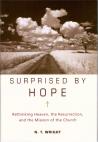 Finally, I have chosen Surprised by Hope as the first book in this series because it is a much-needed theological challenge to popular evangelicalism. It gives us a biblical vision of God’s good future for heaven and earth.
 The Centrality and Supremacy of Jesus Christ