Tag Archives: kingdom of god

What Would Jesus Not Do?

In Matthew 4:1-11, Jesus is led by the Spirit into the Judean wilderness to be tempted by the devil following his baptism by John, his own cousin.

But before Jesus can begin his ministry of revealing the Kingdom of God, Jesus must first undergo a series of temptations that will forever define him. He must decide in his own heart, and for the testimony of his followers, what kind of Messiah he will be.

What kind of king and kingdom will Jesus choose? His way then becomes our way. The temptations of Jesus are a matter of our own discipleship.

“Whoever claims to live in him must walk as Jesus did.”  1 John 2:6 (NIV)

In order to understand the temptations, we must see them in conjunction with the previous event. They should not be isolated from Christ’s recent baptism. John the Baptizer recognizes Jesus as the coming king of the promise, the Messiah for Israel. And that’s what he will be.

So, what kind of Messiah will Jesus be for his people?

The temptations of Christ are not just examples of Jesus overcoming sin. They were never meant to be read as examples of Christ experiencing random temptations. The gospel writer sees them as the defining moment for the person and work of Jesus.

“Only as we see what Jesus rejected, can we know what he has affirmed.”  Donald Kraybill, The Upside-Down Kingdom, 34.

The nature of these three temptations is critically important for seeing what Jesus will not do in his ministry.

Bread from Stone—Kingdom Economics

After fasting forty days and forty nights (a reenactment of Israel’s wilderness wandering), Jesus was tired and hungry. This clearly would have made any proposal appealing to the flesh. Our physical state often affects our spiritual condition.

And this was the point of the fasting. Jesus makes himself completely vulnerable to opposition. It would have certainly been a time of closeness with the Father and a time of great challenge in his humanity against Satan. Jesus must now face his greatest challenges as Messiah.

The devil came to him and said, “If (since) you are the Son of God, tell these stones to become bread.” Jesus replies, “It is written, “Man does not live on bread alone, but on every word that comes from the mouth of God” (Matt.4:3-4).

Was Jesus simply tempted to eat because he was hungry? What does this have to do with the baptism event and Jesus’ coming Kingdom ministry?

Jesus embodies Israel and reveals the nature of his divine mission. The connection to Israel’s history and Christ’s words of total submission to God is obvious. So, what does this have to do with his kingship and Kingdom?

There were two classes of people in the Roman Empire: upper and lower class. Evidence suggests that 90% of the citizens were of the lower class. Most folks were unbelievably poor.

Since Jesus is the Messiah, the devil tempts Jesus to be a welfare king. “Turn these stones to bread” he said. How will Christ deal with the economic problems of the world? This is the question Christ answers. It is a question every king must consider.

Will he open the grain houses upon his arrival? Like Julius Caesar returning from Gaul seeking to manipulate and pander to the masses, will Jesus use his power to win people through their stomachs? What will be his method of proving his divine rule?

Jesus relates to the hunger of people all over the world. He embraces the hunger of others. Jesus’ response ought to be seen as a rejection of solving the problem as an earthly king would.

He doesn’t ignore the physical needs of the world. Jesus will go on to feed many who are hungry. However, the Kingdom of God is much bigger than a loaf of bread—it is more than food. And Jesus doesn’t need bread because he is the bread of life.

Jesus deals with poverty in a different manner. He will feed folks, but he seeks to do more than feed mouths. He will seek to restore the dignity of others and reconcile them to God.

Base Jumping From the Temple—Bad Religion

Then the devil took Jesus to the highest point of the Temple in Jerusalem. Satan says, “If (since) you are the Son of God, throw yourself down” (Matt 4:6). The devil then proceeds to quote Scripture (Psalm 91), twisting it to tempt Jesus to action.

Is Jesus going to swoop in and gain the approval of the religious establishment? He very easily could have removed all doubt to who he was.

A grand entrance would certainly gain recognition that he was indeed the Messiah. Yet he resists the temptation to gain approval of those religious folk. If Christ were going to convince the religious leaders, the “Doctors of the Law,” this would be the way to do it. But he doesn’t do it.

Jesus chooses not to parachute in and remove any obstacles from them hearing his message of the coming Kingdom.

He will make his presence known in the Temple, but only right after he drives out those practicing bad religion. This is quite different than the entrance he was tempted with by the devil.

FYI: This isn’t how you win the votes of the Sadducees on the left (who were in charge of the Temple) or the Pharisees in the “Religious Right” who were popular with the people.

Instead, Jesus storms in to the heart of Jewish religion, and turns it upside-down. The Temple is no longer the place of worship and symbol of God’s presence. For the Spirit of God has come to dwell in men. There is now something, someone, greater than the Temple.

He is Immanuel, God with us.

Jesus will not do any pandering to the religious elite. No sir. Jesus will shut down institutional religion for good and tell the ruling party that they are now out of a job.

There’s a new king in town. His name is Jesus… the Christ from Nazareth.

Kings and Kingdoms—The Politics of Jesus

Jesus has already rejected two powerful offers to play by the world’s rules and give the people the Messiah that was expected—a Messiah that fixes this present age by methods characteristic of this world.

Jesus refuses to manipulate people using the old avenues of power. Instead, he will offer people bread from heaven and true religion that’s good for the soul, which is much more satisfying.

Now Jesus faces his most difficult challenge yet. Jesus is taken to a high mountain. In the ancient world, mountains were seen as places where deities come to earth. From the pagan “high places” to the receiving of the Ten Commandments, God chose to work within this ancient mindset.

And this final temptation should be seen as an offer of divine importance.

“Again, the devil took him to a very high mountain and showed him all the kingdoms of the world and their splendor. “All this I will give you,” he said, “if you will bow down and worship me.”  Matthew 4:8,9 (NIV)

Lest you think this temptation is merely about getting Christ to commit to devil worship, let’s look closer at what really faces Jesus in this final bout with the devil.

Christ is shown all the kingdoms of the world. The devil has power over them, which Jesus does not deny. The evil one still manipulates these kingdoms today. The Messiah will crush these kingdoms as Daniel prophesied (Dan 7:14). But how will he crush them?

Will he take the world by force using violence? Will he succumb to the way of the present evil age and the prince of the air by putting his hand to the plow of political power? Will he commit to the way of the devil—the source of all war and violence?

Will he be an Alexander, a Julius Caesar, an Augustus, or better yet… a King David?  This would not be the last time he is faced with this temptation (Matt. 16:23; 26:51,52; Jn. 6:15).

Christ redefines power in his rejection of earthly kingship. He rejects the avenue of earthly politics to advance the Kingdom of God. As God’s full revelation of his own character, he intentionally rejects power-over methods of coercion and force to advance the Kingdom.

Jesus embodies God’s will for his people and all those who seek to enter in to the rightful reign and rule of God on earth. Do not pass by this temptation and miss the foolishness of the Kingdom of God, for therein is power that we have not fully known in our day.

We must be willing to say to the prince of the power of the air and the kingdoms he controls, “Away from me!  For it is written: ‘Worship the Lord your God, and serve him only’” (Matt. 4:10).

Walking the Kingdom Way

If we’re really concerned with WWJD, maybe we should first look at what Jesus would not do for the sake of clarity.

The temptations of Jesus prove that Christ rejects the secular concept of Messiah in both the way he confronts social injustices, instutionalized religion, and the political powers of his day.

Jesus is faced with three major social institutions: economic (bread), religious (temple), and the political (mountain).

Notice that Jesus would not capitulate to the world system. The rejection of these three temptations characterizes the entire ministry of Christ.

Until we’re willing to reject what Christ rejected, we have not fully accepted the Kingdom of God as revealed by Jesus.

If we desire to follow Christ, we must embrace the way of the suffering Messiah, instead of that way which is common to man.

We must walk the Kingdom way. And that way always looks like Jesus.

D.D. Flowers, 2012.


Greg Boyd on Faith & Politics

Greg Boyd received his Ph. D. from Princeton Theological Seminary (1988), his M.Div. from Yale Divinity School (1982) and his B.A. from the University of Minnesota (1979). He was a professor of theology for 16 years at Bethel University (St. Paul, MN).

He is the founder and senior pastor of Woodland Hills Church, an evangelical church in St. Paul.

In 2004, Boyd preached a seriers of sermons called the Cross & the Sword that resulted in his book, The Myth of a Christian Nation: How the Quest for Politics is Destroying the Church (Zondervan, 2006).

Woodland Hills lost about 1,000 members due to Boyd’s sermon series. But Boyd’s vision for the Kingdom of God has since gained an even larger audience. Here is Boyd in a CNN interview explaining his views.

Do you agree or disagree with Boyd? Do you see a problem with how the church has fused her faith with politics? What sort of changes does the church need to make in the future if she is to remain faithful to Jesus’ vision for the Kingdom of God?

D.D. Flowers, 2012.


Vision for 21st Century Evangelicalism, Book One

N.T. Wright is one of the leading voices within New Testament scholarship today. Wright taught New Testament studies for twenty years at Cambridge, McGill, and Oxford Universities. He presently holds the Chair in New Testament and Early Christianity at St. Andrews, Scotland.

Wright, a prolific author, has written over forty books, including both scholarly and popular works. His major academic series Christian Origins and the Question of God is making no small contribution to NT studies. There are six proposed volumes in this series. The fourth volume is anticipated as being Wright’s magnum opus on Paul.

Wright undoubtedly stands at the summit of NT scholarship. I sincerely believe he is the most important of Christian thinkers alive today. His writings offer fresh insight and a stimulating challenge to evangelical Christianity.
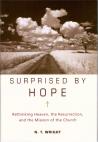
Therefore, it comes as no surprise as to why I have chosen one of his books as the first in a list of five books offering up a new vision for evangelicalism.

In his book Surprised by Hope: Rethinking Heaven, the Resurrection, and the Mission of the Church (Feb. 2008), Wright challenges the notion of “going to heaven when you die” and spending an eternity in some bodiless future. For if this was the case, Wright says, “then what’s the fuss about putting things right in the present world?”

Is our evangelical language of our future existence reflective of NT orthodoxy? Do we have a consistent biblical message on “life after death?” Wright doesn’t believe so, and he claims we have instead embraced a Gnostic view of the future that fouls up our presentation of the gospel in the present. He believes we have lost sight of the biblical vision for the future.

Our future home is not “heaven”—for this is where God is presently—another dimension altogether. Our hope is in this spiritual heaven coming down to earth. The climax of all human history is the consummation of God’s spiritual realm (heaven) breaking through to our earthly existence. Therefore, in Wright’s view, it is “life after life after death” that we find our hope, and a hope for the world.

Wright’s greatest emphasis is on “resurrection” and “new creation” that has already begun in this world. It is time to realize the great significance with that which is at the heart of our faith in Christ (1 Cor. 15:12-28). He writes, “it is (resurrection), principally, the defining event of the new creation, the world that is being born with Jesus.”

It is in the resurrection of Christ that happened in this old creation that gives us hope for a new creation taking place right now in the 21st century.

“Hope is what you get when you suddenly realize that a different worldview is possible…” (pg.75).

This “new creation” should not be confused with baptizing the culture into Christianity and attempting to enact a utopian dream, as some evangelicals have embraced. Wright says that his misplaced trust in the myth of progress does not work because it does not fully account for evil.

This myth may sometimes run parallel to our Christian hope, but it “veers off toward a very different destination” that ignores the need for the cross of Christ upon the natural fallen creation. It doesn’t see the need for change within, only uniform capitulation to a set order of ideas.

Wright declares, “What matters is eschatological duality (the present age and the age to come), not ontological dualism (an evil “earth” and a good “heaven”)” (pg. 95). Evangelicals have also been guilty of preaching the apocalyptic demise of the space-time universe! Therefore, we all must get ready to be raptured for another world altogether.

This belief in a Platonic escapism has pervaded our theology and demanded that we adopt a popular dispensationalist view of the future—a future where we “fly away” and are “raptured” to spend an eternity in a glorified retirement home in the sky.

Wright believes that embracing the biblical vision of the future will lead us to a proper practice of the church. If our beliefs about heaven and the resurrection are wrong, then we are not entirely about the Lord’s business in ushering in the Kingdom of God, more specifically in ways keeping with the example of Christ who has revealed what it means to be human.

It is time we abandon this empty belief for one that appreciates the hope given to us in the NT—a hope where God restores his good creation and finishes the work he began in the universe. Wright states, “What creation needs is neither abandonment nor evolution but rather redemption and renewal; and this is both promised and guaranteed by the resurrection of Jesus from the dead” (pg. 107).

Wright draws our attention to Christ’s ascension as well as his resurrection. Because of the ascension of Christ, we not only have a savior who is indwelling us and present with his people, but a Lord who is at the same time “gone on ahead of us” by being the first to enter into our promised resurrected existence.

In other words, the work of Christ is finished and yet to be realized. It is reflective of the “already, but not yet” tension of the Kingdom of God.

We await a savior to complete the work he began in us. This completion shall come by way of the parousia or his “coming.”  Wright very simply writes, “he will in fact be “appearing” right where he presently is—not a long way away within our own space-time world but in his own world, God’s world, the world we call heaven” (pg. 135).

Wright challenges our traditional picture of our journey being completed upon death. He argues that there is indeed a temporary “paradise” for believers awaiting the resurrection of the dead and the completion of all things. But if evangelicals ignore the finished work of Christ through the final resurrection of the dead, then we miss the entire Christian hope.

God’s judgment is a good thing, something that believers ought to celebrate—for evil will be dealt with once and for all and heaven will make its home on earth. On the other hand, the judgment gives the unbeliever much to worry about.

While Wright calls into question our modern interpretations of hell that are reflective of a theology from the Dark Ages, he finds it impossible not to believe in some sort of “ultimate condemnation” for those who have rejected God’s purposes for the earth. He says that these folks will cease to bear the divine image, and by their own choice become “beings that once were human but now are not.”

Wright believes that whatever “hell” is in reality, beyond the bizarre biblical metaphors, it should suffice for evangelicals to agree that it is a horrible end. And that should be enough. It is time to stop arguing over evangelical views about hell. Belief in a literal hell is not the true test of orthodoxy.

Wright’s main idea is this:

Heaven and hell ought not be the focal point of the Gospel.

The resurrection and ascension is not designed to take us away from this earth but instead to make us agents of transformation, anticipating the day when, “the earth shall be full of the knowledge of the Lord, as the waters cover the sea.”

Wright looks at the themes of justice, beauty, and evangelism. What do these look like in light of this radical message of hope? What does this look like in retrospect to the resurrection of Christ and the promise that we will inherit the same? Furthermore, what should the mission of the church be in light of this biblical hope for the future? Wright believes it is “to live consciously between the resurrection of Jesus in the past and the making of God’s new world in the future” (pg. 213).

Finally, I have chosen Surprised by Hope as the first book in this series because it is a much-needed theological challenge to popular evangelicalism. It gives us a biblical vision of God’s good future for heaven and earth.

I pray that Wright’s message will begin a move among evangelical churches to return to the biblical hope for the future, and offer the world more than an escape from a devil’s hell for a distant realm in a bodiless heaven.

For those interested, you may also purchase the 6-session DVD study with this book. It is an excellent resource for both independent and group study.

D.D. Flowers, 2012.

Read the next post: Vision for 21st Century Evangelicalism, Book Two

* See the first post Vision for 21st Century Evangelicalism, Intro for information on the free book giveaway at the end of this series.


Hidden Treasure & Fine Pearls

What is it that has some folks continually making bad decisions and finding themselves in the dump of life? Do they enjoy their isolation? Do they revel in their private hell? Don’t they see the trail of tears in their rearview mirror?

I’m no psychiatrist, but I have some experience with this sort of thing and I believe that most people don’t want to live this way. So why do they persist in their destructive decisions and fleshly behavior?

Now before you suppose that I’m about to tell you that the Christian life is all care bears and sunshine, I want to make it clear that I’m well aware of the challenges and, as Mike Yaconelli put it, the “messy spirituality” of us all.

None of us have it all together. I got it. We all get it. We have all made bad decisions at one point or another. And sometimes life just happens.

No, my heart is heavy for those that continually ignore sound advice and biblical wisdom—allowing their emotions to steer their ship into a whirlpool of more pain and death. They invite darkness upon themselves.

They see the signs, they hear the warnings, but their foot remains on the pedal as they speed past one stop sign after another. They say, “I’m gonna do what I want.” They avoid total surrender to Christ.

These folks will usually find someone to comfort them and affirm their destructive way. The world is filled with plenty of people wandering around in the dark claiming to know a thing or two.

We have all been there. You can surround yourself with ungodly counsel and feel good about it, especially when they tell you what you want to hear.

But listen to the biblical sage in Proverbs 2:1-8:

My child, listen to what I say, and treasure my commands. Tune your ears to wisdom, and concentrate on understanding. Cry out for insight, and ask for understanding. Search for them as you would for silver; seek them like hidden treasures. Then you will understand what it means to fear the Lord, and you will gain knowledge of God. For the Lord grants wisdom! From his mouth come knowledge and understanding. He grants a treasure of common sense to the honest. He is a shield to those who walk with integrity. He guards the paths of the just and protects those who are faithful to him. (NLT)

Jesus told a series of parables about the “kingdom of heaven” in Matthew 13. In the Gospel of Matthew the “kingdom of heaven” is synonymous with what the rest of the New Testament refers to as the “kingdom of God.” The kingdom is at the forefront of Jesus’ message.

Jesus says, “Seek the Kingdom of God above all else, and live righteously, and he will give you everything you need” (Matt 6:33). Let there be no mistake, Jesus was all about kingdom.

So what is the kingdom? Entire books have been written on the kingdom. I’ll just sum it up this way:

The kingdom is God’s reign and rule in the cosmos. It’s God’s divine program!

We don’t really use “kingdom” language anymore. A “kingdom” is literally a king’s domain. Jesus preached that God had arrived to establish his reign and rule on the earth—to claim it as his own! That’s why Jesus prayed that God’s will be done on earth as it is in heaven. He was praying for the very reign and rule of God upon the earth (Matt 6:10).

The kingdom—his reign and rule—always looks like Jesus.

It shouldn’t come as a surprise then that Jesus would call his followers to “seek the Kingdom of God above all else” because it is where real rewarding life happens. When we are participating with Christ in allowing God’s reign and rule to saturate our lives, and in the lives of those around us, we experience what it means to truly live.

When we live for kingdom, our lives are being built upon the solid rock of Christ.

In order to experience this “abundant” life of kingdom, we must be willing to deny ourselves and sell all that we have to take possession of it (Jn 10:10; Matt 16:24). It’s the only way.

Listen to this short parable of Jesus.

“The Kingdom of Heaven is like a treasure that a man discovered hidden in a field. In his excitement, he hid it again and sold everything he owned to get enough money to buy the field.”  Matthew 13:44

What do those frustrated folks I mentioned above share in common? Simple. For whatever reason, they have not found Christ and his kingdom a treasure worth reorienting their entire lives around. Some “thing” or some “body” excites them much more than Christ.

It’s no secret that their persistence in making poor decisions is evidence that Christ is not central and supreme. There is one throne in their life… and they are sitting on it.

“Again, the kingdom of heaven is like a merchant looking for fine pearls. When he found one of great value, he went away and sold everything he had and bought it.”  Matthew 13:45-46

If you are not a follower of Christ, please know you can trust that the yoke of Jesus is easy and his burden is light (Matt 11:28-30). The yoke of the world is hard and the burden of it will eventually crush you. Are you willing to sell all that you have to purchase that field… to acquire the fine pearl? Or would you rather take your chances with the world?

If you are a follower of Christ, I want to remind you that your salvation began with a passionate love of Jesus and his kingdom. Have you forgotten your first love? What are you loving more than Christ?

Dear friend, God loves you and wants to supply you with true nourishment for the soul. He alone will satisfy. How long will you turn to temporal things for your identity, security, and self-gratification?

What has become more important to you than the kingdom of God? Jesus said, “No one who puts a hand to the plow and looks back is fit for service in the kingdom of God” (Lk 9:62). What has you looking back? Can’t you see you’re plowing crooked rows?

Listen to wisdom. Respond to the voice of the Spirit of God. Put your hand to the plow and don’t look back. What’s past is past. Make your next decision for Christ and the furtherance of his kingdom.

You won’t be at peace until you do.

D.D. Flowers, 2011.