Tag Archives: house church

Organic Church Life: The Beginning

Organic Church Life: The Beginning

My wife and I left the traditional church in September 06 and began a search for authentic church life around Jesus Christ. In November 06 we began meeting with a group of folks who all left the same organized church in East Texas. We call this our “experimental house church” when telling our story. Why? Well, frankly, we didn’t know what we were doing.

We were all reading books on house churches and studying the Scripture in new ways. It was simply a time of discovery and of detoxing from religion. This is when I first began a long-distance relationship with Frank Viola. The Lord is still using his influence in our discovery of Christ in the church.

We were largely concerned about “what to do” than simply letting Jesus give us that familial community that is in Christ. Yet, this was the season the Lord had us in and it was an essential part of the journey.

In January 07 we went to the North Texas House Church Conference in Dallas. It was there that we learned not everyone was gathering in homes for the same reasons we were learning about through Viola and a few other authors.

We learned a huge lesson at this conference. Some folks had just switched venues (from the building to the house) but had no new revelation of Christ. It was really sad to watch. But we are thankful that the Lord allowed us to see the difference and draw close to him.

We were in this experimental stage for about 7 months. In the Summer of 07 we moved to Houston to seek new jobs and a new life. Our move was primarily made as a result of connecting with a group of believers who had been meeting in homes for 7 years in West Houston. I can still remember that first visit. Wow! That was when everything clicked.

The brothers and sisters there were radiating Christ in their gatherings. It was the first time I saw Jesus lead a gathering where there was no man leading. There was leadership, but not in any way I had ever seen.

It was also the first time I had ever met an 80 year old man who knew the Lord as a Person. He is now in heaven awaiting the resurrection of our bodies and the fullness of the Kingdom of God on earth.

The Lord moved us to The Woodlands in July 07 just north of Houston. It was clearly where the Lord wanted us… even though it was 45 minutes from the believers in West Houston. To keep this note short(er), I will just tell you we met with the saints there for a year. In that year, the simplicity of church life gathered around Christ had become natural for us.

We quickly began sensing the Lord calling us to meet where we lived. Not only were we convinced that this is how churches ought to be established (locally), we felt a deep desire for greater community with believers in our area. We knew the Lord wanted us to be an expression of his Person where we lived.

So, my wife and I, along with our friend Grant (27) who lived down the road from us, decided together that it was time to begin meeting in our city.

I wish I could tell you that the people started knocking on our door, but I would be dishonest with you if I did. We waited patiently for the Lord to naturally cause us to cross paths with folks who longed for more of Christ. The three of us met in our home (with an occasional visitor) for about 6 months before Jesus began moving around us.

We were just about to the point of discouragement (OK, maybe we were already there) when the Lord brought Michael (39) to us. He had been on a similar journey as the three of us. Toward the end of the year, we had another solid addition. Rita (50) committed herself to the fellowship.

Joel (39) e-mailed me after having read my Confessions of an Ex-Clergy Member. He and his family had been detoxing from the religious “mega-church” life for about a year. They lived right down the road from us! I met Joel at Starbucks for coffee and a bit of convo and we hit it off! His family of four (with one on the way) has been meeting with us since the first of the year.

Presently, we gather on Sunday mornings and Wednesday nights regularly. These times are etched out in our schedules and are the easiest for sure times to meet. Every other week it seems we have a visitor.

The Lord is really busy around us. I have met with two brothers this month who just wanted to talk about Christ and our journey. I am meeting another brother this week who lives in Houston. I constantly have folks writing and inquiring about the gathering of the saints in our city.

Three weeks ago we had a gathering of house churches from all over the city. It was the first of its kind that we know of in Houston. There were about 60 there from all over Houston. One older brother there said he had been meeting in homes for 25 years and never knew we all existed. This tells me that we are on the front lines of what Jesus is doing in the greater Houston area.

We feel blessed to be included in the Lord’s work. In August, we will be having an Organic Church Life Conference in The Woodlands with Frank Viola and Milt Rodriguez. We are excited about what the Lord is going to do between now and then.

Finally, I just want to add what a joy it is to know Christ in community. As a local expression of Jesus in our city, we feel like we have known each other forever. We are beginning to see Jesus build his Body through real relationships that have him at the center. Thank you Lord!

3/15/09


Christ the Center

Christ the Center– The Journey from Religion to Relationship

“This is what we speak, not in words taught us by human wisdom but in words taught us by the Spirit, expressing spiritual truths in spiritual words.” Paul, First Letter to the Corinthians

It was a few years ago that I first began realizing that American Christianity does a fine job of polishing its rhetoric to reflect a Christ-centered creed, but its practices are far from resembling Jesus of Nazareth in the Gospels. It speaks of spiritual things and words that have not been taught by the Spirit.

Human wisdom has produced a religion founded on doctrines and teachings about Christ, and we are continually being diverted from knowing Christ by way of relationship.

Having spent seven years in vocational ministry within the institutional church, I can personally attest to the constant struggles that come by attempting to implement a New Testament church life in the present model of institutional Christianity. I learned all the right words, memorized all of the correct doctrines, and made the Bible the passion of my life.

I (like so many others) believed that the more Bible I could master the sooner we would see “revival” and a restoration of the church. If this passion for the Bible became contagious throughout the entire church (I thought), then the church will be what she was created to be. Everything will come together, right? Quite the opposite for me.

This is when everything fell apart.

Leaving Religion

I left vocational ministry in September of 2006 to follow Jesus in search of a religionless Christianity. In a relentless pursuit of the Person of Jesus in the Gospels, I found that I could no longer be faithful to Christ within a system that makes a nice living off of talking a great deal about Jesus, but seemingly unwilling to follow him beyond the boundaries of tradition and empty clichés.

I had my fill of religion and felt like I was only spinning my wheels. I was exhausted in my efforts to see any kind of resemblance to the simple yet powerful church life described in the book of Acts. I was tired of feeling that all my efforts were self-defeating. I was burnout and more than willing to rethink everything I knew about Christ and his church.

I have only Jesus to thank when it comes to the strength it took to leave this burdensome life behind. It was a little scary, but my knowledge of the Scripture told me there must come an exodus and an exile before there can be a restoration.

As religion becomes smaller and smaller in the rearview mirror of this vehicle called “my faith.” I am finding the call of Jesus a satisfying cross to embrace.

I am finding that my past burdens were largely brought on by self. I had a work-centered faith that I passed off as “Christ-centered” while living amongst many folks that were largely self-centered and disinterested in knowing Jesus beyond the Sunday school quarterly.

All of this produced in me an experience of extreme highs and lows. Everything about the way we taught and practiced our faith kept God at a distance it seemed. This was my greatest frustration.

I am happy to say that the Prozac popping Santa Claus god is now dying a slow death. I am learning of a Lord that loves me beyond anything I have ever known. And this love attracts me to his Person. It calls to me and tells me there is more. It tells me that I will never be able to experience the full depths of his being, but that I should continue trying evermore.

The Word Became… Ink?

“Bible instruction can easily be diverted from its God-intended purpose: love of God and fellow human beings. In its place is a new, lesser purpose: the Bible as an object of curiosity and fruitless spiritual debate.”
Tom Hovestol, Extreme Righteousness: Seeing Ourselves in the Pharisees

As I look back on my journey with the Lord, I see his wonderful patience with me. My spiritual birth began with an intimate knowledge of him in my spirit. How else would any of us receive eternal life without this engagement with Christ? Yet, this relationship, this intimate knowledge of the Person of Christ, quickly became secondary to the things I could learn about him with my mind.

I didn’t understand Paul’s words, “just as you received Christ Jesus as Lord, continue to live in him…” (Col. 2:6).

I do not mean to present some false dichotomy between me learning about Christ with my mind and knowing him in my spirit, but let’s be honest, you can easily do one without the other. And I would venture to say that most people confuse the first with the later.

The Pharisees did this and Jesus called them out for it. They studied the Scripture, but did not know the Lord. They did not recognize God in the flesh. They were zealous for the written word but rejected the Word made flesh.

Despite their expectations about Messiah, they were given ample opportunity to embrace the living Word, but instead chose a religion filled with human rules and regulations. What was intended for life only brought death. It enslaved the people and kept them from knowing the Lord (Matt. 23:13-39).

“You diligently study the Scriptures because you think that by them you possess eternal life. These are the Scriptures that testify about me, yet you refuse to come to me to have life.” Jesus, The Gospel of John

I have found that we can still read the Scriptures like these infamous Pharisees. I obtained a degree and spent years studying the Bible. Like the Pharisees, I believed that a strict orthodoxy was the key to revolution.

Like so many popular reformed theologians today, it is believed that correct doctrine and defending the “truth” in the culture is the secret to God’s Kingdom coming to earth. These men boldly rebuke “heretics” and don’t mind offending you for the sake of their personality. And of course, all of this is done in the name of Christ. This is what so many believe to be “Christ-centered.”

When Sola Scriptura (i.e. Scripture alone) is your war cry, you have no choice to make for yourselves a Bible-centered life that is disconnected from Christ the living Word. A faith built on a passion for doctrine demands the same attitude that put Jesus on the cross.

In this kind of life, the Bible becomes an end unto itself. And whatever a person needs to do to further “correct” doctrine and defend the Bible is permissible in certain circles of evangelicals today. They are quick to denounce the sincere pursuit of others who seek a Christ that is more than a few theological bullet points and sin-centered sermons littered with meaningless clichés.

The least we can do is question the approach of these modern-day Pharisees who are Christ-centered in their language, but only promote teachings that disregard the way of Jesus. These men use the Scriptures to defend Christ, but do so in a manner that offends the heart of God.

“The holy writings are valuable for those who use them right,” testified one Anabaptist at the Regensburg trials in Bavaria. “But their misuse is the source of all heresy and unbelief. To the scribes and the Pharisees the holy writings were not a guide to Christ, but a hindrance and eventually a punishment.” Peter Hoover, The Secret of the Strength: What Would the Anabaptists Tell This Generation

Wait! Isn’t doctrine important? Yes, but right doctrine comes from a close examination of the Person and work of Christ in the Gospels. It comes from an intimate knowledge of the indwelling Christ. From my own personal experience, I believe it is because of our failure to give attention to Jesus in the Gospels that we have interpreted the letters of Paul as merely instructions on doctrine instead of an exposition of Jesus and his Kingdom come on earth as it is in heaven.

“My purpose is that they may be encouraged in heart and united in love, so that they may have the full riches of complete understanding, in order that they may know the mystery of God, namely Christ, in whom are hidden all the treasures of wisdom and knowledge.” Paul, Letter to the Colossians

I don’t know what I did with verses like the one above before the Lord gave me eyes to see and ears to hear. It wasn’t until I became intrigued with Christ as Person that I began to see a spiritual revolution in my own life. When I made Christ my only doctrine and concerned myself with the fact that his very Person lives within me, I was then able to begin a journey from religion to relationship; from rhetoric to revelation; from intellect to indwelling; from academia to apprehension.

I was trained in the historical-grammatical approach to studying the Scriptures. Mostly due to immaturity, I had not learned to bridge my intellect with my spirit. Bible study was simply an intellectual exercise.

Sure, there were many times I had some sort of spiritual encounter and sensed the Lord working in my life through it all, but I now see that the written word of God had become a substitute for actually knowing Jesus in spirit and in truth. The Scripture was not ushering me in to knowing Christ in personal experience. Therefore, my transformation was slow and my strength was limited to what I could do on my own. The Lord allowed this for a time.

This Bible-centered life was evident in my passion for doctrinal purity. I was not yet aware of the full measure of the indwelling Christ and how to study the Scripture out of that life. It was like living with someone in your house but rarely speaking to them.

I was learning a great deal “about” Jesus, but had a difficult time making it to the couch to sit and chat with the lover of my soul. I allowed my analytical mind to be entertained by theology, but my spirit was desperately longing to kiss the face of God.

“The word of God states that the truth shall make us free, but how many times truth is merely a doctrine to us. Our eyes have not been opened to see Christ.” Watchman Nee, Christ: The Sum of All Spiritual Things

I did not feel free in my spirit. My soul was restless. I believed that all I could aspire to was to be filled with more Bible and great theological ideas. I constantly struggled with a distorted view of God. I knew what the Scriptures said about the closeness of God in Christ, but I didn’t have the experience to go along with it.

I just kept yearning after the Lord and seeking to find him in one teaching after another. And when the Lord is a teaching instead of a Person, you die for teachings (believing them to be Christ) and you attempt to rid the church of all who disagree with you. I don’t believe I ever gave myself over to that completely, but I did see plenty of older folks that had.

When the Lord is found in a teaching and you have no working knowledge of Christ, you are not content to let the Person of Jesus deal with the shortcomings of others and the errors of the church. When your God is restrained to paper and ink, you can’t know him in the flesh. And you must know, the Word “became flesh” (Jn. 1:14).

The incarnation of God is mankind’s only hope. This is becoming less and less something to simply “Amen!” and move on about your business. It is for me, becoming everything.

Bible-Centered or Christ-Centered?

“The cumulative effect of all parts of the Word of God is to bring you to Christ.”
T. Austin-Sparks, The Centrality and Supremacy of the Lord Jesus Christ

Is there a need for proper interpretation of the Scriptures? Most definitely! However, we must understand that this interpretation does not end in a study of the context of Paul’s letters to the Corinthians. It ends in a dazzling display of Jesus! It culminates into a spiritual apprehension of Christ. And this is something only he can give you when the “Divine quest” for the Person of Jesus is at the center of your being.

Until Christ is all that you desire, you will continue to know frustration and heartache.

We can’t gain knowledge of Jesus and an inward apprehension of him and receive shady theology in return. It is in knowing Christ that we understand what birthed the writings of the apostles. It is only then that we may receive proper instruction on worship and how the believer is to relate to a world marked by estrangement.

Christ is not a teaching or a “Bible-study”, he is a person to be cultivated in human experience. This may begin out of a sincere longing to know Christ in our mind and much study of him with our intellects. But in the end it ought to lead us to a knowing him in the depths of our spirit. It is only then that we partake of the bread of life. It is only then that everything finds its proper place.

This is where evangelical Christianity has fallen to its greatest depths. Since the Protestant Reformation, it is the written word of God that has become the highest attainable goal. The Anabaptists believed this to be the mightiest error of Luther and company.

The “Reformers” of the Catholic Church clung to Scripture, not to Christ. They rested in doctrines alone and thought it strange to speak of Christ as your closest friend. Folks that talk this way, these “mystics”, were burnt alive and met their end in martyrdom. And they are still to this day read with caution and some with disdain.

According to the testimony of those they persecuted, the Protestants rested in grace and did not live in the power of the resurrection. Their strict interpretations of the Scripture and their zeal for orthodoxy actually led them down a path of anti-Christ. Their failure to let go entirely of the church that Constantine built produced in them a deception that can only be matched by the men that cried out for the death of Jesus.

Knowledge that comes to us apart from the indwelling Christ will puff up the most sincere of men (1 Cor. 8:1). Knowledge obtained without first having passed through the cross of Jesus will always lead to sin. It is here where many believers find themselves. They have learned the appropriate rhetoric of Christ-centeredness, but their words are not born out of a revelation from the Lord himself. They easily find themselves continuing on with right speech, but their actions actually begin to prove that something else is at work.

It is not long and this person finds that their faith is filled with all kinds of contradictions and empty clichés that have no practical meaning for their lives. They sound holy, their words reflect a sort of biblical Christology, but their spirits are not governed by the life of Christ. They have not experienced the faith that is continually being born from above. What they have has not been given to them by Jesus in their spirit.

There is no inward reality of the indwelling Christ shaping them and molding them. The Person of Christ is not guiding their every step and speaking to their hearts. They have a few momentary spiritual glimpses into the Lord but the rest is just adrenaline and good intentions.

What is the Bible? Simply stated, it is the Spirit-inspired written testimony of men about the living God coming to earth and revealing himself in Jesus Christ of Nazareth. How has this collection of writings we call “The Bible” become the object of so much division among believers? “Is Christ divided?” What have we done with Paul’s warnings of division in the Body of Christ? We have celebrated them in what we call “denominations” and we treat this as a good thing.

Our passion for doctrine has blinded us to the many contradictions we have embraced. And we continue to find reasons not to abandon 1700 years of institutional Christianity founded on the ideas of men that can’t be justified by the Scriptures.

This is another piece of twisted evidence that the Bible is not being read as a testimony of the Christ presented in the Gospels. It is not being studied and read for the purpose of apprehending Christ in community, but for the mere propagating of a doctrine, a mission, a program, a ministry or a movement. We are guilty of worshipping the biblical text instead of the One it reveals.

We can know we have done this by the many ways we have violated the Person of Jesus and contradicted his example left in the Gospels. Having lived this way, we may only say that we are “Bible-centered” or “Paul-centered” or better yet, “Mission-centered.” But we dare not say we are Christ-centered when Jesus is not our only concern. If the Lord has not yet revealed to us that out of Christ comes the church, then we must wander a little while longer.

“I consider everything a loss compared to the surpassing greatness of knowing Christ Jesus my Lord, for whose sake I have lost all things. I consider them rubbish, that I may gain Christ and be found in him…” Paul, Letter to the Philippians

Conclusion—Christ the Center

We may say Christ is central and supreme in our lives, the church, the world, and the cosmos, only after we have put our hand to the plow of his Person and work; after we have forsaken all others for his namesake. Once we are willing to lay all else aside to experience the depths of who he is, we may call him “Lord” with complete assurance that he is indeed the Lord.

Brothers and sisters, it is in these things that the Lord says, “Yes!” The Son has been exalted that we might know him “in whom are hidden all the treasures of wisdom and knowledge” (Col. 2:3). He has become flesh that we might know that “in Christ all the fullness of the Deity lives” (2:9). It is not a method we seek, we seek Christ. Any “good” thing outside of Christ is dead! It is not a thing we desire, it is a Person. Will we continue running after dead things in Jesus’ name?

On this journey from dead religion to a living relationship, I have occasionally asked myself, “Am I making too much of Jesus? Is it all really this simple?” And I hear the Lord speak, “Come to me, all you who are weary and burdened, and I will give you rest… for my yoke is easy and my burden is light” (Matt. 11:28; 30).

Well, I must say I am finding that “yoke” much easier than before. But, could I be oversimplifying things and reducing the Gospel message? (I smile with a faint chuckle) What else is there but Jesus? Very confidently I reply, “Nothing of any worth.”

Let us press on in the journey of experiencing the depths and riches of Christ Jesus our Lord. No other purpose will satisfy the heart of God or our own groaning for a savior. May we give up our Christ-less “Bible studies” and our foolish church practices that not only hinder, but replace our Center.

Through the power of his resurrection we may break free from religion’s chains and discover a truly Christ-centered faith.

Suggested Reading:

“The Centrality and Supremacy of the Lord Jesus Christ” by T. Austin-Sparks
“Christ: The Sum of All Spiritual Things” by Watchman Nee
“The Secret of the Strength” by Peter Hoover
“The School of Christ” by T. Austin-Sparks
“Extreme Righteousness: Seeing Ourselves in the Pharisees” by Tom Hovestol
“Christ the Center” by Dietrich Bonhoeffer
“The Normal Christian Life” by Watchman Nee
“Bethany: The Lord’s Heart for His Church” by Frank Viola


The Problem with Modern-Day Preaching

“Preach the Word (i.e. Christ; John 1:1-2, 14); be prepared in season and out of season; correct, rebuke and encourage– with great patience and careful instruction. For the time will come when men will not put up with sound doctrine. Instead, to suit their own desires, they will gather around them a great number of teachers to say what their itching ears want to hear.” Paul, Second Letter to Timothy, 4:2-3

I write to you out of an observation of the great majority of today’s preaching from the pulpit and the pen. The pulpit may be bulky and made of solid oak, or a glass podium, or even a simple music stand… it doesn’t matter. From whatever pulpit… by whatever popular teacher or author… in whatever form… something is most definitely wrong with today’s “Christian” preaching.

In addition to bad hermeneutics and those who preach for monetary gain, there is a compromising of our faith being displayed in the sermons of many respected preachers and a capitulation to the surrounding culture.

I am writing to you from what I believe is coming out of the last few years of my life–out of an immense shift in my understanding of the centrality and supremacy of Christ. I believe this observation is born out of what I have dubbed my “renewed” Christology.

For me, it was a revolution of the heart. And this revolution has set into motion a great undoing for an even greater relearning. It has caused many curtains of culture to be lifted from my eyes. This light, I believe, is available to all that desire it. To those who knock, the door will be opened. To those that seek, they shall find (Matt. 7:7).

Let the heart of this examination be known to you who read. And together, let us seek the centrality and supremacy of Christ… especially in our preaching.

The Christian Life is Principles?

“See to it that no one takes you captive through hollow and deceptive philosophy, which depends on human tradition and the basic principles of this world rather than on Christ.” Paul, Letter to the Colossians, 2:8

According to most preaching today, a person could easily make the judgment that Jesus did not come to give us his life, but to give us principles to live by. Yes, it is fair to say that Christ is not the end of popular preaching today. It could easily be deduced from your nearest pulpit that Christ was a mighty philosopher who has given us morals, values, and principles to follow that we might find happiness on earth. It is often presented that if we will learn the right formula all will be well with the soul.

Let us at least be clear about this one thing, this is not the message of Christ or the first apostles.

During the last hours of Christ’s life, he prayed, “My prayer is not for them (i.e. 11 disciples) alone. I pray also for those (i.e. you and I) who will believe in me through their message, that all of them may be one, Father, just as you are in me and I am in you… I have given them the glory that you gave me, that they may be one as we are one: I in them and you in me.” Jesus, The Gospel of John, 17:20-23

The apostle Paul wrote, “God has chosen to make known among the Gentiles the glorious riches of this mystery, which is Christ in you, the hope of glory. We proclaim him, admonishing and teaching everyone with all wisdom, so that we may present everyone perfect in Christ. To this end I labor, struggling with all his energy, which so powerfully works in me.” Paul, Letter to the Colossians, 1:27-29

When the Gospel of Jesus is reduced down to forgiveness of sin and going to heaven when you die… we miss the true message of the whole Gospel of Christ. When we talk about knowing Christ today and all we think of is Jesus dying for our sins, we fall short of the complete good news of God. We must move on and grow up into the fullness of Christ in us! We must commit to rereading Scripture with this as the primary concern of all of the apostles of Jesus. They understood that the message in all of Scripture was that God has given us his life through Christ Jesus his Son.

Therefore, the Gospel message is to preach that God has paid our sin debt in order that his life can reign in us. The only concern of the first Christians was to preach that the person of Jesus was the gift, not heaven. The Christian life is not a destination, it is a journey. It is not about principles, it is about a Person.

I am fully aware that today we have philosophers and motivational speakers sitting in the prophet’s chair. Clearly, these men preach human wisdom and use the Bible to polish their self-centered messages in order that they might label them “biblical.” It is very disturbing to see the multitudes that are being deceived by these men.

However, I would like to particularly focus my attention on those who preach principles while at the same time mixing Christian language in the message. They preach Christ, but through learning steps and principles… instead of learning of his Person. They do not present the message I have stated above. They speak of living Jesus’ life without first knowing his being. They see only the benefits of following Christ. They do not embrace his Person as the life force within them that will carry out his commands.

If we are honest with ourselves, much of the so-called “Christ-centered” preaching that we hear today is presented in expounding on principles taken from Christ’s life… instead of it simply being Christ’s life in us. It is an attempt to use Christ to achieve our ends, instead of knowing Christ to reach his own.

Yes, if we are honest… most Christians believe that Christianity is about following some guidelines (which translates into a particular way to eat, dress, live, love, vote, etc.)… and we never embrace the full Person of Jesus. Therefore, we attempt to sustain life by principles, fail to receive life from the Person, and we never see Christ come to full expression in our earthly lives.

Is this not evident by the bestselling books today? If you will look closely at a few of the most recent popular books you will notice that Christ is not central and supreme. In some cases, Christ is completely absent from the message. These books present Christianity as principle-filled instead of Person-filled (i.e. Christ-centered). The authors, as well-intentioned as they may be, are trading the Person of Christ for principles to live by. (Some have even denied Christ’s supremacy.) On top of that, these principles are presented in a very self-centered and hedonistic theology.

Life comes out of Christ, never out of principles.

This is what we must understand. If we desire to work out our salvation as we have been commanded… we must come to this: Christ is our salvation from beginning to end. Preaching worldly principles will clearly lead us to destruction. And preaching biblical principles that do not first come from knowing Jesus will stunt our spiritual growth.

This is why so many Christians are banging their heads up against the wall today. They are running from one pulpit to another, one book to another, and one emotion to another. They have not been taught how to grow up into Christ. It reminds me of a Credence Clearwater Revival song called, “Commotion.” There is a bunch of it going on, and seldom do we ever truly live. Let’s stop and rethink our Christology.

Trading Principles for a Person

A couple of years ago I was captivated by seeing Christ’s principles and teachings on the Sermon on the Mount in a new way. It was like I had never read them before or been taught its true meaning in all of my Christian upbringing. The Lord had opened my eyes to verses that we had ignored or watered-down for years.

I began to teach these things without fully understanding “Christ in you.” I believe that I had a brief understanding, but it was not yet articulated in my thought or life. It must have seemed impossible to my students, “How can we live this way?” I imagine this is exactly what Jesus’ audience was thinking when they heard it for the first time, “What is this man saying, ‘love my enemies’?… he is out of his mind!” No doubt, many thought he was crazy, even his own family (Mk. 3:20-21).

It didn’t take long for me to develop a renewed Christology. The Lord had been preparing the ground of my heart to receive a new revelation of his Son. It finally came upon reading Watchman Nee’s exposition of the book of Romans in his book, “The Normal Christian Life.” Nothing has been the same since. And I mean nothing.

I will not mince with words on such a critical issue. Living by principles will fail you. Your life is not found in following rules and guidelines and then waving to Jesus off to the side, saying, “Thanks for these wonderful principles my Lord! Now I can live a happy life and expect preferential treatment from the world.” Many of my readers may be thinking, “I would never say that.” Yet, we fail to see that we don’t have to say it. Our focus today and our faithfulness to these principle preachers have already condemned many of us tomorrow. We need to trade in principle-centered teachings for those that are first Christ-in-you-centered.

“But now that you know God– or rather are known by God– how is it that you are turning back to those weak and miserable principles? Do you wish to be enslaved by them all over again?” Paul, Letter to the Galatians, 4:9

Can we truly live the abundant life Christ gives by simply being mindful that we might die in 30 days? Will inspiration last by holding on to some cliché or our trust in 12 steps? Will legalism and ascetics save the day? Seriously, how long does that work for you?

This may help the world make it through the day, but our hope is not in worldly wisdom and things of men… our hope is in the Person of Jesus Christ. Has not Christ given us himself to be everything that we need to motivate and inspire, to fill us with purpose and a mission? Hasn’t he made a way to fulfill the law by embracing his Person? From what I am hearing today, apparently not. And I sincerely believe this great distraction of God’s people is fueled by the devil.

“How far Satan will go even in bringing about a kind of devotion to Christ, and promote a mystical, physical “Christianity” with elements of moral elevation, and yet hide within that very thing something which is of himself and, being of himself, savors of that which was in him from that time when he himself was hurled out of heaven, that thing which would take from the Lord Jesus the absoluteness of His place in the Godhead.”T. Austin Sparks, The Centrality and Supremacy of the Lord Jesus Christ, p.38

If you listen closely, much of modern-day preaching is an attempt to fill the void in people’s soul by taking the back door approach to living victoriously. In the end, it undermines the absolute centrality and supremacy of Christ. Instead of preaching the depths and riches of Christ, his principles are taught in its place (not entirely of course, just those principles that fit our accepted cultural and theological ideas). To add to that… mix some new age self-help heresy in there and you completely lose anything that comes close to resembling Christ.

Christ has made a way for us to come to him directly. We should not concern ourselves with the effect (his living), until we begin with the cause (his life). Beginning with Christ will in the end give us those things that we see in his principles. We must concern ourselves with the being, instead of the doing. The doing will come naturally after we have locked on to his Person and understand that knowing Christ in spirit and in truth is our only concern.

Principles Out of the Person

About a year ago, I met a man and discussed with him that there are churches that believe there comes a time to kill enemies, despite what Jesus has said. Being Christ-centered and understanding “Christ in you”… he was befuddled and could not comprehend that there were professing believers that actually believed this.

He was so consumed with “Christ in you” he did not see an unattainable principle, he understood that the Person of Christ in him would never even entertain the thought of violating a teaching of Jesus. The same Christ that loved his enemies in the first-century was the same Christ living in him today. Although his reaction proved him to be a bit cut off from the outside world, I will never forget his reaction of complete shock.

When the Person of Christ has not been embraced and when we have missed the full message of the Gospel which is “Christ in you”… then of course, many of Christ’s principles and teachings seem absolutely ridiculous and impossible to expect adherence. This is why teaching principles without the Person can never lead us to Christ in the way he has prepared.

Ultimately, we fail to apply principles because the nature of the matter is to accomplish these things by doing in our own strength, instead of knowing and being the Lord in his strength.

When we falsely believe that forgiveness of sin is all there is to Christ, we will inevitably fail to see the world rightly through the eyes of Christ, for we have not fully realized that life within us. We must enter into his life before he can use us to manage his affairs in the church and preach the pure Gospel of salvation to the world.

We have to decide which it will be. Will we attempt to live out his principles apart from first knowing his life? Can a popular book on principles give me the life in Christ I desire? Can a sermon that says, “Principles in you, the hope of glory” save? Can this save you?

Should we not seek to understand Paul’s words, “Christ in you, the hope of glory.” The later will deliver the life that is promised. The first will only sell books and gather around men a great following of religious people. Outwardly, the hype might appear as success and fulfillment, but the people who go home empty in heart know better. We simply must be willing to be honest with ourselves and the Lord.

At the end of the day… pop culture Christianity is a mirage in a desert wasteland. We must cross over Jordan to Christ in this life… if we ever wish to enjoy the fruit of the land in the next.

emerging_church1It is evident in whatever form of church you find yourself in. Something is missing in it all. Where there ought to be spiritual life, there is death. Over the last decade or so I have noticed the church drama has been building. Have you? Everyone is offering up their “new” and “innovative” ideas to blow life into the church.
Yet, it would seem that many have not noticed that Christ is absent. He stands outside knocking… he is softly saying, “I would like my church back.” He calls to us in the wilderness, “I am the river flowing from the throne of God.” We must dance in the river if we want to see his life flow from ours.

A Renewed Christology

It was all about Jesus when you were born again. If it had not been… you never would have been saved and regenerated by his Holy Spirit. It would appear that the great problem in the church today is this: Coming to Christ in salvation and then moving off of Christ to fulfill passions, purposes, ministries, and movements by substituting the person of Christ with principles.

The problem with our lives and our churches is not solved in discovering our inner potential through motivational books and sermons. In fact, these messages actually take us further away from dependence on Christ’s life in us. Apart from the Person of Christ, you have no potential.

Likewise, the church’s problems are not solvable by new emerging methods for our narcissistic ecclesiology. It is not answered in bigger buildings, louder music, and marketing degrees. It is not found in being “seeker friendly” or adopting a new program of discipleship. The answer to all of our problems is found in Christ alone. Nothing else will do.

“I myself am the way and the truth and the life.”
Jesus, The Gospel of John, 14:6

It is time for us to return back to our “first love” (Rev. 2:4) We came to Christ in the beginning and we realized the love of the Father, that our sins had been forgiven. Now, we must continue to pursue him in all things and grow up into our salvation (Phil. 2:12). We must move on past the elementary teachings of our faith (Heb. 6:1). We must commit ourselves to rediscovering the Christ of the Gospels. We must move toward revolution instead of vainly attempting to bring life through reformation.

A Challenge

Here it is straight: We cannot fully know Christ’s true principles until we have been captured by Christ’s true Person. Just as you cannot fly a plane while sitting in the terminal… you cannot know Christ by living out principles born from your own will and determination. True Christ principles come flowing from the life that is consumed with: “the mystery of God, namely, Christ, in whom are hidden all the treasures of wisdom and knowledge.” (Col. 2:2-3)

I challenge you to listen to the words being taught by men today. Is Christ’s life the Gospel being preached? With all of the preaching and teaching today, you have to wonder… wonder why there is not a clear distinction between the natural faith of Christ vs. religion. If Christ was all that was being preached, I have to believe we would see a different church.

I am convinced that the Lord is setting a new stage for the churches in America. The stage is filled with suffering and heavy persecution. The right response in preparation is to put our hope and complete trust in the centrality and supremacy of Jesus Christ. Let it be known that Christ is the main actor in this production. It is not the church. We are but mere stage hands. We must understand the implications of this if we are to persevere through what is to come.

Let us go to the Scriptures in search of the indwelling Person of Christ, not principles that we might mold into our corrupted theology of Jesus and the church. Let us pray like Jesus in the garden. “Lord, make us one in you. Prepare us for that Day that is coming. Come Lord Jesus, come!”

“I am the resurrection and the life. He who believes in me will live, even though he dies; and whoever lives and believes in me will never die. Do you believe this?” Jesus, The Gospel of John, 11:25


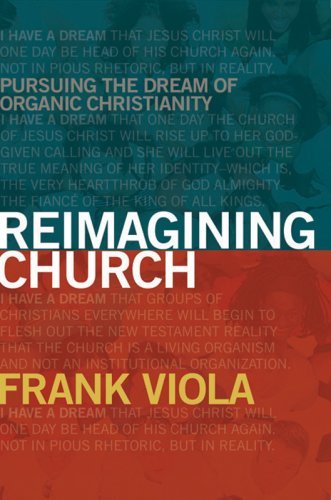
Reimagining Church (Book Review)

reimaginingThe Dream of Organic Christianity

A Book Review of: Reimagining Church: Pursuing the Dream of Organic Christianity by Frank Viola

Reimagining Church: Pursuing the Dream of Organic Christianity by Frank Viola, is sure to send every “clergy-laity” member scratching around for a biblical defense to the claims made against the 1700 year old institutional form of church.  And according to Viola, they will not find a “shred of biblical warrant” to support its existence.

At last, the sequel to the highly controversial book, Pagan Christianity?: Exploring the Roots of Our Church Practices, has arrived!  And it is for certain that not all will applaud its arrival to the bookstore.  No doubt, many readers are still trying to grapple with the favorable recognition and popularity of the first book to this series of 4 books on organic Christianity.

The first time, Viola had the help of George Barna and Tyndale in gaining a few listening ears.  Now that he has the attention of no small number of readers… he has set off to propose serious answers to an audience that is filled with sincere questions.  And Reimgaining Church will not leave readers dissatisfied in their quest for the normal Christian church life.  In fact, it will leave them hungering for authenticity in the New Testament fashion.

As the saying goes, “You can’t judge a book by its cover.”  Many readers have learned that from PC.  So let the reader first understand the title.  Viola states, “it’s the present practices of the church that I’m seeking to reimagine, not the church itself” (p.13).  He clearly outlines his purpose so that there is no misunderstanding.  He writes that the purpose of the book is: “to articulate a biblical, spiritual, theological, and practical answer to the question, Is there a viable way of doing church outside the institutional church experience, and if so, what does it look like” (p.12)?

Let there be no mistake, any serious reader cannot accuse Viola of impure motives or building the house of God on sand.  Indeed, the foundation of the ideas communicated in this book are constructed upon the triune God (i.e. Trinity as archetype for the church).  Therefore, RC should be understood as a proposal that the church of Jesus Christ mirror the very image of God: Father, Son, and Holy Spirit.

Viola writes, “the church is the earthly image of the triune God” (p.35).  In the spirit of Stanley Grenz, Leonardo Boff, and Miroslav Volf… Viola has wonderfully woven together the fabric of God’s eternal purpose in a clear, concise, and intelligent way.  Its inspiration can be questioned, as with any author, but its scholarship is insurmountable in its presentation.  This is a work for the carpenter and the scholar.

“The Reformation recovered the truth of the priesthood of all believers. But it failed to restore the organic practices that embody this teaching. It was restricted to soteriology (salvation) and didn’t involve ecclesiology (the church)” (p.59).  In the pursuit of an organic Christianity that is rooted in the triune God, the greatest hurdle will be with what lies at the heart of the institutional model of the church: hierarchal leadership.  And Viola goes to great lengths in addressing the error we have made in our teaching and practice of authority and “spiritual covering.”  He even extends his address in the appendix “Objections and Responses about Leadership.”

In every chapter, Viola seems to anticipate the objections and rebukes… and very skillfully, with ease, answers those objections and the many misconceptions that are born out of a first-reading of the ideas presented in PC and RC.  I have read all of Viola’s similar writings in his original series… and RC in this new series is definitely his finest presentation thus far.  He leaves little in his language to trip over… just a great deal of truth to bear.

Readers will appreciate Viola’s honesty and sensitivity to the issues.  Each chapter builds one upon the other and guides you to the end.  I found that when a question would arise, it would quickly be addressed to satisfy a deep-seeded longing to know and follow the truth.  Although it is not necessary for the reader to have previously read PC… it is recommended.  It is always best to start listening to a conversation from the beginning.

Finally, I want to communicate to the reader that only those interested in spiritual revolution, instead of religious reformation, will benefit from RC.  We must be willing to forsake all the new recovery methods of the institution and leave behind all the drama surrounding passions, programs, methods, and movements.  It is time for a paradigm shift!

Viola writes, “Recovering the organic expression of the church and the practical headship of Jesus Christ necessitates that we forsake our ecclesiastical patches and Band-Aids” (p.270).  Only a life fixated on the centrality and supremacy of Jesus Christ and longing to see that expressed in the church… will find comfort in the reading of this book.

A great exodus is occurring even as I write this book review.  It is not one of rebellion, but one of submission.  Dear reader, consider a renewed Christology that gives birth to a glorious ecclesiology.  Consider the message of this book, and let Christ’s person and work be reflected in all compartments of life.