
Tag Archives: greg boyd

Jumping Over Jesus

Do you see any conflict with Yahweh as portrayed in the Old Testament with the God revealed in Jesus?

I recently shared what I believe to be a Christocentric hermeneutic that not only places Jesus at the center of the salvific story told in the Bible, but that also requires all Hebrew perceptions of God in the OT to be understood in light of Christ, the final self-revelation of God.

It’s a radical hermeneutic that the Anabaptists used, which I also believe was being used by the NT writers themselves in the first century.

Whatever happened in the OT, and however you interpret the seemingly darker sides of God at work within the history of Israel, the buck now stops with Jesus. Plain and simple. While that may not solve those areas of character conflict between Yahweh and Yeshua at this point, it does settle the matter for the sake of discipleship and obedience to Christ’s commands.

Therefore, accepting that Christ is what God is like and has always been like demands a fresh reading of Scripture.

Before folks think this is “cherry picking” to suit our fancy, it ought to be recognized that Jesus did this with much of the Hebrew Scriptures. He reinterpreted the Law and the Prophets in a way that set himself up as the promised “non-violent” and peace-making Messiah—not the Messiah they expected by any stretch of the imagination.

Jesus’ interpretations bewildered and even ticked people off, especially the gatekeepers of Judaism. We need to remember that.

Those who subscribe to my blog may remember that I did a Q&A with Greg Boyd last year. Greg is currently in the process of leading his church through a sermon series on why their church is most closely aligned with the Anabaptist tradition. (Read the Anabaptist Core Convictions.)

Woodland Hills has plans to soon affiliate with an Anabaptist denomination. Greg has been sharing this radical Christocentric hermeneutic with his fellowship. This past Sunday he continued with “The Twist.”

In the following sermon clip, Greg talks about how many believers “jump over Jesus” to support their “biblical” agenda. He says they’ve not embraced Jesus as the full manifestation of God’s good will for their lives.

What do you think about what Greg has said? Do you agree or disagree?
Do you agree that we’re often guilty of mushing the Testaments together?

D.D. Flowers, 2013.


Talking to Jesus on the Back Porch

Have you ever struggled with prayer? You may not be quiet as analytical as I have been with prayer, but maybe you have at some point wrestled with the purpose and the practice of it—even doubted its power to make any difference at all.
Let’s be honest. Prayer is a mysterious thing. But even those of us who are willing to embrace mystery often stumble over deterministic theology (everything is already settled), well-meaning sermons on prayer that only brought the ceiling closer to you, and marque slogans like “Prayer doesn’t change God, it changes you.” It’s enough to make you want to become a Buddhist.

About 6 or 7 years ago I entered into a new understanding of my identity in Christ. I had recently come out of vocational ministry and was burdened down with a work-centered faith. In many ways I suppose it was like hitting the reset button on all the things I thought I knew about Jesus, the church, my identity, and prayer. I needed it. Ever felt like that before?

“Come to me, all of you who are weary and carry heavy burdens, and I will give you rest.” Jesus, Matthew 11:28

If you want to experience the Lord afresh in intimate fellowship with the Father by way Jesus, then I think it’s necessary to see prayer as a way of resting in the Spirit. It’s amazing how often you can do this throughout the day if you’re intentional about it. Prayer requires intentionality.

“But when you pray, go away by yourself, shut the door behind you, and pray to your Father in private.” Jesus, Matthew 6:6

While we’re told to “pray without ceasing” (1 Thess 5:17), it would be wise to listen to Jesus talk about prayer as a personal retreat. The intimate times with the Lord enable us to pray continually from a renewed identity with sensitivity toward the Spirit.

Can You Hear Me Now?

Ever find yourself saying, “Was that you, Lord?” Maybe you’ve wondered, “Was that my thoughts, or was God speaking?” I’m willing to bet that you’ve been there before. We’ve all been there.

A few years ago I decided to make an intentional effort to move out of the “roaming” mode of prayer—that place where I’m skeptical about hearing from the Lord—like a bad connection. I became convinced that God speaks to us through our thoughts into our spirit.

When I finally let go of this paranoia and unhelpful skepticism, knowing that I certainly wasn’t having a conversation with myself, I then began to experience intimate moments with the Lord, and much more frequently.

I simply trusted that the Lord was listening, and that he always desires to speak to me. He is closer than a brother (Prov 18:24).

Meeting Jesus Around a Campfire

If I have a place to “go away” by myself and “shut the door” (so to speak), it’s my back porch. Over my fence looms a forest of pine trees. I enjoy creation around me as I sit next to my cast iron chimenea (Mexican-styled fire pit) at dusk. A cup of hot tea or coffee aids in relaxation.

I enter into a place of solitude within my soul, opening myself up to the Lord, as I stare into the fire and close my eyes… waiting… expecting.

I imagine the Lord there with me, I see him just as I might see the face of a loved one. The real difference is that I’m not simply visualizing or remembering. I’m creatively imagining for the sake of conversing with a real person. I’m not talking about delusions of grandeur here.

Since I haven’t seen Jesus with my own eyes, not yet anyway, I borrow the face of Christ played by Jim Caviezel in The Passion of the Christ (2004). That may seem strange at first, but it’s perfectly safe and effective.

The first time I did this I imagined myself on a beach at dusk. I saw the Lord’s face through the fire as if he’s sitting across from me. Within myself I said, “Lord.” He looked at me and began speaking with, “My son, I love you.” Those are usually the first words I hear him speak to me in prayer.

While my mind often races and seeks to be interrupted by intruding thoughts or slip into “roaming” mode, I resist the distraction and focus on the Lord—remaining in the moment as long as I can.

If I will stay open to the Lord and allow my imagination to move freely with the Spirit, I have found that I’ve been pleasantly surprised by a rush of words from Christ, who is the embodiment of the Father.

Jesus Wants to Get Personal

“Though most believers are comfortable speaking of a ‘personal relationship with Jesus,’ few concepts are so greatly celebrated and little experienced.” Wayne Jacobson

I feel that I’ve only begun to experience Jesus in a fresh way. I’m what you would call an aspiring Christian mystic. What I hope to inspire with this post is a courage to try a method of prayer that treats the Lord as a real person, and a dialogue between two beings. Don’t pray like the hypocrites.

What’s keeping you from a fulfilling prayer life? Where’s your back porch? Does your prayer life suffer because of bad theology? What about your ability to creatively imagine the Lord being present in your life?

Give it a try. Take some deep breaths, close your eyes, and see the Lord there before you in the power of a disciplined imagination.

D.D. Flowers, 2013.

For more on prayer, see the following books:


Finding the Naked Anabaptist

Most of my readers know that I grew up a Southern Baptist. I went to a Baptist university for my undergrad, and served in two SBC churches. Seven years later, I can say that I no longer think of myself as a Southern Baptist, for several reasons.

Primarily, it’s because I have found that I’m more closely aligned with another historical tradition in theology and church practice—Anabaptism.

I first encountered Anabaptism in college. I learned that the Baptists actually have historical roots going back to the 16th century Anabaptist movement.

John Smyth was an English separatist who planted the first Baptist church in Amsterdam. Before his death he had moved to receive believer’s baptism by the Mennonites, an Anabaptist group named after Menno Simons.

Smyth’s friends, Thomas Helwys and John Murton would return to their homes to form the first Baptist church in England. For my Baptist friends, the Baptist church was a mix of Protestant and Anabaptist ideas. It was Luther, Calvin, Zwingli, and Menno Simons all under one roof.

Roger Williams was responsible for planting the first Baptist church on American soil. He rejected the theocratic view of the Calvinistic pilgrims, detested the idea of a Christian nation, and argued for religious liberty and separation of church and state––an idea that the Anabaptists had been ruthlessly persecuted for a century earlier.

So who were the Anabaptists? And what is Anabaptism? 

The Anabaptists were a scattered and diverse group of 16th century separatists who first originated in Switzerland. The self-identified “Swiss Brethren” called for a “radical reformation” of the church that went far beyond the reform movements known as Protestantism.

The early Anabaptists rejected infant baptism as a civil rite, which denied the church’s relationship to the state, and called for strict adherence to the teachings of Jesus following a believer’s baptism.

Since it appeared they were being baptized a second time, their opponents called them Ana-baptists (re-baptizers).

These radicals claimed that Protestants only wanted a “half-way” reform because they refused to put down the sword and follow Christ in non-violence. They posited that the Reformers only rested in grace, but did not walk in resurrection life. Obeying Christ is the evidence of a changed life.

The Anabaptists denounced the emperor Constantine as “the great dragon” for fusing the cross and the sword in the 4th century. They called for a restoration of NT church life. This undermined the very foundations of Christendom (church militant and triumphant), and made them enemies of both Protestants and Catholics who held to the power of the sword.

Many Anabaptists were martyred during the 16th century. Their ideas would live on in the Mennonites, the Amish, and the Brethren in Christ.

The Naked Anabaptist

Enter Stuart Murray, chair of the Anabaptist Network and PhD in Anabaptist hermeneutics. Stuart is the founder of Urban Expression, a pioneering urban church-planting agency, and has spent the last fourteen years as an urban church planter in East London.

His recent publications include: Post-Christendom: Church and Mission in a Strange New World (2004), Church after Christendom (2005), Changing Mission (2006), and The Naked Anabaptist (2010).

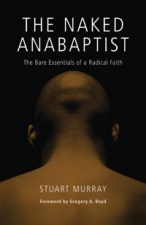
In his book, The Naked Anabaptist: The Bare Essentials of a Radical Faith, Stuart sets forth a fresh vision of the core convictions held by Anabaptists today.

Greg Boyd, pastor of Woodland Hills in St. Paul, has written the forward to The Naked Anabaptist. [It’s worth mentioning that his church is presently considering aligning themselves with an Anabaptist denomination.]

Stuart says that Anabaptism is being (re)discovered by folks from many different traditions. In fact, you might be an Anabaptist and just not know it.

“We believe that the Christendom era has bequeathed a form of Christianity that has marginalized, spiritualized, domesticated, and emasculated Jesus. The teaching of Jesus is watered down, privatized, and explained away. Jesus is worshipped as a remote kingly figure or a romanticized personal savior. In many churches (especially those emerging from the Reformation), Paul’s writings are prioritized over the Gospel accounts of the life of Jesus. And in many Christian traditions, ethical guidelines derived from the Old Testament or pagan philosophy trump Jesus’ call to discipleship.” The Naked Anabaptist p. 55-56

What does Anabaptism look like stripped down to to the bare essentials? Listen to Stuart discuss the core convictions of the Anabaptist Network.

Stay tuned for a Q&A with Stuart Murray next month on Anabaptism.

Suggested Anabaptist Reading:

D.D. Flowers, 2013.


How I View Christ & the Scriptures

I’ve recently been in conversations over many different theological and interpretive issues pertaining to the Bible. In discussing my interpretations with family, friends, students, and readers of my blog, the nature and authority of the Scriptures are always brought up.

While I’ve actually been asked several times, “Do you believe that the Bible is God’s Word?”, it’s usually just insinuated in their response to being challenged on the way they’ve always read or been taught the Scriptures.

I think this happens for one or more reasons: (1) the Scriptures are rightfully regarded as authoritative among Christians; (2) I’m challenging their interpretation which they mistake for disbelief in the Bible; (3) they simply do not understand my position; (4) they are entirely closed off to learning and they prefer to shut the conversation down by underhandedly claiming I don’t believe the Bible. This is also done by claiming the Holy Spirit guided their interpretation. So, of course they must be correct, making me wrong.

Therefore, in light of these recent conversations, and because it’s long overdue, I will briefly lay out my view of Christ and the Scriptures.

Biblical Inspiration

The Bible (Old & New Testaments) is the inspired, infallible word of God (2 Tim 3:16; 2 Peter 1:20-21). I believe that the Scriptures are trustworthy in conveying God’s progressive revelation through the history of Israel, culminating in the life of Jesus of Nazareth—who is the exact representation of God in the fullness of divine, incarnational revelation (Matt 16:16, 21:33-40; Jn 1:1-14, 5:39, 8:58, 10:33, 14:9; Col 1:15-20; Heb 1:3).

Inspiration testifies to the Spirit’s activity in the lives of the prophets and apostles who penned what in time became celebrated as sacred Scripture (2 Peter 1:20-21). The testimony handed down to us in the text is reliable in its transmission, and it is trustworthy in what it intends to communicate to the ancient and modern reader about God in Christ.

I believe that saying the Bible is “inspired” (God-breathed) refers to the Spirit-revealed truth in the original, ancient context and literary genres.

It does not mean that all of the Bible should be read literally, or that your or my own interpretation is the one that’s inspired.

Therefore, interpretation requires a responsible handling of the biblical text, “rightly dividing” it in Christian community. This should be done in a spirit of grace and humility. As the church, we must recognize the difference between the inspired Scriptures and our interpretations.

Christocentric Hermeneutic

I believe Scripture should be read using a Christocentric hermeneutic (interpretation). This means that Christ is not only the center of the salvific story told in the Scriptures, but that all Hebrew perceptions of God in the OT should be understood in light of Christ, the final self-revelation of God.

To affirm that the OT is inspired isn’t to say that the Hebrews saw God in his fullness, or that all portions of Scripture are equally authoritative (e.g. Canaanite genocide, imprecatory psalms, nationalism, levitical laws, etc.).

All Scripture is subordinate to Christ. He is the reality of the OT shadows (Col 2:17). Jesus sorts out all misconceptions of God in the OT.

As Greg Boyd stated in my 3-part interview with him last year…

“The cross reveals what God is truly like and thus what God has always been like.” 

Wherever OT portraits of Yahweh do not look like Christ, I see God making significant concessions, taking the sins of Israel upon himself, and accommodating himself to their limited vision and partial revelation.

I think this fresh understanding of inspiration is found in a true Christocentric or “cruciformed” interpretation of the Holy Scriptures.

And I think this should be embraced by all Christians who affirm that Jesus is the full and final revelation of God. But instead there seems to be a bewildering confusion on this that actually makes what I’ve stated above sound dangerous, even heretical to some folks.

“Reading Scripture through a christological and theographical lens is more radical a move than we might think at first blush. In our observation, it’s rarely practiced today—even among those who claim to uphold the centrality of Christ. It’s one thing to profess to read the Scripture christologically or to agree with in principle. But it’s quite another to actually practice it.”  Leonard Sweet & Frank Viola, Jesus: A Theography, pg. xviii

How does it happen that so many in the church have failed to accept Jesus as central and supreme over the OT portraits of God?

I’m convinced that it has a great deal to do with how many Christians have learned to compartmentalize the life and teachings of Jesus, and reduced the Gospel to a “sinners prayer” salvation.

For some people, Jesus mostly said what he did for the next life, and lived the way he did to get crucified for our sins. Therefore, the incarnation as a way of setting the record straight about what God is like is lost in the midst of proof-texts and meshing the Old and New Testaments together.

It seems to have begun around the 4th century when Constantine merged the church and state. Christians began picking up the sword and justifying it in the name of the OT. Slowly but surely the church learned to ignore the negative contrast of God in the OT seen through the lens of Christ.

When this happens Jesus can be used as the cheerleader for the “Christian” state, and any other agenda that needs “biblical” justification. This method of using the OT to support anti-Christ agendas is still practiced today.

So, not only does this ignore the conflict, but in disregarding that Christ stands above the OT portraits of God, a person is short-changing, even diminishing, the cosmic importance of the incarnation.

That’s no small matter.

In other words, this implies that there is something about God that Christ doesn’t reveal to us. This seems to me to be the real threat to the inspiration of progressive revelation summed up in Christ, God in the flesh.

You may remember that Marcion (c.85-c.160AD) was excommunicated as a heretic because the way in which he dealt with the OT. Marcion went so far to say that the god of the OT was not the Father of Jesus, but a lesser deity.

While I grant that Marcion was a gnostic heretic, and wrong for the way he handled the Scriptures, he was right to acknowledge the conflicting portraits of God in the OT with Christ in the Gospels.

Therefore, I’m convinced that the Old and New Testaments cannot be fully reconciled without using a radical Christocentric hermeneutic.

The Word Made Flesh

The highest view of the Scriptures is not the one that seeks to make an idol of the Bible (biblicism), but the one that allows the biblical text to exalt Christ as the living Word over all creation. The Word became flesh, not ink.

“God’s truest, highest, most important, most authoritative, and most compelling self-revelation is the God/Man Jesus Christ. It is Jesus Christ—and not the Bible—who is the “image of the invisible God” (Col. 1:15). It was in Jesus Christ that “God was pleased to have all of his fullness dwell” (Col. 1:19).” Christian Smith, The Bible Made Impossible, pg. 117.

I believe it’s important to let the Scripture be Scripture, and let Christ be Christ. That is to say that we should view the Scripture as a sign-post and a pointer to the eternal Word of God, Messiah Jesus (John 5:39). He is the true Word of God, living and active (John 1:1-14; Heb 4:12). He is not bound by the written text or dependent upon any view of inspiration.

It is because Christ is revealed in the Scriptures from Genesis to Revelation that I believe in the inspiration of the Bible. And this reminds me, and I hope you as well, that our confession and obedience to Jesus as the Word is the true arbiter of faithfulness. There is nothing else.

As the apostle Paul has written, “I consider everything a loss compared to the surpassing greatness of knowing Christ Jesus my Lord, for whose sake I have lost all things. I consider them rubbish, that I may gain Christ and be found in him” (Phil 3:8).

May we be found in Christ and get all of our life from him, not from our differences of opinion on theology, our varying interpretations, or our nuanced views of biblical inspiration.  

For it is Christ above all things, “in whom are hidden all the treasures of wisdom and knowledge” (Col 2:2-3).

D.D. Flowers, 2013.

Suggested Reading: