Radical Church Restoration

Radical Church Restoration–A Review of the Book Series Helping Others to Catch the Vision of Organic Church Life

Frank Viola says, “The church is a living organism.”

Many Christians would concur with Viola that the true nature of Christ’s church is born out of the soil of His finished work and moves forward in the power of the Holy Spirit.

However, as Viola has pointed out in his radical church restoration series, many believers have no problem speaking of the church as organism, but they are quite content to go on practicing the church as an organization.

untold2The series begins with The Untold Story of the New Testament Church: An Extraordinary Guide to Understanding the New Testament Church. Viola relies on some of the best New Testament scholarship to vividly retell the story of the first-century church in Acts. The New Testament comes alive in one sweeping narrative to give us a clear picture of the life and nature of those first Christian communities.

Pagan Christianity? Exploring the Roots of Our Church PracticesPagan Christianity? Exploring the Roots of Our Church Practices is the second book in the series, but the first to really capture the attention of Christians across the country. Frank Viola and George Barna team up to give their readers a critical examination of the last 1700 years of church history.

Does the institutional church have any biblical and historical right to exist? Viola asks, “Are the practices of the institutional church God-approved developments to the church that the New Testament envisions? Or are they an unhealthy departure from it?”

As I stated in my review of PC in January 08, this book “may very well be the most important book written on the Christian church in the last two millennia.” I still stand by this statement as it speaks a great challenge to the organized church. I believe we have yet to see the full impact of this book. In the coming days, I think you can expect to see it nailed to the door of an organized church near you.

reimaginingReimagining Church: Pursuing the Dream of Organic Christianity is the follow-up to the controversial PC. It is in this book that Viola offers a new vision, which is truthfully an old vision, of the church as organism.

RC is a proposal that the church of Jesus Christ mirror the very image of God: Father, Son, and Holy Spirit. If you agreed with PC and it left you clueless as to the alternative of the organized church, RC paints a new picture of a church that looks like the community of the Triune God and can truly be characterized as every-member functioning, familial, and organic.

from eternity picIt is in From Eternity to Here: Rediscovering the Ageless Purpose of God, the fourth book in the series, that Viola takes a step back to show us the bigger picture. It is in this book that he communicates the driving passion behind the work of planting organic churches.

Viola simplifies church life as an act of gathering around Jesus Christ. Yet, much of the Body of Christ has been forced into an institution and she has forgotten God’s eternal purpose. She has lost sight of the grand narrative and the great landscape of God’s love story. She has been preoccupied and polluted by an ecclesiology that leaves out the ageless purpose of God.

If you’re more right-brained and you just can’t seem to sit down to read a book on the church, then read From Eternity to Here and have your eyes opened to God’s eternal purpose. This book is bound to be a favorite among many readers.

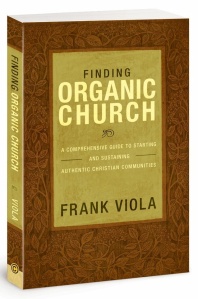
Finding Organic Church: A Comprehensive Guide to Starting and Sustaining Authentic Christian Communities is the final book, and probably the most anticipated, in the radical church restoration series. It is in this book that Viola offers up a practical guide to understanding and implementing organic church life.

Viola writes this book for three different audiences. First, for those who desire to meet organically and would like some practical help. Second, it is written for all those already involved in alternatives to the traditional church (missional, emerging, house church movements, etc.). Third, it has been written for everyone interested in planting churches.

What is an organic church? Viola says…

“By organic church, I mean a church that is born out of spiritual life instead of being constructed by human institutions and held together by religious programs. Organic church life is a grassroots experience that is marked by face-to-face community, every-member functioning, open-participatory meetings (as opposed to pastor-to-pew services), nonhierarchical leadership, and the centrality and supremacy of Jesus Christ as the functional Leader and Head of the gathering” (p. 20).

There are four models of church planting in the New Testament. Viola begins by discussing these models and also addresses the spontaneous expressions of church life that spring up without the work of a church-planter. Viola thoroughly covers the New Testament pattern of church planting and church growth in the first half of the book.

There are four parts to this book. Throughout the first two parts of the book, Viola helps us to rediscover the purpose and function of the itinerant worker. He deals with questions concerning this largely discarded and often controversial role of the itinerant worker. He has even devoted a chapter to the book entitled “Wasn’t Paul the Last Apostle?”

He skillfully presents his case for the restoration of traveling church planters (i.e. apostles) and their task in empowering and equipping the church to function organically by the indwelling Christ. Can the New Testament model work today? Viola believes so. And he testifies to experiencing it personally over the last 20 years.

In the third part of the book, Viola discusses how to gather and gives practical steps for beginning to meet organically. Maybe you are presently meeting in an organized church but would like to begin meeting organically. It could be that you have left the institutional church and would like to begin meeting with others who are interested. And there are those who are already meeting in homes but are in need of some guidance. You will find this book a great help in moving forward.

How do you sing without a “leader” to direct you? What about teaching? What about giving? What about evangelism? What does it all look like in this new paradigm? And the most often asked question of all, “What about the children?” Viola addresses these concerns and so much more. He gives practical exercises and suggestions in getting started.

In the final part of the book, Viola discusses the seasons and stages of growth within organic church life. He also mentions the diseases and pitfalls of gathering around Christ. His descriptions of these periods no doubt come from his own personal experiences.

Finally, Viola gives a call out to his readers.

“I believe the need of the hour is for Christian who are called by God to raise up the church as a living, breathing experience. Christians who are broken and tested. Christians who refuse to take shortcuts but who have first lived in an organic expression of body life as brothers and sisters before they ever dare plant a church.”

He continues…

“The need of the hour is for such a people to wait on God until they are properly prepared and then sent. And once sent, to plant the church in the same way that all first-century workers did: by equipping it and then abandoning it to the Holy Spirit” (p. 306).

And to those pastors who wish to make the transition, Viola writes…

“As I have said elsewhere, transitioning from an institutional church to an organic church is not cosmetic surgery. It’s a complete overhaul” (p. 311).

For pastors, he closes with three steps to take in moving your church to functioning organically.  But you’re gonna have to get the book to see what those steps call for.

Are you satisfied with shoulder-to-shoulder religion or are you looking for face-to-face community?  It’s not for those that aren’t willing to endure the cross.  Are you ready to dive in to an exciting journey of experiencing the indwelling Christ in familial community?

Then take a bold step outside the walls of institutionalized religion and recline at the table with others who hunger for more of Jesus.

D.D. Flowers, 2009.


Living Room Faith: The Couch of Completion

For a season the Lord calls us to sit with Him in the living room of spiritual fellowship. It is there we come to know the peace and tranquility of the stillness of the being.

He whispers to us and shows us his way of day-to-day fellowship; the simplicity of being aware of his presence and walking in freedom. It’s a freedom that comes as the Lord severs our ties to the work-centered faith.

It’s a time of undoing that places us firmly on the Couch of Completion.

It is there that the Lord reveals to us all that has been accomplished in His finished work. It is in this fellowship that the Lord reveals the Father’s heart toward us: LOVE SO AMAZING… SO DIVINE!

It is on the Couch of Completion that we learn of the Lord’s eternal purpose (Eph. 3:10-21). We learn that the Lord desires a spiritual house that begins with Him finding His home within you.

It is here that we have come to know that in Christ is hidden all wisdom and knowledge (Col. 2:2-3). Our searching is over.

It’s in this place that we first know Christ is enough. We have come to realize that our identity and purpose is only found in knowing Him. Knowing Christ from the couch is evident in several ways.

For starters, you no longer feel that the weight of the world’s salvation is dependent upon you. You also have recognized that you are not called to correct everyone’s doctrine and “fix” the ills of the church.

The way of man is power-over control through human authority. The way of Christ is long-suffering and enduring love. It’s a spiritual authority earned through sacrifice and a life of altruism.

You know you are touching the Lord on the Couch of Completion because you no longer move before having first received a revelation from the Lord. You are learning how to be sensitive to the Spirit instead of being driven by your own desires to serve and force the Lord’s hand in ministry.

We have not been given a work, we have been given a Person. We have not been called to further a movement, propagate a teaching, or even save souls.

We have first and foremost been invited to sit and recline with the Lord on the Couch of Completion.

“Come to me, all you who are weary and burdened, and I will give you rest.” Jesus (Matt. 11:28)

Until we have sat and learned what it means to “sit” we labor in vain. We can’t walk with Christ, and we most certainly will not be able to stand, if we fail to recognize the cross of Christ leads us to the couch.

New creation comes after a period of rest.

Couch to Couch

In His time, our Lord will go with us from the Couch of Completion into the field to work. Yet this work isn’t like anything we have known before. For we have reclined on the couch of His love and have known the fellowship that brings freedom.

In the past, we believed the Lord was telling us to leave the living room in order to go out and work for Him. We heard him say, “Get out there and build me a house!” Our relationship with the Lord was not known as friendship, but as lowly servant (Jn. 15:15).

We must learn that the Lord calls to us work with Him. He has gone out into the field with us. To be more precise, we are going out to join Him and His work. And His work is always done free of religious obligation and duty.

There is no burden involved in the Lord’s work. We do not “burn-out” in the Lord’s ministry. When ministry is born out of intimacy with Christ, we sing in jail and rejoice in our sufferings.

His work is done in response to His love. It becomes a matter of fellowship among friends. That’s where He is and that’s where we want to be. If we are called to work it is because He is already working where He is calling.

There is freedom in this sort of laboring.

We do not go out to work on the house because we believe it to be a good idea or even because it is something expected of us. No, we do it out of response to His fellowship.

We must understand this. We may be presently working tirelessly for the Lord, building a house in our own strength and using our own blueprint, only to discover that the Lord is waiting in the living room…

calling us to the Couch of Completion.

We can rush into building for the Lord before we have received the proper spiritual knowledge and the experience that only comes from reclining with the Lord for a season.

Furthermore, it is right to acknowledge that this preparation does not come from principles and formulas learned in a book, it is the Lord’s knowledge and wisdom born out of trial and error. It is born out of time and experience with the Lord and His people.

The work of ministry ought to be an overflow of the relationship that began in the living room with the Lord. Indeed, we never leave the living room of our faith. As the seasons change, we are continually brought back to recline with the Lord. It is there we are reminded of His goodness and that we are to place no confidence in the flesh.

red-couch-424Our journey is one that moves from couch to couch. It is because of us having rested upon the Couch of Completion with Christ that we can know the yoke that is “easy” and the burden that is “light.”
In this rest, we can truly know the experience of Christ being in all and through all. Rest in him today. Amen.

D.D. Flowers, 2009.


Organic Church Life: Sunday Gathering

Organic church life is expressed in many different ways, in different seasons, at different times of the week. It  is life born out Christ, moves forward in freedom, and is mutually dependent upon each other in Trinitarian love.

Hence the term “organic.”

From our experience, the Sunday gathering is a unique time of worship that is unlike any other communal event we practice (except for the Lord’s Meal of course). This time is set aside for the most divine expression of Christ among the saints.

As folks are coming into Christ and joining the organic expression of the church, we find that the saints must learn what it truly means to “gather around Christ.” It takes time, lots of time, to let go of many things (e.g. ill-feelings toward the organized church, old ideas of worship, an awareness of our thoughts about “doing” church, the uncomfortable silence, etc.).

Those of us who have been meeting outside the organized church for a little while now are by the Lord’s grace  beginning to learn how to know the Lord with the saints free of having to fight through the junk.

Even after a person begins to let these things go and throw off that dead weight into the deep chasm of death, there arise other challenges that face the saints as they seek the Lord’s heart in the gathering.

Whether it is a concern about the children in the church meetings, giving into the temptation to speak whatever is on your mind in worship, forcing something spiritual to happen when you meet, or following the occasional bunny trails leading to a lot of talk about the organized church, I believe the Lord has helped to discern these challenges with a question:

What is the purpose of the Sunday gathering?

The kind of gathering we seek to have around the Lord on Sunday is best described by Paul in 1 Cor. 14:26. (Note: This type of gathering could take place on any other day of the week, e.g. Saturday evening.) What is the purpose of “each one” sharing and giving their portion of Christ?

Generally, it is for the building up of the Body, of course. But to be more specific, it is a time where we are corporately, in spiritual unison and in open participation, seeking the Lord’s heart for his church.

We are reaching out to touch the Lord together. He is reclining with us and we want to hear from him.

This kind of meeting requires a sensitivity to the Spirit that has never been taught to us in the past and comes through purposely setting our hearts upon Christ. Sure, we have heard a lot of talk about it, but we have seldom experienced it in a context of real community.

We may have known him in private, but the Lord is longing for us to be a spiritual dwelling and experience him in community (1 Pet. 2:5).  For this reflects the Triune God.

Here is a brief description of the spiritual life and that Life we share as believers in this type of meeting:

  • Worship in spirit (Jn 4:24)
  • Waiting “be still and know” (Ps. 46:10)
  • Listening (Ps. 85:8; 1 Cor. 14:30)
  • Psalms, hymns, and spiritual songs (Eph. 5:19)
  • Teach and admonish (Col. 3:16)
  • Prayer (Lk. 19:46; Phil. 4:6)

As we enter into a time of worship on Sunday, we are meeting like the believers in the village of Bethany (Mk. 14:3). As friends of God, we are reclining at the feet of Jesus to hear what he might speak to us.

The Lord is spirit. To touch (worship, lit. “to kiss”) the Lord we must worship him in spirit. This does not come natural for us. Therefore, as we seek the Lord together and reach out to touch him through the things mentioned above, we can easily be distracted.

Any distraction, whatever that might be, can make it very difficult for us to know the Lord’s heart together. It will be a challenge to bind our spirits together in love when we are not sensitive to what Christ wants to speak to us, and in moments of stillness there are noise and chatter.

There are those table times of fellowship where we are very much sharing like any natural family event (e.g. kids running around, noise, multiple conversations, etc.). But, what I am referring to, what I believe the Lord is calling us to in this meeting, is a supernatural experience that can only be entered in through deep spirit-filled prayer and concentration.

There is order within this sort of meeting (1 Cor. 12).

The Sunday gathering is the only time where we meet this way around Christ as an entire church fellowship. Anything we can do to accommodate for this unique once-a-week meeting is well worth the effort.

I personally have conversed with Frank Viola for three years now. Frank is a wonderful gift to the church. As an outside worker, his calling is to stir up Christ in us and help us press on in the Lord.

I have read quite a bit on the organic expression of the church and have experienced a couple of years of church life centered on Christ. I have visited several other organic expressions on this journey.

In that short time, we have learned a great deal. We are so very blessed to have gleaned from Frank and others who have helped us along the way. I believe this equipping has helped us to see the uniqueness of the Sunday gathering that may elude many who seek to gather around Christ in the New Testament fashion.

“It’s all too common for Christians to know Christ’s lordship and yet know nothing of His headship.”  Frank Viola, Reimagining Church, p.67

Lord, keep us close to you.  As we seek your headship, remind us that we are all learners.

FOCGet Frank’s new book Finding Organic Church: A Comprehensive Guide to Starting and Sustaining Authentic Christian Communities today!  In this final book on radical church restoration, Viola addresses all the practical questions a person might have about organic church life.  Of course, if you really want to understand an organic church… join one!


The Torch of the Testimony (Book Review)

thetorchofthetestimonyThe Struggle for the Centrality of Christ—Book Review of “The Torch of the Testimony” by John W. Kennedy—Reviewed by David D. Flowers

John W. Kennedy has given us a great gift that has gone largely unnoticed in the western world. “The Torch of the Testimony” uncovers the 2,000-year history of those believing Christians and churches that stood outside the Protestant and Catholic traditions.

“The history of the working of the Spirit of God is not the history of any organization, and what usually goes by the name ‘Church History’ is only too often a sorry tale of bigoted quarrels and selfish intrigue. Yet the history of the two, the spiritual movement, and the earthly institution, are sometimes so closely intermingled that it is impossible to give an account of one without referring to the other.” p. 56

Kennedy gives us a concise narrative of church history while distinguishing between the “spiritual church” and the organized church of man.

He is gracious and honest to point out the good that was achieved within the organized church, but is consistent in his critique of both movements of the church.

He very powerfully exposes the shortcomings of the institutional church and how past saints concluded that it can never be reformed. What is needed is a return to New Testament church practice.

“The life of Christ and the Lordship of Christ through His Word are, therefore, two things which mark out the church of the New Testament. When these are supplanted by anything else, the result is a departure from the principle of Scripture and ultimate confusion.” p. 177

He wonderfully weaves together the disjointed stories of the church to paint a clear picture of the challenges that still face us today. The reader can’t help but be awakened to the reality that we are a part of the unfolding story of Christ’s church.

In this book, you will learn about how the the church began to drift from apostolic teachings through Greco-Roman influence and opened the door for the Constantinian State in the fourth century.

You will discover the enduring testimony of the remnant that existed apart from the organized church up to the Protestant Reformation and onward. You will learn how a break from the State Church into independent movements produced denominations built upon doctrines instead of the rock of Christ.

How did we get to where we are today? Where are we in the story of God’s people? Will we learn from the mistakes of the past? What will be written about us?

Will our relationship to Christ be the unifying bond that births our church practice or will we be distracted by power and cling to weapons of the world in an attempt to advance the Gospel?

I can’t stress enough how important this book is to the study of the development of Christianity. This book is a “must read” for every serious student of church history.

If you are involved in organic church life and gatherings outside of the institutional church, this book should be required reading before you can say, “I am part of a house church.”

If this account of church history doesn’t move you… I would recommend you check your spiritual pulse.

Suggested Reading:
The Untold Story of the New Testament Church: An Extraordinary Guide to Understanding the New Testament
Paul’s Idea of Community: The Early House Churches in Their Cultural Setting, Revised Edition
Pagan Christianity?: Exploring the Roots of Our Church Practices
The Reformers and Their Stepchildren (Dissent and Nonconformity)