Trinity & Incarnation

Finding a Biblical Christology Within a Trinitarian Monotheism
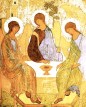
Tertullian (c. 160-220 AD) is officially given credit for coining the term “Trinity” to refer to the triune nature of the Godhead (Father, Son, and Holy Spirit).[1] The term itself is nowhere used in the Biblical text, but the majority of Christian traditions have accepted “Trinity” as a sufficient way of describing the three-in-one relationship of God.

The Biblical text, specifically the NT, references the Father, Son, and Spirit in about 120 different passages (e.g. Matt 28:18-20; Jn 14-17; Acts 2, etc.).[2] Jesus of Nazareth began a fringe movement within a strict monotheistic Second Temple Judaism that would in time overtake the entire Roman Empire.

In the beginning, Christ’s claims to divinity set forth an early “binitarian devotional pattern” which revealed a plurality within the one God.[3] The doctrine of the Trinity would eventually arise during the patristic age in an effort to accommodate the lordship of Jesus and the experience of the Holy Spirit into a Trinitarian monotheism.

Larry Hurtado makes the following observation:

It may not be sufficiently recognized by historians of dogma or contemporary theologians that the Christian doctrine of the Trinity is essentially a christologically shaped statement of monotheism. To be sure, the earliest Christian texts reflect a triadic experience of “God,” comprising the sense of “God” (“Father”) as the source and ultimate destination of all things, Jesus as the essential and unique agent of divine purposes through whom creation is now to be seen and through whom also redemption is provided, and the Spirit is the impartation and gift of “God” that is at the same time also the advocate and medium through which believers receive a filial status that derives from Jesus’ own unique divine sonship. So, if it is a bit anachronistic to speak of “trinitarian” theology in the NT, it is right to see the roots of this doctrinal development in this body of texts.[4]

Questions of Jesus’ relationship to God within a Trinitarian monotheism, while being the very God-man himself, naturally leads the student to consider the incarnation of Christ—the divine and human natures of Jesus. How can both natures coexist in one person? How can Jesus be fully God and fully man at the same time?

In pursuit of discovering the truth about the real identity of Jesus, the scholar must ask: “Can the Christ of faith and the Jesus of history be held together?” Millard Erickson concludes: “Since the Jesus of history is approached through reason and the kerygmatic Christ is seized by faith, we are apparently dealing with a case of the classic faith-reason dichotomy.”[5]

The kerygmatic Christ and the historical Jesus are the same person. Therefore, faith in the divine Christ does not exclude the use of reason, it makes it necessary.

In his Theology for the Community of God, Stanley Grenz writes:

Of the various aspects of our Christian understanding of God perhaps none is as difficult to grasp as the concept of God as triune. At the same time, no dimension of the Christian confession is closer to the heart of the mystery of the God we have come to know. In fact, what sets Christianity apart from the other religious traditions is the confession that the one God is Father, Son, and Spirit. As a consequence, no teaching lies at the center of Christian theology, if not of Christian faith itself, as does the doctrine of the Trinity.[6]

There are several historical traditions that have sought to make sense of Trinity and the incarnation of God in Christ. The purpose of this paper is to take a defendable position on the Trinity and incarnation by: (1) giving a brief critical examination of each major historical Trinitarian formulation, (2) surveying and critiquing the historical development of incarnational Christology, (3) constructing a Biblical theology that is sensitive to the Biblical texts in their original context.

This paper will conclude with a challenge to remain committed to a practical Trinitarian monotheism and faithful to a functional Christology that is rooted in the Scripture.

HISTORICAL TRINITARIAN CONSTRUCTIONS

The Eastern Orthodox Formulation

The two most historic of traditions are the Eastern Orthodox and Western views. Both of these formulations were largely constructed in response to the Arian controversy.

Arius, a deacon in the Alexandrian church, taught that the Son was the first creation of the Father. He said that God “beget” Jesus—the Father made the Son. Therefore, Arianism stated that Christ was not co-eternal with God.

Arius’ teaching was especially concerning because of the way in which he argued from the Scripture and Greek philosophy to make his case. Arius was opposed by the theologian Athanasius at the First Ecumenical Council at Nicea in 325.

The church unequivocally affirmed the NT and the full divinity of Christ.

Arianism was denounced as a heresy and Arius himself was banished as a heretic. In the Nicean Creed, the council asserted that the Son is “begotten of the Father, of the substance of the Father, begotten not made, of one substance with the Father.”[7]

Tertullian used the Latin phrase tres personae, una substantia (“three persons, one substance”) to describe the Trinity, which the Cappadocian fathers would later refine to produce the classic formulation of the doctrine of the Trinity in order to avoid tritheism and modalism.

Tertullian and the church historian Eusebius are remembered as promoters of the Eastern Orthodox view. This view is heavily rooted in Greek philosophical (Stoic Logos) thought of the second and third centuries. Proponents of the Orthodox tradition believe in “eternal procession” from God the Father—the Spirit and the Son both proceeded from God. They are merely an extension of the Father, who is the source.

The incarnation is then the generated Son invading a (Neo-Platonic) human spirit and soul. The greatest weakness of the Eastern formulation is that it relies more heavily upon philosophical rhetoric and categories than it does the Biblical text.

The Western Formulation

Augustine was a major proponent of what is known as the Western view. He expressed that the “eternal generation” within the Trinity describes ontological relationships. He believed that any distinction of persons must reside within the relationships found in Triune community.[8] Each member of the Trinity is equally God and they have always operated together according to one will.

The Western view emphasizes the threeness characteristic of God as relational. This can be seen in the use of the triangle as a symbol for the shared relationships within the Trinity. Augustine saw human beings as a triad of being, knowing, and willing. He developed several analogies to further the idea that the Trinity has implications for living.[9]

Augustine’s view was much more balanced with a concern for the relationality of God within himself and creation. He nevertheless constrained himself to philosophical categories.

This philosophical understanding of God will reach its climax with Aquinas and continue to dominate until the Reformation.[10]

The Biblical Theology Formulation

There are two modern views that seek to modify the Eastern Orthodox and Western views. Dale Moody and Doug Kennard promote a Biblical Theology view that is careful to point out that the Father, Son, and Spirit are all God, but the Son is not the Father and the Father is not the Son.

These scholars hold that the philosophical language of “eternal procession” in understanding John 1:14, 18; 3:16, 18 and 1 John 4:9 is logically contradictory and not helpful in discussions of Trinity and incarnation.

Instead, Jesus should be seen as being sent by God, not as the “only begotten” Son (Jn 3:16), but as the monogenes, from mono (single) and genos (kind)—Jesus is the only one of his kind. Just as Isaac was the uniquely chosen son of Abraham, not the only son (Ishmael), Jesus is the chosen one sent by God (Gen 21:12; Heb 11:18).[11]

In the Johannine writings the word monogenes is used exclusively to speak of Jesus’ unique historical birth. From this perspective, Biblical Theology proposes that there is an economic procession of Trinitarian ministry. There are three who’s and one what. Each member of the Trinity is unique in function.

Doug Kennard believes it is best to discard the ancient philosophical rhetoric:

Since the Biblical texts used to defend the doctrine of generation emphasize monogenes to be the historical birthing of Jesus’ humanity in incarnation, it is best to reject the ancient tradition that Jesus Christ was generated before all ages in eternity. As a historical oddity eternal generation does not reflect the Bible. At this point, the unanimous voice of scholarly commentators agree, further confirming the exegetical view that the generation of the Son should be Biblically understood as an initiation of an economic ministry of the divine Word incarnating to reveal the Father through His humanity.[12]

The Social Trinity Formulation

The Social Trinitarian view has been popularized by Leonard Hodgson, Stanley Grenz, and Jurgen Moltmann. This formulation emphasizes the ontological relationships shared within the Godhead.

This view incorporates the language of “generation,” but it is more specifically concerned to preserve the interpersonal relationships within the God who binds together all things in love. God is love because he is himself a social “familial” Trinity.

Therefore, Christ is fulfilling his divine familial role within the Trinity and incarnation. The Father is the originator, the Son is the revealer, and the Spirit is the completer of the divine program.

Grenz writes, “The ontological differentiations facilitate an economic as well as an ontological diversity in the one God. Each of the three Trinitarian members fulfills a specific role in the one divine program.”[13]

THE DOCTRINE OF THE INCARNATION

Logos Christology

Since Trinity and incarnation go hand in hand, it is necessary to briefly examine a few historical views regarding the incarnation of Christ before taking a position on the best Biblical explanation for the Trinity.

James D.G. Dunn reminds the student of the great importance in the unfolding of incarnational theology within the Biblical text:

We have found nothing in pre-Christian Judaism or the wider religious thought of the Hellenistic world which provides sufficient explanation of the origin of the doctrine of the incarnation, no way of speaking about God, the gods, or intermediary beings which so far as we can tell would have given birth to this doctrine apart from Christianity.[14]

Hurtado adds to the significance of incarnational theology: “In historical terms we may refer to a veritable “big bang,” and explosively rapid and impressively substantial Christological development in the earliest stage of the Christian movement.”[15]

This development begins with the NT writers revealing the full humanity and deity of Christ, and continues through to the creeds of Nicea (325 AD) and Chalcedon (451 AD)—affirming that Jesus is both God and man.

The first major philosophical explanation employed during the second and third centuries was known as Logos Christology. John declared that Jesus is the Word (Logos) in the prologue to the Fourth Gospel. The term corresponded with the Hebrew concept davar (Word of God) and the Stoic logos (inner law which humans ought to orient their lives).[16]

As stated previously concerning the Eastern Orthodox thinkers, this means that the incarnation is then the generated Logos invading a human spirit and soul. Folks like Justin Martyr and Origen utilized Stoic concepts to make sense of the Trinity and incarnation.

Kennard points out that, “the early church comes out strongly against embracing a Stoic world view, even though a few Stoic concepts contributed to Christology.”[17] It is understandable why the apologists would make use of philosophical concepts of their day to explain and defend the doctrine of Christ, but it quickly becomes a matter of debate and confusion (Arianism).

Logos Christology is built upon Greek concepts and it is explained in philosophical rhetoric that goes far beyond Biblical language.

Nestorian Christology

There does not seem to be any agreement as to how the early church articulated the paradox of Christ having two natures in one person. Nestorius (c. 386-451 AD) proposed that the two natures of Christ should be held apart from one another.

Was Nestorius promoting the heretical idea that two distinct persons resided in Jesus? It is hard to say because of the political and ecclesiastical rivalries that involved him in the church.[18] Also, his ambiguous language was easily misunderstood among the many heresies swirling about (e.g. adoptionism, docetism, Apollonarianism, etc.) Nestorius was viewed as not fully appreciating the unity of Christ’s person.

The West resolved the debate of the two-natures at the Council of Chalcedon (451 AD):

Therefore, following the holy Fathers, we all with one accord teach men to acknowledge one and the same Son, our Lord Jesus Christ, at once complete in Godhead and complete in manhood; truly God and truly man, consisting also of a reasonable soul and body; of one substance with the Father as regards his Godhead, and at the same time of one substance with us as regards his manhood; like us in all respects, apart from sin; as regards his Godhead, begotten of the Father before the ages, but yet as regards his manhood begotten, for us men and for our salvation, of Mary the Virgin, the God-bearer; one and the same Christ, Son, Lord, Only-begotten, recognized in two natures, without confusion, without change, without division, without separation, the distinction of natures being in no way annulled by the union, but rather the characteristics of each nature being preserved and coming together to form one person and subsistence, not as parted or separated into two persons, but one and the same Son and Only-begotten God the Word, Lord Jesus Christ; even as the prophets from earliest times spoke of him, and our Lord Jesus Christ himself taught us, and the creed of the Fathers has handed down to us.[19]

It should be acknowledged that Chalcedon did not entirely remove the mystery of the paradox that exists in the person of Christ. At best, the Chalcedonian Creed states what the “two natures in one person” does not mean.[20]

The Eastern Church continued with a Logos Christology. And others would come along and express dissatisfaction with the older explanations.

Kenosis Christology

In the modern era of Protestant scholasticism, Sartori sought to resolve the problem of the relationship between the two natures with his interpretation of Philippians 2:7.[21]

“Kenosis” is the Greek term used to say that Christ “emptied himself” (RSV) to take on human form. This view theorizes that Christ gave up or emptied himself of those divine attributes that were incompatible with his human existence (especially omnipotence, omnipresence, and omniscience).

Some proponents go so far to say that Christ set aside all divine attributes. This great flaw in the theory inevitably leads to confessing that Jesus is less than God. Therefore, a modified Kenosis theory is necessary.

Grenz says the appearance of setting aside those attributes is actually the Son’s giving up the “independent  exercise of those powers.” Christ submitted his divine capabilities to the Father’s will.[22]

Since it is right to affirm that all the fullness of God dwells in Christ (Col 1:19), it is most appropriate to accept a modified Kenosis theory. Jesus emptied himself of those attributes that were incompatible with his humanity in order to be fully human. He was obedient to the Father and did not consider equality with God something to be exploited (Phil 2:5-8).

This view is preferred to all the rest.

CONCLUSION—FINDING A BIBLICAL CHRISTOLOGY

The historical views of Trinity and incarnation have laid a foundation on which future generations may construct, and deconstruct if necessary. It is likely that each generation of believers will seek to express a Christology that speaks directly to the needs of their own Christian community.[23]

As for the historical constructions, I believe it is the best of Biblical Theology and the Social formulation that combine for the strongest presentation of the Trinity. The relevant NT passages should not be read through Greek philosophical lenses of the patristic era in defense of  a Trinitarian monotheism and the incarnation of God in Christ.

Christ was uniquely born (Jn 3:16), sent into the world as the exact representation of God (Heb 1:3), and only subordinate to the Father in an earthly temporal sense (Phil 2:6-11). Christ is fully man and fully God. The NT writers do not leave this open to readers.

Jesus claimed to be divine and equal with the Father on multiple occasions (Matt 16:13-20; 26:63-65; Jn 1:1-14; 8:19-59; 10:30-33), God vindicated him through his resurrection from the dead (Jn 20), and he even received worship of himself (Jn 20:28-29). The Holy Spirit is economically sent by Christ after his ascension as the completer of God’s will (Jn 14:15-21; 16:12-15). The Father, Son, and Spirit are wholly God in a mysterious community of love (2 Cor 13:14; Gal 4:6; 1 Pet 1:2).

Oscar Cullmann said, “in the light of the New Testament witness, all mere speculation about his (Christ’s) natures is an absurdity. Functional Christology is the only kind which exists.”[24]

The church will continue to discuss and debate Trinity and incarnation. What matters most is that the church maintain a working Christology that leads to the perpetual celebration of the incarnation of the Trinitarian God, and faithful adherence to the Christ who has revealed the new way to be human.

May the continued pursuit of a Biblical Christology bless heaven and earth—until the Lord joins them together forever, and mystery gives way to perfect understanding.

D.D. Flowers, 2011.

[1] Fisher Humphreys, “The revelation of the Trinity.” Perspectives In Religious Studies 33, no. 3 (September 1, 2006): 287.

[2] Ibid., 292.; Not all of the references include the three persons together.

[3] Larry W. Hurtado, Lord Jesus Christ: Devotion to Jesus in Earliest Christianity (Grand Rapids: Wm. B. Eerdmans, 2003), 134-153.

[4] Hurtado, God in New Testament Theology (Nashville: Abingdon Press, 2010), 46-47.

[5] Millard J. Erickson, Christian Theology (Grand Rapids: Baker Academic, 1998), 689.

[6] Stanley J. Grenz, Theology for the Community of God (Grand Rapids: Eerdmans, 1994), 53.

[7] Henry Bettenson and Chris Maunder, eds. Documents of the Christian Church (Oxford: Oxford University Press, 1999), 27.

[8] C.C. Pecknold, “How Augustine used the trinity: functionalism and the development of doctrine.” Anglican Theological Review 85, no. 1 (December 1, 2003): 134.

[9] Grenz, 62.

[10] R.L. Saucy, “Doctrine of God” Evangelical Dictionary of Theology. ed. Walter A. Elwell, 500-504 (Grand Rapids: Baker Academic, 2001), 503.

[11] Dale Moody, “God’s only Son : the translation of John 3:16 in the Revised Standard Version.” Journal Of Biblical Literature 72, no. 4 (December 1, 1953): 213.

[12] Douglas Kennard, Messiah Jesus: Christology in His Day and Ours (New York: Peter Lang, 2008), 503.

[13] Grenz, 67. Also see Moltmann’s The Trinity and the Kingdom. San Francisco: Harper & Row, 1981; and Hodgson’s How Can God Be Both One and Three? London: SPCK, 1963.

[14] James D.G. Dunn, Christology in the Making: A New Testament Inquiry into the Origins of the Doctrine of the Incarnation (Grand Rapids: Wm. B. Eerdmans, 1989), 253.

[15] Hurtado, Lord Jesus Christ: Devotion to Jesus in Earliest Christianity, 135.

[16] Grenz, 300-301.

[17] Kennard, 495.

[18] Erickson, 743.

[19] Bettenson, 56.

[20] Erickson, 747.

[21] Kennard, 505.

[22] Grenz, 307.

[23] See Daniel L. Migliore’s “Christology in Context: The Doctrinal and Contextual Tasks of Christology Today.” Interpretation 49, no. 3 (July 1, 1995): 242-254.

[24] Oscar Cullmann, The Christology of the New Testament (Philadelphia: Westminster, 1963), 326.


An Organic Church Challenge

For those who follow my blog, you know I’ve been reassessing my understanding of “organic” church life in the NT. As I mentioned in a few recent posts, I’m finding that it’s not really helpful to use the term, especially since it has gone viral.

I agree with much of the contrast that is drawn between the church as institution vs. organism. So, I’m currently opening myself up in order to imagine a church life that does not grow out of reaction to the abuses of the organized church, or from the neglect of the NT by those who believe they have obtained something of Christ that others have not.

Here are some thoughts I’ve been having.

It is entirely understandable that many people hear what some “organic” folks are advocating (as I have also advocated) sounds like an abandonment of all ecclesiastical structures. It then becomes confusing for folks to hear them say that it’s OK to have some sort of skeletal structure, you just need to find the “balance” in it all.

What does that look like? We can all say, “It doesn’t look like this or that…” but I don’t see how it’s possible to judge one church from another on whether Christ is truly reigning in their meetings based off our prescriptive readings of the NT. I’m fine with saying there are things the NT does not explicitly teach, advocate, or allow—even prohibits—things that are antithetical to every-member functioning. But beyond that I think we need to be careful how we proceed in setting boundaries.

It seems to me that the “organic” promoter viewing another person’s practice of church life (with all of their biases, interpretations of Scripture about church practice, good/bad personal experiences, etc.) could make many wrong judgments about many churches because they don’t fit their own vision of NT church life. This concerns me.

Something else that troubles me is the constant downplaying of teaching and doctrine. At the same time I hear “organic” advocates affirming that teaching and doctrine are good for the church. Huh? Which is it? Naturally, folks in and outside of these house churches hear this and think that doctrine can only divide and that it’s not conducive to “gathering around” Christ.

I don’t think that’s what the “organic” leaders mean, so I think it really needs some clarification if they’re going to help others hear what they’re trying to say about Christ and the church.

I also think it assumes that we have a prescriptive church life, instead of a descriptive one contained in the NT. It might at times be necessary for a church to become a forum for discussing doctrine. Just like there are times the church needs to adapt for other concerns facing the community. I believe the unveiling of Christ can happen during these times as well.

Could it be that assuming Christ can’t be unveiled during these times is also a reaction that equally leads to wrong conclusions?

Having spent a few years in “organic” church life, I’m beginning to think that we should keep a big vision of Christ and a small vision of the church, as far as our ideas and expectations are concerned.

We can learn this from those who first pioneered the house church movements within China and the United States.

This would require us celebrate Christ in community wherever we find it (calling others to that), and say less when it comes to critiquing the church practices of others who sincerely love the Lord and are being faithful to him where they are.

I hear more lines touching on what church life is not, than what it is. Which seems to translate that there are tons of things that folks serious about church life will not do if they want to meet around Christ. I don’t think that’s what is intended, but I feel that’s what those on the outside hear. I heard that on the inside, and I’m now hearing it as I have put a little distance between myself and the “organic” folks.

I tend to think a generous ecclesiology that is Christ-centered in community, is not continually preoccupied with denouncing what may be “pagan” Christianity, but rather it is concerned for sharing the Christ you know and leaving it at that. Are “organic” folks OK with that?

Some days I’m not so sure.

I don’t think this means there isn’t a place for deconstructing the church, (cause I do!) especially among those who are asking questions and are open to rethinking the wineskins. However, if we’re not careful, we can easily set ourselves up against those that don’t meet like us or share the same vision for the church. We can easily build more walls than open up doors.

We can forget our visions of Christ at this point… they will only edify those that agree with us. Though in the end it’s not edification, just spiritual narcissism nicely contained in elitism masked as dreams and visions.

Since it is a “balance” that we seek (one that is hard to reach and know when we’ve reached it), I don’t see how it’s honest and edifying to talk like we know exactly what the church is supposed to look like when we’re getting it right (or when we think we are). Lord, help us!

In a nutshell, we need more humble recognition that the Lord moves through the church in more ways than one. Then we may rejoice with others receiving their own revelation of Christ and being faithful to their calling.


Christian Gnosticism in the Pastorals?

It was largely the work of Rudolf Bultmann in his Theology of the New Testament (1951) that first set out to determine the extent to which the Christian Gospel unfolded by way of Gnostic terminology in order to refute the dangerous fast-growing heresy later to be known as Christian Gnosticism.[1] Bultmann’s reconstruction of early Christianity has been severely attacked and criticized relentlessly in the last fifty years.

Many scholars have abandoned this Hellenistic reading of the New Testament. However, there are certain signs that interest of this Gnostic presupposition is on the rebound.[2]

I believe that the New Testament was in fact written in the context of various Jewish fringe groups that were syncretistic by their nature. It would the appear that second century Christian Gnosticism was born out of a fusing together of a wide array of Jewish religious beliefs with other emerging Hellenistic philosophical ideas.

Although a systematic Gnosticism did not arise until the second century, as William Barclay has written: “The basic ideas of Gnosticism were there in the atmosphere which surrounded the early Church, even in the days of Paul.”[3] Therefore, the purpose of this paper is to uncover any evidence that may exist for an early Christian Gnosticism being addressed specifically by Paul within the New Testament letters to Timothy and Titus.

GNOSTIC CHRISTIANITY
A Synopsis of Origin and Belief

It is necessary to begin this presentation of the evidence with what the student can know about the origins of Gnosticism before turning to what is certain about the fully developed Christian Gnosticism in the second century AD. Then after having explored Gnosticism in its infancy and examined it in full expression, the reader will be more apt to determine what level of Gnosticism is being combated in the first century Pauline texts.

This paper will begin by briefly summarizing Gnostic origin and belief in order that the reader will be familiar with the rhetoric and historical traditions of Gnosticism.

Pheme Perkins says: “The history of both Gnosticism and Christianity begins in the margins of Judaism, among persons whom might be called ‘Jews’ by some and ‘non-Jews’ by others.”[4] Perkins believes a simple division of “Jewish” and “non-Jewish” is not representative of the pluralistic society of Paul’s day. Instead, the world in which Gnosticism was born was one of religious syncretism. This means that determining clear lines of religious belief was often next to impossible.

Perkins mentions Gnostic origins and the New Testament in the following:

Even though Nag Hammadi texts are not evidence for a pre-Christian Gnosticism in the same sense in which the Dead Sea Scrolls provide evidence for messianic expectations in a Jewish sect prior to the emergence of Christianity, it is no longer possible to account for everything in the second-century Gnostic writings as derived from Christianity. They provide a different constellation of traditions from the remarkably varied religious landscape of the first and second centuries. New Testament writings are evidently neither advocating Gnostic ideas nor combating the formal systems that would emerge in the second century. But the religious currents that appear in the Gnostic writings are also part of the environment of the New Testament.[5 

Perkins proposes that the formation of Gnostic mythology first begins in a Jewish context within a Hellenized culture during the first century BC.[6] N.T. Wright suspects the same: “There may have been some before the time of Jesus who claimed to posses a special ‘gnosis,’ a knowledge which set them aside from ordinary folk and marked them out for a heavenly destiny.”[7] Many scholars have acknowledged the evidence for this found in Paul’s letters (e.g. 1 Cor. 8:1-4; Col. 2:6-22).

The second century Apologists’ view of the origins of Gnosticism lay with Simon Magus in Samaria (Acts 8). However, Magus may only mark a turning point whereby Christian teaching was merged with Gnostic myths, thus birthing a Christian Gnosticism.

This is because Samaritan belief and practice cannot account for the bitterness directed at the Creator God of the Old Testament. Perkins states that “periodized salvation history, interest in cosmology, the origins of humanity, myths of the rebellious angels” did not derive from the second century interaction between Gnostic teachers and orthodox Christian apologists.[8] Therefore, the origins of Gnostic thought precede Christianity.

It is most likely that Gnosticism grew out of the Hellenizing of Judaism in the early centuries BC. There are elements of Gnosticism that are similar to Neo-pythagoreanism and Middle Platonism—a revival of Platonism from the first century BC to the second century AD. It was Plato that coined the word gnostikos (related to ‘gnosis’) and it continued to be used philosophically to refer to intellectual knowledge.[9]

Among these ideas, the student must also consider the impact of Stoicism and Epicurean philosophical ideas. All of these Greek ideas fused together with elements of Judaism will eventually threaten the new radical first century sect that proclaimed Jesus Messiah.

Second Century Christian Gnosticism

Helmut Koester has written: “The history of Gnosticism in its early stages during the period of early Christianity cannot be identified with the history of a tangible sociological phenomenon.”[10] The Gnostic teachers, like other teachers in the Hellenistic world, combined religious, mythological, and philosophical ideas each with their own unique spin.

There was no uniform Gnostic system.

However, as previously stated, the second century apologists believed Gnosticism could be traced back to Simon Magus in Samaria.  Even though Gnosticism was a scattered variety, its characteristic features were well known by those church fathers that were schooled in Greek ideas and religious syncretism. The leading apologists were: Irenaeus, Ignatius, Justin Martyr, and Clement.

Among the leading Gnostics were: Basildes, Carpocrates, Cerinthus, and Valentinus. Valentinus held the most attractive and better known systems of Gnostic thought. For the sake of argument it is best that the student be aware of the most basic teachings that all Gnostic sects shared in common. This will help in bridging the gulf between Gnostic origins and the systematic Christian Gnosticism in the second century.

Gnostics believed the material world was not created by the Father of Jesus, but rather a Demiurge (lesser deity) created all things material and therefore all matter was considered evil. The God of the Old Testament was considered to be this Demiurge. Marcion, a Gnostic heretic who first formulated his own canon of Scripture, is best known for teaching against Yahweh of the Old Testament.  It was likely due to the heretical teachings and efforts of Marcion that the early church was intentional in establishing an official canon of the New Testament books.[11]

The Gnostics taught that the God of the Old Testament was evil. The serpent in the Garden of Eden is therefore seen as a liberator of humankind by giving them secret knowledge (gnosis) of their own divinity. Since the Creator is evil, his creation is also evil.  Therefore, flesh is inherently corrupt. This caused the ultimate God, the Father of Jesus, to have pity on humans and send them his Gnostic Son to be savior. Those known as Docetists taught that Jesus had the illusion of flesh. Others said the body of Jesus was merely possessed by the Son upon a Gnostic baptism and abandoned him at crucifixion.[12]

Since the Gnostics thought the flesh was evil and of no consequence, they naturally rejected the Christian teaching of the physical resurrection of the body. This played out ethically in two extremes: liberty and legalism.

It was not until the discovery of the Nag Hammadi documents in 1945 that Gnostic studies were greatly advanced. Before that time, scholars were dependant upon the writings of the early apologists to understand their Gnostic opponent. The Coptic manuscripts date from the mid-fourth century and contain writings that were originally in Greek. Those portions date as early as the second and third centuries.

The Gnostic writings have helped scholars understand the “inner religious spirit”[13] of Gnosticism as a developed rival system of belief in contrast to orthodox Christianity in the second century.

THE LETTERS TO TIMOTHY AND TITUS
Authorship and Date

Did the apostle Paul write the letters to Timothy and Titus? Contemporary critical scholars insist that someone other than Paul wrote the letters to Timothy and Titus as late as the early second century.[14] Donald Guthrie says, “those who deny Pauline authorship must at once accept these epistles as pseudonymous.” And Guthrie believes there is not “impressive evidence” for an early Christian practice of this.[15] There has been considerable debate over Pauline authorship for the following reasons.

Historically there has been difficulty in fitting the letters into the Acts account. P.N. Harrison has postulated a second Roman imprisonment and an extended journey that would allow Paul time to write before being executed in 67-68 AD. F.C. Baur suggested that the epistles were a work of fiction in order to do some good in the name of Paul.[16]

Furthermore, due to the genuine nature of the letters, some believe that a later admirer of Paul collected his notes and incorporated them into letters to preserve them. This view would account for the linguistic problems in the letters. There are a large number of words in the letters not found in the rest of the Pauline corpus.

It is also believed that there are echoes of Pauline theology, but an absence of characteristic Pauline doctrines. Some scholars believe that terms like “the faith” and “sound teaching” suggest a later fixed tradition. Along with the concern of doctrine, comes a claim that the letters reflect a more institutional form of the church.[17]

If critical scholars are correct, it must be concluded that an admirer of Paul is responsible for the composition of the letters and the instruction reflects the church situation in the early second century. I’m not willing to concede with this reasoning and therefore I disagree with the contemporary critics of the letters to Timothy and Titus.

Historically it is possible that the mission accounts contain gaps.[18] Paul mentions activities and events that Luke was unaware or simply did not know about (2 Cor. 11:23-29). Luke is known to give sweeping summary statements that open up possibilities for Pauline activity (Acts 20:1-3). Literary concerns should also be reexamined.

Even the undisputed letters of Paul are not uniform in style. Is it possible that several minds (or hands for that matter) were involved in the process of letter writing (e.g. amanuensis)? [19] There is good evidence that the letters to Timothy and Titus were accepted by Clement (c.95) and Ignatius (c.115) attesting to first century Pauline authorship.[20]

Finally, do the letters to Timothy and Titus reflect an organized second century church? Robert Banks says all too often the differences between Timothy and Titus to other letters of Paul have been exaggerated.[21] For example, Paul still continues to speak in familial terms and uses language of function rather than office (1 Tim. 3:1). There is no teaching of a monarchial bishop that was so emphasized in the second century.

Occasion and Purpose

If the reader accepts Pauline authorship, then the purpose of these three epistles is self-evident. In contrast to Paul’s letters written to churches, these three epistles are addressed to individuals.

It was not until D.N. Berdot (1703) and Paul Anton (1726) that the epistles were designated as “Pastoral” to describe them.[22] This is a bit misleading since the letters are apparently written to co-workers of Paul who are following in his footsteps of apostolic ministry to the Gentiles.

The letters to Timothy were likely written in the early or middle 60’s. The letter to Titus may have been written in the late 50’s.[23]

As the reader will learn in the upcoming section, the letters to Timothy and Titus address similar issues. In 1 Timothy and Titus the apostle Paul gives his young co-workers instructions for dealing with their respective churches and the issues that have presented themselves there.

Paul’s primary concern in both 1 Timothy and Titus is false teachers and the nature of their doctrines. He will also address church leadership in the middle of his instructions on handling those who have “wandered from the faith.” Paul addresses false teaching once again in 2 Timothy, but this time Paul is writing from prison and he is more or less “handing the baton” off to Timothy.

The letters to Timothy and Titus are intimate correspondence sent from Paul to men who have been called to do the work of an apostle—that work requires preparedness “in season and out of season” to correct and rebuke with great patience (2 Tim. 4:2).  Assuming Pauline authorship and a first century context for the epistles, the investigation into the evidence of early Christian Gnosticism within those letters can now begin.

EVIDENCE OF EARLY CHRISTIAN GNOSTICISM
The Letters to Timothy

Paul instructed Timothy to “stay there in Ephesus so that you may command certain men not to teach false doctrines any longer nor to devote themselves to myths and endless genealogies” (1 Tim. 1:3-4). A few verses later (v.7), Paul describes these men as wanting to be “teachers of the law” but in the end they only teach false doctrines and stir up controversy.

Gordon Fee is convinced that “myths and genealogies” does not fit within Gnosticism and is instead solely reflective of Hellenistic Judaism.[24] It is true that genealogies played an important role in determining a person’s family or tribe and their rights by birth, but Paul couples this with “myths” that undoubtedly link this heresy to something more than quarrels over the Jewish family tree (2 Tim. 4:4).

Perkins draws attention to Sethian myth that emerged sometime in the late first century: “At the early stage Sethian mythology includes the concept of a preexistent redeemer associated with Seth, identification with a heavenly Wisdom figure, the origins of evil as a result of the ignorant creator and his offspring.”[25]

Gnosticism taught “myths” in order to describe the families of aeons that separated God from the evil physical world.[26] Gnostics created myths and genealogies in order to make sense of the evil created world so that a person could then climb the spiritual ladder of gnosis to reach the divine. The Gnostic must ascend the many emanations of God with a very special sort of knowledge—a knowledge of the highest caliber.

Paul tells Timothy to “fight the good fight” and to hold on to “faith and a good conscience” because some have “shipwrecked their faith” (1 Tim. 1:18-19). Then Paul names Hymenaeus and Alexander as the culprits. Hymenaeus is mentioned again in 2 Tim. 2:17 along with Philetus as having taught that the resurrection has already happened.

It is believed that Alexander may have moved on after the first letter to Timothy.[27] He is later described as having done Paul “a great deal of harm” and the Lord knows what he has done (2 Tim. 4:14).

As for Hymenaeus and his new partner Philetus, their denial of a future bodily resurrection may be the strongest evidence for an incipient Gnosticism at work in the first century. There is clearly a misunderstanding of resurrection. Towner suggests that it is merely confusion with the tension of the “already” but “not yet” aspect of salvation,[28] but further examination of the letters indicate something more is at work.

In 1 Tim. 2:3-4, Paul declares, “This is right and acceptable in the sight of God our Savior, who desires everyone to be saved and to come to the knowledge of the truth” (NRSV). The language Paul uses here seems to speak to the beginnings of Gnostic tendencies within Jewish fringe groups. First, Paul repeats “our Savior” and “all men” throughout the letters to speak against any form of elitism as it pertains to salvation.

More to the point, Paul uses “knowledge of the truth” (2 Tim. 2:25; Titus 1:1) to seemingly contrast a gnosis of lies (1 Tim. 1:10, 4:2; Titus 1:12).  Paul says, “For this I was appointed a herald and an apostle (I am telling the truth, I am not lying), a teacher of the Gentiles in faith and truth” (1 Tim. 2:7).

Paul may have in mind those in Ephesus who were challenging his apostolic authority.[29] There could also be much more being implied here. Paul is a teacher of the “true faith to the Gentiles” and not the Hellenized elitist version of faith within Judaism. There is reason to suspect elements of Gnosticism within his words to Timothy. It is highly unlikely that Paul would need to convince Timothy of this truth by saying “I am not lying.” Paul’s Gospel belongs to Gentiles more than some secret gnosis of lies sent out from the syncretistic false teachers claiming they have the edge on truth.

In 1 Tim. 3:16, Paul recites what appears to be an early creed or hymn:

“Beyond all question, the mystery of godliness is great: He appeared in a body, was  vindicated by the Spirit, was seen by angels, was preached among the nations, was believed on in the world, was taken up in glory” (NIV, emphasis mine).

Towner says that Paul’s statement “the mystery of godliness is great” is an echo of the city’s cry, “Great is Artemis of the Ephesians” (Acts 19:26, 34).[30] It is interesting that the hymn is concerned with Christ’s resurrected body and mentions the Spirit, angels, the nations believing on Christ in the world, and that Christ was taken up into glory.

All of these speak against an elitist Jewish fringe group with Gnostic tendencies. Within Gnosticism, resurrection is denied, angels are really demons, Gnostic spirits bring salvation, and only a select group is able to tap into the gnosis of a spiritual other-world.[31]

In 1 Tim. 4:1-10, there continues to be ample evidence of a Jewish-Gnostic asceticism that Paul says are due to some who have followed “deceiving spirits and things taught by demons” (v.1). They forbid marriage, abstain from certain foods, and in response Paul says, “everything God created is good” (v.4). There is a Jewish flavor to all of this, but yet there still remains a more than Jewish atmosphere to the things that Paul describes. It was the Gnostics that taught a strict dualism and asceticism as they rejected the material world.

One again Paul says, “Have nothing to do with godless myths and old wives’ tales” (v.7). Some women were apparently being idle and “going from house to house” stirring up trouble (1 Tim. 5:13). In 2 Tim. 3:6, Paul says the false teachers found women (particularly widows) as easy targets for their gnosis of lies.

These false teachers embraced what Paul called a “false” knowledge and have “wandered from the faith” (1 Tim. 6:20-21). There were even some who were peddling their doctrines for cash (1 Tim. 6:5). Here is how Paul describes them to Timothy: they are devoted to myths and genealogies (1 Tim. 1:4, 4:7; 2 Tim. 4:4), desire to be teachers of the law (1 Tim. 1:7), ungodly and hypocritical liars (1 Tim. 1:10; 4:2), consciences are seared (1 Tim. 4:2); teachers of strict asceticism (1 Tim. 4:3-4); elitists (1 Tim. 2:3-4; 4:10); conceited and controversial (6:4); and obtaining a false knowledge (6:20). Paul urges Timothy to devote himself to the public reading, teaching, and preaching of Scripture in response to these false doctrines (1 Tim. 4:13).

Paul says, “All Scripture is God-breathed and is useful for teaching, rebuking, correcting and training in righteousness” (2 Tim. 3:16 NIV). He is told to “gently instruct, in the hope that God will give them a change of heart leading them to a knowledge of the truth” for they have been taken captive to the devil (2 Tim. 25-26).

Timothy is commanded to rebuke these teachers in love from a pure heart with a good conscience (1 Tim. 1:3-5). Paul is confident that these false teachers and their doctrines will not triumph (2 Tim. 3:9).

The Letter to Titus

Paul writes to Titus in Crete (1:5, 12). He begins his letter to Titus by declaring that he is an apostle of Jesus Christ for the sake of the “knowledge of the truth” and a “knowledge resting on the hope of eternal life” (v.1-2). Paul is saying that real gnosis belongs to the God who alone is aionios (eternal). The Gospel does not offer an intellectual creed or a way of life for the spiritual elite. Paul says that God chose to reveal his truth as it was promised before time began. As Paul will make clear in this letter, God’s salvation has come to “all men” (2:11).

Part of the reason Paul sent Titus to Crete was to “straighten out what was left unfinished” (1:5 NIV). He gives a brief description similar to the qualifications of an elder given to Timothy and proceeds to warn Titus of those of the “circumcision group” (1:10).  Titus is commanded to “rebuke them sharply” and ignore those who are distracted by “Jewish myths” (1:13). These “Jewish myths” do in fact identify these false teachers in Crete as Jewish to some degree. Just how Jewish they are is debatable. Towner seems to think that it is likely that Jewish-Christian opponents were creating doctrine based on OT heroes and using them against Paul in some way.[32]

Whatever their teachings were, they were not a part of mainstream Judaism.

The false teachers described in Titus would certainly appear to be more Jewish than those mentioned in the letters to Timothy. A major difference with the teachers in Crete is their licentious behavior. Paul says that their “minds and consciences are corrupted” and that believers should reject their “worldly passions” (1:15-16; 2:11-12). Once again, Paul tells Titus to avoid “arguments and quarrels about the law” (3:9). There is unquestionably a greater Jewish brand of heresy that Paul is addressing in Crete.

CONCLUSION—THE EVIDENCE DEMANDS A VERDICT

W. Schmithals is best known for his belief that the letters to Timothy and Titus were written at the beginning of the second century.[33] He proposed that the vocabulary in the letters were so distinctively Gnostic that they simply could not have been written by Paul in the first century.

I believe that the epistles do in fact include Gnostic terminology, but the systematic Gnosticism of the second century is just not in play in Timothy and Titus. Paul is not even able to give the heretical teaching a name, as other NT authors have done (Rev. 2:6,15). Paul’s inability to give this heresy a name does not rule out Gnosticism, it actually confirms an incipient Christian Gnosticism starting to vie for the hearts and minds of believers.

As one author has written: “1 Timothy probably represents an early stage in the emergence, identification, and rejection of the Gnostic viewpoint.”[34]

It is likely that Gnosticism is not the only heresy threatening the early Christian communities, but there is strong evidence that it is certainly one of them. Even in Titus, which is more Jewish than anything else, the heresy seems to come from “Gnosticizing Judaists”[35] who were masquerading as genuine Christians.

There is reason to believe that an incipient Gnosticism was clutching to the back of Christianity due to its explosive growth.

Bultmann elaborates on this:

At first, Gnosticism probably penetrated into the Christian congregations mostly through the medium of a Hellenistic Judaism that was itself in the grip of syncretism. The Gnostic Spirit-enthusiasts whom Paul opposes at Corinth are of Jewish origin (2 Cor. 11:22). Whether the false teachings advanced in Colossae are also derived from a syncretistic Judaism, is not certain (cf. Col. 2:11,14 and espec. 2:16). But in the case of the pastorals it is probably a Jewish-Christian Gnosticism that is involved.[36]

Philip Lee in his book Against the Protestant Gnostics writes: “The syncretism of Gnosticism was purposeful.”[37] This syncretism of religious and philosophical ideas would make it very difficult to give any heresy a name—just as the Romans confused Christianity with all manner of fringe cults in the middle of the first century. It was only a matter of time before Christianity would stand alone as a separate religious movement.

It will continue to be a matter of scholarly debate on how much Gnosticism influenced Christian vernacular. Some even today would like to say that Paul was himself a Gnostic that inspired the likes of Valentinus.[38] Folks like Elaine Pagels have helped to bring about a revival of Gnosticism, not only within scholarly circles, but in pop-culture as well. [39] The world of evangelical Christianity is indebted to those serious scholars who have taken the time to refute the Gnostic dreamers still among us today.

The letters to Timothy and Titus still speak to those Gnostics who will listen.

In Gnosticism we see the intellectualism, the intellectual arrogance, the fables and genealogies, the asceticism and the immorality, the refusal to contemplate the possibility of a bodily resurrection, which are all part and parcel of the heresy against which the Pastoral Epistles were written.[40]

D.D. Flowers, 2011.


[1] Rudolf Bultmann, Theology of the New Testament. Trans. Kendrick Grobel (New York: Charles Scribner’s Sons, 1951), 164.

[2] N.T. Wright, The New Testament and the People of God, Vol. 1: Christian Origins and the Question of God (Minneapolis: Fortress Press, 1992), 156.

[3] William Barclay, The Letters to Timothy, Titus and Philemon. The Daily Study Bible Series (Philadelphia: Westminster Press, 1960), 11.

[4] Pheme Perkins, Gnosticism and the New Testament (Minneapolis: Fortress Press, 1993), 49.

[5] Ibid, 4.

[6] Perkins, Gnosticism and the New Testament, 29.

[7] Wright, The New Testament and the People of God, 155.

[8] Perkins, Gnosticism and the New Testament, 39.

[9] Everett Ferguson, Backgrounds of Early Christianity, 3d ed. (Grand Rapids: Wm. B. Eerdmans, 2003), 300-301.

[10] Helmut Koester, History and Literature of Early Christianity, Vol. 2: Introduction to the New Testament (Philadelphia: Fortress Press, 1982), 207.

[11] F.F. Bruce, The Canon of Scripture (Downers Grove: InterVarsity Press, 1988), 134-144.

[12] David W. Bercot, A Dictionary of Early Christian Beliefs (Peabody, MA: Hendrickson Publishers, Inc., 1998), 305.

[13] Ferguson, Backgrounds of Early Christianity, 306.

[14] D.A. Carson and Douglas J. Moo, An Introduction to the New Testament (Grand Rapids: Zondervan, 2005), 555.

[15] Donald Guthrie, New Testament Introduction, Rev. ed. (Downers Grove: InterVarsity Press, 1990), 607-608.

[16] Ibid, 614.

[17] Charles B. Cousar, The Letters of Paul (Nashville: Abingdon Press, 1996), 177.

[18] Philip H. Towner, The Letters to Timothy and Titus. The New International Commentary on the New Testament (Grand Rapids: Wm. B. Eerdmans, 2006.), 22.

[19] Michael J. Gorman, Apostle of the Crucified Lord: A Theological Introduction to Paul and His Letters (Grand Rapids: Wm. B. Eerdmans, 2004), 536.

[20] Towner, The Letters to Timothy and Titus, 24.

[21] Robert Banks, Paul’s Idea of Community, Rev. ed. (Peabody, MA: Hendrickson Publishers, 1994), 197-198.

[22] Donald Guthrie, The Pastoral Epistles, Rev. ed. Tyndale New Testament Commentaries (Grand Rapids: Wm. B. Eerdmans, 1990), 17.

[23] Carson, An Introduction to the New Testament, 571-582.

[24]  Gordon D. Fee, 1 and 2 Timothy, Titus. New International Commentary (Peabody, MA: Hendrickson Publishers, Inc., 1988), 41.

[25] Perkins, Gnosticism and the New Testament, 46.

[26] William D. Mounce, Pastoral Epistles. Word Biblical Commentary (Nashville: Thomas Nelson Publishers, 2000), lxxi.

[27] Towner, The Letters to Timothy and Titus, 630-631.

[28] Ibid, 528.

[29] Ralph Earle, “1 & 2 Timothy.” The Expositor’s Bible Commentary. ed. Frank E. Gaebelein, 341-418. Vol. 11 (Grand Rapids: Zondervan, 1981), 359.

[30] Towner, The Letters to Timothy and Titus, 277.

[31] Perkins, Gnosticism and the New Testament, 16-17.

[32] Towner, The Letters to Timothy and Titus, 705.

[33] Walter Schmithals, “The Corpus Paulinum and Gnosis.” The New Testament and Gnosis. ed. Logan and Wedderburn, 107-124. Edinburgh: T&T Clark, 1983.

[34] Robert A. Spivey and D. Moody Smith, Jr., Anatomy of the New Testament: A Guide to Its Structure and Meaning, 2d. ed. (New York: Macmillan Publishing Co., 1974), 394-395.

[35] Edmond D. Hiebert, “Titus.” The Expositor’s Bible Commentary. ed. Frank E. Gaebelein, 421-449. Vol. 11 (Grand Rapids: Zondervan, 1981), 432.

[36] Bultmann, Theology of the New Testament, 171.

[37] Philip J. Lee, Against the Protestant Gnostics (New York: Oxford Univ. Press, 1987), 41.

[38] Stephan A. Hoeller, Gnosticism: New Light on the Ancient Tradition of Inner Knowing. (Wheaton: First Quest, 2002), 112.

[39] Elaine Pagels, The Gnostic Gospels. New York: Vintage Books, 1989.

[40] Barclay, The Letters to Timothy, Titus and Philemon, 10.


The Limits of Canon

For those of us who grew up within Protestantism, especially in the Bible belt, it’s likely that we were seldom ever confronted with questions concerning the limits of the biblical canon.

If ever we happened to come across a NRSV (including Apocryphal or Deuterocanonical books), we may have possibly responded with, “What is this? The book of Mormon or something?” OK, maybe I’m not giving my fellow southerners enough credit. It’s more likely we thought, “This must be a Catholic Bible.” Ecumenical might as well mean heretical for some.

It’s a legitimate concern for Christians of whatever tradition to have a reasonable and defensive position on what books are considered “inspired” by God—which books ought to be in our Bibles and read as the inspired Word of God—those books which are the standard biblical text.

I personally believe the process of canonization should follow a few basic criteria: (1) Does the text claim divine inspiration? (2) Was the text written by a true prophet or an apostle of Christ? (3) Is the text consistent with the orthodox message of other inspired texts? (4) Is the text broadly accepted by adherents and followers of Judaism and Christianity? (5) Does the text have transformative power for readers? Was it widely used for teaching and liturgical purposes within the Early Church?

It is clear that the canonizing of Scripture is a communal effort that took place over the first two centuries of the church. Contrary to Dan Brown’s fictional “The Davinci Code,” I reject the idea that Constantine was responsible for the limits placed on the canon at the First Council of Nicea in AD 325. There is no evidence to support the idea that the biblical canon was discussed at Nicea. Arianism (the Father created the Son) and the nature of Christ (the articulation of his deity) was the primary concern of the council.

No, the evidence suggests that the collection of NT writings had been formulating years prior due to the rising threat of Gnosticism. This heresy brought about the canonization process, the earliest creeds, and the articulation of Christian theology. All of this happened in the ecclesiastical community one-two generation(s) removed from the apostles.

That being the case, it ought to be through the efforts of the community that a person comes to any particular conclusion regarding the limits of the Biblical canon—lest they follow in the infamous steps of the second-century heretic, Marcion, or other Christian gnostic pretenders.

There are several historic Christian traditions that have set boundaries upon the canon—the primary canons being the Protestant and Catholic of the Western tradition, and the Greek Orthodox tradition of the East.

There is a great deal of agreement among these traditions as to what books should be included in the canon of Scripture, but there is still a noticeable difference with some books being placed in an “appendix,” some being dubbed as “apocrypha” or “deuterocanonical,” and others being entirely excluded from the collection altogether.

Like most Christian traditions, I accept the time-honored 27 books of the New Testament. However, I do not accept those “apocryphal” or intertestamental (e.g. Jubilees, Enoch, 1 & 2 Maccabees, etc.) books as being on the same level of inspiration as the rest of the 66 books of the Old and New Testaments (i.e. Protestant Canon).

I use the criteria mentioned above, along with the interpretive methods of my own communal tradition, in order to reach that conclusion.

I do believe those texts that lay beyond the limits of canon can be a tremendous help in reconstructing the historical and theological developments during the biblical period. However, they do not find overwhelming support for canonicity based off the reasonable and communal guidelines for canonization set forth in this post.

How have you worked these things out in your own tradition?