Q&A with Pastor Greg Boyd, Part III


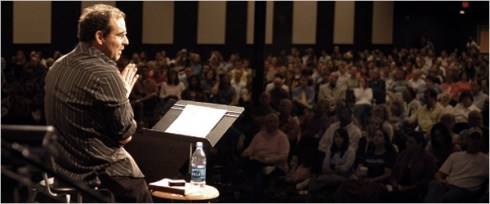
Greg Boyd is co-founder of Woodland Hills Church, an evangelical fellowship in St. Paul. He is also president of ReKnew.org. Greg is a pastor, theologian, and author of more than a dozen academic and popular books.

I have been personally challenged, encouraged, and inspired by Greg’s work for many years now. So, I asked Greg if he would share his Kingdom vision with my readers. He was gracious enough to answer some of my questions about his ministry at Woodland Hills and talk about his upcoming books.

It’s my desire that you will find Greg’s ministry intellectually honest and spiritually refreshing in today’s fractured and dry evangelicalism.

Did you read Q&A with Pastor Greg Boyd, Part I and Part II?

This is the final installment in a three-part interview.

___________________________________________________________________

Greg, before your massive Crucifixion of the Warrior God with IVP comes out, I’m told you have another smaller worker coming out with Baker called Benefit of the Doubt: Dismantling the Idol of Certainty.

What is the release date for this book?

Greg: I believe it’s scheduled for Spring of 2013.

What led you to write this book?

Greg: A number of factors led me to write this book. First, I find that most people today hold to a concept of faith that assumes that a person’s faith is as strong as they are certain and free of doubt.

So in this model, certainty is a supreme virtue and doubt is the enemy. This prevalent model is wreaking havoc with people’s heads and with the church!

For example, several months ago a lady came up to me after church and told me that, while she loves Jesus and believes the Bible is the Word of God, she struggles with some of its violent stories. They don’t seem to be something God would inspire. She was worried that her doubts were causing her to lose her salvation.

I met a couple last year who wondered if the reason their daughter wasn’t healed was because they “lacked faith” when they prayed — meaning, they couldn’t make themselves certain their daughter would for sure be healed when they prayed. Think what a burden that would be to carry around!

This idea that your faith is as strong as you are free of doubt is a form of psychological torture for some people!

On top of this, this model of faith encourages people to TRY to make themselves certain and to TRY not to doubt, which in turn creates a culture of closed-minded people who view challenges to their faith as threats and who are afraid of reading books or listening to speakers who might challenge their views. (With heaven and hell riding on how certain you remain, why would you risk being open-minded?).

I’m convinced this is one of the reasons Barna’s research shows that Evangelicals have a reputation for being intolerant and ignorant.

Another negative aspect of the equation of faith with feeling certain is that it presupposes a strange, if not malevolent, picture of God. I have always wondered what it was about “faith” (understood as striving for certainty) that made God value it so highly.

Why would God leverage salvation or a daughter’s healing on the degree to which a person can convince him or herself that something is true? What is virtuous about this? In fact, what is rational about this, for rational people usually allow the strength of evidence and the persuasiveness of arguments determine their degree of certainty for a particular belief?

The ability to make yourself feel certain about a belief for which there is insufficient evidence and argumentation is an ability that simple people and delusional people tend to possess while people who are rational or naturally skeptical tend to lack. This difference is natural because people simply possess different sorts of minds.

But why would God leverage everything in favor of simple and delusional people and be so prejudiced against grounded, inquisitive or skeptical people? And what kind of God would put parents in a position where the fate of their daughter is dependent on how certain they can make themselves feel that their daughter will be healed? It’s cruel!

Over the years I have grown increasingly suspicious that there was something “off” with this wide-spread model of faith. And my research over the years increasingly confirmed my suspicion.

As I argue in Benefit of the Doubt, the contemporary model of faith is very different from the way Scripture understands faith.

The modern concept of faith is a PSYCHOLOGICAL concept, while the biblical model is COVENANTAL.

Faith in Scripture isn’t about striving for certainty: it’s about being willing to commit to a course of action — to a way of living — in the face of uncertainty. And while the modern concept makes people run away from doubt, the biblical model encourages us to embrace it.

Another thing that motivated me to write this book is that I’m deeply grieved by the astounding number of young people — especially college kids —  who are walking away from the faith because they become convinced that it is no longer tenable.

So far as I can see, the main reason this is happening is that young Evangelicals are taught to embrace their faith as a sort of “package deal.” To be a Christian means you have to hold a an assortment of different beliefs, as though each were equally important.

I call this way of embracing faith a “house of cards” model of theology. If one card gets knocked out, the whole edifice of faith comes crashing down.

This model was tenable in the past when a Christian could live most of their life and never confront sincere and informed people of other faiths or never have to confront serious objections to their faith. But it is no longer tenable in the world we live in today, a world that is much smaller, much more complex and much more ambiguous than the world people lived in up until fifty to a hundred years ago.

This is why the “house of cards” theology forces many to leave the faith.

I had a discussion on a plane with a guy several months ago who told me he was forced to conclude Christianity wasn’t true while taking a course on the Bible in a secular university. A book he was assigned to read presented archeological evidence that convinced him the story of God’s people conquering the promised land was not historical.

I asked him, “Why on earth did you reject a relationship with Jesus because of that?” His response was that he had always assumed that believing every story in Scripture was divinely inspired and historically accurate was simply part of what it meant to be a Christian.

I include a lot of personal stories in Benefit of the Doubt, one of which is my loss of faith in college. I had the same “house of cards” experience as this man. According to the teaching I’d been given in the Pentecostal Church I was “saved” in,  the first two chapters of Genesis had to be scientifically accurate or, as one preacher put it, the whole Bible is a book of lies.

Unfortunately, my first course in college was a class on evolutionary biology. I fought hard to defend my faith by reading every book I could find on creationism, but it wasn’t long before I felt I had no choice but to concede there was at least some truth to the theory of evolution.

Consequently, I rejected the Christian faith and thereby embarked on the most existentially excruciating year of my life before I began to slowly work my way back into a much less rigid form of Christianity.

In Benefit of the Doubt, I offer people an alternative to the “house of cards” way of embracing faith. It’s a flexible model in which (among other things) our faith isn’t leveraged on the historicity of every particular story, or any particular story of the Bible.

In fact, in the model I propose, the intellectual foundation of our faith isn’t rooted in Scripture, but in the historical Jesus, based on what I believe are strong historical-critical considerations.

Hence, in the model I propose, one can feel comfortable entertaining doubts about every belief they have, so long as they are sufficiently convinced of the Lordship of Christ (based on considerations I prove in the book) to commit to acting in a certain way – viz. to living as though Jesus is Lord, which includes cultivating a relationship with him.

How is this book on faith and doubt different from other books on the subject?

Greg: At the risk of sounding immodest, I believe there are four things that sets Benefit of the Doubt apart from other books that address faith and doubt.

  1. Benefit of the Doubt exposes the unbiblical, irrational and idolatrous nature of the certainty-seeking faith that most people embrace today in a way that has not been done before.
  2. I am not aware of any book that fleshes out the biblical nature of faith the way I do in Benefit of the Doubt.
  3. This book is very unique in the way it empowers readers to cultivate an intellectually grounded, confident, vibrant relationship with Christ while embracing doubt about any number of beliefs.
  4. And finally, not only does Benefit of the Doubt help readers not be afraid of doubt; it empowers them to see how doubt can and should play a positive role in their life.

David: You have recently presented the basic message of this book to Woodland Hills as you finished the first draft.

How have the folks at Woodland Hills responded to this message?

Greg: The feedback I’ve gotten from both the attenders and the podritioners (our 10-15,000 weekly podcasters) of Woodland Hills Church has been simply overwhelming. Many have found my way of reframing faith and doubt to be absolutely liberating.

In fact, I’ve had a dozen or so people tell me that the way of embracing faith that I propose has been a life-line that has kept them from losing their faith.

From the feedback I’ve received, it seems the most important distinctive of my approach has been the way it shifts the intellectual foundation of the faith from the Bible to the historical Jesus.

I encourage people to not believe in Jesus because they believe in the Bible, but to believe in the Bible because they believe in Jesus.

In my view, the Bible is inspired to serve as the foundation for what we believe, but it was never intended to be the foundation for why we believe.

In my view, the Bible is far too vulnerable to serve as this foundation. That is, there are far too many problematic aspects to Scripture to make our faith dependent on this book.

It should never be the case that a person’s faith hangs in the balance on whether or not (for example) the conquest narratives are anchored in history, or whether or not the story about Samson is historical or legend (or a thousand other disputed aspects of Scripture).

By contrast, the case for believing that the historical Jesus is the ultimate revelation of God is very compelling (on this issue, see P. Eddy, G. Boyd, The Jesus Legend [Baker, 2007).

When a person’s faith depends on Scripture, every one of Scriptures problematic features becomes all-important and the foundation of their faith is constantly vulnerable as a result.

But when a person’s faith depends only on the historical Jesus, the problematic aspects of Scripture become irrelevant.

From the feedback I’ve gotten, this has been the most liberating aspect of my model of faith. My prayer is that many others will find that Benefit of the Doubt helps them cultivate a vibrant, Christ-centered faith in our increasing complex, ambiguous and doubt-filled world.

David: Thanks, Greg! I appreciate you taking the time to share.

___________________________________________________________________

If you would like to hear more from Greg Boyd, check out his website & blog and sermons! Interested in his books? See his collection of academic and popular writings at Amazon. Thanks for reading!

D.D. Flowers, 2012.


Q&A with Pastor Greg Boyd, Part II

Greg Boyd is co-founder of Woodland Hills Church, an evangelical fellowship in St. Paul. He is also president of ReKnew.org. Greg is a pastor, theologian, and author of more than a dozen academic and popular books.

I asked Greg if he would share his Kingdom vision with my readers. He was gracious enough to answer some of my questions about his ministry at Woodland Hills and talk about his upcoming books.

Did you read Q&A with Pastor Greg Boyd, Part I?

This is the second installment in a three-part interview. Enjoy!

___________________________________________________________________

Greg, speaking of violence, you’re currently working on a big book project called, The Crucifixion of the Warrior God: Reinterpreting Divine Violence in Light of the Cross (IVP).  That’s a provocative title!

What’s the thesis of the book?

Greg:  I’d like to address your question in a round about way.

Throughout Church history theologians have made a lot of use of the concept of divine accommodation. Whenever they came upon passages that seemed “unworthy” of God, they surmised that God was condescending to communicate at a level that we finite, fallen people could understand.

The main criteria these theologians employed to discern when God was accommodating himself was “the classical view of God” — that is, the view that God is above time, change, movement, passions and being affected by anything outside himself.

With this presupposed view of God, of course, most of the Bible had to be viewed as an accommodation, since the God of the Bible moves with humans through time, interacts with them, responds to them, changes his plans in response to them, is affected by what they do and experiences deep emotions in relationship with them.

I am largely opposed to this view of accommodation, since I don’t espouse this view of God. But what I find particularly interesting is that, for all their talk of divine accommodation, after Augustine, theologians never struggled with portraits of God acting violently or engaging in violence.

This despite the fact that traditional theologians have always confessed that Jesus is the definitive revelation of God, and despite the fact that enemy-loving non-violence is at the center of his teaching and example.

If ever we were going to apply the concept of accommodation, I would think it would be to portraits of God that seem to contradict what we learn about God in Christ.

What I am doing in The Crucifixion of the Warrior God is essentially claiming that we should read the entire Bible through the lens of the cross and that, when we do, we can discern that God is accommodating the limited and fallen worldviews of the people he’s dealing with when he allows himself to be depicted as engaging in or commanding violence.

More specifically…

I’m arguing that the cross reveals what God is truly like and thus what God has always been like.

Since God entered our fallen humanity and bore our sin on Calvary, taking on the appearance of one who was much less beautiful than God actually is, we should read the OT looking for other ways in which God entered the humanity of his people, bore their sin, and took on appearances that were far more ugly than what God is actually like.

So I’m basically arguing that all the violent divine portraits in Scripture are examples of divine accommodation and are harbingers of God’s ultimate accommodation on Calvary.

Now, the book is presently over 600 pages, and I’m quite a ways from being finished!  So there is obviously a whole lot more going on than what I could communicate here. But this is the most basic idea.

What motivated you to write this book?

Greg:  I am writing this book primarily because I have for decades been bothered by the radical difference between the God who gives his life for enemies on Calvary, on the one hand, and the God who commands his followers to “show no mercy” and slaughter “everything that breathes,” on the other.

The more clearly I’ve seen the centrality of loving enemies and non-violence in Jesus’ life and message, the more troubling these violent portraits of God in the OT have become.

I believe the whole Bible is divinely inspired, so I can’t simply reject these violent portraits as many liberal theologians do. Yet, I can’t with integrity deny that these violent divine portraits seem to contradict what I learn about God in Christ.

In fact, inasmuch as Jesus taught that ALL Scripture points to him (e.g. Jn 5:39-45), the problem is not just to show how the genocidal portrait of God is CONSISTENT with the God revealed in Christ, but to show how it and similar violent portraits actually POINTS TO Jesus!

About four years ago I decided it was time to stop all I was doing (I’ve had several book projects on hiatus for the last four years) and figure this out. But its not just for myself that I researched and wrote this book.

So what do you hope to accomplish?

It’s my impression that this is among the most pressing problems Christians today have, especially those who affirm the inspiration of the OT and yet grasp the centrality of non-violence in the teachings and example of Jesus.

And I’ve found its one of the main reasons many today won’t give the Christian faith serious consideration.

If I can provide a plausible way of explaining the brutally violent OT portraits of God and of showing how they point to the God revealed on Calvary, I believe I will have offered many people a great service.

Q&A with Pastor Greg Boyd, Part III

___________________________________________________________________

NOTE: Greg plans to have a popular version of this book made available after the initial printing of The Crucifixion of the Warrior God (IVP, 2013). I will be responding to these books after their publication.

In the meantime, listen to Greg’s sermon, God’s Shadow Activity and more of his thoughts at his website & blog.

D.D. Flowers, 2012.


Who Gets Left Behind?

I’m thoroughly convinced that the Scriptures themselves, and a long history of the church doing biblical theology, simply doesn’t support the idea of a secret escape from tribulation and an abandonment of the earth.
If you’re a subscriber to the blog, you know that I have recently been challenging rapture theology. If you’re new to the blog or you just drop in from time to time, please know that the following posts should really be read as a series of my thoughts on the subject:

When I first posted on the topic, I had no plans to address the rapture systematically. I never really had a plan, and honestly I still don’t. I’m just sharing whatever I’m thinking as I reflect on my upbringing, pop-culture Left Behind ideas, and what some of you have written in response to my posts.

Thank you to those who have responded. You really do help cultivate ideas for future posts. You can expect that I will further address some of your questions and concerns that relate to key rapture passages and ideas.

So, here’s my next installment.

In a previous post, I wrote: “Pay careful attention to this truth. It’s those who are righteous that are “left behind” (Matt 24:38-41). The wicked will not inherit the earth. They will be swept away in a flood of judgment.”

Let me expound on this point as I continue to dismantle rapture theology.

I Wish We’d All Stop Singing This Song

Did you ever hear the song “I Wish We’d All Been Ready” (1969) by Larry Norman? I remember hearing DC Talk’s (1995) version of it when I was in junior high. I admit that it was a moving song back then.

Life was filled with guns and war
And all of us got trampled on the floor
I wish we’d all been ready
Children died the days grew cold
A piece of bread could buy a bag of gold
I wish we’d all been ready
 
There’s no time to change your mind
The Son has come and you’ve been left behind
 
A man and wife asleep in bed
She hears a noise and turns her head he’s gone
I wish we’d all been ready
Two men walking up a hill
One disappears and one’s left standing still
I wish we’d all been ready
 
There’s no time to change your mind
The Son has come and you’ve been left behind
 
Children died the days grew cold
A piece of bread could buy a bag of gold
I wish we’d all been ready
 
There’s no time to change your mind
The Son has come and you’ve been left behind

It’s a catchy tune, no doubt. It can even spur someone on to trusting in Jesus. But it’s songs like this that often shape our theology for the worse.

And our theological ideas impact the way in which we live.

What’s the problem? Well, it’s a plain distortion of the biblical hope for the righteous, and the righteous judgment for the wicked.

Let’s take a look at our primary text.

The Righteous Get Left Behind

Where does the idea of “Two men walking up a hill, one disappears and one’s left standing still” come from anyway? It’s taken from Matthew 24:36-44. But notice that the one left “standing still” is not the wicked man.

It’s the wicked that are taken from the earth. The righteous are left behind.

As it was in the days of Noah, so it will be at the coming of the Son of Man. For in the days before the flood, people were eating and drinking, marrying and giving in marriage, up to the day Noah entered the ark; and they knew nothing about what would happen until the flood came and took them all away. That is how it will be at the coming of the Son of Man. Two men will be in the field; one will be taken and the other left. Two women will be grinding with a hand mill; one will be taken and the other left. Therefore keep watch, because you do not know on what day your Lord will come.  Jesus, Matthew 24:37-42 (NIV)

See my post Then the End Will Come for the context of Matthew 24.

Jesus is talking about his imminent return at the end of the age, and he uses the story of Noah as an example of the judgment to come. So when he mentions two people in the field, and two people at the hand mill, it must be recognized that the ones taken are the wicked that reject God’s image in the earth. The flood of God’s judgment will remove the wicked from the earth.

It teaches the exact opposite of what rapture folks propose.

Therefore, the context of Matt 24:36-44 rules out a secret escape for Christians. Instead, as I have presented in my previous posts, Christians should expect God’s Kingdom to come to earth. As Jesus said, “the meek shall inherit the earth” (Matt 5:5) and God’s will is to be done “on earth as it is in heaven” (Matt 6:10). Heaven is coming to earth (Rev 21).

Christ will return in glorious fashion to dwell on the earth forever. We shall go out to meet him and parade our divine King back into his rightful domain (1 Thess 4:15-17). Let’s be clear about this…

Kingdom people aren’t going anywhere.

The earth is the Lord’s and everything in it (Ps 24:1). We will receive resurrected bodies for a resurrected world. It’s the wicked that will not enter into God’s rest on the earth. Just like in the flood, the wicked shall be removed in judgment. They want no part in God’s new creation.

The righteous will be left behind.

Of course, this means that we should then expect to endure suffering and tribulation on the earth. You can’t offer a well-rounded challenge to rapture theology without addressing the matter of tribulation.

I suppose that’s where I’ll take us next.

Stay tuned!

D.D. Flowers, 2012.


Q&A with Pastor Greg Boyd, Part I

Greg Boyd received his Ph. D. from Princeton Theological Seminary (1988), his M.Div. from Yale Divinity School (1982) and his B.A. from the University of Minnesota (1979). He was a professor of theology for 16 years at Bethel University (St. Paul, MN).

In 1992, Greg co-founded Woodland Hills Church, an evangelical fellowship in St. Paul. He is also president of ReKnew.org. Greg is a pastor, theologian, and author of more than a dozen academic and popular books.

Some of his books include, Letters From a Skeptic: A Son Wrestles with His Father’s Questions about ChristianityThe Jesus Legend: A Case for the Historical Reliability of the Synoptic Jesus TraditionIs God to Blame?: Moving Beyond Pat Answers to the Problem of Evil, and the best-selling book The Myth of a Christian Nation: How the Quest for Political Power Is Destroying the Church, which led to a New York Times front-page article and several television interviews.

In 2010, Greg was listed as one of the twenty most influential Christian scholars alive today. He continues to challenge evangelicals with his theological ideas and Kingdom vision. His work is an inspiration to those evangelicals that believe a revolution is needed in the church.

Greg is a pioneering Christian intellectual and church practitioner. He is helping to bridge the gaps between the church & academy, faith & reason, theology & science, as well as confession & mission.

I asked Greg if he would be willing to share his Kingdom vision with my readers. He was gracious enough to answer some of my questions about his ministry at Woodland Hills and talk about his upcoming books.

The Q&A will come in three parts. Enjoy!
___________________________________________________________________

Hey Greg, thank you for taking time out to talk about your ministry at Woodland Hills, and to give us a sneak peak of your two upcoming books.

I must say that I’ve been personally impacted by the work you’re doing in the church today, and I think many evangelicals need to hear and understand your vision for the Kingdom of God.

I recently featured your book The Myth of a Christian Nation in a blog series of five books offering a new Vision for 21st Century Evangelicalism. Your 2004 sermon series The Cross & the Sword was the foundation for this book.

What is the core message you set forth in your sermons and in your book? 

Greg Boyd: Thanks for the invitation to dialogue, David. I appreciate your passion for the Kingdom and your desire to see Evangelicalism freed from its cultural imprisonment.

Well, the core message of my sermon series and book is simply that the Kingdom of God is not merely the best version of the kingdoms of this world. It’s a Kingdom that is “not of this world,” as Jesus said (Jn 18:36).

As the incarnation of God, Jesus perfectly modeled what it looks like for God to reign over a person’s life. So you can always tell where the Kingdom is present, because it always looks like Jesus.

Individuals and groups under the reign of God manifest the kind of humble, self-sacrificial love that Jesus demonstrated in his life, and especially in his death, when he freely offered himself up on behalf of the very people who crucified him, praying for their forgiveness with his last breath.

To the extent that individuals and groups lovingly sacrifice for others the way Jesus did, the Kingdom is present. To the extent that they don’t, it’s not. It’s really that simple.

Obviously, no nation, government and political party has ever looked anything like this. Indeed, given the power-dynamics of our fallen world, I don’t believe any nation, government or political party ever COULD look like this. And this is why we should never identify any nation, government or political party as being the kingdom of God, or even as a means of bringing about the Kingdom of God.

It’s also why we should never think any nation, government or political party is more “Christian” than another.

The Kingdom that Jesus inaugurated is altogether unique, and I believe that everything hangs upon God’s people keeping it unique, set apart, or “holy.”  The minute we start associating the Kingdom with nations, governments or politics, we water it down and compromise its distinctive beauty.

It’s my conviction that the job of Kingdom people is to live a Jesus-looking life that CONTRASTS with the world and thereby offers people who have open hearts an ALTERNATIVE to all the kingdoms of this world.

How has Woodland Hills Church changed as a result of this message? 

Greg Boyd: It seems to me that Woodland Hills turned a corner when I first preached the “Cross and the Sword” series.

While we lost around a thousand people as a result of this series, it helped us acquire a sharper vision of the Jesus-looking Kingdom we are called to be citizens and ambassadors of.

We’ve thus grown increasingly aware of how thoroughly American Christianity has been co-opted by American culture and how radically different the Kingdom is from what most Americans identify as the “Church.” Along the same lines…

we’ve come to a greater realization of how challenging it is to make authentic disciples out of American church attenders. 

This has in turn motivated us to explore strategies to help people wake up to the way they’ve been conditioned by things such as the individualism, consumerism, materialism, hedonism and triumphalism of American culture.

And its motivated us to put in place courses to walk people through this process and eventually get them plugged into missional Kingdom communities in which they worship, minister and share life with others in meaningful ways.

I’d also add that over the last five years Woodland Hills has increasingly come to see itself as a resource center for individuals and groups around the world who are waking up to this distinctive vision of the Kingdom.

So what would you say to those who are worried about the outcome of the presidential election?

Greg Boyd: I’d simply encourage them to place their trust where their trust ought to be: in JESUS. He is the King of all kings and the Lord of all Lords, and his Kingdom will last forever and ever!

Presidents, political parties, governments and nations come and go, but Jesus “is the same, yesterday, today and forever.”

While we should expect pagans to think that the future of the world is in their hands — this is why they seize whatever power they can to try to control how things unfold — children of God are called to place their trust completely in him and to aspire to be faithful to his call.

We are called to crucify ourselves, which means we are to die to living out of our own self-interest, and instead seek only to love, serve, and bless all people, including our enemies.

So long as we think it is UP TO US to fix the world, we can never love and bless those who oppose us.

Only when we realize that we are called to be faithful in living a Jesus-looking life while leaving all outcomes to God can love our enemies and refrain from violence the way Jesus commanded us to (Lk 6:27-35).

Q&A with Pastor Greg Boyd, Part II

D.D. Flowers, 2012.