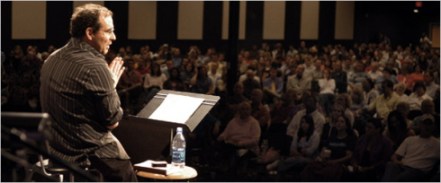
Greg Boyd on Anabaptist Mega-Churches

Yesterday over at ReKnew.org, Greg Boyd responded to a common objection. Can you have an Anabaptist mega-church?

Some may claim that a church can espouse an “Anabaptist” theology (or partially), but if they are large enough to be considered a “mega” church they can’t really be an Anabaptist congregation.

I’ve heard this skepticism before. In fact, I have personally discussed this objection with Greg, since Woodland Hills Church has evolved into an Anabaptist congregation, and because I entered the Mennonite USA back in June of this year to pastor an Anabaptist church in Virginia.

Here’s an excerpt of what Greg had to say in his post:

Ironically, those who argue mega-churches can’t be Anabaptist churches are assuming, in the process of raising this objection, a non-Anabaptist definition of church as a weekend gathering. If the leadership of Woodland Hills thought that our “mega” weekend gathering was “the church,” the objection would indeed be valid. But we don’t think this, precisely because this would be a very non-Anabaptist position to assume!

I was encouraged to read Greg’s response because it reflects my own thoughts, and my personal experience as well.

After leaving vocational ministry within the SBC in 2006, and meeting in “organic” house churches for five years, I became very critical of organized churches, especially mega-churches. And for good reason. Mega churches have a tendency to base their success on attendance in their corporate gatherings, and have little to no concern for real community.

Meeting in homes for several years, deconstructing and reconstructing my understanding of the church, was necessary for me to see the benefits of face-to-face community, as well as the larger “mega” gatherings.

It was during that time that I was becoming an Anabaptist. And I deeply resonated with this concern that Anabaptists have for community and keeping it simple. Historically, they’ve done it better than most.

Anabaptist theology and practice rightfully recognizes that face-to-face community is essential in being the Body of Christ in any given location. So, there is a legitimate concern that community might be lost if a church grows beyond a certain point. Some would say it will be lost.

But is this necessarily so?

Again, listen to Greg’s response:

What Woodland Hills Church (as well as and the Meeting House in Toronto and other mega-Anabaptist Churches that may be out there) demonstrates is that we don’t have to chose between embracing the church as community, on the one hand, and holding a large weekend gathering, on the other. There’s nothing intrinsically anti-kingdom about large gatherings. After all, large crowds flocked to Jesus, and the early Christians in Jerusalem met in large groups in “Solomon’s porch” (Acts 5:16-19). The key, however, is to always remind people that the primary expression of church is not the large group, but the smaller communities that come together in houses to share life, study the word, worship and minister together.

I’ve discovered that it is possible to grow in number (corporately) and maintain real community. With it will come challenges, but they’re opportunities to build the Kingdom. We should embrace them.

It may be that the maturity level of some believers has them seeing a weekend “mega” gathering as church. They are just passive receivers of sermons. I think you’re always going to have people who think that way. I’ve even seen them in house churches. They just come, sit, and leave.

So it’s like this. If the leadership and core members hold fast to promoting and practicing sincere relationships in face-to-face community, the church will stay the course of vibrant Kingdom community and outreach.

I appreciate Greg helping us to see the way forward.

Are you a part of an Anabaptist church? How has your church responded to the idea of growing into a large congregation as you reach your community? Do you believe it’s possible to grow numerically and maintain a deep level of community? Please, share your thoughts.

D.D. Flowers, 2013.

Read Greg’s entire post here at ReKnew.org.


The Futility of Behavior Modification

Jonathan Merritt recently interviewed Tullian Tchividjian, pastor and author of the new book, One Way Love: Inexhaustible Grace for an Exhausted World (David C. Cook, 2013).

Tullian is the grandson of Billy Graham. And he seems to have Graham’s gift of stating things very plainly. Listen to what he says.

Tullian claims that grace has been “tragically hijacked by an oppressive religious moralism” that leads to condemning others in and outside the church. For these terrorists, it’s about rules, rules, and more rules!

Sadly, too many churches have helped to perpetuate the impression that Christianity is primarily concerned with legislating morality. Believe it or not, Christianity is not about good people getting better. If anything, it is good news for bad people coping with their failure to be good. Too many people have walked away from the church not because they’re walking away from Jesus, but because the church has walked away from Jesus.

That’s a hard pill to swallow for many evangelicals. And I’m glad to hear it coming from a reformed pastor. It needs to be said because it’s true.

I’ve seen it firsthand. I’m sure many of you have as well.

OK, maybe you don’t believe in legislating sin and supporting the Religious Right, but you may need to hear what Tullian says next.  Have you traded your identity in Christ for performance based spirituality?

Ironically, I’ve discovered that the more I focus on my need to get better, the worse I actually get—I become neurotic and self-absorbed. Preoccupation with our performance over Christ’s performance for us actually hinders spiritual growth because it makes us increasingly self-centered and morbidly introspective—the exact opposite of how the Bible describes what it means to be sanctified. Sanctification is forgetting about yourself.

What is the remedy for this neurosis of the soul? It is nothing more than discovering our true identity in the Christ of grace, and replacing our narcissistic self-absorption with an undying concern for others.

Read the full interview: Billy Graham’s grandson takes Christians to task: An interview with Tullian Tchividjian

What do you think about Tullian’s words of challenge and rebuke? How have you been discovering your true identity in Christ?

D.D. Flowers, 2013.


Brennan Manning on the Compassion of Jesus Christ

Brennan Manning passed away in the Spring of this year, April 12, 2013. His ministry and books have made a tremendous impact on my understanding of the gracious God revealed in Jesus of Nazareth.

He wrote many popular and influential books, including The Ragamuffin Gospel, Abba’s Child, Signature of Jesus, Ruthless Trust, The Wisdom of Tenderness, etc.

But it was a video of Manning sharing a message on the compassion of Jesus that caused me to break down in tears at my desk one afternoon. I had come to realize, in a much deeper way, how much God really loves me. I was forever changed in that moment. Seriously, I will never forget it.

I pray that you will take a moment of your time to consider the compassion of Jesus. The following typography video is an excerpt from that message.

Do you believe that the complete character of God has been revealed in Jesus? Do you know Jesus as the Son of compassion? Call on him today to meet you where you live. Believe that Jesus loves YOU.

D.D. Flowers, 2013.


Pray for the Persecuted Church

Friends, our Christian brothers and sisters are being persecuted. Please remember to be in prayer for the saints in Nigeria, Kenya, Pakistan, Syria, Egypt, Iran, Afghanistan, and other hostile areas around the world.

It’s critical for us to be reminded that there are demonic powers at work behind the political regimes and religious fundamentalists threatening the church. We can’t afford to look only at the surface of these atrocities.

“For our struggle is not against flesh and blood, but against the rulers, against the authorities, against the powers of this dark world and against the spiritual forces of evil in the heavenly realms.” Ephesians 6:12

Our enemy prowls around like a roaring lion seeking to devour followers of the Lamb. We need to pray for our spiritual family (1 Pet 5:8-10).

They are counting on us. Tell your local church to pray for the persecuted.

As Jesus said to Saul, a persecutor of Christians, on the road to Damascus, “Saul, Saul, why do you persecute me” (Acts 9:4)? It is Jesus in us, the church, that is being mocked, reviled, and struck down.

“Blessed are those who are persecuted because of righteousness, for theirs is the kingdom of heaven.” Jesus, Matthew 5:10

Stay informed and connected to the persecuted church through The Voice of the Martyrs and International Christian Concern at persecution.org.

Watch this video by Open Doors USA and learn more.

Do you feel a connection to the persecuted church around the world? What can you do to be more aware of their sufferings? How can you help? 

D.D. Flowers, 2013.