Category Archives: Theology

Loving God With Your Mind

In setting forth the purpose of my blog, I have written that I want to be about loving Jesus with all of my heart, soul, strength, and mind.

This blog is dedicated to all those who desire to do that—making Jesus Christ central and supreme in every way.

Here is what I have made clear about myself and the blog:

As a young academic and an aspiring Christian mystic, this blog is unashamedly a reflection of my pursuit of Christ in spirit, soul, and body—the realm of the intellect as well as spiritual imagination. It is my desire that this blog would contribute to biblical academic dialogue, encourage humble Christ-followers, and challenge honest skeptics.

Those who follow my blog regularly know that I’m not afraid to press our collective evangelical buttons. I don’t do this because it’s in vogue, or because it’s the new hip (even “progressive”) thing to do these days.

No, I write about where I’ve been and where I am currently in my walk. I seek to remain teachable for the future. But I’m not afraid to be passionate about those things I’ve been convinced of in the present.

I wanted to share that with you. I suspect there are others that can relate to my own journey. I pray that you find this blog a place to think out-loud with me, even come to some much-needed conclusions.

I want to be flexible as I grow up into Christ. I truly want to be “semper reformanda” (always reforming). I hope you will commit to this principle of Christian growth with me.

I do recognize that it’s no easy thing to question long-held beliefs, or to challenge deeply rooted traditions. It’s a hard and often uncomfortable road. Many folks are just not willing to wrestle with new thoughts and ideas that seem to threaten their basic theological framework.

But I’m convinced it’s part of discipleship.

“Disciple” means we are learners on a journey. Learners change and grow.

While we may not be willing to embrace a new teaching today (or an old one that’s new to us), we might be in a better position later on to see the wisdom of it and experience its life-giving freedom. We must be careful. Overreacting to new ideas can actually make it harder to accept them later on when/if we begin to sense a change in the wind of conviction.

Of course, it may be a teaching we never accept because we feel it’s not compatible with our interpretation(s) of Scripture. Regardless, we must remain humble and teachable, allowing others to follow the Lord as best they know how, even if we decide we just flat out disagree.

This requires an attitude of humility and a willing spirit of forbearance with others. If we’re going to love the Lord with all or our mind, as we seek to hold together faith and reason, we must be intentional about these things.

In humility we must all recognize that there is inspired Scripture, and then there are our interpretation(s) of Scripture. We must remember this when we’re in dialogue with others. And we should always think the best of those who disagree with our interpretations.

Finally, we need not be fearful of intellectual challenges to our faith when we are getting all of our life from Christ, and entrusting others to him also.

When we’re doing this, we can allow each other freedom and space to grow.

The following video is a Greg Boyd sermon excerpt from a 2009 message on eternal punishment. He is prefacing his message by talking about the need for intellectual inquiry in our pursuit of Christ.

Are you encouraged to think and question in your church? What rewards have you experienced from loving God with all of your mind? What can the church do to be a safe place for intellectual inquiry?

D.D. Flowers, 2013.


Open Theology in MIB3

A few weeks ago my wife and I rented Men in Black 3 (MIB3 – 2012), starring Will Smith, Tommy Lee Jones, and Josh Brolin. I didn’t dislike the first two films, but it’s not really my style. I like sci-fi films, but sci-fi comedy… not so much. However, we heard it was good so we decided to give it a go.

I was pleasantly surprised with how well the plot held my attention. I like Will Smith, and of course Tommy Lee Jones and Josh Brolin are great actors. But as entertaining as it was to watch them, I found that the most fascinating character in the movie was an alien named Griffin (Michael Stuhlbarg). He appeared to be human, but he was unlike anyone you’ve ever met.

Griffin has the ability to see all possible futures. While Griffin is merely a human (or alien), he possesses a “supernatural” ability to see what only an infinite-minded being could foreknow.

I think Griffin works well as a comedic caricature of God, as presented in the open view. In fact, I believe that Griffin offers a teachable moment for those who remain unclear or even skeptical of open theism.

In a nutshell, open theology comes down to this:

God created a free universe where creatures are always given an appropriate degree of freedom to operate within creation and shape the future. Therefore, God is immanent and operates within his creation according to its laws and nature. Since God’s foreknowledge is perfect in his infinite ability to know all possible futures, as if they were all certainties, he is forever ahead of his creatures and fully prepared to interact and respond to us.

In the following scene, Agent J (Smith) and a young Agent K (Brolin) are introduced to Griffin. They quickly discover his unique abilities. They are at first bewildered by Griffin’s great power of foreknowledge, but in time they see his ability as reason to place great confidence in him.

Do you think it is logically and biblically consistent to believe that God sees all of the future as predetermined, while at the same time claiming that human beings have free will? Let’s instead consider how an infinitely intelligent God can grant a great level of freedom to human beings, leaving the future open to a degree, and also reign supreme over creation in the unfolding of God’s good purposes for the cosmos.

D.D. Flowers, 2013.


On Church Doctrinal Statements

Last week I posted on Creeds & the Local Church. I’ve been giving some thought to the importance, even necessity, of a church doctrinal statement.

I’ve also been thinking about the difference(s) between dogma, doctrine, and opinion. In the pursuit of planting a church, it must be examined and discussed with others who are joining together in community.

I concluded that…

“a healthy church will continue to wrestle with dogma, doctrine, and opinion in every age and culture.”

I wanted to share a few more thoughts I’ve had in light of a couple responses to my last post on the topic.

Why We Need Doctrinal Statements

I admit that a lengthy doctrinal statement can present obstacles for folks. I know that when I see a long doctrinal statement, I honestly anticipate something that’s gonna rub me the wrong way.

I even do this when looking at schools. I almost expect that the longer the statement, the more likely we’re going to clash.

I quickly move off church websites when I see that they believe in a “rapture” pre-millenial/pre-trib theology. That’s of course because I so strongly disagree with it, and I often don’t see why it needs to be stated.

I think… “Can’t we just agree that Christ is returning?”

I think it’s different when there is a statement included that allows for differing views on the matter. It should be clear that people are welcome (and treated that way) even if they disagree with the “official” doctrine of the church. There ought to be an atmosphere of freedom.

But I want to be clear that I don’t see anything wrong with a church saying, “Here’s where we are as a local fellowship.” I would rather they be upfront about it, because it’s there whether visible in a confession or not. This is good and can please the Lord, when it’s done in grace and love.

Contrary to those that think creeds and doctrinal statements are always and only divisive, I think they are helpful for a fellowship and for those who would visit them. We mustn’t jump to such extremes just because we’ve seen examples of churches who did not hold their doctrine with grace, humility, and love. It’s reckless to respond in such a way.

A doctrinal statement captures the heart of the people, and serves as a guide for further growth into Christ.

I think it’s beneficial for visiting Christians to know where a church is in its journey. A doctrinal statement can reveal that to a certain extent. I would like to know where most of the fellowship is at in their walk. Wouldn’t you?

In reality I think it’s unhealthy not to at least hold some distinctives as a local church seeking to express the Christ they know. Where are we theologically as a fellowship? How are we seeking to manifest Christ among our culture and context? How do we feel about issues that often divide the church and the world? These are important questions that should be answered, leaving room for exploration and growth moving forward.

I believe it’s possible to plant your church’s creed, mission, and vision in certain doctrinal ideas while at the same time welcoming everyone who agrees upon the foundation—the mysterious incarnation of Christ.

I don’t think it’s a good idea to enter into any fellowship where doctrine isn’t apart of the church’s life together. That fellowship may have good intentions, but they open themselves up to problems born in the opposite extreme of dogmatism. They imagine that doctrine is inevitably against knowing Christ. They’re wrong. And they’ll be proven wrong.

So, I would say folks will (and should) find union with saints based on their basic confession of something like the Apostles Creed. But I also believe it’s healthy—even necessary—for a church to be upfront and clear about their doctrinal positions, holding them in love, grace, and humility.

It can be done, even if we’re skeptical because of our bad experiences.

What do you think? How have you seen doctrine and church distinctives serve as a healthy guide to growing in Christ? How are you and your church handling doctrinal matters?

D.D. Flowers, 2013.


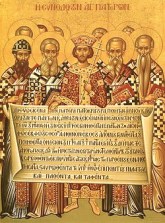
Creeds & the Local Church

I’ve been doing some thinking about the difference(s) between dogma, doctrine, and opinion when it comes to the local church.

Simply put… it looks like this.

  • Dogma — Irreducible beliefs of the Christian faith. What do we say about Jesus?
  • Doctrine — Historical or traditional beliefs on a plethora of theological issues. What sets us apart?
  • Opinion — Debatable issues that you’re free to agree or disagree upon. What do you think?

I agree with these three distinctions (leaving room for some overlap), but how do you determine what belief goes where in these categories? And is it possible for a local church (pastors & elders) to proclaim a certain view as “doctrine” but leave room for members to disagree? I think so.

One thing is for certain, this is a task for folks in community together and those who are willing to wrestle with it. That’s an invitation.

Two Ways of Dealing With It

Let me first address two common ways of dealing with these issues, and then I’ll share my working thoughts.

Group One — “Give me Jesus, not your divisive doctrine.”

Some of you know that I spent about five years meeting in homes and interacting with a network of “organic” churches. I had some great experiences. However, many of the folks I ran into sought to downplay the role of theology and creeds (statement of beliefs) for fear that it is divisive and characteristic of the beastly institutional church.

They have a point. Beliefs can be divisive. But I don’t think the answer is to avoid the need for a creed, or set Jesus against doctrine.

So, I’m saying that I know people that don’t seem to think that worrying about dogma, doctrine, and opinion really matters. In their “opinion” (catch that?), we should just wander about in nebulous fashion and refrain from any organization—church practice and theology included.

This group is imagining that there is not a systematic theology at work in the members of their group or church. It doesn’t need to be posted on a church website or posted on the wall of their meeting place, it’s alive in the hearts and minds of the saints there.

A fellowship may not discuss what they believe openly or form a statement of faith by consensus, but it’s at work among them.  Avoiding the obvious need for a creed of theology, mission, and vision will lead to a certain death. That’s if the church even gets off the ground in the first place.

You can’t escape a “theology of the people” who have decided to band together for Kingdom purposes.

Trying to do so will lead to division of another sort. Once more proving that reactionary thinking and practice is not the answer.

I suppose this groups believes that if you stay away from labels and systems of thought that there will not be any division or controversy. They must think this reflects a purer stage of the NT church.

Back when there weren’t any problems, right?

I respect the desire to not be needlessly building walls of separation between saints. I’m all for that. But I can’t espouse the idea that having a statement of belief (creed) is damaging to the church.

In fact, I believe it is healthy and necessary.

Group Two — “Let’s get back to the basics… of the 4th century.”

Then there are other folks who are rightfully fed up with sectarianism in the church but believe that we must stand firm on some basic theological truths about Christ. They believe we should only stick to the ancient creeds in our attempts to articulate the essentials of our faith.

I grew up a Southern Baptist. The SBC has a very lengthy confession (Baptist Faith & Message) dealing with just about every issue under the sun (OK, I’m exaggerating a little bit). Needless to say, I didn’t grow up reciting the Apostles or Nicene Creed. I regret that.

My wife and I attended a Methodist church for a year and we deeply benefited from the recitation of these ancient creedal statements. The recitation of creeds in worship is a healthy way of reminding everyone in attendance of what brings them together and is forming their new identity as members of the universal church.

Hear me out. I like reciting the ancient creeds, but I do think it’s important to remember that the Apostles & Nicene Creeds (4th cent) were written against their own contextual issues of heresy and debated ideas of Christology in the church from ages ago.

Let’s remember the ancient creeds and recite them together in our churches. I’m cool with that. I think there is something deeply beneficial that comes with this practice. But I submit to you that a healthy church will continue to wrestle with dogma, doctrine, and opinion in every age and culture.

The local church can do this by amending the ancient creeds to better address our 21st century issues and challenges.

It’s necessary for a church that wishes to be a relevant organism seeking to make a Kingdom impact in every culture and context. Our evolving world demands it. We must not be afraid to speak to, for, and against issues of our time. We must move forward with courage.

Finding a Third Way

If you follow this blog regularly, you know that I have intentions to plant a church in the near future. I do this with fear and trembling. It’s not gonna be easy, but I’m convinced the Lord wants it.

The church today is fragmented in many ways. And I don’t wish to add to the problem by doing more of the same. But a new church plant is gonna require some line-drawing when it comes to dogma, doctrine, and opinion.

For example, some issues of “classical” theology, especially as it relates to our view of God in Christ, need to be revisited in order to reflect a change in the 21st cent church—a church that presently finds herself forced to accept views about God which contradict the revelation of God in Christ, or leave behind belief in a good God altogether.

The church that humbly professes the better view of God in Christ is being a faithful church, not a divisive or dogmatic church.

If we don’t speak up about these matters and courageously hold our ground against competing views that undermine the revelation of God in Christ… what good are we? What Gospel are we proclaiming?

There are other issues related to our culture and context that should be addressed in our creeds. We can’t afford to avoid these issues.

Some positions will need to be taken in response to culture, most others in response to misguided Christians propagating views about God and his sovereignty that don’t look like Jesus. It will require us hold positions that may not be popular, but are necessary to maintain the centrality and supremacy of Christ for authentic faith and practice.

Here’s what I’m saying… what may have been considered “opinion” or a non-essential in one generation can move into the realm of accepted doctrine worthy to be included in a church’s creed and statement of faith if it is needed in our response to bad theology and pagan culture.

The creeds of the local church should move forward in every cultural context, though never away from Christ who is eternal in the heavens.

The way forward affirms the importance of beliefs, expands on matters critical to our confession of Christ, and is willing to draw necessary lines in order to be faithful to the Kingdom.

This third way looks like Jesus Christ of Nazareth—Truth for the church and culture, saturated in love and grace for every age.

D.D. Flowers, 2013.