Category Archives: Reviews

Surprised by Hope (Book Review)

Getting It Wright!

A Book Review of “Surprised By Hope: Rethinking Heaven, the Resurrection, and the Mission of the Church” by N.T. Wright Reviewed by David D. Flowers

Tom Wright undoubtedly stands at the summit of New Testament scholarship. I sincerely believe he is the most important of Christian thinkers alive today. His writings are a refreshing challenge and a beacon of hope in a world where much of Christianity has lost its way. Wright’s work is unsurpassed as it reminds us all that our faith is not founded on shady history and loose myths about Jesus.

In his book Surprised by Hope: Rethinking Heaven, the Resurrection, and the Mission of the Church, Wright challenges this notion of “going to heaven when you die” and spending an eternity in some bodiless future. For if this was the case, Wright’s concern is “then what’s the fuss about putting things right in the present world?”

Is our present language of our future existence reflective of sound New Testament orthodoxy? Do we have a consistent biblical message on “life after death?” Wright doesn’t believe so, and he claims we have instead embraced a Gnostic idea of the future that fouls up our presentation of the Gospel in the present.

Our future home is not “heaven”–for this is where God is presently; another dimension altogether. Our hope is in this spiritual heaven coming down to earth. The climax of all human history is the consummation of God’s spiritual realm (heaven) breaking through to our earthly existence. Therefore, in Wright’s view, it is “life after life after death” that ought to be on our minds.

Only this sort of thinking will lead us to a proper practice of the church. If our beliefs about heaven and the resurrection are wrong, then we are not about the Lord’s business in ushering in the Kingdom of God in ways keeping with the example of Christ.

Wright’s greatest emphasis is on “resurrection” and “new creation” that has already begun in this world. It is time to realize the great significance with that which is at the heart of our faith in Christ (1 Cor. 15:12-28). He writes, “it is (resurrection), principally, the defining event of the new creation, the world that is being born with Jesus.”

It is in the resurrection of Christ that happened in this old creation that gives us hope for a new creation taking place right now in the twenty-first century. “Hope is what you get when you suddenly realize that a different worldview is possible…” (pg.75).

This “new creation” should not be confused with baptizing the culture into Christianity and attempting to enact a utopian dream, as so many in evangelicalism have embraced. This misplaced trust in the myth of progress does not work because it does not account for evil, Wright says.

This myth may sometimes run parallel to our Christian hope, but it “veers off toward a very different destination” that ignores the need for the cross of Christ upon the natural fallen creation. It doesn’t see the need for change within, only uniform capitulation to a set order of ideas.

Wright declares, “What matters is eschatological duality (the present age and the age to come), not ontological dualism (an evil “earth” and a good “heaven”)” (pg. 95). We all have seen how this belief in a Platonic escapism has pervaded our theology and demanded that we adopt a popular dispensationalist view of the future; a future where we “fly away” to “Beulah Land” and spend eternity in a glorified retirement home in the sky.

It is time we abandon this empty belief for one that appreciates the hope given to us in the New Testament; a hope where God restores his good creation and finishes the work he began in the universe. Wright states, “What creation needs is neither abandonment nor evolution but rather redemption and renewal; and this is both promised and guaranteed by the resurrection of Jesus from the dead” (pg. 107).

Wright draws our attention to Christ’s ascension as well as his resurrection. Because of the ascension of Christ, we not only have a savior who is indwelling us and present with his people, but a Lord who is at the same time “gone on ahead of us” by being the first to enter in to our promised resurrected existence. In other words, the work of Christ is finished and yet to be realized. It is reflective of the “already, but not yet” tension of the Kingdom of God.

We await a savior to complete the work he began in us. This completion shall come by way of the parousia or his “coming.”  Wright very simply writes, “he will in fact be “appearing” right where he presently is—not a long way away within our own space-time world but in his own world, God’s world, the world we call heaven” (pg. 135).

Wright challenges our traditional picture of our journey being completed upon death. He argues that there is indeed a temporary “paradise” for believers awaiting the resurrection of the dead and the completion of all things.

Likewise, there would appear to be the same for those who have rejected Christ in this life. When Jesus spoke of “many dwelling places” in his Father’s house, he is speaking of a temporary stop on the journey.  To ignore the finished work of Christ through the final resurrection of the dead is to miss the entire Christian hope.

God’s judgment is a good thing, something that believers ought to celebrate—for evil will be dealt with once and for all and heaven will make its home on earth. On the other hand, the non-believer has much to worry about. Wright calls into question our modern interpretations of hell that reflects a theology from the church of the Dark Ages. Yet, he doesn’t go as far as some “emerging” leaders who, I have reason to believe, may never emerge.

Wright finds it impossible not to believe in some sort of “ultimate condemnation” and loss to human beings that have rejected God’s good grace. He simply says that these folks cease to bear the divine image and by their own choice become “beings that once were human but now are not.”  Whatever “hell” is in reality, none of us would ever desire such a place. The important thing Wright wants to note is that heaven and hell ought not be the focal point of the Christian message.

In the last part of the book, Wright does a wonderful job with making this challenge practical for us all. The resurrection and ascension is not designed to take us away from this earth but instead to make us agents of transformation, anticipating the day when, “the earth shall be full of the knowledge of the Lord, as the waters cover the sea.”

Wright looks at the themes of justice, beauty, and evangelism. What do these things look like in light of this radical message of hope?  What does this look like in retrospect to the resurrection of Christ and the promise that we will inherit the same? Wright believes it is “to live consciously between the resurrection of Jesus in the past and the making of God’s new world in the future” (pg. 213).

My only point of disagreement with this book is in the last chapter. Although I do believe there are nuggets of truth founded in Wright’s attempt to manifest our hope in church practices, his commitment to not only his Anglican heritage but to high church in general is reason enough to move beyond his conclusions and on to a narrative ecclesiology that mirrors the earliest disciples.

It seems to me that this is his only break from a legitimate concern for a Pauline hermeneutic. His hope in a revival within the church practices that came years after Paul, as evident in church history, is wishful thinking indeed. It is here that we begin to replace hope with doom and despair.

“Surprised by Hope” is an excellent book that breathes out an overdue challenge to believers in every corner of the earth. I do hope and pray that its message will start a move of the church to return to the Gospel that looks like Jesus and offers the world more than an escape from a devil’s hell.

N.T. Wright is presently one voice among many that is being heard and has earned the right to be heard in a post-Christian world of conflicting voices. How will we respond? Shall we cling to those chains presently dubbed as “tradition” or will we allow the resurrection of Christ to give us wisdom and understanding into that beautiful hope known as the age to come?

I am pleasantly surprised by the hope we have in Christ… for whose sake I am able to reimagine a world without evil.


*Please take the time to vote on this review at Amazon.
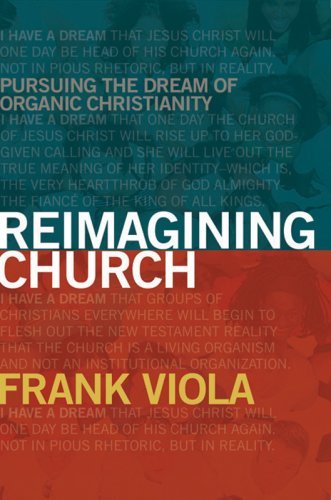

Reimagining Church (Book Review)

reimaginingThe Dream of Organic Christianity

A Book Review of: Reimagining Church: Pursuing the Dream of Organic Christianity by Frank Viola

Reimagining Church: Pursuing the Dream of Organic Christianity by Frank Viola, is sure to send every “clergy-laity” member scratching around for a biblical defense to the claims made against the 1700 year old institutional form of church.  And according to Viola, they will not find a “shred of biblical warrant” to support its existence.

At last, the sequel to the highly controversial book, Pagan Christianity?: Exploring the Roots of Our Church Practices, has arrived!  And it is for certain that not all will applaud its arrival to the bookstore.  No doubt, many readers are still trying to grapple with the favorable recognition and popularity of the first book to this series of 4 books on organic Christianity.

The first time, Viola had the help of George Barna and Tyndale in gaining a few listening ears.  Now that he has the attention of no small number of readers… he has set off to propose serious answers to an audience that is filled with sincere questions.  And Reimgaining Church will not leave readers dissatisfied in their quest for the normal Christian church life.  In fact, it will leave them hungering for authenticity in the New Testament fashion.

As the saying goes, “You can’t judge a book by its cover.”  Many readers have learned that from PC.  So let the reader first understand the title.  Viola states, “it’s the present practices of the church that I’m seeking to reimagine, not the church itself” (p.13).  He clearly outlines his purpose so that there is no misunderstanding.  He writes that the purpose of the book is: “to articulate a biblical, spiritual, theological, and practical answer to the question, Is there a viable way of doing church outside the institutional church experience, and if so, what does it look like” (p.12)?

Let there be no mistake, any serious reader cannot accuse Viola of impure motives or building the house of God on sand.  Indeed, the foundation of the ideas communicated in this book are constructed upon the triune God (i.e. Trinity as archetype for the church).  Therefore, RC should be understood as a proposal that the church of Jesus Christ mirror the very image of God: Father, Son, and Holy Spirit.

Viola writes, “the church is the earthly image of the triune God” (p.35).  In the spirit of Stanley Grenz, Leonardo Boff, and Miroslav Volf… Viola has wonderfully woven together the fabric of God’s eternal purpose in a clear, concise, and intelligent way.  Its inspiration can be questioned, as with any author, but its scholarship is insurmountable in its presentation.  This is a work for the carpenter and the scholar.

“The Reformation recovered the truth of the priesthood of all believers. But it failed to restore the organic practices that embody this teaching. It was restricted to soteriology (salvation) and didn’t involve ecclesiology (the church)” (p.59).  In the pursuit of an organic Christianity that is rooted in the triune God, the greatest hurdle will be with what lies at the heart of the institutional model of the church: hierarchal leadership.  And Viola goes to great lengths in addressing the error we have made in our teaching and practice of authority and “spiritual covering.”  He even extends his address in the appendix “Objections and Responses about Leadership.”

In every chapter, Viola seems to anticipate the objections and rebukes… and very skillfully, with ease, answers those objections and the many misconceptions that are born out of a first-reading of the ideas presented in PC and RC.  I have read all of Viola’s similar writings in his original series… and RC in this new series is definitely his finest presentation thus far.  He leaves little in his language to trip over… just a great deal of truth to bear.

Readers will appreciate Viola’s honesty and sensitivity to the issues.  Each chapter builds one upon the other and guides you to the end.  I found that when a question would arise, it would quickly be addressed to satisfy a deep-seeded longing to know and follow the truth.  Although it is not necessary for the reader to have previously read PC… it is recommended.  It is always best to start listening to a conversation from the beginning.

Finally, I want to communicate to the reader that only those interested in spiritual revolution, instead of religious reformation, will benefit from RC.  We must be willing to forsake all the new recovery methods of the institution and leave behind all the drama surrounding passions, programs, methods, and movements.  It is time for a paradigm shift!

Viola writes, “Recovering the organic expression of the church and the practical headship of Jesus Christ necessitates that we forsake our ecclesiastical patches and Band-Aids” (p.270).  Only a life fixated on the centrality and supremacy of Jesus Christ and longing to see that expressed in the church… will find comfort in the reading of this book.

A great exodus is occurring even as I write this book review.  It is not one of rebellion, but one of submission.  Dear reader, consider a renewed Christology that gives birth to a glorious ecclesiology.  Consider the message of this book, and let Christ’s person and work be reflected in all compartments of life.


Experiencing the Depths of Jesus Christ (Book Review)


Jeanne Guyon has given the church a spiritual gem with her book Experiencing the Depths of Jesus Christ. And this gem has been mostly hidden by years of religious junk that is void of life-changing power!

She writes of what many call “the deeper Christian life” when it is truthfully the normal Christian life. Unfortunately, most believers never mature and grow up into Christ.

Guyon calls out to us believers to learn a new way of prayer and a new way to read Scripture. This new way will ultimately lead us to experience the depths of Jesus Christ.

Guyon recognizes that man is tripartite or trichotomous in nature. Meaning that man is composed of spirit, soul (psyche), and body. It is in the spirit of man that we meet Christ. It is through the denial of our soul-life (i.e. will, emotions, intellect) that we learn to meet with God in the spirit. The spirit then governs the soul and body as Christ intended in divine order.

It is through abandonment and pressing through the “spiritual dryness” that we shall take hold of a deeper experience with Christ. Discerning the activity of your spirit vs. your soul will allow you to come to Christ in the way he has placed before us.

It is by turning inward to Christ that we discover his life in us.

“When your soul is once turned toward God—the God who dwells within your spirit—you will find it easy to keep turning within. The longer you continue to turn within, the closer you will come to God and the more firmly you will cling to him” (p.54).

Many believers are led astray by external activities of the soul for years before they ever take seriously the spiritual things spoken of in this book. This is a common occurrence, but it is not normal and it never should be accepted as an inevitable delay of Christian maturity.

Guyon writes, “If a new convert were introduced to real prayer and to a true inward experience of Christ as soon as he became converted, you would see countless numbers of converts go on to become true disciples.”

She goes on to say, “the present way of dealing only with external matters in the life of the new convert brings little fruit. Burdening the new Christian with countless rules and all sorts of standards does not help him grow in Christ.

Here is what should be done: The new Christian should be led to God. How? By learning to turn within to Jesus Christ and by giving the Lord his whole heart” (p.117).

This book is about how this happens. I have not read a more practical book about Christian prayer. I highly recommend this book to those who have exhausted themselves by attempting to live like Christ in the soul-life.

For more of a thorough teaching on the tripartite nature of man, read: The Release of the Spirit and The Spiritual Man, vol.1 by Watchman Nee.

Suggested Reading:

  • The Centrality of Jesus Christ (Works of T. Austin-Sparks) Vol. 1
  • The Pursuit of God: The Human Thirst for the Divine by A.W. Tozer
  • Seeing is Believing: Experience Jesus Through Imaginative Prayer by Gregory Boyd

Check out all of my reviews at Amazon!

D.D. Flowers, 2008.


Pagan Christianity? Exploring the Roots of Our Church Practices (Book Review)

Pagan Christianity? Exploring the Roots of Our Church Practices

Spiritual Revolution Instead of Religious Reformation

A Book Review of: “Pagan Christianity? Exploring the Roots of Our Church Practices” by Frank Viola and George Barna


“Pagan Christianity? Exploring the Roots of Our Church Practices,” may very well be the most important book written on the Christian church in the last two millennia.  Frank Viola and George Barna team up to give their readers a critical examination of the last 1700 years of church history.


Does the institutional church have any biblical and historical right to exist?  “Are the practices of the institutional church (the clergy/laity system, salaried pastors, sacred buildings, the order of worship, etc.) God-approved developments to the church that the New Testament envisions? Or are they an unhealthy departure from it?”

The first edition of this book entitled, “Pagan Christianity: The Origins of Our Modern Church Practices” by Frank Viola… is the third book written in a set of five books on church restoration and organic church life.  Viola and George Barna, Christian pollster and author of the book “Revolution,” have co-authored the newly revised and updated “Pagan Christianity?: Exploring the Roots of Our Church Practices.”

Barna brings to the book a fresh look and a polished language that improves on the delivery of Viola’s original work.  Barna, who has caused no small stink upon his recent confessions regarding the church, makes his decision to leave the institutional church complete with the publication of this book.  If it wasn’t clear in his book “Revolution”… it is certainly clear now.

I enjoyed the new format of this book.  At the end of each chapter, the authors give the reader a “Delving Deeper” section which lists common questions with answers in return.  I felt that this helped to clarify what the authors were truly saying in order that fact might be separated from fiction.  I also enjoyed the updated references and the plethora of footnotes listed at the bottom of each page.  These references may be in a smaller font, but they are the entire foundation of historicity which resulted in the penning of this book.

Therefore, the serious reader will not want to overlook the footnotes.  The reader will also find the “Summary of Origins” and “Key Figures in Church History” in the back of the book a great help as well.  The book may look like a long read… yet, you will find that your interest is peaked beyond that of any other historical book you have ever read.  You will read until you are done… or until you have thrown it out the window.

The serious questions raised in this book will give the Christian reader more than enough to wrestle over.  Viola traces the pagan origins of almost every church practice that institutional Christianity holds dear and holds it to the light of the New Testament.  I remember first reading the original “Pagan Christianity” over a year ago.  I had spent 6 years of my life in “vocational ministry” within the institutional (Southern Baptist) church and I had a degree in Religion/Biblical Studies from a Baptist University.  I had just resigned from my position as Minister to Students/Education because the church’s leaders were opposed to fundamental teachings of Jesus.  My wife and I saw that we could no longer serve among them.

It was during this time that I began to read and study like never before.  I was seeking to be a senior pastor in a church somewhere in the United States.  I studied church history, ecclesiology, Christology, etc. I was seeking the Lord’s will for his church. I compiled a list of what the New Testament described the church looked like in fellowship and among the world. With the help of Viola’s book, I quickly realized that my list did not reflect the church I knew and that that church could not be seen in the model of the traditional church. I had to rethink my understanding of it all.

I know how hard this read will be for many people, especially clergy members. “Pagan Christianity?” will, no doubt, be a most uncomfortable read for all those who believe the Body of Christ is an institution.  For the clergy member, the read will almost be impossible.  At every turn of the page… the flesh will flare up in a horrible display of arrogance and pride.  Many will scoff at its claims and discourage others from reading it before an honest examination can be made.  If the reader is not prepared to reexamine his faith and practice for a paradigm shift… he or she might as well leave this book well alone.

If the reader is not yet at the end of their rope in frustration against the church practices and shallow conception of Christ that is believed and taught within the institutional church… this book will only breed anger and confusion.  But, if you were like me a year ago… you are tired and want answers… and, most importantly, you want more of Christ… then please read this book and allow yourself to be moved by it.  I encourage you to have an honest conversation with the Lord as you read.  And listen to his still small voice.

To the rabid opponents of this book, I strongly recommend you speak to no one before you have done truthful research concerning these matters AND have had an honest conversation with Jesus first.  Many will argue that this book only proposes another “form” or method of church.  This book is not about forms, but about principles.  To argue forms… is to miss the point of this book.

Many will make preposterous claims that this book seeks to tear down the church of Jesus Christ, when in all reality… this book exalts Jesus Christ of Nazareth and submits that we return to simple community gathered around his headship free from the human inventions of man and religion that hinders the Body from every-member functioning.

This book does not propose we mimic the model of first-century Christianity, but that we mimic our Lord.  Out of our Lord’s commands and the principles of his person and work (i.e. life and teachings) will come normal Christian church life!

Why has this book been written?  The authors write, “we have written this book for one reason: to make room for the absolute centrality, supremacy, and headship of Christ in His church.” (p.250)  This statement alone should be enough for any true follower of Christ to pick up and read.  But unfortunately, many people, for whatever reason, will choose to accept slander about the authors (even from trusted pastors) as enough reason to discredit and discount them as credible voices of truth in mainline Christianity.

This is an incredible action considering that many institutional churches in the last decade have built their entire plan of attack off the statistical findings of pollster George Barna.  On top of that… both of these men boldly proclaim Christ in a way that is undeniably and unmistakably from a spirit of love and edification.  The premature responses of the majority prove how mankind is driven by mere human emotions and tradition… instead of biblical truth discovered through a consistent and verifiable method of biblical interpretation that seeks to exalt Christ above all things.

This reviewer and ex-clergy member challenges you to consider the message of these men.  Compare the claims of this book with the Christ and the church of the New Testament before you decide who and what are truly following and being a reflection of pagan Christianity.

All of us must choose between spiritual revolution (i.e. return to Christ) or religious reformation (i.e. tweaking the old pagan systems).  One of these will release the church from her chains and free her from the bondage of man’s religion to experience the natural faith of Christ.  The other will only prolong God’s people from beholding Christ in majesty and splendor to the world.  There is only one life to live.  Choose wisely.