Category Archives: Religion & Spirituality

Reimagining Church (Book Review)

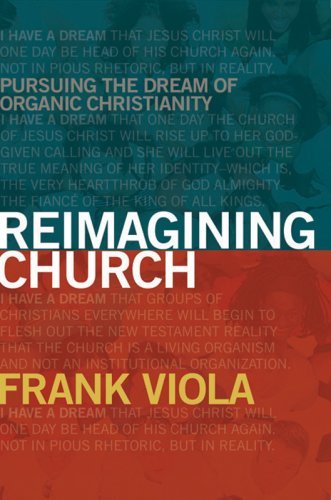
reimaginingThe Dream of Organic Christianity

A Book Review of: Reimagining Church: Pursuing the Dream of Organic Christianity by Frank Viola

Reimagining Church: Pursuing the Dream of Organic Christianity by Frank Viola, is sure to send every “clergy-laity” member scratching around for a biblical defense to the claims made against the 1700 year old institutional form of church.  And according to Viola, they will not find a “shred of biblical warrant” to support its existence.

At last, the sequel to the highly controversial book, Pagan Christianity?: Exploring the Roots of Our Church Practices, has arrived!  And it is for certain that not all will applaud its arrival to the bookstore.  No doubt, many readers are still trying to grapple with the favorable recognition and popularity of the first book to this series of 4 books on organic Christianity.

The first time, Viola had the help of George Barna and Tyndale in gaining a few listening ears.  Now that he has the attention of no small number of readers… he has set off to propose serious answers to an audience that is filled with sincere questions.  And Reimgaining Church will not leave readers dissatisfied in their quest for the normal Christian church life.  In fact, it will leave them hungering for authenticity in the New Testament fashion.

As the saying goes, “You can’t judge a book by its cover.”  Many readers have learned that from PC.  So let the reader first understand the title.  Viola states, “it’s the present practices of the church that I’m seeking to reimagine, not the church itself” (p.13).  He clearly outlines his purpose so that there is no misunderstanding.  He writes that the purpose of the book is: “to articulate a biblical, spiritual, theological, and practical answer to the question, Is there a viable way of doing church outside the institutional church experience, and if so, what does it look like” (p.12)?

Let there be no mistake, any serious reader cannot accuse Viola of impure motives or building the house of God on sand.  Indeed, the foundation of the ideas communicated in this book are constructed upon the triune God (i.e. Trinity as archetype for the church).  Therefore, RC should be understood as a proposal that the church of Jesus Christ mirror the very image of God: Father, Son, and Holy Spirit.

Viola writes, “the church is the earthly image of the triune God” (p.35).  In the spirit of Stanley Grenz, Leonardo Boff, and Miroslav Volf… Viola has wonderfully woven together the fabric of God’s eternal purpose in a clear, concise, and intelligent way.  Its inspiration can be questioned, as with any author, but its scholarship is insurmountable in its presentation.  This is a work for the carpenter and the scholar.

“The Reformation recovered the truth of the priesthood of all believers. But it failed to restore the organic practices that embody this teaching. It was restricted to soteriology (salvation) and didn’t involve ecclesiology (the church)” (p.59).  In the pursuit of an organic Christianity that is rooted in the triune God, the greatest hurdle will be with what lies at the heart of the institutional model of the church: hierarchal leadership.  And Viola goes to great lengths in addressing the error we have made in our teaching and practice of authority and “spiritual covering.”  He even extends his address in the appendix “Objections and Responses about Leadership.”

In every chapter, Viola seems to anticipate the objections and rebukes… and very skillfully, with ease, answers those objections and the many misconceptions that are born out of a first-reading of the ideas presented in PC and RC.  I have read all of Viola’s similar writings in his original series… and RC in this new series is definitely his finest presentation thus far.  He leaves little in his language to trip over… just a great deal of truth to bear.

Readers will appreciate Viola’s honesty and sensitivity to the issues.  Each chapter builds one upon the other and guides you to the end.  I found that when a question would arise, it would quickly be addressed to satisfy a deep-seeded longing to know and follow the truth.  Although it is not necessary for the reader to have previously read PC… it is recommended.  It is always best to start listening to a conversation from the beginning.

Finally, I want to communicate to the reader that only those interested in spiritual revolution, instead of religious reformation, will benefit from RC.  We must be willing to forsake all the new recovery methods of the institution and leave behind all the drama surrounding passions, programs, methods, and movements.  It is time for a paradigm shift!

Viola writes, “Recovering the organic expression of the church and the practical headship of Jesus Christ necessitates that we forsake our ecclesiastical patches and Band-Aids” (p.270).  Only a life fixated on the centrality and supremacy of Jesus Christ and longing to see that expressed in the church… will find comfort in the reading of this book.

A great exodus is occurring even as I write this book review.  It is not one of rebellion, but one of submission.  Dear reader, consider a renewed Christology that gives birth to a glorious ecclesiology.  Consider the message of this book, and let Christ’s person and work be reflected in all compartments of life.
Experiencing the Depths of Jesus Christ (Book Review)


Jeanne Guyon has given the church a spiritual gem with her book Experiencing the Depths of Jesus Christ. And this gem has been mostly hidden by years of religious junk that is void of life-changing power!

She writes of what many call “the deeper Christian life” when it is truthfully the normal Christian life. Unfortunately, most believers never mature and grow up into Christ.

Guyon calls out to us believers to learn a new way of prayer and a new way to read Scripture. This new way will ultimately lead us to experience the depths of Jesus Christ.

Guyon recognizes that man is tripartite or trichotomous in nature. Meaning that man is composed of spirit, soul (psyche), and body. It is in the spirit of man that we meet Christ. It is through the denial of our soul-life (i.e. will, emotions, intellect) that we learn to meet with God in the spirit. The spirit then governs the soul and body as Christ intended in divine order.

It is through abandonment and pressing through the “spiritual dryness” that we shall take hold of a deeper experience with Christ. Discerning the activity of your spirit vs. your soul will allow you to come to Christ in the way he has placed before us.

It is by turning inward to Christ that we discover his life in us.

“When your soul is once turned toward God—the God who dwells within your spirit—you will find it easy to keep turning within. The longer you continue to turn within, the closer you will come to God and the more firmly you will cling to him” (p.54).

Many believers are led astray by external activities of the soul for years before they ever take seriously the spiritual things spoken of in this book. This is a common occurrence, but it is not normal and it never should be accepted as an inevitable delay of Christian maturity.

Guyon writes, “If a new convert were introduced to real prayer and to a true inward experience of Christ as soon as he became converted, you would see countless numbers of converts go on to become true disciples.”

She goes on to say, “the present way of dealing only with external matters in the life of the new convert brings little fruit. Burdening the new Christian with countless rules and all sorts of standards does not help him grow in Christ.

Here is what should be done: The new Christian should be led to God. How? By learning to turn within to Jesus Christ and by giving the Lord his whole heart” (p.117).

This book is about how this happens. I have not read a more practical book about Christian prayer. I highly recommend this book to those who have exhausted themselves by attempting to live like Christ in the soul-life.

For more of a thorough teaching on the tripartite nature of man, read: The Release of the Spirit and The Spiritual Man, vol.1 by Watchman Nee.

Suggested Reading:

  • The Centrality of Jesus Christ (Works of T. Austin-Sparks) Vol. 1
  • The Pursuit of God: The Human Thirst for the Divine by A.W. Tozer
  • Seeing is Believing: Experience Jesus Through Imaginative Prayer by Gregory Boyd

Check out all of my reviews at Amazon!

D.D. Flowers, 2008.


Church Drama or Christ Dogma?

There seems to be a great deal of drama surrounding the church today. It would appear that many Christians believe that more talk about church practice will lead to a fruitful end. Apparently, arguing over church forms and methods are going to lead us to unity in the Body of Christ, and that through pragmatism we will be able to obtain a church utopia on earth.

Many believers have been fooled into thinking that more emerging conversations will give birth to a glorious epiphany in our ecclesiology. I don’t have to defend my statements with statistics. Anyone paying attention to the church climate in this generation can see the ridiculous mess we have created for ourselves.

Pagan Christianity: Exploring the Roots of Our Church Practices by Frank Viola and George Barna is causing the much expected firestorm of debate. We are even seeing Christians persecuting Christians. It is proof that history does indeed repeat itself. In the middle of the conversations I am hearing the way in which the bruised up and world-intoxicated church should conduct herself when she gathers together.

Primarily, I hear conversations centered around “forms” and “models.” When bloggers and the occasional “anonymous” writers are not trying to make judgments against a book they have not read, they pull out old arguments to ease their conscience and defend their uncontested and undigested presuppositions concerning the church. I would laugh at some of the things I am hearing if I wasn’t so deeply disturbed in my spirit.

The church is torn and caught in a whirlwind of drama, and the one thing we should be talking about is being replaced with narcissistic ecclesiastical conversations perpetuating the feeling of utter despair.

In my review of PC and in all of my comments elsewhere, I have stated over and over that this book is not about “doing” church or about “forms.” This book is about returning to the person and work of Christ–it is about spiritual revolution, not religious reformation.

When we examine the New Testament without bringing the last 1700 years of church practice with it, we will see a church that gathered around Christ in simplicity.  We see a church consumed with all things Christ, not self-absorbed in a crazy array of emerging church practices.

When it comes to the historical research and work presented in PC, we must be willing to accept that the pagan origins documented in this book sound an alarm that should result in great concern from us. We must be open to a paradigm shift and be willing to lay aside many things before we will hear the clear exaltation of Christ in his Body the church. And this is the purpose of the book: “to make room” for Christ!

A person should not hear the authors as trading one church form for another. All readers should take a mature view of the message undoubtedly being presented in this book. There is a clear cry of spiritual revolution back to the centrality, supremacy, and headship of Christ in the church.

The way by which we are able to remove our preconceived notions concerning the church, is by a complete emersion and commitment into rediscovering the Christ of the Gospels.

Out of Christ is born the church. Out of Christ is born this house church “form” many readers see Viola describing. It is natural to first see this as strictly being forms, I know. I was distracted by the “doing” in the beginning. Nevertheless, if a person will continue to seek the Lord in spirit and in truth, in time, you should see things differently. In time, the Lord will bring more light that illuminates himself, not the church.

Many readers may not agree with the premise of the book because they ultimately have not taken the time to rethink Jesus’ words. Church history and its 1700 years of accumulating paganism speaks for itself. The reason for documenting these facts of history is to clear the stage for a narrative ecclesiology built upon Christ. In order to have a correct ecclesiology, we first need a renewed christology.

Readers must not confuse the thesis of this book with “doing” a different “model.” The book’s claim is that the “organic” church is born out of the natural faith of Christ (i.e. life and teachings) and the institutional church is born out of man’s wisdom in applying pagan models of leadership and acquiring all sorts of religious practices. 

I would rather people become even more upset by this, then they hear something else and be upset for the wrong reasons. Again, the purpose of PC is to spur us on to removing all church models and forms in order that our reactions to Christ would produce a church life that reflects his person and work.

This is the church that gathers in the “New Testament fashion”–the church gathered around the centality, supremacy, and headship of Christ.

I am now very cautious when recommending this book to people who have not already come to a place of total dissatisfaction with the Christ and the Christianity that is taught and practiced in America. The book could build up walls that prevent any real search for the authentic Christ from ever happening. And then again, it may be the shot in the pants that many professing believers need. Time will tell.

It was because of my own experience with church drama and the discontentment I felt with the Christ presented in the traditional church… that I was even open to a renewed Christology.  It is by the mercy and grace of God that I found Christ instead of latching on to forms, methods, and movements, and being distracted by them.

It is quite a thing, I know, to claim that the reason people react harshly to the message presented in this book is because they are not “hungry for more of Jesus.” However, I have given this a great deal of thought. I am certain that this is the case.

If a person can quickly pass off the Christ-centered message presented in PC, or any Christ-centered book for that matter, then it is apparent that there are things coming before Christ. These things, whatever they may be, are keeping people from their heart’s desire. These people may find that Christ is not the sum of all spiritual things wherever they are at in life.

The truth of the matter will only be found in discerning with the Spirit of Christ that indwells the spirit of man. When all is still and quite within a man’s soul, a person can know if Christ is truly first in the matter.  The Holy Spirit longs to exalt the Lord above all other pursuits and things that stand in the way of his absolute centrality and supremacy.

The purpose of this article is not to defend PC or the authors who are but mere men. The purpose is to sound a call for all believers to be consumed with Christ dogma instead of church drama.  It is a plea for the church to see the need for spiritual revolution (i.e. return to Christ), instead of religious reformation.

Before anything else is said or written, we must be aware of the fact that we are so easily misled into hype and drama with talks of methods and movements.  It is time to trade in our methods and movements dialogue for a renewed understanding of Jesus.

I’m afraid that much of the talk today about the church has little to nothing to do with Christ’s headship.  It would appear that many believers are taking the devil’s bait.  The evil one has the church talking about everything but Christ. He can’t keep us from noticing the problems, but he can keep us busy trying to solve those problems with some “new” way of “doing” church.

There is a revolution rising. The men and women who make up this revolution want to give the church back to Christ. However, if we do not concern ourselves with the centrality and supremacy of Christ, we will no doubt continue the drama that has lasted for over 1700 years.

The drama is evidence that there are many who have not concerned themselves with the centrality, supremacy, and headship of Christ in the church.  If Christ was central and supreme, we would be patiently discussing his person and works with each other instead of debating forms and methods.

Where will the church go from here? What voices will she listen to in this generation? Will she settle for reform and be persuaded by man and his movements or will she press on to her Lord and aid in the tearing down of the kingdom of hell?

There is only one road that leads to Christ, that is the way of the cross. If the church is willing to press on to Christ, she must ready herself for a major shift in the culture. For when the church is founded on the rock of Christ, the mighty winds of persecution will blow. And in the storm we will find peace.

May the Lord give us a continual hunger for his centrality and supremacy in all things. May Christ be our primary pursuit, the centerpiece of our conversations, and the subject of our personal meditation and reflection. Let us set our hearts to learning Christ, and we will be led to a normal “organic” church life that is born out of knowing the person and work of Christ Jesus our Lord.

“He is the image of the invisible God, the firstborn over all creation. For by him all things were created: things in heaven and on earth, visible and invisible, whether thrones or powers or rulers or authorities; all things were created by him and for him. He is before all things, and in him all things hold together. And he is the head of the body, the church; he is the beginning and the firstborn from among the dead, so that in everything he might have the supremacy.”

Paul, Letter to the Colossians 1:15-18

D.D. Flowers, 2008.


Jim Caviezel to the Church

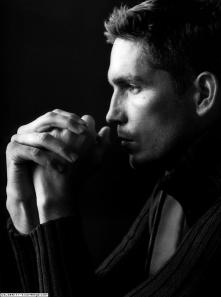
james-caviezelI had the wonderful privilege of hearing Jim Caviezel speak last night. No, he was not greeted with chants of “Hosanna!” and the waving of palm branches while riding in on a donkey. Yet, I must say that that would have been funny.

He walked on stage in a black leather jacket and black jeans sporting a new hairdo. He was given a warm welcome and no one pressed the stage to be healed. Jim began by sharing how he came to play Jesus in the 2004 film, The Passion of the Christ.

He spoke on the making of the movie and the many trials he went through while playing the part of the Suffering Messiah. His words were honest and inspiring as scenes from the film played on the big screens behind him. The entire audience was moved as Jim shifted everyone’s focus off of himself and onto Jesus of Nazareth.

Jim is a very serious and sincere man. If you have watched any of his films, especially behind the scenes, you will know this to be true. He is very serious about his work as an actor—not for acting sake—but in order to portray good versus evil and judgment versus redemption. I was thrilled to be able to hear his heart as he spoke of his own faith in Christ and how that faith is to be lived out in all the dark places in our world.

I believe what stuck out to me the most about what he shared was what I would call a prophetic message to the church. Jim mentioned the increasingly hostile world that we live in and how persecution and suffering was coming to the church. He referred to this as God’s way. If I remember correctly, he said, in reference to suffering, “This too is from God.”

He reminded the audience that all of the saints who have gone on before us were all acquainted with this one thing: suffering. He went on to encourage the audience to be the Lord wherever they are at and to not be concerned about what others think. He said:

“We may never win an Oscar or be known by men, but we are known by God and that’s all that matters.”

I met Jim after the talk to have him sign something. Relax, it was the only way to speak to him. 🙂  Since I’m aware that he is serious and that he seemed to be tense from all the attention, I thought I would break the mood with some humor.

I shook his hand and said, “Jim, I just want to know one thing… how hard was it not to laugh in your interview with Ron Burgundy?”  (If you don’t know what I am talking about, you can watch the interview on You Tube.)  He laughed and replied, “You know… you didn’t see all of the outtakes. It wasn’t easy.”

I laughed with him and shook his hand one last time.  As I shook his hand to leave, I said, “Keep being a light in a dark world.” His serious look returned with an expression that conveyed appreciation and at the same time a hopeful brother in an evil place; a brother who understands what it means to be in the world, but not of it.

Finally, I just want to say that I was moved by the Spirit of Christ in the hearing of Jim’s words. I was moved enough to stay up until three in the AM to tell you about it. I truly believe the Lord spoke through Jim Caviezel in a powerful way. I just hope that the Christians in the room and those reading this blog are receiving the “heads up” on what God is getting his people ready to endure.

Soon we will have a new context in which to live out our Christianity. Soon and very soon, Christians living in the empire will experience the purification of God’s people on earth; to bear the marks of Jesus on our bodies and identify with him through suffering. May those of us who have long enjoyed the security of the world be ready for what is to come.