Category Archives: Religion & Spirituality

The Limits of Canon

For those of us who grew up within Protestantism, especially in the Bible belt, it’s likely that we were seldom ever confronted with questions concerning the limits of the biblical canon.

If ever we happened to come across a NRSV (including Apocryphal or Deuterocanonical books), we may have possibly responded with, “What is this? The book of Mormon or something?” OK, maybe I’m not giving my fellow southerners enough credit. It’s more likely we thought, “This must be a Catholic Bible.” Ecumenical might as well mean heretical for some.

It’s a legitimate concern for Christians of whatever tradition to have a reasonable and defensive position on what books are considered “inspired” by God—which books ought to be in our Bibles and read as the inspired Word of God—those books which are the standard biblical text.

I personally believe the process of canonization should follow a few basic criteria: (1) Does the text claim divine inspiration? (2) Was the text written by a true prophet or an apostle of Christ? (3) Is the text consistent with the orthodox message of other inspired texts? (4) Is the text broadly accepted by adherents and followers of Judaism and Christianity? (5) Does the text have transformative power for readers? Was it widely used for teaching and liturgical purposes within the Early Church?

It is clear that the canonizing of Scripture is a communal effort that took place over the first two centuries of the church. Contrary to Dan Brown’s fictional “The Davinci Code,” I reject the idea that Constantine was responsible for the limits placed on the canon at the First Council of Nicea in AD 325. There is no evidence to support the idea that the biblical canon was discussed at Nicea. Arianism (the Father created the Son) and the nature of Christ (the articulation of his deity) was the primary concern of the council.

No, the evidence suggests that the collection of NT writings had been formulating years prior due to the rising threat of Gnosticism. This heresy brought about the canonization process, the earliest creeds, and the articulation of Christian theology. All of this happened in the ecclesiastical community one-two generation(s) removed from the apostles.

That being the case, it ought to be through the efforts of the community that a person comes to any particular conclusion regarding the limits of the Biblical canon—lest they follow in the infamous steps of the second-century heretic, Marcion, or other Christian gnostic pretenders.

There are several historic Christian traditions that have set boundaries upon the canon—the primary canons being the Protestant and Catholic of the Western tradition, and the Greek Orthodox tradition of the East.

There is a great deal of agreement among these traditions as to what books should be included in the canon of Scripture, but there is still a noticeable difference with some books being placed in an “appendix,” some being dubbed as “apocrypha” or “deuterocanonical,” and others being entirely excluded from the collection altogether.

Like most Christian traditions, I accept the time-honored 27 books of the New Testament. However, I do not accept those “apocryphal” or intertestamental (e.g. Jubilees, Enoch, 1 & 2 Maccabees, etc.) books as being on the same level of inspiration as the rest of the 66 books of the Old and New Testaments (i.e. Protestant Canon).

I use the criteria mentioned above, along with the interpretive methods of my own communal tradition, in order to reach that conclusion.

I do believe those texts that lay beyond the limits of canon can be a tremendous help in reconstructing the historical and theological developments during the biblical period. However, they do not find overwhelming support for canonicity based off the reasonable and communal guidelines for canonization set forth in this post.

How have you worked these things out in your own tradition?


A Shift in My Ecclesiology

I recently revealed that I’m experiencing a shift in my ecclesiology. For the sake of clarification, I do still agree with much of what Sparks, Nee, Viola, and others have written about Christ in “organic” community. I don’t want anyone to think I believe a little institutionalism is cool or that the church is nebulous in nature. I think both miss the mark for Christian community.

As for the nebulous church idea, I really appreciate the work of Wayne Jacobsen, but his view of community is a bit loosey goosey for me. Knowing Christ in community requires people in committed relationships—that’s the very nature of a worshipping “community.”

I agree that the church should function as an organism in its familial context. But I also think it’s possible that it can at times look like an organization–depending on the season and the context of the church. That’s the great thing about an organism. It can do that. Nevertheless, it will always adhere to Christ in community, regardless of the changes in culture and context.

That means that I don’t think it is possible to fully know Christ in community when the center of church life is a one-hour weekly service (or Sunday school) where only a few function and there is little interaction among the saints. That isn’t to say larger gatherings with music and teaching are off limits to us. That would be prohibiting something that can and does edify folks. I have heard this time and again, “We miss the music and teaching.” I hear a longing to receive these gifts.

The problem for a lot of “organic” church folks is that’s all they had ever experienced. After having experienced face-to-face community, it’s easy to then voice criticisms of the large corporate gatherings. In some minds there was abuse there in that setting, therefore, everything that resembles that sort of thing should be rejected. I have also met folks who have experienced pain and abuse in small groups and house churches. So they run to the isolated pew or leave the church altogether. It’s all reactionary thinking.

Constantine did not invent large gatherings involving worship and teaching. The Jews, and later Jewish Christians, were doing that in the synagogues long before the great dragon polluted the church and set a full-blown priesthood in place to rule over church services.

No matter what order you adopt, some great stuff can happen in a larger setting, but the rubber hits the road in the face-to-face community. Unfortunately, most folks view church life as a teaching time or two during the week, not a shared life together in and outside church meetings.

What I intended to communicate in my last post is that I am disassociating myself with a strict order and calling for a redefining (or clarification) of the NT pattern, which is Christ alone. The church is free to edify and structure their life together any way they choose. As long as “Christ in community” (which at the heart means every-member functioning) is being known in their practice, not just in rhetoric and theory, there is freedom to allow the Spirit to mold that local ekklesia into a unique vessel for God’s glory.

If a church chooses to have a larger worship and teaching time for the exercise of those gifts, an event that the early church was likely not able to do on a regular basis, that’s awesome! But I believe this should only be seen as the dessert, not the main course—a great thing, but not the main thing. Discipleship plays out in relationships through Christian community.

The challenge is building a church life centered upon Christ in community, not upon a one-hour service. I may write on this later, because I think there are things that a church could do to see to it that the body of believers steers away from taking on the trappings of an institution that works only to maintain its overhead. That’s where my thoughts are currently going.

I suppose I’m exploring the many ways Christ can be experienced in community apart from a rigid order or trying to reduplicate the same context and experience of the first-century church. That might be easier for Christians in Mexico or China to relate to in their political and cultural context, but most folks in the US know a different context.

That’s not me shirking the NT pattern of church life, that’s me seeking to uphold it in the pattern of Christ.

Therefore, we should not envision any set order for any church. The Spirit will shape every community of believers each according to their gifts and context—always at the same time holding them to the pattern of Christ. The Lord sees in color, not in black and white. And the Lord may show us colors we have never seen before if we are open to receiving them with joy.

It’s not about finding the right church order or the secrets of the first church for a new book. It’s simply about learning to appreciate the many ways God is able to work his power through faithful followers of Christ.

D.D. Flowers, 2011.


1 Cor 14:26 Descriptive or Prescriptive?

I have been known as a proponent of “organic” church life for several years now. Due to the confusion over this now popular nuanced term (cp. Sparks, Cole, & Viola’s usage), I have decided to stop using it when describing the sort of church life that is to be enjoyed by all Christian communities in every cultural context until Christ returns.

It’s just not worth having to respond to all of the questioners with, “Well, what I mean by it is…” It was helpful (at least to me) for a while, but not so much anymore. I do still use it when I’m among close friends, but other than that it only becomes one more obstacle in communication.

I must admit that over the last year or so I have been led to believe that some dear saints run the risk of promoting organic church life at the expense of Christ and unity among all believers—as well as promoting Christ while attached to a specific church model (though they would claim they are not promoting a model) or even a “no order at all” approach.

The first group is likely not aware that they have bound Christ to a rigid church order. And the later group, while talking a lot about Christ, is mostly concerned with maintaining no set order in their meetings. No order has become their order. They will do nothing that even comes close to resembling organized Christianity (a person standing to deliver a message longer than 10-15 minutes is definitely out!).

If that fellowship doesn’t change its reactionary thinking, it will eventually meet its demise. Hopefully, there will be enough folks who grow tired of just chatting about Jesus over coffee for a couple hours a week to bring about a healthy change.

I found that it is possible to begin with a new vision of Christ in community, only later to gravitate toward an “us vs. them” mentality. Of course, it might have always been a mix of both—some days more of this, other days more of the other. I have become sensitive to those thoughts of mine that set myself above another person that clearly loves Jesus, but is just currently being faithful to Christ in a different setting.

Christ in Community

Looking back over the last several years of study, reflection, and experience, I’m convinced that the NT reveals some basic principles concerning church life that can be summed up like this: Everything should look like Christ and build up the saints (Eph 4:16; 1 Jn 2:6).

Beyond that, there is no church law. There is no restrictive law that says, “You can’t do that!” Nor is there the libertarian law that says, “Anything goes!” The law is Christ… Christ in community.

Regardless of what side of the church fence you’re on (organized or organic), you may think my “no law” declaration needs a qualifier. Well, I just don’t think so. Anything beyond “Christ in community” leads to divisions among us, and becomes self-righteousness dressed in the garb of the centrality and supremacy of Christ. It’s time we stop it.

“Christ in community” does involve what some have called a NT pattern. But let’s be clear, the principles of that pattern are known only in an examination of the person and work of Christ. Failing to closely examine and take serious the life and teachings of Christ is something that both institutional and organic churches do regularly.

Both groups have isolated and eisegeted (read things into) certain texts to promote their church order, all the while neglecting the life and teachings of Jesus, the very center of our faith.

For example, when his disciples were arguing over who would be greatest in the kingdom, Jesus made it very clear that true leadership was not reflected in the “top-down” hierarchal leadership seen with the politicians and corporations of the world (Mk 10:35-45; Jn 13). No, you can’t have a nation of priests when one person, other than Jesus himself, gets to be the “high” priest and the inheritor of special treatment, and regular monetary blessings.

Therefore, a prime example of the Jesus prescription—the one that goes to the heart of what’s wrong with organized religion—is that anything that doesn’t look like servant-leadership, or creates an unhealthy dependence upon one human priest, leads to spiritual paralysis in the body of Christ.

Whatever each local ekklesia decides about the role and function of pastor/teachers today, our conclusions should always be based upon the example of Christ and what he said about leadership. Church practice should always reflect the person and work of Christ among his first disciples.

Paul in Community?

What about Paul, you ask? Well, what about Paul? Paul’s idea of community comes by merely expounding upon Christ. Therefore, viewing anything Paul says as a rigid “prescriptive” order for the church in every age, when Paul is merely describing a communal life that flows out of Christ, is to put forth a law other than Christ himself.

Jesus is the only prescription for the church in every age.

That isn’t to say that Paul can’t tell us anything about church order in the 21st century. By no means! Instead, it means that Paul should be read as an apostle who guides each church to creatively adhere to the life and teachings of Jesus in their own unique context.

In 1 Corinthians 12-14, Paul addresses the believers at Corinth concerning their disorderly meetings. If the saints in Corinth were not squabbling over spiritual gifts, we likely would not even have Paul saying anything about order for the church. So notice, the pattern is given in a context of disorder and division over the way things ought to be done.

What then shall we say, brothers and sisters? When you come together, each of you has a hymn, or a word of instruction, a revelation, a tongue or an interpretation. Everything must be done so that the church may be built up.  1 Cor 14:26 NIV

The pattern here is not that all these things, and nothing else, should happen in a church meeting. It’s simply what was happening in Corinth at this moment in time. Paul was not intending to say that every church meeting for all time should always look like what is described here (i.e. every single meeting should always and forever be open-participatory).

No, the pattern for every generation is always and only Christ.

So, what does Christ look like in this particular gathering? He looks like ordered sharing, not disrespectful neglect of others and their gifts (14:27-33). It’s this open-participatory meeting, and only this type of meeting, that we hear Paul addressing with his guidance.

We should not gather from the NT that there is never a place for a meeting set aside to hear a teacher. Paul’s concern in this open meeting is that Christ would not have chaos and disrespect of others when meeting in such an intimate familial setting. I imagine that he might have said something similar in spirit if there was a church who opted to have teaching times in a larger setting. He apparently was cool with this sort of thing when he held his own “apostolic meetings” (Acts 20:7).

There is no church manual that prescribes the activity and function of church meetings. Even if you were to gather up all of the “one another” verses of the NT, you are still not given a rigid order of how things must be done in a church meeting. To force that upon the NT is not only promoting an agenda, it undermines the only prescription, which is Christ.

Biblical scholar and “house church” attendee, Robert Banks, writes:

“The basic principle that Paul lays down for the conduct of the church is that all things should be done for edification. Only when a contribution has this as its object should it be exercised” (Paul’s Idea of Community, 100).

Jesus (and Paul) leaves a great deal of freedom to all local churches. However, that freedom will in the long run never undermine Christ expressed throughout the entire priesthood of believers over the many seasons of the church.

D.D. Flowers, 2011.


God Behaving Badly

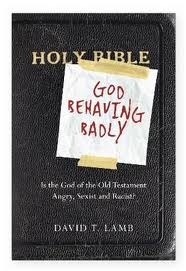
God Behaving Badly: Is the God of the Old Testament Angry, Sexist and Racist? (Downers Grove: InterVarsity Press, 2011) by David T. Lamb

In his 2004 bestseller, The End of Faith: Religion, Terror, and the Future of Reason, Sam Harris first introduced the world to the popular New Atheism. Listen to leading apologist William Lane Craig talk about the new atheists.

Christopher Hitchens followed with his attack on God in his 2007 book: God is Not Great: How Religion Poisons Everything. The very next year, Richard Dawkins made his claim that the God of the Old Testament is “arguably the most unpleasant character in all fiction” (The God Delusion, p.51).

David Lamb, associate professor of Old Testament at Biblical Theological Seminary in Hatfield Pennsylvania, believes that Dawkins “simply isn’t reading his Bible well” (p.16).

Lamb, with refreshing wit and respect, responds to accusations being made against God in his book, God Behaving Badly: Is the God of the Old Testament Angry, Sexist, and Racist? (June, 2011).

Lamb says that the avoidance of certain texts by Bible teachers has actually made it seem that atheists are reading the Bible more carefully than those who accept it as God’s word. Far from ignoring problematic texts, this OT scholar writes from his extensive study of history and Scripture to provide insight into the biblical context, which he claims is the key to proper interpretation.

Lamb notes that the God of the OT has a bad reputation. Are the critical perceptions valid? He doesn’t deny the difficulty with certain texts, but he insists that God’s hesed (love) is abundant in the OT. He rejects the Marcionite heresy that the God of the Old Testament is cruel and vindictive, not the same loving God of the New Testament.

He writes “compared to other ancient Near Eastern literature, the Old Testament is shockingly progressive in its portrayals of divine love” (p.23).

Lamb addresses those OT texts that reveal God’s anger, commands of violence, appearances of sexism, racism, legalism, and what seems to be a stubborn inflexibility in God. Lamb touches on those passages that are most often quoted to show that God is a big meanie.

Why did God kill Uzzah for touching the ark (2 Sam 6:1-8)? Does the Bible present an unfavorable view toward women (Gen 3:1-19; 19:5-11)? Is slavery, racism, and genocide being supported in the biblical text (Josh 10:40; 11:12-15)? Does God endorse child sacrifice and violence against enemies (Gen 22; 2 Kings 2:23-25; 19:35)? And what about all those pesky out-dated commandments (Ex 20-23; Lev 17-26; Deut 12-26)?

Lamb believes that the OT text should be harmonized with the life and teachings of Jesus. He seeks to accomplish this by finishing each chapter with relevant passages from the Gospels.

What is God like? Lamb wants to make it clear that “this book is essentially about the nature of God” (p.177). He writes: “Instead of ignoring passages that seem to portray Yahweh negatively, we need to study them, discuss them and teach them to gain understanding. While all our questions may never fully be answered, we will find that Yahweh and Jesus can be reconciled and that the God of both testaments is loving” (p.178).

I’m recommending this book to all of those wrestling with what seems to be a dichotomy within the biblical text—where God appears to be bi-polar and where Jesus finally managed to satisfy the bloodlust of his abusive Father.

God Behaving Badly should be required reading for all skeptics and students of theology, especially those Christians who habitually yank verses from their OT context to skillfully ignore the teachings of Jesus.

I want to thank Adrianna Wright at InterVarsity Press for sending me Lamb’s book to read and review.

D.D. Flowers, 2011