Category Archives: Historical Jesus

Why I Believe in the Resurrection of Jesus, Part II

The majority of scholars agree on some basic events in the life of Jesus. E.P. Sanders has written, “There are no substantial doubts about the general course of Jesus’ life: when and where he lived, approximately when and where he died, and the sort of thing that he did during his public activity …” (Sanders, 11). You simply will not find any real expert denying these things.

Even the liberal Jesus Seminar scholar, John Dominic Crossan, admits that the crucifixion of Jesus is historical “as sure as anything historical can be” (Crossan, 145). It’s one of the major points of agreement between liberal and conservative Jesus scholars. For any person to deny the crucifixion of Jesus of Nazareth, they must be ignorant of history or purposely distorting the facts. Ancient historians such as Josephus, Tacitus, Lucian, Mara Bar-Serapion, and the Jewish Talmud, mention that Jesus was crucified.

[This is an embarrassing historical blunder on behalf of the Quran, which denies that Jesus was crucified on a Roman cross (Surah 4:157-158). That’s not some insignificant textual variant or slight discrepancy in the Islamic text, that’s what you call a historical contradiction—plain and simple.]

So, let’s get the facts straight. Jesus really lived, he was crucified, he died, and he was buried. And Joseph of Arimathea let Jesus use the family tomb for the weekend (Mk 15:42-47; Matt 27:57-61; Lk 23:50-54).

II. Empty Tomb, Resurrection Appearances, & Growth of the Early Church

The empty tomb is recorded and admitted by Christians, enemies of Jesus, and skeptics alike—in ancient and modern times. All four canonical Gospels mention the empty tomb. Paul affirms the empty tomb with the early creed in 1 Cor 15:3-4, and so does Luke in Acts 13:29.

While you can find scholars today that refuse to acknowledge an empty tomb (e.g. Crossan believes that Jesus’ body was discarded with criminals and eaten by dogs), most scholars recognize the empty tomb as a historical fact. The empty tomb makes the most historical sense. If the body wasn’t missing, the early Christian message could have been easily stamped out with, “Resurrected? We have his body right here!”

The big question is ‘why was it empty?’

The Jewish polemic against the Christian message was that the disciples had stolen the body (Matt 28:11-15; Justin Martyr’s Dialogue with Trypho, 108; Tertullian’s On Spectacles, 30). Matthew writes, “And this story has been widely circulated among the Jews to this very day” (28:15). If you have a “stolen” body, then you have an empty tomb.

The swoon theory was first proposed in the eighteenth century. This theory claims that Jesus was not really dead after all, but merely slipped into a coma, later to be revived in the cold conditions of the dark tomb.

Let there be no mistake. The Romans knew how to kill condemned criminals. While there may have been an occasion where someone escaped the cross (e.g. when Romans fled the scene of battle), the historical evidence in the case of Jesus does not allow for a great escape. The medical evidence recorded in the Gospels indicates a certain death (Jn 19:34).

“. . . interpretations based on the assumption that Jesus did not die on the cross appear to be at odds with modern medical knowledge.” The Journal of the American Medical Association “On the Physical Death of Jesus Christ” Vol. 255 (March 21, 1986), 1463.

David Strauss, a nineteenth century liberal scholar, was unconvinced of the swoon theory, saying that a half-dead Jesus would not have convinced his disciples of a glorified resurrection. Strauss points out that you can’t talk about the empty tomb without considering the transformation that took place with the disciples who had previously abandoned Jesus. How can we explain what they claimed they saw, and empowered them to speak the message of the risen Jesus?

According to a small few, the disciples actually had some sort of mass LSD trip, a group hallucination. Yeah, that’s the theory some have proposed—they were trippin’ with the psychedelic Christ!

After you’re done laughing, please keep reading.

There are many reasons why this theory doesn’t add up. In short, the disciples claimed to have touched him, ate with him, yet he walked through walls! Also, there has never been one documented account of an entire group of people having the same hallucinations. And the disciples would need to be under a continual psychotic delusion to face martyrdom with non-resistance, declaring that Jesus had been raised from the dead.

Other theories have been proposed: Jesus had a twin brother that dropped in after the crucifixion and appeared to the disciples; the women went to the wrong tomb; and the resurrection was only spiritual. But none of these theories can account for all of the historical evidence, what the disciples believed were resurrection appearances, the teaching of the apostles, and the growth of the early church in the face of intense persecution.

“I know in their own terms what they saw was the raised Jesus. That’s what they say and then all the historic evidence we have afterwards attest to their conviction that that’s what they saw. I’m not saying that they really did see the raised Jesus. I wasn’t there. I don’t know what they saw. But I do know that as a historian that they must have seen something.” Paula Fredriksen (Boston University) Peter Jennings interview, July 2000.

Even the late atheist, Christopher Hitchens admits that “something was going on” that Sunday morning. But what was going on? Whatever it was, it was enough to change the mind of James, the brother of Jesus, and Saul of Tarsus, a zealous Pharisee and persecutor of the church.

James becomes the leader of the Jerusalem church, and he is later martyred for his belief that Jesus had been raised from the dead. Seriously! Who is going to believe that their brother is the Son of God? James didn’t—not until some life-altering event. What could have happened to prompt the brother of Jesus to become one of the church’s greatest leaders? I think that an encounter with the risen Jesus is the most likely of all possible scenarios.

We’re told that Saul of Tarsus had a first-hand encounter with the resurrected Christ, while on his way to persecute the church in Damascus, Syria (Acts 9). Something happened to this Saul, student of the great Jewish teacher, Gamiliel (Acts 22:3). He said his transformation from persecutor to apostle was a result of being confronted by the resurrected and glorified Christ. What could change this zealous teacher of the Law? I can think of one thing, and one thing only. The apostle Paul had met the risen Jesus.

“With great power the apostles continued to testify to the resurrection of the Lord Jesus… ” Acts 4:33

The message of the resurrection of Jesus began circulating very early on in the Christian movement. And the growth of the early church steadily rose during local and empire-wide persecutions. By the early fourth century, there are estimates of about 3-5 million Christians in the Roman Empire. Was this a result of a stolen body or of a mass hallucination?

On multiple occasions, I have read and heard renowned scholar N.T. Wright make the claim that he knows nothing else that could explain the initial birth and rapid expansion of the early church, but that Jesus was really raised from the dead. I’m in agreement with Wright. The growth of the early church occurred because the church was on a mission for the resurrected Jesus. She advanced in humble service and sacrificial love, not by coercive force or religious violence.

What is most convincing to me at this point in my examination of the Gospels is the way the story of the resurrection is told. Fitting with the principle of embarrassment, the Gospel writers report that it was women who first found the empty tomb and met the risen Jesus (Matt 281-10; Mk 16:1-11; Lk 24:1-11). This is rather peculiar since women were not even considered reliable witnesses in a first century law court (Josephus, Ant. 4.219).

It’s no surprise that the disciples did not believe the report of distraught women (Lk 24:11). They would need to see Jesus for themselves.

Why would they tell it like that unless it really happened that way? If you’re making up a story about a resurrected Messiah, especially when the whole idea was foreign to Judaism in the first place, the last thing you do is have women as the first eyewitnesses to the empty tomb and resurrection. But there is no attempt made to gloss over this embarrassing episode.

I believe this account is historically accurate. I believe this adds to the credibility of the story. It’s heavy evidence in the case for the resurrection.

For this reason, and many reasons that I will not mention here, the historical narrative reads as an authentic retelling of the events. The tomb was indeed empty. I believe the physical resurrection of Jesus is the best explanation for the empty tomb, the experiences of the disciples, and the rapid growth of the early church against all odds.

D.D. Flowers, 2012.

Now Read: Why I Believe in the Resurrection of Jesus, Part III.                 Limitations of Science & Boundaries of Human Reason                                   Conclusion—Believing in the Face of Objections & Seasons of Doubt


Why I Believe in the Resurrection of Jesus, Part I

With Palm Sunday behind us, we will now take the next few days to remember the Passion Week of Christ—soon to celebrate the death of Christ by Roman crucifixion.

Let’s be honest, it’s a rather odd thing to celebrate someone’s death, especially when it was such a brutal and barbaric execution. Have you seen Passion of the Christ (2004)?

Some skeptics today, certain that Christians are a few fries short of a happy meal, have written us off as sick delusional people. No doubt, it’s an old charge. We only need to remember how strange it appeared to Pliny the Younger who investigated the early church’s worship of the crucified Jesus—those who sang “a hymn to Christ as to a god.”

But for us who are Christians, Good Friday is a time of deep theological reflection. The biblical narrative from creation to fall, from exilic despair to salvific hope, from sinner’s debt to atoning sacrifice, has reached its climax in the life and death of Christ—the true Israelite, the promised Messiah who takes away the sins of the world.

It’s a beautiful death because it’s the first and only death in the history of mankind that has the power to save. The Creator God becomes human flesh and displays boundless love to his broken creation. The idea of it is too good to be compared to any ancient myth of dying and rising gods, and it is so self-incrementing that any man would or could make it up only to endure the wrath of empire for proclaiming it.

But we need to remember that the death of Jesus holds no power if he stays dead. That’s why the apostle Paul was so adamant about it to the Corinthians who were arguing about the future of those who had died before Christ’s Second Coming (parousia). He writes:

“If Christ has not been raised, our preaching is useless and so is your faith. More than that, we are then found to be false witnesses about God, for we have testified about God that he raised Christ from the dead. But he did not raise him if in fact the dead are not raised. For if the dead are not raised, then Christ has not been raised either. And if Christ has not been raised, your faith is futile; you are still in your sins.” (1 Cor 15:14-17) NIV

There has been no shortage of books, articles, and journal entries written on the resurrection of Jesus, especially in the last ten years. There are excellent presentations that have been published that I could recommend—much of it is very readable, even to the man on the street (no worries, suggested reading list sure to come).

But I think we all know that a good number of folks won’t take the time to read them. So, I’ll bring out what I believe to be some of the strongest points in defense of the historical resurrection of Jesus. I will do this by discussing three primary reasons that have convinced me of the resurrection, while discussing many other interesting points along the way.

I. Reliability of the New Testament, Eyewitness Testimony & Multiple Attestation

All four of the Gospels record the death and resurrection of Jesus (Matt 28; Mk 16; Lk 24; Jn 20). If you engage folks today about anything pertaining to the Christian faith, and you appeal to the authority of Scripture, you may discover that the inspiration and trustworthiness of the Bible is no longer a given anymore. There was a time not long ago that many assumed what is written in the Bible is accurate and reliable. Those days are gone.

Truthfully, the reliability of the Bible has been heavily attacked since the Enlightenment. It would appear that even those of us in the Bible-belt are now beginning to feel the affects. I think our response should be to step up to the plate and be willing swing for the fences with a reason for the hope that we have (1 Pet 3:15). We can no longer afford to settle for the old clichés, church programs, and “momma said” or “my pastor said” or some other spiritual platitude.

The place to begin is by taking a look at the evidence for ourselves. While a case could be built for the death and resurrection of Jesus apart from the New Testament sources, I’m not so willing to give up on the reliability of the NT, and the Gospels as historical ancient biographies of Jesus.

Daniel Wallace has recently written, “In Greek alone, there are more than 5,600 manuscripts today… altogether about 20,000 handwritten manuscripts of the NT in various languages” (Wallace, 28). Even if someone were to destroy all of those manuscripts, the NT could be entirely reconstructed with the one million quotations by the early church fathers! We have more evidence for the life, death, and resurrection of Jesus than Julius Caesar or Alexander the Great.

What about all those discrepancies you say? Well, there are certainly textual variants in the many manuscripts we have, but don’t let Bart Ehrman convert you to agnosticism just yet. F.F. Bruce has written, “The variant readings about which any doubt remains among textual critics of the New Testament affect no material question of historic fact or of Christian faith and practice” (Bruce, 14-15). That’s enough to make Greek scholar Bruce Metzger come back to life and smack his old student (Ehrman) around a bit.

The more historical and textual criticism that is being done on the NT Gospels, the more scholars are recognizing just how meticulous the ancient authors were in their creative retelling of the life of Christ. For instance, Luke, a companion of the apostle Paul, says he consulted with the “eyewitnesses” and “carefully investigated everything from the beginning” (Lk 1:2-3). Luke’s concern to give an “orderly account” of the things that truly happened in the first half of the century simply can’t be denied if any historian is consistent with their treatment of historical texts.

Luke said it happened the way he reports it, and we have no historical reasons why we should doubt his account is an accurate retelling of the events, or any of the other Gospel writers for that matter, since they are sharing much of the same material.

Now, there will be some who will reject the “supernatural” occurrences within the Gospels. Thomas Jefferson did this in his “Life and Morals of Jesus of Nazareth” where all miracles of Jesus, including the resurrection, were cut out of the Gospels because they didn’t fit his eighteenth century naturalist perspective on the way things are in the world—a world where men can’t walk on water, blind people can’t be made to see, and dead men stay in the grave.

It is for the reason of “miracles” and the divinity attributed to Jesus that some “historians” find reason not to trust anything the Gospel writers say. They believe the Gospels are tainted with wishful thinking. Therefore, it’s hard to determine who the “historical Jesus” really is after all.

It will not come as a surprise to you that I’m not so quick to dismiss the miraculous as human inventions by lunatic disciples wanting to start their own religion on a failed Messiah. I think we must welcome in the mysterious possibilities and phenomenon of miracles into our decision-making. More on that coming up in my third reason for believing in the resurrection of Jesus.

In 1 Corinthians 15:3-8, the apostle Paul passes along an early creedal statement about Jesus.

“For what I received I passed on to you as of first importance: that Christ died for our sins according to the Scriptures, that he was buried, that he was raised on the third day according to the Scriptures and that he appeared to Peter, and then to the Twelve. After that, he appeared to more than five hundred of the brothers at the same time, most of whom are still living, though some have fallen asleep. Then he appeared to James, then to all the apostles, and last of all he appeared to me also, as to one abnormally born.”

James D.G. Dunn has written that we can be “entirely confident” that this tradition was formulated within months of Jesus’ death. So, with the early dating of the Gospels being within approximately 30 years of the actual events, the careful oral transmission and tradition between Jesus and the writing of the Gospels, and the multiple eyewitness testimony that Jesus was seen in a resurrected form (something they had a difficult time finding the words to express), I would say that’s good reason to believe that something out of the ordinary happened.

I believe it happened just as it is written.

D.D. Flowers, 2012.

Now Read: Why I Believe in the Resurrection of Jesus, Part II.
Empty Tomb, Resurrection Appearances, & Growth of the Early Church


The Transfiguration

Theological Interpretation of the Glorified Christ

Dale Allison has written, “Reducing the theological Jesus to the historical Jesus is no more plausible than reducing the mental world to the physical world, even if a lot of smart people have tried to do both.”[1]
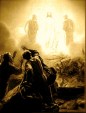
There is hardly a pericope in the Synoptic Gospels that presents such a challenge to critical historical Jesus scholars than that of the transfiguration of Christ. It is no wonder why this bizarre epiphany is chalked up as yet another mythological fabrication of the historical Jesus—the sad divinizing of a failed would-be Messiah.

It is this post-enlightenment rationalism that refuses to believe in miracles of any sort. If there is a god, he most certainly does not become human flesh, make the lame walk and the blind see, or raise folks from the dead.

This is of course not an issue for those who believe that the theological Jesus is also the historical Jesus, and that the earliest testimony about Jesus is reliable and trustworthy. Those believers who affirm the creeds of Nicaea and Chalcedon are open to God breaking forth from heaven with divine power into that realm in which human beings live, and move, and have their being. The transfiguration of Jesus is one of those breaking-in-moments where God visibly manifests his power and favor upon the one he claims to be his Son—the glorified Christ—the God-man.

Oddly enough, the transfiguration of Jesus is one of the most “neglected” stories in the entire New Testament.[2] Many widely acclaimed theology textbooks used in seminaries over the years say little to nothing about this magnificent display of the divinity of Jesus of Nazareth.[3]

What is the reason for so many pastors, theologians, and biblical scholars distancing themselves from the transfiguration narratives? To be truthful, not everyone is ignoring the transfiguration. Dorothy Lee states that the neglect is committed largely by the Western tradition.

Lee writes, “Christians in the East regard the transfiguration as central to the symbolism of the gospel, disclosing as much about themselves as about God.”[4] So, what is happening in the West?

In the West, contemporary scholarship has not given the transfiguration story as significant a place in the discussion on New Testament theology as might be expected. This is not to say that there has been a total absence of discussion, but the difficulties which the text itself poses to the modern exegete—literary, historical, and theological—have led scholars to give it relatively little attention.[5]

The purpose of this paper is to give a theological interpretation of the transfiguration of Jesus found within the Synoptic Gospels and elsewhere in the New Testament by: (1) giving a brief critical examination of the more recent scholarship, (2) appreciating the slight nuances between the Synoptic redactors, (3) revealing a Christology from “above” with feet still on the ground of real history, (4) proving that multiple attestation of the event adds to its significance. This paper will move past the often-debated concerns of origin, genre, and nature of the Synoptic account.

The author makes an informed assumption that the biblical text is accurate in what it reports about Jesus of Nazareth and the mysterious happenings on the mount of transfiguration. This paper will conclude with a challenge for Western traditions of Christianity to rediscover the transfiguration of Jesus with its theological and Christological implications for faith and practice.

THE TRANSFIGURATION IN THE SYNOPTIC GOSPELS

It is of first importance to notice that each of the Synoptic Gospels places the transfiguration within the same sequence of events:

(1) Peter confesses that Jesus is the Messiah; (2) Jesus commands the disciples not to tell anyone; (3) Jesus predicts his coming suffering, death, and resurrection from the dead; (4) Jesus calls his disciples to follow him sacrificially; (5) the transfiguration; (6) Jesus commands the disciples to keep quite until after his resurrection; (7) a discussion on the coming of Elijah (except in Luke); (8) the miraculous healing of a demonized boy; and (9) a second prediction of the passion of Christ.[6]

W. L. Liefeld declares, “The assumption is clearly that the event [transfiguration] took place at this juncture in the life and ministry of Jesus.”[7] This event must have taken place somewhere in the middle of Jesus’ ministry, and it stands alone as a one time occurrence. The transfiguration only finds meaning as a unique event occurring in the life and ministry of Jesus prior to his death, resurrection, and ascension. The case for a “misplaced resurrection account” has been laid to rest once and for all.[8]

The Gospel of Mark (9:2-10)

The vast majority of scholars believe that the Gospel of Mark was the first of the Synoptic Gospels (i.e. Marcan priority), and probably written in the mid to late 60’s to a predominately gentile audience.[9] Matthew and Luke are commonly thought to have borrowed from Mark—possibly using earlier source material and oral traditions to compose their biographies for their own purposes. Therefore, it is best to begin with the account in Mark.

Six days later, Jesus took with him Peter and James and John, and led them up a high mountain apart, by themselves. And he was transfigured before them, and his clothes became dazzling white, such as no one on earth could bleach them. And there appeared to them Elijah with Moses, who were talking with Jesus. Then Peter said to Jesus, “Rabbi, it is good for us to be here; let us make three dwellings, one for you, one for Moses, and one for Elijah.” He did not know what to say, for they were terrified. Then a cloud overshadowed them, and from the cloud there came a voice, “This is my Son, the Beloved; listen to him!” Suddenly when they looked around, they saw no one with them any more, but only Jesus. As they were coming down the mountain, he ordered them to tell no one about what they had seen, until after the Son of Man had risen from the dead. So they kept the matter to themselves, questioning what this rising from the dead could mean.  (Mark 9:2-10 NRSV)

As an ancient literary genre, the transfiguration is known as an “epiphany” because of the sudden manifestation of a divine being where the witnesses are invited to participate in the plan of God.[10] Marks says that the transfiguration took place “six days” after Jesus’ words that “some standing here will not taste death until they see that the kingdom of God has come with power” (9:1). The “some” are Peter, James, and John—the power is seen in the glorification of Christ on the mountain.

Scholars are not certain on what mountain this occurred, but the most likely spot is Mount Meron located in Galilee about eight miles northwest of the Sea of Galilee. It is the highest peak in Palestine and close to Caesarea Philippi, the place of Peter’s great confession.[11] It comes as no surprise that this epiphany happens on a mountain. Mountains and other “high places” were viewed as the setting for divine experiences. For Jesus to lead Peter, James, and John up a “high mountain” prepares the audience for a forthcoming revelation.

Moses ascended the “mountain of God” (Exod 19:3) and had a divine encounter by way of a theophany on Sinai (Exod 19:16-20). After this encounter Moses took with him Aaron, Nadab, Abihu, and seventy elders of Israel (Exod 24:9-10). Mark sets his readers up for a similar event, but it turns out to be something much different—far more extraordinary than anyone could expect or imagine. Jesus gives three of his disciples more insight into the previous confession that he is Messiah (8:29).

Mark says that Jesus was temporarily “transfigured” or “transformed” (metamorphoo) externally before them, and that his clothes were dazzling white. He emphasizes this fact with “no one on earth could bleach them” (9:3) that white. The shining white clothing is characteristic of heavenly beings, thus it draws attention to the heavenly nature of Jesus. R. T. France writes, “The point is presumably that no naturalistic explanation can account for what the disciples witnessed.”[12]

The story continues with its bizarre happenings as the OT prophets Elijah and Moses appear, and then begin “talking with Jesus” (9:4). Mark does not tell his readers what they are discussing, but the mere appearance of these two prophets speak a great deal to those sensitive to the Jewish Scriptures. It is probably best the traditional idea that these two men represent the Law and the Prophets be rejected.[13] Elijah was not a writing prophet, and his name is mentioned ahead of Moses.

The presence of these prophets triggers the eschatological promise of the coming of Elijah (6:15; 8:28) who was taken to heaven without dying (2 Kgs 2:11) and was expected as a forerunner to the new age (Mal 3:23-24). Moses had an experience where his face was left radiant from the glory of God (Exod 34:35). He prophesied in eschatological hope that a prophet greater than himself would come (Deut 18:15-19). The appearance of these two prophets symbolizes the arrival of the messianic age. The suffering and rejection of these prophets prefigure the experiences of the passion of Christ.

The Messiah has indeed arrived in Jesus. But as the rest of the pericope will reveal, he’s not the Messiah they expected.

Mark says that Peter responds to this mysterious event with words that have been greatly debated: “Rabbi, it is good for us to be here; let us make three dwellings, one for you, one for Moses, and one for Elijah” (9:5). Mark tells us that Peter said this because he was terrified and did not know what to say (9:6).[14] It is worth noting that Peter may not have fully grasped the full meaning to his previous confession in Caesarea Philippi. Here he addresses Jesus as “Rabbi” (teacher), and appears to interpret this event as signifying the equality of Jesus and the prophets.[15] Then from the heavenly cloud—representing the divine presence—came a voice saying, “This is my Son, the Beloved; listen to him” (9:7)![16] Jesus is the glorified Christ—the Word of God.

In an instant things return to normal and Jesus tells the three disciples not to speak of what they have seen until after the “Son of Man had risen from the dead” (9:9). Mark reports that they did not understand what Jesus meant. The confusion of the disciples is common in Mark’s Gospel. Dorothy Lee writes, “Mark sees discipleship as flowing from Christology—that is, from his understanding of Jesus—so that the revealing of Jesus’ identity is bound up with the calling of the disciples.”[17]

Lee succinctly describes the symbolic significance of the prophets and the purpose for their appearing during the transfiguration:

Moses and Elijah are thus complex symbols, representing God’s ancient people, Israel, and associated with mountain epiphanies and the events of the end time. One thing is clear in the range of possible meanings. For Mark, the symbolic significance is unmistakably Christological: their presence acts as a dual pointer to the identity of Jesus himself. It is no coincidence that they appear at the very moment of Jesus’ metamorphosis, opening up past, present and future to the heavenly world, and giving a cosmic perspective on the human world embodied in Israel.[18]

The Gospel of Matthew (17:1-9)

Matthew was written for a Jewish audience, yet his Gospel is at the same time universal in its scope (13:38; 21:33-43; 28:18-20). The “Jewishness” of the Gospel can be seen in the extensive use of OT Scriptures and the substitution of “heaven” for God’s name. Matthew is intent on proving that Jesus is the new and greater Moses—the fulfillment of Jewish prophecy.

Matthew is interested in the church and the needs of the growing Jewish community. His Gospel comes later than Mark’s Gospel, and he abridges Mark’s material to make it more easily remembered by the new Jewish believers.[19] Matthew also stresses the inevitability of God’s judgment, apocalyptic eschatology, and that Jesus is the promised Messiah. Matthew focuses on the significance of Jesus and the cost of following Christ for the sake of the kingdom.

Matthew uses Mark’s narrative of the transfiguration, but there are clear nuances and variations that Matthew has added to the story in order allude more clearly to the OT, as the true identity of Christ is revealed in a call to discipleship. Matthew also says that it is “six days” after Jesus told the disciples about seeing the Son of Man “coming in his kingdom” (16:28). The six days may be a literary device used to set up a glorious seventh day event.[20]

In Matthew’s account, it is not only his clothes that are transformed into a dazzling white, but he says that Jesus’ face “shone like the sun” (17:2). He undoubtedly intends to evoke remembrance of the radiant face of Moses after having been in the presence of God (Exod 34:29-35). Moses is of course mentioned before Elijah in their appearing. Moses and Elijah had important roles as precursors to Jesus, now Christ comes to be more than an eschatological prophet. Matthew presents Jesus as coming to fulfill the Law and the Prophets. He himself is the fulfillment.

How did the disciples recognize Moses and Elijah? None of the Synoptic narratives tell us how they knew them, but it was most likely because of the conversation they overheard.[21] Matthew has Peter responding to Jesus with “Lord” instead of “Rabbi” (17:4). Where Peter’s folly in addressing Jesus as “Rabbi” is clear in Mark, Matthew may not want to use this title more as a literary avoidance of the words later to be spoken by Judas (26:25, 49).

Therefore, Matthew is able to keep Peter from speaking words that might sound like denial to readers, but maintain his clear confusion with what is happening. For Peter to suggest the building of three tents is in some manner to express that confusion (17:4). He may have suggested this for several reasons: (1) he wanted to honor each figure in a commemorative way; (2) he wanted them to stay on the mountain and continue communicating with them, like that of the Tent of Meeting; (3) he was simply being hospitable in seeking to provide habitations for them.[22]

Regardless of Peter’s true intentions (even if he himself knew what he meant), it was wrong to place Jesus on the same level with Moses and Elijah during this temporary event. The voice from heaven speaks (actually interrupting Peter), like the voice at Jesus’ baptism, testifying to the superiority of Christ over his predecessors. The enveloping cloud restrains Peter much like the cloud that kept Moses from entering the tabernacle (Exod 40:35).[23] The disciples fall down in fear after the hearing of the voice from heaven, indicating worship of the heavenly Christ.

Lee writes that the transfiguration “is the outward manifestation of the inner person, as revealed by God. Jesus is shown as he is in his true self, hidden from the eyes of the world…”[24]

The response of the church is to worship!

The Gospel of Luke (9:28-36)

The Gospel of Luke is the longest of all four gospels and is the first volume in his “orderly account” (Luke-Acts) of the life and teachings of Jesus. For those believing in the two-source theory with Marcan priority, both Matthew and Luke used Mark, as well as an unknown “Q” source.[25] Is Luke’s account of the transfiguration a simple redaction of Mark and Matthew? Maybe not.[26] There are similarities, but striking differences as well.

Luke begins his narrative with “eight days after” instead of the six days that both Mark and Matthew use. Is this a plain contradiction with what happened? Also, Luke will provide insight into the conversation that Jesus, Moses, and Elijah were having, not found in Mark and Matthew. Luke mentions the disciples being “weighed down with sleep” during the event, and uses slight differences in vocabulary and sequence. How do scholars account for the differences, and what do they mean?

Luke may have been relying on an unknown source, but explanation can be given apart from knowing that source and what it actually contained. As a historian, Luke smoothes out the “six days” to an approximate week. For Luke’s Gentile audience, it is not necessary to maintain such a direct connection to the OT. Luke says that Jesus went up with his disciples to pray (9:28). Prayer is a major theme in Luke-Acts as the author draws attention to this act in order to reveal its relationship to heaven (e.g. Lk 3:21-22; Acts 1:14; 2:1). The prayer of Jesus brings about the transfiguration event.

It would appear that in order to speak with the heavenly prophets Jesus would need for himself to be transfigured into heavenly form. Luke says that Jesus and the prophets were “speaking about his departure” that was coming in Jerusalem (9:31)—an exodus which leads to the playing out of salvation history.

So why does Luke mention that the disciples were sleepy? Luke intends to prefigure the prayer scene in the Garden of Gethsemane (22:39-53). At the transfiguration there is glory, in the garden there is agony. Luke ties these two scenes together in order to emphasize the confusion and misunderstanding of the disciples.[27]

The glorified Jesus will overcome this agony in resurrection (24:5). And the confusion of the grief-stricken disciples will be transformed into a bold confession of the glorified and resurrected Christ (24:52-53). As Luke says, “in those days” they told no one about what they had seen. But they would not stay silent forever.

THE TRANSFIGURATION ELSEWHERE IN THE NEW TESTAMENT

The Gospel of John

The Gospel of John is missing the transfiguration narrative. Why is that? George Ladd says, “John differs from the Synoptics in making the entire ministry of Jesus a manifestation of glory.”[28] It is clear that John seeks to portray the glory of Jesus throughout his Gospel, so why does he not include the narrative? It is hard to say. However, there is some evidence that John may have this event in mind in a couple of places.

John testifies to seeing the “glory of the one and only” (1:14). This could refer to the transfiguration, or he might be speaking of the entire life, death, and resurrection of Christ. Also, there is the Father’s voice from heaven, which proclaims that he had “glorified” the name of Jesus, and would do it again (12:27-33).

There is no way to be certain if John is referring to the transfiguration, but it does seem unlikely that such an event would not find its way into his Gospel, considering his theological emphasis and having experienced something as glorious as Jesus being transfigured before his very eyes.

Lee writes the following on the “absence” of the transfiguration:

If there is cross-fertilization between the two traditions, the Synoptic and the Johannine, the question of why John did not use the transfiguration story becomes more insistent. And here an answer can be suggested: that John did know something of the transfiguration and chose to use it, not as a single tale, but as a motif—a series of symbols—throughout his Gospel. If so, this would mean that, instead of re-telling the story with his own editorial changes, John has chosen to weave the threads of the transfiguration into the warp and woof of his tale, so that the main symbols are rehearsed again and again throughout the Johannine narrative. If so, the whole Gospel could be viewed as a ‘transfiguration’ story: ‘the glory which in the Synoptics flashes into the story on the mountain is perceived by Saint John to pervade all the words and works of Jesus.’[29]

Lee’s suggestion to view the entire Gospel as a transfiguration story is profound. This only further highlights the sheer beauty of John’s Gospel. John didn’t include the transfiguration narrative because it is not his style. He prefers to stretch such a grand event throughout his work.

The Second Epistle of Peter (1:16-18)

For we did not follow cleverly devised myths when we made known to you the power and coming of our Lord Jesus Christ, but we had been eyewitnesses of his majesty. For he received honor and glory from God the Father when that voice was conveyed to him by the Majestic Glory, saying, “This is my Son, my Beloved, with whom I am well pleased.” We ourselves heard this voice come from heaven, while we were with him on the holy mountain. (NRSV)

In an effort to validate the “power and coming” of Christ, Peter reminds his audience that the disciples were eyewitnesses to the transfiguration. He actually uses a first-person-personal-pronoun to emphasize, “we ourselves heard” a voice that exalted Christ in the glorious event.[30]

This event is treated as a historical and spiritual reality which confirms the certainty of the future parousia of Christ.

The transfiguration actually happened and was observed. It is not legend or a mythical tale used much later to deify a crucified Messiah. In Peter’s mind, the disciples witnessed many mysterious things that present overwhelming evidence of the divinity of Jesus of Nazareth.

CONCLUSION—MOTIFS & MEANING

The many motifs within the transfiguration narrative can now be summarized before clarifying the theological interpretation of the glorified Christ. The first motif encountered is the “after six days”—used as a common literary pattern in Semitic literature.[31] This immediately parallels Exodus 24:16. The mountain ascension is the next feature reminiscent of Mount Sinai, as well as other events of divine revelation.

Also, the cloud on the mountain symbolizes the presence of the Lord on many occasions throughout the OT (Exod 19:16-19; Isa 4:5; Dan 7:13). The appearance of Moses and Elijah is significant for they are precursors to Christ and they represent eschatological prophets. This immediately identifies Jesus as eschatological prophet, but the unfolding of the vision reveals that he is much more than that—he is the Son of Man.

The voice from heaven is the climax of the experience. This “voice” alludes to Psalm 2:7. And it might even be possible that there is an allusion to Isaac, making Jesus the willing sacrifice.

Finally, what can be said and done for the recovery of the transfiguration in Christian faith and practice within the church? What difference does this make for the doctrine of Christ?

Western Christianity in many places is struggling for survival against a deadly secularism that smothers any sense of transcendence or mystery, too much of which has penetrated its own ranks. The Church needs to regain the vision of Christ on the mountain, the light in which we see light, the echo of the divine voice acclaiming Jesus the beloved Son—the biblical symbolism of a majestic, incarnate, crucified God as the only source of hope for the transfiguring of a disfigured world.[32]

The transfiguration affirms the church’s eschatological hope in the resurrected Christ, as the One who is greater than all the prophets—equal only to God—who reigns the universe supreme.

D.D. Flowers, 2012.

[1] Dale C. Allison, The Historical Christ and the Theological Jesus, (Grand Rapids: Eerdmans, 2009), 79.

[2] Dorothy Lee, Transfiguration. New Century Theology Series. (New York: Continuum, 2004), 1.

[3] For example, Millard Erickson in his Christian Theology (Grand Rapids: Baker Academic, 1998), 1241, only gives passing mention to the pericope in order to speculate about heavenly bodies; Stanley Grenz doesn’t mention it at all in his Theology for the Community of God (Grand Rapids: Eerdmans, 1994); George Ladd briefly addresses the implications of the Matthean account in his A Theology of the New Testament (Grand Rapids: Eerdmans, 1993), 222.

[4] Lee, 1.

[5] A. D. A. Moses, Matthew’s Transfiguration Story and Jewish-Christian Controversy (Sheffield, England: Sheffield Academic Press, 1996), 13. For a bibliography of scholarship before 1981, see T. F. Best, “The Transfiguration: A Select Bibliography.” Journal Of The Evangelical Theological Society 24, no. 2 (June 1, 1981): 157-161. Also see Dale Allison, The New Moses: A Matthean Typology (Minneapolis: Fortress Press, 1993).

[6] W. L. Liefeld, “Transfiguration,” Dictionary of Jesus and the Gospels. ed. Joel B. Green and Scot McKnight, 834-841 (Downers Grove: InterVarsity Press, 1992), 834.

[7] Ibid., 835. Something out of the ordinary occurred on that mountain prior to the resurrection!

[8] Wellhausen, Bultmann, Carlston, and other liberal scholars have promoted this view. See Bultmann, The History of the Synoptic Tradition (Oxford: Blackwell, 1963), 259-260. The case for a misplaced resurrection appearance has been convincingly refuted. See Robert H. Stein, “Is the transfiguration (Mark 9:2-8) a misplaced resurrection-account.” Journal Of Biblical Literature 95, no. 1 (March 1, 1976): 79-96.

[9] Raymond E. Brown, An Introduction to the New Testament, (New Haven: Yale Univ. Press, 1997), 111; 163; also Stanton’s The Gospels and Jesus, (New York: Oxford University Press, 1993), 34.

[10] John Paul Heil, The Transfiguration of Jesus: Narrative Meaning and Function of Mark 9:2-8, Matthew 17:1-8 and Luke 9:28-36, (Rome: Pontifical Biblical Institute, 2000), 38-39. The divine being remains invisible in a theophany. In the transfiguration, the disciples are being called to play a role in God’s salvific plan for the world.

[11] Liefeld, 835.

[12] R. T. France, The Gospel of Mark: A Commentary on the Greek New Testament, The New International Greek Testament Commentary, (Grand Rapids: Eerdmans, 2002), 351.

[13] Ibid.

[14] This is very telling since it is believed that Mark was largely dependent upon the testimony of Peter.

[15] Heil, 161.

[16] The first time this heavenly voice is heard is at Jesus’ baptism in Mark 1:11.

[17] Lee, 10.

[18] Ibid., 19.

[19] Robert H. Mounce, Matthew. New International Commentary (Peabody, MA: Hendrickson Publishers, 1998), 4.

[20] Craig S. Keener, The Gospel of Matthew: A Socio-Rhetorical Commentary, (Grand Rapids: Eerdmans, 2009), 436. See Exodus 24:15-18. This and other features of the narrative are recalling the Sinai revelation.

[21] Ibid., 438.

[22] Heil, 127.

[23] John Nolland, The Gospel of Matthew: A Commentary on the Greek Text. The New International Greek Testament Commentary, (Grand Rapids: Eerdmans, 2005), 704. The call to “listen to him” echoes that of Dt. 18:15.

[24] Lee, 47. See James A. Penner, “Revelation and Discipleship in Matthew’s Transfiguration Account.”

Bibliotheca Sacra 152, no. 606 (April 1, 1995): 201-210. He claims the event is about revelation and discipleship.

[25] Brown, 116-122. See R.E. Brown’s Introduction to the New Testament for an overview of “Q”.

[26] Barbara O. Reid, “Voices and Angels: What Were They Talking about at the Transfiguration? A redaction-critical study of Luke 9:28-36.” Biblical Research 34, (January 1, 1989): 19-31.

[27] Lee, 74.

[28] Ladd, 312.

[29] Lee, 101.

[30] Leifeld, 836.

[31] Liefeld, 839.

[32] Lee, 2.


The Jewish Religious World of Jesus

The Jewish Religious World of Jesus—A Brief Overview

There is a great deal of misunderstanding that often derives from a reading of the New Testament when the modern reader does not consider the religious matrix of the first-century.

Ultimately, proper application to our own situation suffers tremendously.

In the last 20 years, biblical scholars have taken great strides in discovering the world of Second-Temple Judaism. This new wealth of information has made it possible for the church to better understand the religious world of Jesus. Placing Jesus within his own context, helps us to see him in our own.

Scholars are learning that the Jewish Religious landscape was much more multi-faceted than previously imagined.

N.T. Wright has written, “the one thing we can safely say about first-century Judaism is that there is no such thing as first-century Judaism, and that it may be best to speak of ‘Judaisms,’ plural” (Wright, 244).

In the previous two centuries before Jesus, political and religious strife created a tumultuous climate, especially in the region of Palestine.

The successful Maccabean Revolt, and then the people’s utter disgust with the failure of the Hasmonean Dynasty, had largely brought about an apocalyptic worldview, deep longings for a Jewish Messiah to establish the kingdom of God on the earth, and a hope in the imminent restoration of Israel according to God’s covenantal faithfulness.

There were several religious parties and sects that grew up during this period, and they were in full bloom during the ministry of Jesus.

This article will briefly examine what is currently known about those Jewish Religious groups that existed in the time of Jesus, and beckon the reader to consider what Jesus’ relationship was to them.

Pharisees

The Pharisees emerge as the most popular of all religious groups in the first-century. The etymology of the name Pharisee is uncertain, but some scholars believe the name is derived from the Hebrew word parush, which means “separation” or “consecration.”

This religious sect has commonly been labeled as strict legalists who were bent on oppressing people with burdensome rules for their own self-righteous pleasure. But that may not be an entirely accurate portrayal.

Jesus did indeed speak harsh words to these religious leaders, calling them hypocrites and “white washed tombs” (Matt. 23). His words of rebuke were certainly the strongest with the Pharisees.

However, it appears that Jesus may have had more in common with the Pharisees than any other religious group in the first-century.

So, who were these teachers of the law? Who were the “scribes” and Pharisees? And why was Jesus so bothered by this religious group?

The Pharisees were deeply concerned about Torah and they actively sought ways to find fresh interpretions and apply the Scripture to a world on the move. The “scribes” were those specifically trained in interpreting Torah. Although the scribes did not belong to any one specific party, it seems that they resonated with the Pharisees.

The Pharisees believed in the resurrection of the dead and eternal life and punishment. They also were accepting of other more recent theological developments regarding angels and demons. The Pharisees were not only concerned about proper biblical interpretation, but also with proving their covenant faithfulness in ritual purity.

For the most part, the people trusted the guidance of the Pharisees as they influenced the life of the nation at the local level and showed great devotion to God. The Pharisees believed that Torah was for all people, and they made a concerted effort to keep the Law of Moses fresh and alive.

“Woe to you, blind guides!”

Why then does Jesus rebuke the Pharisees throughout the Gospels? It is because the Pharisees believed that rabbinical oral-interpretive traditions (i.e. “traditions of the elders”) were just as authoritative as the Torah itself.

Also, the Pharisaical purity practices led them to erect social distinctions between themselves and fellow Jews. It became rather difficult for Pharisees to maneuver in life after adhering to extra human-laws and traditions.

Jesus simply would not allow the accumulation of the petty Pharisaical traditions deter him from the divine law. Jesus was deeply troubled by the “yeast” of the Pharisees (Matt. 16:12).

It was a disregard for the Pharisaical traditions that placed Jesus at odds with this popular sect. The Pharisees were unwilling to depart from those interpretive traditions that they felt were the greatest display of God’s covenant faithfulness. For this, they sought to trap and kill him.

Had the Pharisees not been so fond of their own teachings, and had instead been open to the teachings of the Galilean rabbi, they may have possibly recognized Jesus of Nazareth as the Messiah promised in the Scriptures.

Sadducees

The Sadducees are remembered as the smaller aristocratic party that “combined conservative religious attitudes with power politics” (Ferguson, 519). Unlike the Pharisees, the Sadducees adhered to stricter interpretations, claiming only Torah as authoritative—even rejecting the Prophets and the Writings. They were the Religious Right of Jesus’ day.

What scholars learn about the Sadducees comes mainly from their opponents. The Sadducees are mostly remembered for their denial of the resurrection from the dead (Matt. 22:23). They had no use for the theological developments of the intertestamental period.

Their primary role as a priestly party was controlling the temple ritual. The Sadducees appear to be mostly interested in maintaining the status quo. Where most Jews detested the Roman imperial occupation of Palestine, the Sadducees enjoyed the peace, power, and influence that Rome was able to give them. They preferred the Pax Romana over the peace of Jesus.

They were only interested in serving God in so far as it didn’t require them to give up their secure position of prosperity or progress in their theology. It is worth noting that there is evidence of several Pharisees who followed Jesus, but there is not a single record of a Sadducee convert.

The Sadducees drop off the religious radar soon after the destruction of the temple in AD 70. These conservatives fade with the shifting of their world.

Essenes

The monastic sect that lived at Qumran, which is located on the northwest shore of the Dead Sea, were called the “Essenes.” The Essenes, according to Philo and Josephus, numbered over 4,000 men. This religious group believed they were the rightful heirs of God’s promises.

The Essenes communicated this belief by withdrawing from temple life in Jerusalem, believing the entire religious system was corrupt. They practiced extreme frugality, celibacy, and ritual purity.

Ritual purity was central to the Essene way of life as they began their day with a purification bath before dressing in standard white outer garments.

There were ritual morning prayers, communal meals, and daily agrarian duties. They may have also worked as shepherds, beekeepers, and craftsmen.

The Essenes held an apocalyptic worldview. They believed they were living in the last days and that the prophets pointed to their times. This can be seen throughout Qumran literature. The Essenes were anticipating a conquering Messiah and they believed that they were saving themselves as the faithful keepers of the covenant. All others were just religious pretenders.

They intensely studied and copied the Scriptures. Since the discovery of the Dead Sea Scrolls, scholars have learned that the Essene community believed they were “sons of light” and the last remnant of God’s covenant.

Some scholars have suggested that John the Baptist may have emerged from the Qumran community.

Zealots, Sicarii, and Herodians

The Zealots are known as the extreme anti-Roman party with violent tendencies. Scholars point out that it is likely that these revolutionaries only differed from the Pharisees in their willingness to use violent force and sacrifice themselves for the sake of Jewish liberty.

The Zealots held a biblical hermeneutic that encouraged violent revolt against the enemies of God. Josephus has written, they were Jews expressing their conviction: “No lord, but God” (Jospehus, Ant. 18.1.6). Simon the Zealot was one of the Twelve disciples of Jesus (Matt. 10:4).

Another branch of the Zealots were the Sicarii, or “dagger men” (Acts 21:38). These terrorists would mingle among the crowds of people, especially during Jewish festivals, and strike down prominent Roman officials, only to quickly disappear back into the crowd undetected.

These were the men that held Herod’s wilderness compound, Masada, during the Jewish revolt which first began in AD 66. It was in this military fortress that hundreds of Sicarii, along with their families, would take their own lives in order to avoid capture by the Romans in AD 73. The Romans were impressed by the honor and bravery of these freedom fighters.

The Herodians were another political and religious group that carried great influence among the people of Palestine. They are mentioned only three times in the New Testament. As their name suggests, the Herodians were clearly partisan to the Herodian dynasty, but they are still seen joining with the Pharisees in their opposition to Jesus (Mk. 3:6).

This is significant, since the Herodians were politically affiliated with Herod’s house, but religiously and economically in agreement with the Sadducees. The testimony of Matthew and Mark reveal that the Herodians were willing to work alongside their rivals to oppose Jesus of Nazareth.

Samaritans

Samaria was the hill country located between Galilee to the north and Judea to the south. Jesus told a parable of a Good Samaritan who helped a man that was beaten and left for dead on the side of the road (Lk. 10:25-37). Several pious travelers walk right on by the helpless man, but it is the Samaritan that reflects the kingdom of God.

This story cuts to the heart of Jewish prejudices towards this religious and ethnic group. For the religious Jews living in the first-century, it is impossible to miss Jesus’ provocative challenge to reconsider popular opinion about a religious neighbor and fellow keeper of the covenant.

So who were the Samaritans? Why were they disliked among many Jews?

The Samaritans were considered an unclean and illegitimate “half-breed race” that was neither Jew nor Gentile. This was due to their practice of intermarrying with pagans, being descendants of the northern tribes that split from Judah after the time of Solomon, and their establishment of a rival temple on Mt. Gerizim.

The woman at the well discusses this point of contention with Jesus in John 4:1-42. Jesus proposes that the religious feud of temple worship is no longer relevant because the Messiah has come to set the world to rights.

Jesus indicates that God has something else in mind which goes beyond what was being anticipated and practiced by all religious Jews.

What Religious Brand Was Jesus?

It is worthy of careful consideration that Jesus did not entirely agree with any Jewish Religious group of his own day. Jesus rebuked representatives and ideologies from each group in an effort to reform their ideas of covenant faithfulness, ritual purity, and Messianic expectations.

For some of these religious folk, he did affirm that certain points of their theology were correct, still they needed to be refined through his own divine interpretation of Scripture (Jn. 5:39). Jesus claimed to be the only one able to interpret and teach without any blind spots or lapse in judgment.

Jesus refused to affiliate himself with any of the Jewish denominations of his day. He would not allow himself to be pigeonholed, and he was angered by the efforts other Jews made to place God in a box, constrained by their own theological and philosophical paradigms.

No, Jesus kept a healthy distance from these religious groups and he refused to weigh in on the hot political and religious debates of the day.

Jesus turned the tables on his opponents. He shocked his audience by challenging their view of the Father’s love, teaching the inclusion of all those that welcomed him as Messiah, and proclaiming himself savior of the world.

Instead of joining these religious groups, Jesus gave a clear and resounding call, “Come, follow me” (Mk. 1:17). And the invitation still stands today.

Suggested Reading

  • DeSilva, David. An Introduction to the New Testament: Contexts, Methods & Ministry Formation. Downer’s Grove: InterVarsity Press, 2004.
  • Evans, Craig, and Stanley Porter. Dictionary of New Testament Background. Downer’s Grove: InterVarsity Press, 2000.
  • Ferguson, Everett. Backgrounds of Early Christianity, 3rd ed. Grand Rapids: Wm. B. Eerdmans, 2003.
  • VanderKam, James. An Introduction to Early Judaism. Grand Rapids: Wm. B. Eerdmans, 2001.
  • Wright, N.T. The New Testament and the People of God, Vol. 1: Christian Origins and the Question of God. Minneapolis: Fortress Press, 1992.