Category Archives: Ethics

Preparing for Marriage

Many couples are not excited—even worried and confused—about premarital counseling. It is especially dumbfounding to a world today that has become increasingly desensitized to the sacredness of marriage.

And it is most disconcerting of all that Christians have added to the confusion over biblical marriage and contributed to the epidemic of divorce.

The Christian pollster George Barna has said, “There no longer seems to be much of a stigma attached to divorce; it is now seen as an unavoidable rite of passage.” See my article: Marriage & the Gospel of Jesus.

Christians are called to honor marriage as the most sacred of earthly covenants—a lifelong covenant to be entered in purity with a holy commitment to God in Christ.

Yet the church has succumbed to the spirit of the age by ignoring Jesus’ teaching on sacred marriage and the destructive nature of divorce (Gen 2:24; Matt 19:1-12; 1 Cor 7; Eph 5:22-33; Heb 13:4, etc.).

Let’s be honest, divorce not only destroys marriages and leaves a lasting mark on the couple affected, it tears apart families and perpetuates the cycle of dehumanization. You do not escape unscathed.

Divorce is antithetical to the Gospel and the reconciliatory work of Christ in the world. The church must be reminded of this and be admonished when necessary. Regardless of our mistakes, we must hold marriage high at all costs. We must operate off of principle instead of emotion.

Christian marriages crumble for a number of reasons. It is a relationship that must be continually maintained with a love that knows no bounds and be refreshed by a shared passion for the heavenly bridegroom—Jesus Christ. I can’t stress enough how this must be a “shared” passion and conviction. Believers are not to be “yoked” together with unbelievers (2 Cor 6:14).

Premarital counseling is an attempt to confront couples with the weight of the decision they are preparing to make. It is for the purpose of helping believers enter into marriage grounded upon Christ and equipped to move forward as hopeful realists. Premarital counseling is intended to position the couple for the best possible beginning to a Christ-honoring marriage.

Here are a few specific goals I have for Christian premarital counseling:

Goal One: Help establish and affirm the couple’s commitment to Christ.

If I’m asked to marry a couple, I believe it is necessary to establish the couple’s commitment to Christ. Does each person share a personal knowledge and love for Jesus? Have they both accepted Christ as Lord? Are they active members in a local church?

If so, then the couple will be encouraged in how to share Christ with one another and go on to discuss their plans for church life together.

If it becomes evident that they are unequally yoked and spiritually apathetic, I will advise the couple not to marry (at least until the situation is corrected). If they are insistent upon marriage regardless of the biblical teaching and their spiritual condition, I must decline to marry them.

There will be no hard feelings or judgment on my part if this happens. It’s nothing personal. I simply must respectfully decline out of my own conviction and the best interest of the couple.

As a minister of the Gospel there is no way that I can invoke the Lord’s blessing upon what I perceive to be an unbiblical union. I do not think that the marriage vows and ceremony are meaningless jargon and ritual for the sake of producing a romantic memory or making it “official” for the state.

Marriage is the beginning of a promise before God and men that the two are joining to become one flesh. There is nothing more sacred on the earth than marriage. We dare not enter into it carelessly.

The couple may be able to find a licensed minister to put his stamp of approval upon their marriage and go on to perform the ceremony without any conditions, but my conscience is bound to my understanding of Christian marriage. I’m aware that not everyone understands or agrees with this position, but I do believe that it is reasonable and biblically defensible.

The real challenge is trying to find a biblical argument against it.

Goal Two: Help the couple discern whether or not God is really calling them together.

This goal is reached by challenging the couple to learn more about each other. This goes beyond their fiancés favorite color, how they each feel loved and respected, and what they plan to do about credit cards.

Instead, it goes to the heart of marriage. What brought the couple together? Were they following Christ when they met? What part has Christ played in their dating relationship? Have they sought the Lord as a couple in making the decision to pursue marriage? Are they honoring the Lord now?

It is critical that the couple recognize that they began and/or are now pursuing God’s good will and purposes. Does their relationship go beyond mere attraction and companionship?

If the relationship is not rooted in God and his purposes for their lives, the couple increases their chances for divorce.

I can remember the anxiety I experienced during the pre-engagement period (even some while we were engaged) as I desperately sought after the Lord’s will on whether or not I was to marry my wife. I admit that some of it may have been overkill due to a spiritual immaturity.

However, after almost 10 years of marriage, I believe it was healthy for me to wrestle with the decision to marry, especially at such a young age. We wanted to please the Lord, so it concerned both of us that we trust in the Lord’s best for us. This is a good thing.

I would never advise a couple marry without seeking the Lord about it together. If a couple has decided to get married with little to no concern about the Lord’s thoughts, they need to seriously go before the Lord together in prayer and seek his heart for their relationship.

Making a decision about marriage without having totally surrendered your will and heart to the Lord is reckless.

It is for certain that being intentional about discussing the things that really matter most will raise questions, doubts, and qualms to the surface. Many couples fail to ask uneasy questions of each other and even ignore sensitive issues that they hope will eventually work themselves out later.

Couples will unknowingly—and knowingly—wear blinders to many things. It’s easy to do this when they have become infatuated with each other. So, an outsider is helpful to stir the pot a bit.

Premarital counseling will stimulate conversation that the couple needs to have, but may not have if they are not encouraged and guided in that process. It’s a great way to enter marriage with confidence that the Lord is indeed Master of the relationship—that he brought the couple together and that he will see them through it “until death do you part.”

Goal Three: Help the couple to exchange an idealistic view of marriage for a more realistic and biblical view.

This last goal is met by working to deconstruct the fantasies of romance and marriage. Each person brings with them certain expectations about marriage. There is a great deal of unrealistic expectations that have been acquired from well-intentioned parents all the way to the distortions of Hollywood.

If the couple is not aware of those expectations to discuss them, those unresolved expectations will eventually lead to demands, and demands will lead to an attempt to manipulate and control the other partner.

Many married couples are later blind-sided with this sort of thing and never move beyond this power struggle of bending the other to their will. This leads to isolation for both partners. It is often the killer of many marriages.

H. Norman Wright writes:

Too many couples enter marriage blinded by unrealistic expectations. They believe the relationship should be characterized by a high level of continuous romantic love. As one young adult said, “I wanted marriage to fulfill all my desires. I needed security, someone to take care of me, intellectual stimulation, economic security immediately—but it just wasn’t like that!” People are looking for something “magical” to happen in marriage. But magic doesn’t make a marriage work: hard work does (Communication: Key to Your Marriage).

Premarital counseling’s third goal is to help bring out some of those unrealistic expectations and to find guidance from an older married couple(s) on how confronting this idealism will keep a couple from disappointment, disillusionment, and divorce.

What is a biblical marriage in a broken world? It is important that the couple recognize the lies in order to embrace the truth of the real marriage journey.

Finally, if each partner can begin to identify the baggage from their upbringing and traumas suffered in the past—and do so while dating and during the premarital counseling experience—this will help the couple tremendously as they enter marriage.

When these things are identified, they may be dealt with if the couple is committed to the hard work of investing in a fulfilling marriage.

Selfishness that is displayed in an unwillingness to work through personal problems and past traumas will end a marriage before it even begins. You gotta deny yourself for marriage to work.

The counseling process can help the couple learn how to begin working through the painful experiences that have left open festering wounds that need to be treated. It is for the health of your future marriage.

This process will not uncover all hidden realities and sort out all “issues” a couple may have, but it will most definitely encourage a healthy communication that is essential for a successful marriage.

Preparing for Marriage–Some Premarital Counseling Is Better Than None

Why premarital counseling? Well, I will be so bold to say that those who really care about their future marriage and are seeking to honor Christ with their lives will have no qualms or hesitations with beginning preparatory sessions that will position them for a marriage that lasts.

If you want a marriage that is built on Christ and for a future serving him with your spouse, strengthen your relationship by taking the first steps on solid ground. Take the first steps toward a marriage that doesn’t make you happy, but instead makes you holy.

D.D. Flowers, 2011.

The Law in James

James, the brother of Jesus, writes: “You see that a person is justified by what he does and not by faith alone” (2:24).

It might appear that James is contradicting the apostle Paul, who writes: “For we maintain that a man is justified by faith apart from observing the law (Rom 3:28).

Paul also states, “For it is by grace you have been saved, through faith—and this not from yourselves, it is the gift of God—not by works, so that no once can boast” (Eph 2:8-9). But James says, “faith by itself, if it not accompanied by action is dead” (2:17).

What should we make of this? Is this a glaring contradiction?

It’s no secret that Paul, an educated Pharisee, frequently had his ministry of the gospel threatened by the Law-peddlers, those Judaizers (2 Cor 11:1-15). His letter to the Galatians was prompted by confusion over the place of the Mosaic “works of the law” in salvation (Gal 3:1-5, also Acts 15). He also speaks to this issue in Romans 3-4.

It is evident that Paul’s “observing the law” (Rom 3:28) concerns those covenant boundary markers within the Torah that separate Jews from Gentiles. Paul is saying that a person is not saved (i.e. become a Christian) by adhering to old covenant boundaries.

The law of Moses is fulfilled in Christ and the “law of the Spirit of life” (Rom 8:2; Gal 3:19). This is the main thrust of Paul’s message. But we see James using “law” differently in his epistle. Let’s take a brief look at each instance.

1:25 “But one who looks intently at the perfect law, the law of liberty, and abides by it, not having become a forgetful hearer but an effectual doer, this man shall be blessed in what he does.”

This is the first mention of nomos (law) in the book of James. He says that the “perfect law” should be gazed into like a mirror (1:23-25). He has already used teleios (perfect) to describe a “gift” that comes from God (1:4,17). The “law of liberty” indicates that observance of the law brings freedom.

But whose law? The law of Moses or Jesus?

Notice, James is using “law” to describe moral behavior in the immediate context—behavior that is encouraged in the teachings of Jesus.

2:8If, however, you are fulfilling the royal law, according to the Scripture, “You shall love your neighbor as yourself,” you are doing well.”

James is using the “royal law” in a general way to describe the law of the kingdom of Christ—the law that was ratified by Jesus. It goes to the heart of the law to love your neighbor as yourself (Lev 19:18; Matt 19:19; 22:39).

James is drawing attention to Jesus’ summation of Torah. There is no indication that he is using “law” in verse 8 to refer to Jewish ritual.

2:9But if you show partiality, you are committing sin and are convicted by the law as transgressors.”

This favoritism is quite the contrast with the previous law of love (2:8; also Lev 19:15). Showing partiality is sin and disobedience to the lawgiver—the one who gave the law of love.

This “law” in James does not utilize a Pauline “works of the law” to encompass covenant boundaries. The law in verse 9 refers to that law laid down by Christ.

2:10For whoever keeps the whole law and yet stumbles in one point, he has become guilty of all.”

What is the “whole law” in James? The previous two verses indicate that the “royal law” or the “law of love” is in view here. James’ focus is the law of Christ, which is summed up in love. Those who break the “royal law” are held responsible for rebellion against the lawgiver and all that he has given as a gift to lead a person in the law of love.

2:12So speak and so act, as those who are to be judged by the law of liberty.”

Once again, all human behavior should come under submission to the “law of liberty” which Jesus set forth as key to obedience. This law shows the way of life and points away from sin. If a person operates out of the “law of liberty,” there they will be led down a path of obedience instead of judgment. The “law of liberty” should impact present moral behavior.

4:11Do not speak against one another, brethren. He who speaks against a brother, or judges his brother, speaks against the law, and judges the law; but if you judge the law, you are not a doer of the law, but a judge of it.”

If a person does not walk in accordance to this law of love set forth by Christ, then they “speak against the law” and have placed themselves as a judge over it. Slandering another brother in the Lord is to slander Christ and his law. A person who “judges the law” will then exalt himself to determine which laws to keep and which to ignore.

The law of love prohibits this behavior.

The book of James uses a combination of the Decalogue and Leviticus 19:18 as a summary of the “royal law” that Christ taught. James indicates that behavior and right conduct play a significant role in receiving God’s righteousness (1:20).

Within the context, James is combating the false dichotomy of faith and works. He argues that God’s righteousness is a “harvest” that is sewn through good deeds (3:18). Those good deeds come out of obedience to the law of love. A true believer proves they are saved by their deeds.

So, it’s safe to say that the “law” in James is that which Paul called the “law of the Spirit of life,” not the Law of Moses. Therefore, there is no contradiction. They both agree that Christ is the giver of a new law and that obedience to his commands are evidence of salvation’s power.

In light of the construction of the epistle and the specific issues being addressed by James to these scattered Jewish Christians, it looks as if his audience lives within a collapsing world. We find in James a theology of suffering for these struggling believers.

James is reminding his audience that the Lord Jesus Christ has not forgotten them and that his presence is calling them to display their faith through good deeds as those who are faithful “doer(s) of the law” (4:11).

D.D. Flowers, 2011.


Top Ten Favorite Books

I have often been asked: “What are your favorite books?”

I’m continually reading books from the softer side of Christian spirituality to the thick analytical works of NT scholarship. I’ll give you a list of my favorite “top ten” books from my entire library.

Furthermore, I’ll rate my favorites according to which books have impacted my thinking the most (i.e. turning points) on my journey. Many great works will be excluded. Perhaps in the future I will make another list.

I will not include the Bible in my list. Undoubtedly, growing up in the church, the Scripture has shaped me in ways I shall never know. So, if it concerns you that the Bible is not on my list, I like to remember that it shouldn’t be placed alongside other popular works of men anyway.

The following books are not in the order in which I read them; they are rated according to their greatest level of influence on my life.

  1. “The Centrality and Supremacy of the Lord Jesus Christ” by T. Austin-Sparks
  2. “Surprised by Hope: Rethinking Heaven, the Resurrection, and the Mission of the Church” by N.T. Wright
  3. “Resident Aliens” by Stanley Hauerwas
  4. “The Normal Christian Life” by Watchman Nee
  5. “Is God to Blame? Beyond Pat Answers to the Problem of Suffering” by Gregory Boyd
  6. “Pagan Christianity? Exploring the Roots of Our Church Practices” by Frank Viola and George Barna
  7. “The Myth of a Christian Nation: How the Quest for Political Power is Destroying the Church” by Gregory Boyd
  8. “The Cost of Discipleship” by Dietrich Bonhoeffer
  9. “The Secret of the Strength: What Would the Anabaptists Tell This Generation” by Peter Hoover
  10. “Created for Community: Connecting Christian Belief with Christian Living” by Stanley Grenz

What books have been most influential in your life?


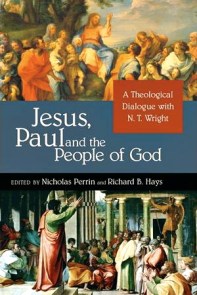
Jesus, Paul, and the People of God

Jesus, Paul, and the People of God: A Theological Dialogue with N.T. Wright (Downers Grove, IL: InterVarsity Press, 2011) Edited by Nicholas Perrin and Richard B. Hays

In the introduction to Jesus, Paul, and the People of God, Nicholas Perrin states, “In contemplating the sum total of all the books written on Jesus and Paul in the last twenty years, one would be hard-pressed to think of a name that comes up more in the indexes than, ‘Wright, N.T.’”

N.T. Wright has indelibly made his mark on biblical scholarship. Wright, a prolific author, has written over forty books, including both scholarly and popular works, and he’s not done yet!

At the 2010 Wheaton Theology Conference, Wright’s scholarship was assessed by nine other biblical scholars and theologians. The weekend conference was set up to laud the work of Wright and to engage with his theology. The series of lectures have been placed nicely within this book.

Jeffrey Greenman, Wheaton’s associate dean of biblical and theological studies and the conference organizer, explains, “We felt that N.T. Wright’s stature as a leading biblical scholar and his widespread influence in the church warranted a unique exploration of his thought.”

PART ONE: JESUS AND THE PEOPLE OF GOD

1.  Jesus and the Victory of God Meets the Gospel of John

Marianne Meye Thompson, Fuller Theological Seminary

* N.T. Wright’s Response

2.  Knowing Jesus: Story, History, and the Question of Truth

Richard B. Hays, Duke Divinity School

* N.T. Wright’s Response

3.  “Outside of a Small Circle of Friends”: Jesus and the Justice of God

Sylvia C. Keesmaat and Brian J. Walsh, University of Toronto

* N.T. Wright’s Response

4.   Jesus’ Eschatology and Kingdom Ethics: Ever the Twain Shall Meet

Nicholas Perrin, Wheaton College Graduate School

* N.T. Wright’s Response

5.   Whence and Whither Historical Jesus Studies in the Life of the Church?

* N.T. Wright, University of St. Andrews

PART TWO: PAUL AND THE PEOPLE OF GOD

6.     Glimpsing the Glory: Paul’s Gospel, Righteousness and the Beautiful Feet of N.T. Wright

Edith Humphrey, Pittsburgh Theological Seminary

* N.T. Wright’s Response

7.    The Shape of Things to Come? Wright Amidst Emerging Ecclesiologies

Jeremy S. Begbie, Duke Divinity School

* N.T. Wright’s Response

8.    Did St. Paul Go to Heaven When He Died?

Markus Bockmuehl, University of Oxford

* N.T. Wright’s Response

9.    Wrighting the Wrongs of the Reformation? The State of the Union with Christ in St. Paul and Protestant Soteriology

Kevin J. Vanhoozer, Wheaton College Graduate School

* N.T. Wright’s Response

10.    Whence and Whither Pauline Studies in the Life of the Church?

* N.T. Wright, University of St. Andrews

If you have followed Wright’s work, you will enjoy reading the lectures that both celebrate and challenge him. In part one, much of the dialogue revolves around Wright’s riveting book, Jesus and the Victory of God (JVG). Although it would be helpful to have read JVG, it is not necessary. In fact, the dialogue will simply encourage you to read JVG if you haven’t already.

In part two, the dialogue centers on his books, What Saint Paul Really Said: Was Saul of Tarsus the Real Founder of Christianity and Surprised by Hope: Rethinking Heaven, the Resurrection, and the Mission of the Church.

Finally, you may prefer listening to the conference lectures as you read along. You will especially enjoy hearing the two panel discussions, which are not included in this book.

Thank you IVP for publishing this wonderful collection of essays that interact with the refreshing scholarship of N.T. Wright.

A special thanks to IVP’s online publicity manager, Adrianna Wright (no relation to Tom), for sending me the book.