Jesus’ Teaching on Divorce
Jesus’ teaching on divorce appears in the synoptic gospels and Paul.[1] It is because of multiple and abundant attestation that Jesus’ sayings on divorce are considered, even among the most liberal of scholars, to be authentic words of Jesus of Nazareth.[2]
This would usually be reason for a moderate evangelical like myself to celebrate. However, not even evangelicals who pride themselves—rightfully so—on believing in the inspiration of the biblical text, can agree on what Jesus meant by what he said.
The catholic scholar J. P. Meier observes that Jesus’ teaching on divorce, “leads us into a confusing morass of historical, exegetical, and theological problems.”[3] No doubt, a great deal of time and energy has been given to discovering what Jesus really said about divorce and remarriage; in spite of the honest trepidation that can accompany such a hermeneutical endeavor.
The purpose of this paper is to bring some contextual clarity to Jesus’ teaching on divorce through: (1) a brief examination of divorce in the Old Testament and in the literature of the intertestamental period, (2) an appraisal of the legalities of divorce that were seemingly in a state of flux during the Second Temple period leading up to Jesus, (3) an exegesis of the divorce passages found in the synoptic gospels—giving special attention to Matthew 5:27-32; 19:3-9 and the so-called “exception” clauses.
DIVORCE IN THE OLD TESTAMENT
The Law
Deut 24:1-4 is the only significant law on divorce in the Pentateuch—which accounts for the debate in early Judaism over the meaning of this passage. What constitutes a legal divorce? It was this one long sentence of casuistic law (“if… then”) that the Jewish leaders sought to extrapolate meaning and application. The center of their deliberations was the obscure Hebrew phrase “erwat dabar” (lit. “nakedness of a thing”) which appealed to the ancient honor/shame culture. This phrase was likely intended to be vague so that it would include a range of marital infractions, but not to include adultery.[4]
In the context, the passage is dealing with a specific case of remarriage. J. Carl Laney writes, “Grammatically the intent of the law is not to give legal sanction to divorce or to regulate the divorce procedure. The intent of the passage is to prohibit the remarriage of a man to his divorced wife in cases of an intervening marriage by the wife.”[5]
Christopher Wright says, “The practical effect of this rule is to protect the unfortunate woman from becoming a kind of marital football, passed back and forth between irresponsible men.”[6] It is clear that Moses was not giving a command or even encouraging divorce. He is merely protecting the people and land from defilement (v.4). The only other law mentioning divorce is Lev 21:7, 13-14, indicating a definite stigma that is attached to divorce in the Pentateuch—divorce is merely tolerated.
The Prophets
Deut 24:1-4 can be seen in the message of three prophets. Yahweh pleads through Jeremiah that Israel repent of her “whoring and wickedness” and return to him (3:1-5). “If a man divorces his wife and she goes from him and becomes another man’s wife, will he return to her? Would not such a land be greatly polluted? You have played the whore with many lovers; and would you return to me” (v.1)? What is impossible under the Law is made possible by God’s grace if they choose to repent (4:1-2).
In Isaiah 50:1, the people of Israel have been sent away for their unfaithfulness, but Yahweh is capable of restoring them to himself if they would only repent and believe that he can redeem them.
Yahweh bends over backwards in Hosea 3:1-3 as he suspends the law against remarriage: “Go, love a woman who has a lover and is an adulteress, just as the LORD loves the people of Israel, though they turn to other gods and love raisin cakes” (v.1). In a bizarre set of circumstances, Yahweh seeks to prove through Hosea’s marriage to the loose woman Gomer that there are no lengths too great that he is not willing to go in order to honor the covenant relationship he made with Israel.
And it is in Malachi that Yahweh denounces the unfaithfulness of men to their young wives (2:14-15). Yahweh declares down through the ages, “I hate divorce” (2:16).
With these sentiments expressed by the Hebrew prophets, how then could there be a debate over divorce in early Judaism? Meier reminds his readers that, “one should remember that prophetic exhortation and condemnation, however fiery, did not possess the same binding force for later Judaism as did the laws of the Pentateuch.”[7] In the day of Jesus, the Law of Moses (i.e. Deut 24:1-4) is front and center in the divorce debate.
THE INTERTESTAMENTAL PERIOD
The Qumran Scrolls
The meticulous study of the Dead Sea Scrolls[8] continues to reveal a wealth of information to biblical scholars working to understand the Second Temple period. The sect that lived at Qumran separated from what they believed to be a corrupted Judaism and settled by the northwest shore of the Dead Sea.[9] They carried on a monastic life as they copied and preserved OT manuscripts, as well as some of the Pseudepigrapha.
The most fascinating find is proving to be the sectarian compositions that describe their communal lifestyle, rituals, theology, and beliefs about a coming eschatological kingdom. The Qumran scrolls give insight into one group that prohibited divorce to some degree.[10]
The Temple Scroll (11Q Temple 57:17-19) sets forth conduct for a future king of Israel that is drawn directly from Deut 17.[11] The text indicates that the sect interpreted the prohibition of polygamy (Deut 17:17) to also include divorce: “And he shall not take in addition to her another wife, for she alone shall be with him all the days of her life; and if she dies, he shall take for himself another (wife).” There is some disagreement among scholars on whether this “utopian” life of a future king would apply to the townsfolk.
11QTemple 66:8-11 repeats the command found in the law of Deut 22:28-29 that a man who seduces a virgin not yet betrothed must marry her and “cannot divorce her as long as he lives.” Is the sect confirming that the law against divorce is only binding under certain circumstances?
In light of 11QTemple 57:17-19, it is possible that “unchastity” mentioned in Damascus Document (CD 4:12b-5:11) includes adultery,[12] polygamy, incest, and divorce. Hans Dieter Betz writes, “There appears to be more agreement that the prohibitions do not merely apply to the king but to the common Jew as well.”[13]
Philo & Josephus
Philo of Alexandria (ca. 20 BC-ca. 50 AD), a Jewish contemporary with Jesus and Paul, is an important witness to Jewish thought and practice during the Second Temple period. As a writer influenced by Hellenism and the allegorical school in Alexandria, Egypt, Philo is often read with a critical eye. However, his commentary on Deut 24:1-4 should not be ignored for those seeking to understand Jewish halakhah (legal rulings).
What insight does Philo give as to the interpretation of the text and the Jewish attitude on divorce in the first century?
In his Special Laws (3:30-31),[14] he introduces the woman who was divorced “under any pretence.” Philo aligns himself with the House of Hillel and their view of an “any-cause” divorce. He gives a plain reading of the Law: a woman divorced from her first husband, having “married another,” must not return to her first husband. He indicates that husband who would take his wife back should “bear the reputation of effeminacy” and should be put to death with his wife.
The Jewish historian and Roman sympathizer, Flavius Josephus (37 AD-ca. 95 AD), also agrees with Philo and the House of Hillel that a husband could divorce his wife for any reason whatsoever.
In Ant 4.8.23 §253, Josephus writes:
He that desires to be divorced from his wife for any cause whatsoever (and many such causes happen among men), let him in writing give assurance that he will never use her as his wife any more; for by this means she may be at liberty to marry another husband, although before this bill of divorce be given, she is not to be permitted so to do; but if she be misused by him also, of if, when he is dead, her first husband would marry her again, it shall not be lawful for her to return to him.[15]
Josephus does appear to focus more on the husband and his actions, where Philo focuses on the wife. Also, Josephus is more concerned about the written certificate of divorce (as a second law) and departs from a plain reading of Deut 24:1-4. Josephus, himself having been married a couple of times (Life 75.415), clearly had embraced the liberal Hillelite interpretation of the OT[16] and had joined the cultural plague of divorce.
Hillel & Shammai
The divorce practices of the first century have been made known to scholars today by surveying the vast collection of papyri from Egypt—that includes marriage contracts and divorce agreements.[17]
Scholars are recognizing that marriage and divorce underwent a “revolution” during this tumultuous era.[18] The Mishnah[19] has also proven to be most helpful in gaining insight into the background of Jesus’ teachings amid the first century debate.[20]
The Mishnah reveals two rabbinical schools that were in dispute over divorce: the schools of Hillel and Shammai. N. T. Wright says that by the time of Jesus, “It is likely that the two ‘houses’ of Hillel and Shammai already represented two alternative ways of being Pharisees.”[21]
As the reader might expect, their debate centered around the proper interpretation of Deut 24:1-4—what is the meaning of the Hebrew phrase “erwat dabar” and what are legal grounds for divorce?
The two Pharisaic schools are represented in m. Gittin 9.10. The House of Shammai teaches that a man can only divorce his wife for marital unfaithfulness. The House of Hillel say, “Even if she spoiled his (husband’s) dish.”[22] As for Shammai’s teaching, “adultery” is condemned in the OT and is deserving of death (Lev 20:10; Deut 22:22). The woman “caught in adultery” in John 8:1-11 affirms this rule of law.[23]
However, there is some question about how this was being applied in the Roman period of the first century. Early rabbinic sources reflect a “clear desire to circumscribe as far as possible the sphere in which such a severe penalty was to be enforced. A wife whose life was to be spared was certainly to be divorced.”[24] What is clear is that the Jewish world of Jesus was unclear as to how the Law was to be applied to divorce.
THE TEACHINGS OF JESUS
It has been said that the NT Epistles are one-dimensional in their historical and literary context; the gospels, on the other hand, come to the reader from a two or three-dimensional historical context.[25] For example, Paul speaks directly to his audience in his letters, but the gospel writers collected sayings and narratives about Jesus that were preserved by church tradition and then arranged according to their own purposes.
The gospel redactor weaves together each pericope to paint a unique grandiose picture of Jesus to meet the immediate needs of his own local community. There have been efforts to synthesize the gospels into one story, yet the church has continued to recognize each separate literary account as an “inspired and authoritative work of the Holy Spirit.”[26]
Therefore, it is important that the reader pay close attention to the careful construction of each author’s narrative and the intentional placement of Jesus’ discourse on divorce.
The Gospel of Mark (10:1-12)
The large majority of scholars believe that the Gospel of Mark was the first of the synoptic gospels (i.e. Marcan priority), and probably written in the mid- or late 60’s to a predominately gentile audience.[27] Jesus’ block of teaching on divorce is found within a narrative that has been purposely placed in a section on discipleship—with children and the kingdom of God on each side of the divorce pericope.
It would appear that accepting Jesus’ teaching on divorce is a matter of the kingdom. He says, “Truly I tell you, whoever does not receive the kingdom of God as a little child will never enter it” (10:15).
Since many scholars believe that Matthew relies heavily upon Mark in this narrative, and since this paper thoroughly expounds upon Matthew’s pericope, it is only necessary to briefly point out some of the similarities and differences of Mark to Matthew’s gospel. Both gospels have Jesus entering “Judea beyond the Jordan” (Mk 10:1; Matt 19:1). This would indicate that the teaching happened in the same setting as both writers remember it.
The divorce teaching is prompted by the inquiry of the Pharisees to the question, “Is it lawful for a man to divorce his wife” (Mk 10:2)? Matthew adds, “for any cause” (Matt 19:3).[28] Jesus practically avoids their trap of entering into a debate, and instead points them to God’s original intention for marriage (Mk 10:6; 19:4).
The next part of Jesus’ saying is given only to his disciples “in the house” as a result of their wanting clarification (v.10). Jesus said to them, “Whoever divorces his wife and marries another commits adultery against her; and if she divorces her husband and marries another, she commits adultery” (10:11-12).
The most obvious difference between Mark and Matthew is found here in the last two verses.[29] Of all the synoptic gospels, Mark shows the woman to have the same ability to divorce as her husband. Unlike Jewish women in first century Palestine, the women in Mark’s gentile audience have the power to divorce their husbands. Also, Mark does not include the so-called exception clause “except for sexual immorality” (Matt 5:32; 19:9).[30]
Meier captures the blunt force trauma of Jesus’ teaching on divorce:
By completely forbidding divorce, Jesus dares to forbid what the Law allows—and not in some minor, obscure halakic observance but in one of the most important legal institutions in society. He dares to say that a man who duly follows the Law in properly divorcing his wife and marring another woman is in effect committing adultery. When one stops to think what this involves, Jesus’ prohibition of divorce is nothing short of astounding. Jesus presumes to teach that what the Law permits and regulates is actually the sin of adultery.[31]
The Gospel of Luke (16:18)
The Gospel of Luke is the longest of all four gospels and is the first volume in his “orderly account” (Luke-Acts) of the life and teachings of Jesus. For those believing in the two-source theory with Marcan priority, both Matthew and Luke used Mark, as well as an unknown “Q” source.[32] It would at first appear that Luke has done a strange thing with the Marcan (and Q?) source of Jesus’ teaching on divorce.
The teaching may at first seem out of place. “The law and the prophets were in effect until John came; since then the good news of the kingdom of God is proclaimed, and everyone tries to enter it by force. But it is easier for heaven and earth to pass away, than for one stroke of a letter in the law to be dropped” (16:16-17). Then Jesus says, “Anyone who divorces his wife and marries another commits adultery, and whoever marries a woman divorced from her husband commits adultery” (v.18).
John Nolland comments on Luke’s thought:
In Luke’s understanding here, the preaching of the good news of the kingdom of God, quite the contrary to offering easy entry into the kingdom, involves an intensification of the demands of the law. The case of divorce is used illustratively… It is clear that in the Lukan understanding the “law and the prophets” are in no sense superseded, but rather added to in the sense of being made yet more rigorous.[33]
The Gospel of Matthew (5:27-32; 19:3-9)
The Gospel of Matthew was used more widely in the early church than any of the other gospels.[34] Reasons for its popularity stretch from the ordering of the gospel to its often poetic and memorable phrases.
The dating of Matthew is difficult to know because it depends on many disputed points. If Marcan priority is accepted and the Gospel of Mark was written as late as AD 65, some scholars believe it would have taken ten years for Matthew to produce his own gospel. D.A. Carson says a written source is circulated quickly and Matthew could have written as early as AD 66.[35] Still other scholars have argued for a date some time after the destruction of the Temple in AD 70.
Anthony Saldarini believes the gospel fits the later development of early church Christology, and also matters of Jewish debate.[36] The divorce passages may be an example of that debate.
Matthew was clearly written to a Jewish audience, yet his gospel is at the same time universal in its scope (13:38; 21:33-43; 28:18-20).[37] The “Jewishness” of the gospel can be seen in the extensive use of OT Scriptures and the substitution of “heaven” for God’s name. Matthew is intent on proving that Jesus is the new and greater Moses.[38]
In the Sermon on the Mount, Jesus sets his teaching alongside the Mosaic Law (5:21, 27, 31, 33, 38, 43).[39] There is a clear emphasis on Jesus’ teaching ministry (5-7)—as it is the largest block to be found in any of the four gospels.
There is no place in the gospel where Matthew plainly states his purpose for writing, but it becomes evident in his particular emphases. Matthew is interested in the church and the needs of the growing Christian-Jewish community. He abridges Mark’s material, likely borrowing from Q as well, and intends to fashion his gospel in a way that is more easily remembered by new believers amidst their Jewish critics.[40]
Saldarini sums up the purpose of Matthew’s gospel:
Matthew does not simply preserve Jewish-Christian traditions which were operative earlier in the century, nor does he effect a synthesis of earlier Jewish with current Christian traditions and customs. The outlook and practice which Matthew promotes in his gospel is thoroughly Jewish and based on the Bible as understood through the teachings of Jesus. Matthew seeks to carry on Jesus’ reform of Judaism and convince his fellow Jews that his understanding of Judaism is God-given (11:25-27) and necessary for Israel and for the gentiles, too.[41]
The Matthean texts will now be examined more critically, as the crux of the debate over Jesus’ teaching on divorce revolves around them.
The first passage for a careful exegesis and examination is found in Matt 5:27-30 NRSV:
You have heard that it was said, ‘You shall not commit adultery.’ But I say to you that everyone who looks at a woman with lust has already committed adultery with her in his heart. If your right eye causes you to sin, tear it out and throw it away; it is better for you to lose one of your members than for your whole body to be thrown into hell. And if your right hand causes you to sin, cut it off and throw it away; it is better for you to lose one of your members than for your whole body to go into hell.
27. “You have heard that it was said, ‘You shall not commit adultery’.”[42] Note: Gk. font not available in blog format.
This verse begins the second antithesis in the Sermon on the Mount.[43] Matthew fashions the discourse to show that Jesus has the authoritative interpretation(s) of Torah.[44] “You have heard that it was said…” is abbreviated from the formula in 5:21. The hearing implies a “chain of verbal communication” that has been passed down in time.[45] It is most likely a reference to the OT itself, since 5:21-48 is dealing with the OT instead of oral law or rabbinic teachings.
The word errethe is the “divine” aorist passive form. In other words, Jesus is using a formula that introduces Torah, not tradition.[46] Jesus recalls for his audience the seventh commandment as found in the LXX Decalogue (Exod 20:14 and Deut 5:18). The use of the imperatival future (moicheuseis) makes the law “You shall not commit adultery” a timeless commandment.
28. “But I (myself) say to you that everyone who looks at a woman to lust for her has already committed adultery with her in his heart.”
Jesus emphatically declares that his words, not the oral traditions of previous rabbis, are the final arbiter of the Law of Moses. He says that adultery begins in the heart of a person who first looks at a woman lustfully.
Daniel Wallace is careful to note that the phrase (everyone who looks at a woman) is a gnomic present participle. It is not a progressive action (e.g. “continually looking”), but rather a general, timeless fact.[47] Therefore, the initial look could very well result in lustful desires of the heart. Regardless of how many looks, it is the sinful thought that Jesus calls “adultery”.
As Davies and Allison point out, “The infinitive after the preposition “pro” represents result and implies that the sin lies not in the entrance of thought but in letting it incite passion.”[48] The aorist infinitive epithumesai is also used in the tenth commandment against “coveting” the wife of your neighbor (Exod 20:17 LXX). Jesus is saying that a real concern for the tenth commandment means a person will root out the evil that first begins in the imagination.
29. “And if your right eye causes you to stumble, tear it out, and throw it from you; for it is better for you that one of your members perish than for your whole body to be cast into Gehenna.”
The use of overstatement is used by Jesus to express the serious nature of sexual sin that must not be handled lightly.[49] A person looks with the eye in lust and then touches with the hand in adultery (v.30). Grant Osborne points out that the “right” side of the body was seen as the more powerful side in antiquity.[50] Jesus says that if lust of the eyes is a problem, it is imperative that a person exele (cut it out!) and bale (throw it away!) in order that they not suffer the violent death of geennan (Gehenna).
The “fire of Gehenna” was mentioned previously (v.22). “Gehenna” refers to the valley south of Jerusalem (gê-hinnõm) that is believed to be the city garbage dump in the first century.[51] It is also known to be the place of child sacrifice to the god Molech (2 Chr 28:3; 33:6). The whole person will suffer the judgment of Gehenna (i.e. “hell”) if the body is given over to sinful desires and passions. Once again, the divine passive (blethe) indicates that it is God who will judge sinners righteously.
30. “And if your right hand causes you to stumble, cut it off, and throw it from you; for it is better for you that one of your members perish than for your whole body to depart into Gehenna.”
Notice the first class conditional sentence (“If your right hand…”). Wallace makes the following comment about this verse and its implications for meaning:
Jesus often put forth a number of challenges to current Jewish orthodoxy, such as that appendages and external things are what defile a person. Reading the text in light of that motif yields the following force: “If–and let us assume that this is true for argument’s sake-your right hand offends you, then cut it off and throw it from you!” The following line only enforces this interpretation (“For it is better for you that one of your members should perish than that your whole body should be cast into hell”). Jesus thus brings the Pharisees’ view to its logical conclusion. It is as if he said, “If you really believe that your anatomy is the root of sin, then start hacking off some body parts! After all, wouldn’t it be better to be called ‘Lefty’ in heaven than to fry in hell as a whole person?” The condition thus has a provocative power seen in this light.[52]
Matthew purposely places Jesus’ teaching on divorce immediately following this passage on adultery that begins within a person’s thoughts. Jesus moves from adultery beginning in the heart, to a person acting out their sinful desires, to the much-debated issue of divorce. It should be noted that adultery is still the concern in the next two verses.
It was also said, ‘Whoever divorces his wife, let him give her a certificate of divorce.’ But I say to you that anyone who divorces his wife, except on the ground of unchastity, causes her to commit adultery; and whoever marries a divorced woman commits adultery. (Matt 5:31-32 NRSV)
31. “And it was said, ‘Whoever divorces his wife, give her a certificate of divorce’.”
Davies and Allison state that the verse above is a “legal prescription” that summarizes the procedure in Deut 24:1-4, where the issue of concern is remarriage, not divorce.[53] However, it is important to recall that the raging debate among the rabbis of Jesus’ day was that since Moses allows divorce in Deut 24:1-4, what then are legitimate grounds for divorce?
Once again, the first century rabbinic schools of Hillel and Shammai argued over the minimum requirements that established those grounds (m. Ketub 5:5-8) based on their interpretations of Deut. 24:1.[54]
Daniel Fanous writes, “First-century Judaic thought took a Mosaic prohibition and transformed it into a law allowing divorce. Jesus on the other hand, took the very same prohibition, highlighted and elevated it, and thus created a law prohibiting divorce.”[55]
32. “But I (myself) say to you that everyone who divorces his wife, except for sexual immorality, makes her to commit adultery, and whoever marries the divorced woman commits adultery.”
Jesus now returns to his concern over the committing of adultery. Debate looms over the “exception” clause (parektos logou porneia). The phrase logou porneia is not standard Greek wording and it is likely not “natural” Greek.[56] Krister Stendahl writes that the phrase “renders the Hebrew” and shows Matthew’s “dependence upon Jewish terminology.”[57]
The Hebrew phrase erwat dabar (lit. “thing of nakedness”) is translated into the Greek phrase logou porneia in Matt 5:32.[58] Therefore, the phrase is clearly evoking the language of Deut 24:1.[59]
However, in the context of Deuteronomy, erwat dabar cannot refer to any form of sexual immorality. The Law demanded capital punishment for adultery instead of a written “certificate of divorce” (Lev. 18:6-19; 20:11-21). Instead, the near context indicates that the offense is indecent public exposure (Deut 23:13-14). According to the Mosaic Law, a husband was allowed to divorce his wife only if there was found in her some “indecency” that defiled her and made her unclean.[60]
What then does porneia mean? The semanctic range of porneia includes: unlawful sexual intercourse, prostitution, sexual immorality, unchastity, and acts of fornication.[61] The word encapsulates a number of sexual offences and is a “catch-all term” used throughout the NT.[62] In Matt 5:32 porneias is referring to any sexually immoral deed that counts toward an adulterous infraction of the marital covenant. In ancient Palestine only men were allowed to dissolve a marriage contract.[63] That is the reason that Jesus is addressing men in this passage.
Jesus says that those who divorce their wives poiei auten moicheutheai (cause their wives to commit adultery). Not only does the husband make his wife commit adultery, but he also causes the new husband that comes after to do the same and join in on the adulterous affair.
The clause parektos logou porneia (except for sexual immorality) means that of course the husband has not caused his wife to commit adultery if she has already done so on her own accord.[64]
In Matt 19:3-9, Jesus’ teaching is given in the Marcan narrative form (10:2-12). Jesus’ teaching on divorce comes in response to questions from the Pharisees.
Some Pharisees came to him, and to test him they asked, ‘Is it lawful for a man to divorce his wife for any cause?’ He answered, ‘Have you not read that the one who made them at the beginning “made them male and female”, and said, “For this reason a man shall leave his father and mother and be joined to his wife, and the two shall become one flesh”? So they are no longer two, but one flesh. Therefore what God has joined together, let no one separate.’ They said to him, ‘Why then did Moses command us to give a certificate of dismissal and to divorce her?’ He said to them, ‘It was because you were so hard-hearted that Moses allowed you to divorce your wives, but at the beginning it was not so. And I say to you, whoever divorces his wife, except for unchastity, and marries another commits adultery.’ (Matt 19:3-9 NRSV)
3-6. “Is it lawful for a man to divorce his wife for any cause” (v.3)? The Pharisees want Jesus to weigh in on the Hillel/Shammai debate. Also, it could be that they have heard that Jesus was opposed to divorce.
How does Jesus respond to the Pharisees desire to have a divine stamp of approval upon divorce? He evokes covenant language of “leave” and “cleave” (Deut 10:20; 11:22; 13:4; 30:20; Josh 22:5; 23:8; Ruth 1:14-16).[65]
Man and woman become a “one flesh” union.[66] This is not merely a sexual union, but a relational union that is created by God. Jesus responds with “what God has joined together, let no one separate” (v.6). According to Jesus, marriage is not a legal contract that can be cancelled by claiming “irreconcilable” differences.
7-9. This prompts another question by the Pharisees: “Why then did Moses command us to give a certificate of dismissal and to divorce her” (v.7)? Jesus says to them, “It was because you were so hard-hearted that Moses allowed you to divorce your wives, but from the beginning it was not so” (emphasis mine). Jesus shifts the focus from divorce itself (Deut 24:1) to the divine intention of marriage (Gen 1:27; 2:4).
N. T. Wright comments on Jesus’ maneuvering the biblical text:
Jesus responds with an assertion which reveals that he stands at a vitally different point in Israel’s story. Deuteronomy, he says, is part of a temporary phase in the purposes of YHWH. It was necessary because of the ambiguous situation, in which Israel was called to be the people of god, but was still a people with hard hearts. Israel cannot be affirmed as she stands. She is still in exile, still hardhearted; but the new day is dawning in which the ‘the Mosaic dispensation is not adequate’, since ‘Jesus expected there to be a better order’. By quoting Genesis 1:27 and 2:4 to undermine Deuteronomy 24:1-3, Jesus was in fact making it clear that the story to which he was obedient was that in which Israel was called by YHWH to restore humankind and the world to his original intention.[67]
“And I say to you, whoever divorces his wife, except for unchastity, and marries another commits adultery” (v. 9). There is a notable difference in the Greek clause of 19:9. The phrase parektos logou porneia from Matt 5:32 and the verse’s connection to Deut 24:1 is lost.
Instead, the clause in Matt 19:9 is “me epi porneia.” As previously stated, 5:32 simply means that the husband “causes” the wife to commit adultery, parektos logou porneia (except for sexual immorality). If she has already done the deed herself then the husband has not caused it. What about the difference of language and syntax in 19:9—how does it harmonize with 5:32?[68] It is probably best to translate the preposition (epi) as a dative in the temporal: “not during sexual immorality.”
Many scholars prefer to read this Matthean clause as a true exception,[69] saying it is representative of rabbinic halakhah and that Jesus was showing his agreement with Shammai.[70] But if Jesus was agreeing with one known tradition of halakhah, it does not merit the culture shock response of the disciples. They reply, “If such is the case of a man with his wife, it is better not to marry” (v.10).
Since Jesus paid no attention to the cultural norm that a husband could not commit adultery against his wife (Matt 19:9; Mk 10:11), it is unlikely that Jesus considered their halakhah demanding divorce for adultery.[71] Jesus instead calls for a higher ethic that is not matched by any known first century halakhah.
Doug Kennard cuts through the great hermeneutical haze that hovers around this oft-debated Matthean text, as he succinctly writes:
Jesus’ ethic on this point of the Law is more restrictive than the Law in its appeal. Therefore, Jesus’ exception clause cannot be softening and expanding the Law’s exception clause. If Jesus is saying that it is acceptable to divorce a wife for her sexual immorality, then He is denying several commands of the Law that required capital punishment (Lev 18:6-19; 20:11-21) and rendering Himself under His own declaration to be the least in the Kingdom and therefore self-contradictory.[72]
CONCLUSION—TILL DEATH DO US PART
After examining the historical and cultural context of the synoptic gospels, it is clear that Jesus radically internalizes the Law of Moses and gives his audience the authoritative call to discipleship in the kingdom of heaven.
In an initial reading, and due to the various traditional readings and interpretations of this passage, it may have seemed like Jesus was siding with the conservative Rabbi Shammai—agreeing that adultery is a legitimate reason for divorce. But Jesus has given us a higher ethic that protects women from abuse, places them on equal footing with men,[73] and sets fidelity in the relational union of marriage well within the scope of what it truly means to be faithful to God—actively participating in the work of the kingdom to build up, not to tear down.[74]
The so-called “exception” clause in Matt 5:32 and 19:9 cannot be allowing for the dissolution of a marriage, regardless of the oft-debated meaning of porneia or the slight differences in the syntax of one verse.[75] Matthew does not stand in contradiction to Mark and Luke on Jesus’ teaching concerning marriage, divorce, and remarriage.
The synoptic gospels must certainly be allowed to speak their inspired message to their own respective audiences. And at the same time, the reader must know that suspected contradictions rest with the interpreter, not in the inspired written text. Matthew was very much aware of Mark, even relying upon his gospel in his own composition. Therefore, he would not have deliberately altered the clear teaching of Jesus or softened it to accommodate a culture grown numb from a rampant “easy” divorce.
The Pharisees wanted to talk about divorce, but Jesus wanted to talk about marriage. People that are preoccupied with seeking legitimate grounds for divorce prove themselves to be guilty of the very thing Jesus condemned.[76]
As Richard Hays writes, “Those who trust God as revealed through Jesus will not seek such an escape clause from their marriages.”[77]
Jesus’ teachings are not an “interim ethic” as described by the quester Albert Schweitzer.[78] They are the true “character of kingdom life”[79] to be lived out while praying, “Your kingdom come. Your will be done, on earth as it is in heaven” (Matt 6:10).
Robert Stein echoes the very heart of Jesus:
The divine intention is a marriage “until death us do part.” A divorce, any divorce, reveals a failure of the divine purpose of marriage. Divorce, for whatever the cause, witnesses to a failure somewhere of what God originally ordained for his creation. The ideal is a lifelong, monogamous marriage that resembles the love affair of Christ and his Church (Eph 5:22-33). To contemplate divorce and in what instances a divorce may be legitimate is to think very differently from the way in which Jesus thought.[80]
And what were the thoughts of Jesus on divorce? He said, “Therefore what God has joined together, let no man put asunder” (Matt 19:6). He concluded with, “Go… teaching them (all nations) to obey everything I have commanded you” (Matt 28:19a,20a).
D.D. Flowers, 2011.
[1] Mark 10:2-12; Luke 16:18; Matthew 5:27-32; 19:3-9; 1 Corinthians 7:10-13.
[2] J. P. Meier begins his investigation of the historical Jesus’ sayings on divorce in his book: A Marginal Jew: Rethinking the Historical Jesus, Vol. 4. (New Haven: Yale University Press, 2009), 74. Meier has a “sample” bibliography that covers a vast amount of scholarly books and articles which address marriage, divorce, and remarriage in the ancient Near East.
[4] Meier, 79. The context (Deut 23-24) seems to indicate that erwat dabar refers to public exposure or indecency mentioned in 23:13. Whatever this “nakedness of a thing” is in 24:1, it does not include adultery. Marital unfaithfulness was a capital crime punishable by death (Deut 22:22; Lev 20:10).
[5] J. Carl Laney, “Deuteronomy 24:1-4 and the Issue of Divorce.” Bibliotheca Sacra 149, no. 593 (January 1, 1992): 4.
[6] Christopher Wright, Deuteronomy. New International Biblical Commentary. (Peabody, Mass.: Hendrickson Publishers, Inc., 1996), 255.
[8] The “Dead Sea Scrolls” describes a vast amount of ancient scrolls discovered from 1947 to 1956 in a variety of different places in Judea. The “Qumran” scrolls refer to those texts found in 11 Qumran caves on the northwest shore of the Dead Sea. See Wise, Abeg, and Cook, The Dead Sea Scrolls: A New Translation. (San Francisco: Harper San Francisco, 2005), 5.
[9] N.T. Wright, The New Testament and the People of God, Vol. 1: Christian Origins and the Question of God. (Minneapolis: Fortress Press, 1992), 203.
[10] Hans Dieter Betz, The Sermon on the Mount: A Commentary on the Sermon on the Mount, including the Sermon on the Plain (Matthew 5:3-7:27 and Luke 6:20-49). Hermeneia—A Critical and Historical Commentary on the Bible. Minneapolis, MN: Augsburg Fortress, 1995.), 252; Betz writes: “New documents from the Dead Sea Scrolls have provided additional evidence that prohibition of divorce was not as uncommon by the time of Jesus as scholars had once believed.” Meier writes that, “sweeping statements about divorce being prohibited at Qumran should be avoided” (Marginal Jew, 93). Fair enough.
[11] Wise, Abeg, and Cook, 623.
[12] The following scrolls condemn the practice of adultery: 1QS 1:1-6, CD 2:14-16; 4:12b-5:11.
[13] Betz, 252. Meier writes, “On the question of divorce, the historical Essenes may be more elusive than the historical Jesus. The Essenes did forbid polygyny; their position on divorce remains a question mark” (Marginal Jew, 93.)
[14] C.D. Younge, trans. The Works of Philo. New ed. (Peabody, Mass.: Hendrickson, 1993), 597.
[15] William Whiston., trans. The Works of Josephus. New ed. (Peabody, Mass.: Hendrickson Publishers, 1987), 120.
[16] David Daube, The New Testament and Rabbinic Judaism. (London: University of London Press, 1956 and Peabody, Mass.: Hendrickson Publishers, 1998), 371.
[17] Everett Ferguson, Backgrounds of Early Christianity, 3d ed. (Grand Rapids: Wm. B. Eerdmans, 2003), 134. Ferguson has a discussion of Jewish and Greco-Roman marriage on pgs 72-79.
[18] David Instone-Brewer, “Marriage and Divorce.” The Eerdmans Dictionary of Early Judaism. ed. John J. Collins and Daniel C. Harlow, 916-917. (Grand Rapids: Eerdmans, 2010), 916.
[19] The Mishnah is a major source of Jewish religious practice and rabbinic legal reflection. It is an official codification of the oral law. It was codified ca. AD 170. Two types of material appear: halakhah (law) and haggadah (stories).
[20] Meier is skeptical of any pre-70 debate within Judaism. He believes this may be anachronistic of NT scholars to read the Mishna back into Gospels. See his Marginal Jew, 94-95.
[21] Wright, N.T. The New Testament and the People of God, Vol. 1: Christian Origins and the Question of God. (Minneapolis: Fortress Press, 1992), 201. Wright says, “Disputes between the different Pharisaic schools are the stuff of which the Mishnah is made up.”
[22] Darrell L. Bock and Gregory J. Herrick, Jesus in Context: Background Readings for Gospel Study. (Grand Rapids: Baker, 2005), 85. After Hillel, Rabbi Aqiba said a man could divorce his wife if he found someone else more attractive! Divorce was out of control in first century Palestine.
[23] There is some question as to the place this passage has in the biblical text. Regardless, the story has all of the historical and biblical signs of a real event in the life of Jesus.
[24] John Nolland, Luke 9:21-18:34. Word Biblical Commentary. (Dallas: Word Books, 1993), 817.
[25] Gordon D. Fee, New Testament Exegesis: A Handbook for Students and Pastors, 3d ed. (Louisville: Westminster John Knox Press, 2002), 20.
[26] Mark L. Strauss, Four Portraits, One Jesus: An Introduction to Jesus and the Gospels. (Grand Rapids: Zondervan, 2007), 32.
[27] Raymond E. Brown, An Introduction to the New Testament. (New Haven: Yale Univ. Press, 1997), 111; 163; also Stanton’s The Gospels and Jesus. (New York: Oxford University Press, 1993), 34.
[28] This addition by Matthew is likely due to the “any cause” divorce teaching of the school of Hillel. The Gospel of Matthew has more of a Jewish concern than does the Gospel of Mark.
[30] This will be addressed in detail within the section on the Gospel of Matthew.
[32] Brown, 116-122. See R.E. Brown’s Introduction to the New Testament for an overview of “Q”.
[33] Nolland, Luke 9:21-18:34. Word Biblical Commentary. (Dallas: Word Books, 1993), 820.
[35] D.A. Carson, “Matthew.” The Expositor’s Bible Commentary. ed. Frank E. Gaebelein, Vol. 8. (Grand Rapids: Zondervan, 1984), 20. It may well be that Carson is reticent to accept that Matthew was written later in the 80’s or 90’s, despite convincing arguments from internal evidence, because some “anti-supernatural” critics presuppose that Jesus could not have foretold the events of AD 70. Regardless, the early Markan testimony of Jesus still remains (13:1-2). Therefore, the weight of Jesus’ words regarding the destruction of the temple is not diminished with Matthew writing of a fulfilled prophecy “after-the-fact”.
[36] Anthony J. Saldarini, Matthew’s Christian-Jewish Community. (Chicago: University of Chicago Press, 1994), 4. Saldarini locates the Matthean community in Syria toward the later end of the first century.
[37] Matthew does not hesitate to show Jesus’ appeal to Gentiles (2:1-12) and he is the only Gospel writer to use the word ekklesia “church” (16:18; 18:17). See Saldarini’s discussion (100-107).
[38] Jacob Neusner, Judaism When Christianity Began: A Survey of Belief and Practice. (Louisville: Westminster John Knox Press, 2002), 24.
[39] This can also be seen in Matthew’s borrowing of phrases from the story of Moses to describe events in Jesus’ life (cf. 2:13, 20-21; 17:2, 5; Exod 2:15; 4:19-20; 34:29; Deut 18:15).
[40] Robert H. Mounce, Matthew. New International Commentary (Peabody, MA: Hendrickson Publishers, 1998), 4.
[42] All of the English translations of the Greek are my own.
[43] John Nolland. The Gospel of Matthew: A Commentary on the Greek Text. The New International Greek Testament Commentary. (Grand Rapids: Eerdmans, 2005), 228. The first of six antitheses begins with Jesus internalizing the Law on the matter of anger/murder (see Matt 5:21-26).
[44] Jesus said that did not come to abolish the Law and the Prophets with his teaching (5:19).
[45] Nolland, 229. The “men of old” in 5:21 are the Jewish ancestors of the wilderness generation.
[46] W.D. Davies and Dale Allison. A Critical and Exegetical Commentary on the Gospel According to Saint Matthew, Vol. 1. (Edinburgh: T. & T. Clark, 1988), 511.
[47] Daniel B. Wallace, Greek Grammar Beyond the Basics: An Exegetical Syntax of the New Testament. (Grand Rapids: Zondervan, 1996), 523, 616.
[48] Davies and Allison, 523.
[49] Robert H. Stein, The Method and Message of Jesus’ Teachings. Rev. ed. (Louisville: Westminster John Knox Press, 1994), 9. Stein makes a distinction between overstatement and hyperbole.
[50] Grant R. Osborne, Matthew. Zondervan Exegetical Commentary on the New Testament. (Grand Rapids: Zondervan, 2010), 196.
[51] Davies and Allison, 514-515: “without ancient support, although it could be correct.”
[53] Davies and Allison, 527.
[54] Instone-Brewer, 917. As previously mentioned, the rabbinic school of Hillel taught that a man could divorce is wife for any cause (e.g. “Even if she spoiled his dish…” m. Gittin 9.10). The school of Shammai was more conservative and taught that a “cause of indecency” (i.e. adultery) was the only legitimate grounds for divorce.
[55] Daniel Fanous, Taught by God: Making Sense of the Difficult Sayings of Jesus. (Rollinsford, NH: Orthodox Research Institute, 2010), 21; also E. P. Sanders writes, “Moses did not command divorce, he permitted it; and to prohibit what he permitted is by no means the same as to permit what he prohibited” in his book, Jesus and Judaism (Philadelphia: Fortress Press, 1985), 256.
[56] Nolland, The Gospel of Matthew, 244.
[57] Krister Stendahl, The School of St. Matthew and Its Use of the Old Testament, 2d ed. (Philadelphia: Fortress Press, 1968), 137. An older book that is still worth its salt.
[58] Nolland, The Gospel of Matthew, 245.
[59] Davies and Allison, 528. Matthew’s Jewish audience would immediately recognize this intentional Semitism. It is Matthew’s way of linguistically connecting Jesus’ interpretation to Deut 24:1.
[60] Douglas W. Kennard, Messiah Jesus: Christology in His Day and Ours. (New York: Peter Lang, 2008), 122. Kennard understands Deut 24:1 in light of covenant nomism and the holiness code.
[61] Walter Bauer, A Greek-English Lexicon of the New Testament and Other Christian Literature, 3d ed., ed. Fredrick W. Danker. (Chicago: University of Chicago Press, 2000), 854; also in Friedrich Hauck and Siegfried Schulz. “porneia” in Theological Dictionary of the New Testament, vol. 6. ed. by Gerhard Kittel, 579-595 (Grand Rapids: Eerdmans, 1964), 579; Word meaning abounds! Robert Guelich believes “porneia” refers to an incestuous relationship. See his book, The Sermon on the Mount: A Foundation for Understanding. (Waco, TX: Word Books, 1982), 245. Craig Keener believes this view is much too narrow. See his commentary, The Gospel of Matthew: A Socio-Rhetorical Commentary. (Grand Rapids: Eerdmans, 2009), 467; A small number of scholars believe that “porneia” is unfaithfulness during the Jewish betrothal period. See David Jones, “The Betrothal View of Divorce and Remarriage.” Bibliotheca sacra 165, no. 657 (January 1, 2008): 68-85; also Abel Isaksson, Marriage and Ministry in the New Temple. (Lund: C. W. K. Gleerup, 1965). This is a plausible view. However, the exact meaning of “porneia” is not that critical to the claims of this paper, since 5:32 and 19:9 are not seen as escape clauses.
[62] Richard B. Hays, The Moral Vision of the New Testament. (New York: HarperCollins Publishers, 1996), 355. Hays has a nice overview of the way “porneia” is used in the NT on pgs 354-356.
[63] Instone-Brewer, 917. See also, Meier, 74-75; and D. Daube, The New Testament and Rabbinic Judaism. London: University of London Press, 1956 and Peabody, Mass.: Hendrickson, 1998), 362-372.
[64] This may be an interpretive clause inserted by Matthew for his Christian-Jewish audience. If that is the case, it is a simple clarification on what was already a hard teaching of Jesus to Law-abiding Jews. It may never be known what actually prompted Matthew to include this explanatory clause.
[65] William A. Heth, “Divorce and Remarriage : The Search for an Evangelical Hermeneutic.” Trinity Journal 16, no. 1 (March 1, 1995): 83. For Heth’s full perspective, Heth and G.J. Wenham. Jesus and Divorce: The Problem with the Evangelical Consensus. (Nashville: Nelson, 1985). Heth and Wenham believe adultery allows for divorce, but they do not believe Jesus permitted remarriage. If God has joined husband and wife in a relational (kinship) unity, then only death can destroy that relationship.
[66] Paul uses this language to depict the unity Christ has with the church (Eph 5:22-33).
[67] N.T. Wright, Jesus and the Victory of God. (Minneapolis: Fortress Press, 1996), 285.
[68] Some MSS include the phrase “poiei auten moicheuthai” which appears to be an attempt to harmonize 19:9 with 5:32. See Bruce Metzger’s A Textual Commentary on the Greek New Testament, 2d ed. (Stuttgart: Deutsche Bibelgesellschaft, 1994), 38.
[69] For a full discussion of views on Matt 5:32 & 19:9, see D.A. Carson’s Matthew, 413-418.
[70] Brad H. Young, Meet the Rabbis: Rabbinic Thought and the Teachings of Jesus. (Peabody, Mass.: Hendrickson Publishers, 2007), 40; also Markus Ν. A. Bockmuehl, “Matthew 5:32; 19:9 in Light of Pre-Rabbinic Halakhah,” NTS 35 (April 1989): 295. Jesus agrees with Shammai? What about Matt 5:20?
[71] James M. Weibling, “Reconciling Matthew and Mark on Divorce.” Trinity Journal 22, no. 2 (September 1, 2001): 229n.
[72] Kennard, 124. See Matt 5:18-19; Mk 10:11-12; Lk 16-18.
[73] Amy-Jill Levine offers her polemical case against the idea that Jesus was elevating women in his teaching on divorce, in her book, The Misunderstood Jew: The Church and the Scandal of the Jewish Jesus. (New York: HarperCollins, 2006), 139-145.
[75] “In our judgment, the issue cannot, unfortunately, be resolved on exegetical grounds. Matthew’s words are too cryptic…” Davies and Allison, 529.
[76] John R. W. Stott, The Message of the Sermon on the Mount (Matthew 5-7). (Downers Grove: InterVarsity Press, 1978), 98.
[78] Albert Schweitzer, The Quest for the Historical Jesus. (London: SCM, 1906, 2000 2d ed.), 352.
[79] D.G. Dunn, Jesus Remembered. Christianity in the Making, Vol. 1. (Grand Rapids: Eerdmans, 2003), 610. Dunn emphasizes the eschatological “already/not yet” tension of kingdom living.
[80] Robert H. Stein, “Is it Lawful for a Man to Divorce His Wife.” JETS 22, no. 2 (June 1, 1979): 120-121. Also see Stein’s article, “Divorce.” Dictionary of Jesus and the Gospels. ed. Joel B. Green and Scot McKnight, 192-199. (Downers Grove: IVP, 1992). He writes, “It is difficult to counsel a Christian that divorce is an option for them. Clearly the burden of proof weighs heavily on anyone considering divorce, for God hates divorce. Divorce is never good, for it witnesses to a failure of the divine purpose” (p 198).

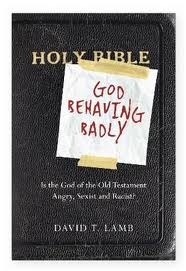 Lamb, with refreshing wit and respect, responds to accusations being made against God in his book, God Behaving Badly: Is the God of the Old Testament Angry, Sexist, and Racist? (June, 2011).
 Andy is currently working on a PhD in New Testament at Durham University (England) while serving as a college pastor at Mountain Brook Community Church and leading University Christian Fellowship in Birmingham, Alabama. He is married with four children.
 The Centrality and Supremacy of Jesus Christ