Category Archives: Christology

The Transfiguration

Theological Interpretation of the Glorified Christ

Dale Allison has written, “Reducing the theological Jesus to the historical Jesus is no more plausible than reducing the mental world to the physical world, even if a lot of smart people have tried to do both.”[1]

There is hardly a pericope in the Synoptic Gospels that presents such a challenge to critical historical Jesus scholars than that of the transfiguration of Christ. It is no wonder why this bizarre epiphany is chalked up as yet another mythological fabrication of the historical Jesus—the sad divinizing of a failed would-be Messiah.

It is this post-enlightenment rationalism that refuses to believe in miracles of any sort. If there is a god, he most certainly does not become human flesh, make the lame walk and the blind see, or raise folks from the dead.

This is of course not an issue for those who believe that the theological Jesus is also the historical Jesus, and that the earliest testimony about Jesus is reliable and trustworthy. Those believers who affirm the creeds of Nicaea and Chalcedon are open to God breaking forth from heaven with divine power into that realm in which human beings live, and move, and have their being. The transfiguration of Jesus is one of those breaking-in-moments where God visibly manifests his power and favor upon the one he claims to be his Son—the glorified Christ—the God-man.

Oddly enough, the transfiguration of Jesus is one of the most “neglected” stories in the entire New Testament.[2] Many widely acclaimed theology textbooks used in seminaries over the years say little to nothing about this magnificent display of the divinity of Jesus of Nazareth.[3]

What is the reason for so many pastors, theologians, and biblical scholars distancing themselves from the transfiguration narratives? To be truthful, not everyone is ignoring the transfiguration. Dorothy Lee states that the neglect is committed largely by the Western tradition.

Lee writes, “Christians in the East regard the transfiguration as central to the symbolism of the gospel, disclosing as much about themselves as about God.”[4] So, what is happening in the West?

In the West, contemporary scholarship has not given the transfiguration story as significant a place in the discussion on New Testament theology as might be expected. This is not to say that there has been a total absence of discussion, but the difficulties which the text itself poses to the modern exegete—literary, historical, and theological—have led scholars to give it relatively little attention.[5]

The purpose of this paper is to give a theological interpretation of the transfiguration of Jesus found within the Synoptic Gospels and elsewhere in the New Testament by: (1) giving a brief critical examination of the more recent scholarship, (2) appreciating the slight nuances between the Synoptic redactors, (3) revealing a Christology from “above” with feet still on the ground of real history, (4) proving that multiple attestation of the event adds to its significance. This paper will move past the often-debated concerns of origin, genre, and nature of the Synoptic account.

The author makes an informed assumption that the biblical text is accurate in what it reports about Jesus of Nazareth and the mysterious happenings on the mount of transfiguration. This paper will conclude with a challenge for Western traditions of Christianity to rediscover the transfiguration of Jesus with its theological and Christological implications for faith and practice.

THE TRANSFIGURATION IN THE SYNOPTIC GOSPELS

It is of first importance to notice that each of the Synoptic Gospels places the transfiguration within the same sequence of events:

(1) Peter confesses that Jesus is the Messiah; (2) Jesus commands the disciples not to tell anyone; (3) Jesus predicts his coming suffering, death, and resurrection from the dead; (4) Jesus calls his disciples to follow him sacrificially; (5) the transfiguration; (6) Jesus commands the disciples to keep quite until after his resurrection; (7) a discussion on the coming of Elijah (except in Luke); (8) the miraculous healing of a demonized boy; and (9) a second prediction of the passion of Christ.[6]

W. L. Liefeld declares, “The assumption is clearly that the event [transfiguration] took place at this juncture in the life and ministry of Jesus.”[7] This event must have taken place somewhere in the middle of Jesus’ ministry, and it stands alone as a one time occurrence. The transfiguration only finds meaning as a unique event occurring in the life and ministry of Jesus prior to his death, resurrection, and ascension. The case for a “misplaced resurrection account” has been laid to rest once and for all.[8]

The Gospel of Mark (9:2-10)

The vast majority of scholars believe that the Gospel of Mark was the first of the Synoptic Gospels (i.e. Marcan priority), and probably written in the mid to late 60’s to a predominately gentile audience.[9] Matthew and Luke are commonly thought to have borrowed from Mark—possibly using earlier source material and oral traditions to compose their biographies for their own purposes. Therefore, it is best to begin with the account in Mark.

Six days later, Jesus took with him Peter and James and John, and led them up a high mountain apart, by themselves. And he was transfigured before them, and his clothes became dazzling white, such as no one on earth could bleach them. And there appeared to them Elijah with Moses, who were talking with Jesus. Then Peter said to Jesus, “Rabbi, it is good for us to be here; let us make three dwellings, one for you, one for Moses, and one for Elijah.” He did not know what to say, for they were terrified. Then a cloud overshadowed them, and from the cloud there came a voice, “This is my Son, the Beloved; listen to him!” Suddenly when they looked around, they saw no one with them any more, but only Jesus. As they were coming down the mountain, he ordered them to tell no one about what they had seen, until after the Son of Man had risen from the dead. So they kept the matter to themselves, questioning what this rising from the dead could mean.  (Mark 9:2-10 NRSV)

As an ancient literary genre, the transfiguration is known as an “epiphany” because of the sudden manifestation of a divine being where the witnesses are invited to participate in the plan of God.[10] Marks says that the transfiguration took place “six days” after Jesus’ words that “some standing here will not taste death until they see that the kingdom of God has come with power” (9:1). The “some” are Peter, James, and John—the power is seen in the glorification of Christ on the mountain.

Scholars are not certain on what mountain this occurred, but the most likely spot is Mount Meron located in Galilee about eight miles northwest of the Sea of Galilee. It is the highest peak in Palestine and close to Caesarea Philippi, the place of Peter’s great confession.[11] It comes as no surprise that this epiphany happens on a mountain. Mountains and other “high places” were viewed as the setting for divine experiences. For Jesus to lead Peter, James, and John up a “high mountain” prepares the audience for a forthcoming revelation.

Moses ascended the “mountain of God” (Exod 19:3) and had a divine encounter by way of a theophany on Sinai (Exod 19:16-20). After this encounter Moses took with him Aaron, Nadab, Abihu, and seventy elders of Israel (Exod 24:9-10). Mark sets his readers up for a similar event, but it turns out to be something much different—far more extraordinary than anyone could expect or imagine. Jesus gives three of his disciples more insight into the previous confession that he is Messiah (8:29).

Mark says that Jesus was temporarily “transfigured” or “transformed” (metamorphoo) externally before them, and that his clothes were dazzling white. He emphasizes this fact with “no one on earth could bleach them” (9:3) that white. The shining white clothing is characteristic of heavenly beings, thus it draws attention to the heavenly nature of Jesus. R. T. France writes, “The point is presumably that no naturalistic explanation can account for what the disciples witnessed.”[12]

The story continues with its bizarre happenings as the OT prophets Elijah and Moses appear, and then begin “talking with Jesus” (9:4). Mark does not tell his readers what they are discussing, but the mere appearance of these two prophets speak a great deal to those sensitive to the Jewish Scriptures. It is probably best the traditional idea that these two men represent the Law and the Prophets be rejected.[13] Elijah was not a writing prophet, and his name is mentioned ahead of Moses.

The presence of these prophets triggers the eschatological promise of the coming of Elijah (6:15; 8:28) who was taken to heaven without dying (2 Kgs 2:11) and was expected as a forerunner to the new age (Mal 3:23-24). Moses had an experience where his face was left radiant from the glory of God (Exod 34:35). He prophesied in eschatological hope that a prophet greater than himself would come (Deut 18:15-19). The appearance of these two prophets symbolizes the arrival of the messianic age. The suffering and rejection of these prophets prefigure the experiences of the passion of Christ.

The Messiah has indeed arrived in Jesus. But as the rest of the pericope will reveal, he’s not the Messiah they expected.

Mark says that Peter responds to this mysterious event with words that have been greatly debated: “Rabbi, it is good for us to be here; let us make three dwellings, one for you, one for Moses, and one for Elijah” (9:5). Mark tells us that Peter said this because he was terrified and did not know what to say (9:6).[14] It is worth noting that Peter may not have fully grasped the full meaning to his previous confession in Caesarea Philippi. Here he addresses Jesus as “Rabbi” (teacher), and appears to interpret this event as signifying the equality of Jesus and the prophets.[15] Then from the heavenly cloud—representing the divine presence—came a voice saying, “This is my Son, the Beloved; listen to him” (9:7)![16] Jesus is the glorified Christ—the Word of God.

In an instant things return to normal and Jesus tells the three disciples not to speak of what they have seen until after the “Son of Man had risen from the dead” (9:9). Mark reports that they did not understand what Jesus meant. The confusion of the disciples is common in Mark’s Gospel. Dorothy Lee writes, “Mark sees discipleship as flowing from Christology—that is, from his understanding of Jesus—so that the revealing of Jesus’ identity is bound up with the calling of the disciples.”[17]

Lee succinctly describes the symbolic significance of the prophets and the purpose for their appearing during the transfiguration:

Moses and Elijah are thus complex symbols, representing God’s ancient people, Israel, and associated with mountain epiphanies and the events of the end time. One thing is clear in the range of possible meanings. For Mark, the symbolic significance is unmistakably Christological: their presence acts as a dual pointer to the identity of Jesus himself. It is no coincidence that they appear at the very moment of Jesus’ metamorphosis, opening up past, present and future to the heavenly world, and giving a cosmic perspective on the human world embodied in Israel.[18]

The Gospel of Matthew (17:1-9)

Matthew was written for a Jewish audience, yet his Gospel is at the same time universal in its scope (13:38; 21:33-43; 28:18-20). The “Jewishness” of the Gospel can be seen in the extensive use of OT Scriptures and the substitution of “heaven” for God’s name. Matthew is intent on proving that Jesus is the new and greater Moses—the fulfillment of Jewish prophecy.

Matthew is interested in the church and the needs of the growing Jewish community. His Gospel comes later than Mark’s Gospel, and he abridges Mark’s material to make it more easily remembered by the new Jewish believers.[19] Matthew also stresses the inevitability of God’s judgment, apocalyptic eschatology, and that Jesus is the promised Messiah. Matthew focuses on the significance of Jesus and the cost of following Christ for the sake of the kingdom.

Matthew uses Mark’s narrative of the transfiguration, but there are clear nuances and variations that Matthew has added to the story in order allude more clearly to the OT, as the true identity of Christ is revealed in a call to discipleship. Matthew also says that it is “six days” after Jesus told the disciples about seeing the Son of Man “coming in his kingdom” (16:28). The six days may be a literary device used to set up a glorious seventh day event.[20]

In Matthew’s account, it is not only his clothes that are transformed into a dazzling white, but he says that Jesus’ face “shone like the sun” (17:2). He undoubtedly intends to evoke remembrance of the radiant face of Moses after having been in the presence of God (Exod 34:29-35). Moses is of course mentioned before Elijah in their appearing. Moses and Elijah had important roles as precursors to Jesus, now Christ comes to be more than an eschatological prophet. Matthew presents Jesus as coming to fulfill the Law and the Prophets. He himself is the fulfillment.

How did the disciples recognize Moses and Elijah? None of the Synoptic narratives tell us how they knew them, but it was most likely because of the conversation they overheard.[21] Matthew has Peter responding to Jesus with “Lord” instead of “Rabbi” (17:4). Where Peter’s folly in addressing Jesus as “Rabbi” is clear in Mark, Matthew may not want to use this title more as a literary avoidance of the words later to be spoken by Judas (26:25, 49).

Therefore, Matthew is able to keep Peter from speaking words that might sound like denial to readers, but maintain his clear confusion with what is happening. For Peter to suggest the building of three tents is in some manner to express that confusion (17:4). He may have suggested this for several reasons: (1) he wanted to honor each figure in a commemorative way; (2) he wanted them to stay on the mountain and continue communicating with them, like that of the Tent of Meeting; (3) he was simply being hospitable in seeking to provide habitations for them.[22]

Regardless of Peter’s true intentions (even if he himself knew what he meant), it was wrong to place Jesus on the same level with Moses and Elijah during this temporary event. The voice from heaven speaks (actually interrupting Peter), like the voice at Jesus’ baptism, testifying to the superiority of Christ over his predecessors. The enveloping cloud restrains Peter much like the cloud that kept Moses from entering the tabernacle (Exod 40:35).[23] The disciples fall down in fear after the hearing of the voice from heaven, indicating worship of the heavenly Christ.

Lee writes that the transfiguration “is the outward manifestation of the inner person, as revealed by God. Jesus is shown as he is in his true self, hidden from the eyes of the world…”[24]

The response of the church is to worship!

The Gospel of Luke (9:28-36)

The Gospel of Luke is the longest of all four gospels and is the first volume in his “orderly account” (Luke-Acts) of the life and teachings of Jesus. For those believing in the two-source theory with Marcan priority, both Matthew and Luke used Mark, as well as an unknown “Q” source.[25] Is Luke’s account of the transfiguration a simple redaction of Mark and Matthew? Maybe not.[26] There are similarities, but striking differences as well.

Luke begins his narrative with “eight days after” instead of the six days that both Mark and Matthew use. Is this a plain contradiction with what happened? Also, Luke will provide insight into the conversation that Jesus, Moses, and Elijah were having, not found in Mark and Matthew. Luke mentions the disciples being “weighed down with sleep” during the event, and uses slight differences in vocabulary and sequence. How do scholars account for the differences, and what do they mean?

Luke may have been relying on an unknown source, but explanation can be given apart from knowing that source and what it actually contained. As a historian, Luke smoothes out the “six days” to an approximate week. For Luke’s Gentile audience, it is not necessary to maintain such a direct connection to the OT. Luke says that Jesus went up with his disciples to pray (9:28). Prayer is a major theme in Luke-Acts as the author draws attention to this act in order to reveal its relationship to heaven (e.g. Lk 3:21-22; Acts 1:14; 2:1). The prayer of Jesus brings about the transfiguration event.

It would appear that in order to speak with the heavenly prophets Jesus would need for himself to be transfigured into heavenly form. Luke says that Jesus and the prophets were “speaking about his departure” that was coming in Jerusalem (9:31)—an exodus which leads to the playing out of salvation history.

So why does Luke mention that the disciples were sleepy? Luke intends to prefigure the prayer scene in the Garden of Gethsemane (22:39-53). At the transfiguration there is glory, in the garden there is agony. Luke ties these two scenes together in order to emphasize the confusion and misunderstanding of the disciples.[27]

The glorified Jesus will overcome this agony in resurrection (24:5). And the confusion of the grief-stricken disciples will be transformed into a bold confession of the glorified and resurrected Christ (24:52-53). As Luke says, “in those days” they told no one about what they had seen. But they would not stay silent forever.

THE TRANSFIGURATION ELSEWHERE IN THE NEW TESTAMENT

The Gospel of John

The Gospel of John is missing the transfiguration narrative. Why is that? George Ladd says, “John differs from the Synoptics in making the entire ministry of Jesus a manifestation of glory.”[28] It is clear that John seeks to portray the glory of Jesus throughout his Gospel, so why does he not include the narrative? It is hard to say. However, there is some evidence that John may have this event in mind in a couple of places.

John testifies to seeing the “glory of the one and only” (1:14). This could refer to the transfiguration, or he might be speaking of the entire life, death, and resurrection of Christ. Also, there is the Father’s voice from heaven, which proclaims that he had “glorified” the name of Jesus, and would do it again (12:27-33).

There is no way to be certain if John is referring to the transfiguration, but it does seem unlikely that such an event would not find its way into his Gospel, considering his theological emphasis and having experienced something as glorious as Jesus being transfigured before his very eyes.

Lee writes the following on the “absence” of the transfiguration:

If there is cross-fertilization between the two traditions, the Synoptic and the Johannine, the question of why John did not use the transfiguration story becomes more insistent. And here an answer can be suggested: that John did know something of the transfiguration and chose to use it, not as a single tale, but as a motif—a series of symbols—throughout his Gospel. If so, this would mean that, instead of re-telling the story with his own editorial changes, John has chosen to weave the threads of the transfiguration into the warp and woof of his tale, so that the main symbols are rehearsed again and again throughout the Johannine narrative. If so, the whole Gospel could be viewed as a ‘transfiguration’ story: ‘the glory which in the Synoptics flashes into the story on the mountain is perceived by Saint John to pervade all the words and works of Jesus.’[29]

Lee’s suggestion to view the entire Gospel as a transfiguration story is profound. This only further highlights the sheer beauty of John’s Gospel. John didn’t include the transfiguration narrative because it is not his style. He prefers to stretch such a grand event throughout his work.

The Second Epistle of Peter (1:16-18)

For we did not follow cleverly devised myths when we made known to you the power and coming of our Lord Jesus Christ, but we had been eyewitnesses of his majesty. For he received honor and glory from God the Father when that voice was conveyed to him by the Majestic Glory, saying, “This is my Son, my Beloved, with whom I am well pleased.” We ourselves heard this voice come from heaven, while we were with him on the holy mountain. (NRSV)

In an effort to validate the “power and coming” of Christ, Peter reminds his audience that the disciples were eyewitnesses to the transfiguration. He actually uses a first-person-personal-pronoun to emphasize, “we ourselves heard” a voice that exalted Christ in the glorious event.[30]

This event is treated as a historical and spiritual reality which confirms the certainty of the future parousia of Christ.

The transfiguration actually happened and was observed. It is not legend or a mythical tale used much later to deify a crucified Messiah. In Peter’s mind, the disciples witnessed many mysterious things that present overwhelming evidence of the divinity of Jesus of Nazareth.

CONCLUSION—MOTIFS & MEANING

The many motifs within the transfiguration narrative can now be summarized before clarifying the theological interpretation of the glorified Christ. The first motif encountered is the “after six days”—used as a common literary pattern in Semitic literature.[31] This immediately parallels Exodus 24:16. The mountain ascension is the next feature reminiscent of Mount Sinai, as well as other events of divine revelation.

Also, the cloud on the mountain symbolizes the presence of the Lord on many occasions throughout the OT (Exod 19:16-19; Isa 4:5; Dan 7:13). The appearance of Moses and Elijah is significant for they are precursors to Christ and they represent eschatological prophets. This immediately identifies Jesus as eschatological prophet, but the unfolding of the vision reveals that he is much more than that—he is the Son of Man.

The voice from heaven is the climax of the experience. This “voice” alludes to Psalm 2:7. And it might even be possible that there is an allusion to Isaac, making Jesus the willing sacrifice.

Finally, what can be said and done for the recovery of the transfiguration in Christian faith and practice within the church? What difference does this make for the doctrine of Christ?

Western Christianity in many places is struggling for survival against a deadly secularism that smothers any sense of transcendence or mystery, too much of which has penetrated its own ranks. The Church needs to regain the vision of Christ on the mountain, the light in which we see light, the echo of the divine voice acclaiming Jesus the beloved Son—the biblical symbolism of a majestic, incarnate, crucified God as the only source of hope for the transfiguring of a disfigured world.[32]

The transfiguration affirms the church’s eschatological hope in the resurrected Christ, as the One who is greater than all the prophets—equal only to God—who reigns the universe supreme.

D.D. Flowers, 2012.

[1] Dale C. Allison, The Historical Christ and the Theological Jesus, (Grand Rapids: Eerdmans, 2009), 79.

[2] Dorothy Lee, Transfiguration. New Century Theology Series. (New York: Continuum, 2004), 1.

[3] For example, Millard Erickson in his Christian Theology (Grand Rapids: Baker Academic, 1998), 1241, only gives passing mention to the pericope in order to speculate about heavenly bodies; Stanley Grenz doesn’t mention it at all in his Theology for the Community of God (Grand Rapids: Eerdmans, 1994); George Ladd briefly addresses the implications of the Matthean account in his A Theology of the New Testament (Grand Rapids: Eerdmans, 1993), 222.

[4] Lee, 1.

[5] A. D. A. Moses, Matthew’s Transfiguration Story and Jewish-Christian Controversy (Sheffield, England: Sheffield Academic Press, 1996), 13. For a bibliography of scholarship before 1981, see T. F. Best, “The Transfiguration: A Select Bibliography.” Journal Of The Evangelical Theological Society 24, no. 2 (June 1, 1981): 157-161. Also see Dale Allison, The New Moses: A Matthean Typology (Minneapolis: Fortress Press, 1993).

[6] W. L. Liefeld, “Transfiguration,” Dictionary of Jesus and the Gospels. ed. Joel B. Green and Scot McKnight, 834-841 (Downers Grove: InterVarsity Press, 1992), 834.

[7] Ibid., 835. Something out of the ordinary occurred on that mountain prior to the resurrection!

[8] Wellhausen, Bultmann, Carlston, and other liberal scholars have promoted this view. See Bultmann, The History of the Synoptic Tradition (Oxford: Blackwell, 1963), 259-260. The case for a misplaced resurrection appearance has been convincingly refuted. See Robert H. Stein, “Is the transfiguration (Mark 9:2-8) a misplaced resurrection-account.” Journal Of Biblical Literature 95, no. 1 (March 1, 1976): 79-96.

[9] Raymond E. Brown, An Introduction to the New Testament, (New Haven: Yale Univ. Press, 1997), 111; 163; also Stanton’s The Gospels and Jesus, (New York: Oxford University Press, 1993), 34.

[10] John Paul Heil, The Transfiguration of Jesus: Narrative Meaning and Function of Mark 9:2-8, Matthew 17:1-8 and Luke 9:28-36, (Rome: Pontifical Biblical Institute, 2000), 38-39. The divine being remains invisible in a theophany. In the transfiguration, the disciples are being called to play a role in God’s salvific plan for the world.

[11] Liefeld, 835.

[12] R. T. France, The Gospel of Mark: A Commentary on the Greek New Testament, The New International Greek Testament Commentary, (Grand Rapids: Eerdmans, 2002), 351.

[13] Ibid.

[14] This is very telling since it is believed that Mark was largely dependent upon the testimony of Peter.

[15] Heil, 161.

[16] The first time this heavenly voice is heard is at Jesus’ baptism in Mark 1:11.

[17] Lee, 10.

[18] Ibid., 19.

[19] Robert H. Mounce, Matthew. New International Commentary (Peabody, MA: Hendrickson Publishers, 1998), 4.

[20] Craig S. Keener, The Gospel of Matthew: A Socio-Rhetorical Commentary, (Grand Rapids: Eerdmans, 2009), 436. See Exodus 24:15-18. This and other features of the narrative are recalling the Sinai revelation.

[21] Ibid., 438.

[22] Heil, 127.

[23] John Nolland, The Gospel of Matthew: A Commentary on the Greek Text. The New International Greek Testament Commentary, (Grand Rapids: Eerdmans, 2005), 704. The call to “listen to him” echoes that of Dt. 18:15.

[24] Lee, 47. See James A. Penner, “Revelation and Discipleship in Matthew’s Transfiguration Account.”

Bibliotheca Sacra 152, no. 606 (April 1, 1995): 201-210. He claims the event is about revelation and discipleship.

[25] Brown, 116-122. See R.E. Brown’s Introduction to the New Testament for an overview of “Q”.

[26] Barbara O. Reid, “Voices and Angels: What Were They Talking about at the Transfiguration? A redaction-critical study of Luke 9:28-36.” Biblical Research 34, (January 1, 1989): 19-31.

[27] Lee, 74.

[28] Ladd, 312.

[29] Lee, 101.

[30] Leifeld, 836.

[31] Liefeld, 839.

[32] Lee, 2.
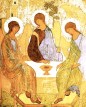

Trinity & Incarnation

Finding a Biblical Christology Within a Trinitarian Monotheism

Tertullian (c. 160-220 AD) is officially given credit for coining the term “Trinity” to refer to the triune nature of the Godhead (Father, Son, and Holy Spirit).[1] The term itself is nowhere used in the Biblical text, but the majority of Christian traditions have accepted “Trinity” as a sufficient way of describing the three-in-one relationship of God.

The Biblical text, specifically the NT, references the Father, Son, and Spirit in about 120 different passages (e.g. Matt 28:18-20; Jn 14-17; Acts 2, etc.).[2] Jesus of Nazareth began a fringe movement within a strict monotheistic Second Temple Judaism that would in time overtake the entire Roman Empire.

In the beginning, Christ’s claims to divinity set forth an early “binitarian devotional pattern” which revealed a plurality within the one God.[3] The doctrine of the Trinity would eventually arise during the patristic age in an effort to accommodate the lordship of Jesus and the experience of the Holy Spirit into a Trinitarian monotheism.

Larry Hurtado makes the following observation:

It may not be sufficiently recognized by historians of dogma or contemporary theologians that the Christian doctrine of the Trinity is essentially a christologically shaped statement of monotheism. To be sure, the earliest Christian texts reflect a triadic experience of “God,” comprising the sense of “God” (“Father”) as the source and ultimate destination of all things, Jesus as the essential and unique agent of divine purposes through whom creation is now to be seen and through whom also redemption is provided, and the Spirit is the impartation and gift of “God” that is at the same time also the advocate and medium through which believers receive a filial status that derives from Jesus’ own unique divine sonship. So, if it is a bit anachronistic to speak of “trinitarian” theology in the NT, it is right to see the roots of this doctrinal development in this body of texts.[4]

Questions of Jesus’ relationship to God within a Trinitarian monotheism, while being the very God-man himself, naturally leads the student to consider the incarnation of Christ—the divine and human natures of Jesus. How can both natures coexist in one person? How can Jesus be fully God and fully man at the same time?

In pursuit of discovering the truth about the real identity of Jesus, the scholar must ask: “Can the Christ of faith and the Jesus of history be held together?” Millard Erickson concludes: “Since the Jesus of history is approached through reason and the kerygmatic Christ is seized by faith, we are apparently dealing with a case of the classic faith-reason dichotomy.”[5]

The kerygmatic Christ and the historical Jesus are the same person. Therefore, faith in the divine Christ does not exclude the use of reason, it makes it necessary.

In his Theology for the Community of God, Stanley Grenz writes:

Of the various aspects of our Christian understanding of God perhaps none is as difficult to grasp as the concept of God as triune. At the same time, no dimension of the Christian confession is closer to the heart of the mystery of the God we have come to know. In fact, what sets Christianity apart from the other religious traditions is the confession that the one God is Father, Son, and Spirit. As a consequence, no teaching lies at the center of Christian theology, if not of Christian faith itself, as does the doctrine of the Trinity.[6]

There are several historical traditions that have sought to make sense of Trinity and the incarnation of God in Christ. The purpose of this paper is to take a defendable position on the Trinity and incarnation by: (1) giving a brief critical examination of each major historical Trinitarian formulation, (2) surveying and critiquing the historical development of incarnational Christology, (3) constructing a Biblical theology that is sensitive to the Biblical texts in their original context.

This paper will conclude with a challenge to remain committed to a practical Trinitarian monotheism and faithful to a functional Christology that is rooted in the Scripture.

HISTORICAL TRINITARIAN CONSTRUCTIONS

The Eastern Orthodox Formulation

The two most historic of traditions are the Eastern Orthodox and Western views. Both of these formulations were largely constructed in response to the Arian controversy.

Arius, a deacon in the Alexandrian church, taught that the Son was the first creation of the Father. He said that God “beget” Jesus—the Father made the Son. Therefore, Arianism stated that Christ was not co-eternal with God.

Arius’ teaching was especially concerning because of the way in which he argued from the Scripture and Greek philosophy to make his case. Arius was opposed by the theologian Athanasius at the First Ecumenical Council at Nicea in 325.

The church unequivocally affirmed the NT and the full divinity of Christ.

Arianism was denounced as a heresy and Arius himself was banished as a heretic. In the Nicean Creed, the council asserted that the Son is “begotten of the Father, of the substance of the Father, begotten not made, of one substance with the Father.”[7]

Tertullian used the Latin phrase tres personae, una substantia (“three persons, one substance”) to describe the Trinity, which the Cappadocian fathers would later refine to produce the classic formulation of the doctrine of the Trinity in order to avoid tritheism and modalism.

Tertullian and the church historian Eusebius are remembered as promoters of the Eastern Orthodox view. This view is heavily rooted in Greek philosophical (Stoic Logos) thought of the second and third centuries. Proponents of the Orthodox tradition believe in “eternal procession” from God the Father—the Spirit and the Son both proceeded from God. They are merely an extension of the Father, who is the source.

The incarnation is then the generated Son invading a (Neo-Platonic) human spirit and soul. The greatest weakness of the Eastern formulation is that it relies more heavily upon philosophical rhetoric and categories than it does the Biblical text.

The Western Formulation

Augustine was a major proponent of what is known as the Western view. He expressed that the “eternal generation” within the Trinity describes ontological relationships. He believed that any distinction of persons must reside within the relationships found in Triune community.[8] Each member of the Trinity is equally God and they have always operated together according to one will.

The Western view emphasizes the threeness characteristic of God as relational. This can be seen in the use of the triangle as a symbol for the shared relationships within the Trinity. Augustine saw human beings as a triad of being, knowing, and willing. He developed several analogies to further the idea that the Trinity has implications for living.[9]

Augustine’s view was much more balanced with a concern for the relationality of God within himself and creation. He nevertheless constrained himself to philosophical categories.

This philosophical understanding of God will reach its climax with Aquinas and continue to dominate until the Reformation.[10]

The Biblical Theology Formulation

There are two modern views that seek to modify the Eastern Orthodox and Western views. Dale Moody and Doug Kennard promote a Biblical Theology view that is careful to point out that the Father, Son, and Spirit are all God, but the Son is not the Father and the Father is not the Son.

These scholars hold that the philosophical language of “eternal procession” in understanding John 1:14, 18; 3:16, 18 and 1 John 4:9 is logically contradictory and not helpful in discussions of Trinity and incarnation.

Instead, Jesus should be seen as being sent by God, not as the “only begotten” Son (Jn 3:16), but as the monogenes, from mono (single) and genos (kind)—Jesus is the only one of his kind. Just as Isaac was the uniquely chosen son of Abraham, not the only son (Ishmael), Jesus is the chosen one sent by God (Gen 21:12; Heb 11:18).[11]

In the Johannine writings the word monogenes is used exclusively to speak of Jesus’ unique historical birth. From this perspective, Biblical Theology proposes that there is an economic procession of Trinitarian ministry. There are three who’s and one what. Each member of the Trinity is unique in function.

Doug Kennard believes it is best to discard the ancient philosophical rhetoric:

Since the Biblical texts used to defend the doctrine of generation emphasize monogenes to be the historical birthing of Jesus’ humanity in incarnation, it is best to reject the ancient tradition that Jesus Christ was generated before all ages in eternity. As a historical oddity eternal generation does not reflect the Bible. At this point, the unanimous voice of scholarly commentators agree, further confirming the exegetical view that the generation of the Son should be Biblically understood as an initiation of an economic ministry of the divine Word incarnating to reveal the Father through His humanity.[12]

The Social Trinity Formulation

The Social Trinitarian view has been popularized by Leonard Hodgson, Stanley Grenz, and Jurgen Moltmann. This formulation emphasizes the ontological relationships shared within the Godhead.

This view incorporates the language of “generation,” but it is more specifically concerned to preserve the interpersonal relationships within the God who binds together all things in love. God is love because he is himself a social “familial” Trinity.

Therefore, Christ is fulfilling his divine familial role within the Trinity and incarnation. The Father is the originator, the Son is the revealer, and the Spirit is the completer of the divine program.

Grenz writes, “The ontological differentiations facilitate an economic as well as an ontological diversity in the one God. Each of the three Trinitarian members fulfills a specific role in the one divine program.”[13]

THE DOCTRINE OF THE INCARNATION

Logos Christology

Since Trinity and incarnation go hand in hand, it is necessary to briefly examine a few historical views regarding the incarnation of Christ before taking a position on the best Biblical explanation for the Trinity.

James D.G. Dunn reminds the student of the great importance in the unfolding of incarnational theology within the Biblical text:

We have found nothing in pre-Christian Judaism or the wider religious thought of the Hellenistic world which provides sufficient explanation of the origin of the doctrine of the incarnation, no way of speaking about God, the gods, or intermediary beings which so far as we can tell would have given birth to this doctrine apart from Christianity.[14]

Hurtado adds to the significance of incarnational theology: “In historical terms we may refer to a veritable “big bang,” and explosively rapid and impressively substantial Christological development in the earliest stage of the Christian movement.”[15]

This development begins with the NT writers revealing the full humanity and deity of Christ, and continues through to the creeds of Nicea (325 AD) and Chalcedon (451 AD)—affirming that Jesus is both God and man.

The first major philosophical explanation employed during the second and third centuries was known as Logos Christology. John declared that Jesus is the Word (Logos) in the prologue to the Fourth Gospel. The term corresponded with the Hebrew concept davar (Word of God) and the Stoic logos (inner law which humans ought to orient their lives).[16]

As stated previously concerning the Eastern Orthodox thinkers, this means that the incarnation is then the generated Logos invading a human spirit and soul. Folks like Justin Martyr and Origen utilized Stoic concepts to make sense of the Trinity and incarnation.

Kennard points out that, “the early church comes out strongly against embracing a Stoic world view, even though a few Stoic concepts contributed to Christology.”[17] It is understandable why the apologists would make use of philosophical concepts of their day to explain and defend the doctrine of Christ, but it quickly becomes a matter of debate and confusion (Arianism).

Logos Christology is built upon Greek concepts and it is explained in philosophical rhetoric that goes far beyond Biblical language.

Nestorian Christology

There does not seem to be any agreement as to how the early church articulated the paradox of Christ having two natures in one person. Nestorius (c. 386-451 AD) proposed that the two natures of Christ should be held apart from one another.

Was Nestorius promoting the heretical idea that two distinct persons resided in Jesus? It is hard to say because of the political and ecclesiastical rivalries that involved him in the church.[18] Also, his ambiguous language was easily misunderstood among the many heresies swirling about (e.g. adoptionism, docetism, Apollonarianism, etc.) Nestorius was viewed as not fully appreciating the unity of Christ’s person.

The West resolved the debate of the two-natures at the Council of Chalcedon (451 AD):

Therefore, following the holy Fathers, we all with one accord teach men to acknowledge one and the same Son, our Lord Jesus Christ, at once complete in Godhead and complete in manhood; truly God and truly man, consisting also of a reasonable soul and body; of one substance with the Father as regards his Godhead, and at the same time of one substance with us as regards his manhood; like us in all respects, apart from sin; as regards his Godhead, begotten of the Father before the ages, but yet as regards his manhood begotten, for us men and for our salvation, of Mary the Virgin, the God-bearer; one and the same Christ, Son, Lord, Only-begotten, recognized in two natures, without confusion, without change, without division, without separation, the distinction of natures being in no way annulled by the union, but rather the characteristics of each nature being preserved and coming together to form one person and subsistence, not as parted or separated into two persons, but one and the same Son and Only-begotten God the Word, Lord Jesus Christ; even as the prophets from earliest times spoke of him, and our Lord Jesus Christ himself taught us, and the creed of the Fathers has handed down to us.[19]

It should be acknowledged that Chalcedon did not entirely remove the mystery of the paradox that exists in the person of Christ. At best, the Chalcedonian Creed states what the “two natures in one person” does not mean.[20]

The Eastern Church continued with a Logos Christology. And others would come along and express dissatisfaction with the older explanations.

Kenosis Christology

In the modern era of Protestant scholasticism, Sartori sought to resolve the problem of the relationship between the two natures with his interpretation of Philippians 2:7.[21]

“Kenosis” is the Greek term used to say that Christ “emptied himself” (RSV) to take on human form. This view theorizes that Christ gave up or emptied himself of those divine attributes that were incompatible with his human existence (especially omnipotence, omnipresence, and omniscience).

Some proponents go so far to say that Christ set aside all divine attributes. This great flaw in the theory inevitably leads to confessing that Jesus is less than God. Therefore, a modified Kenosis theory is necessary.

Grenz says the appearance of setting aside those attributes is actually the Son’s giving up the “independent  exercise of those powers.” Christ submitted his divine capabilities to the Father’s will.[22]

Since it is right to affirm that all the fullness of God dwells in Christ (Col 1:19), it is most appropriate to accept a modified Kenosis theory. Jesus emptied himself of those attributes that were incompatible with his humanity in order to be fully human. He was obedient to the Father and did not consider equality with God something to be exploited (Phil 2:5-8).

This view is preferred to all the rest.

CONCLUSION—FINDING A BIBLICAL CHRISTOLOGY

The historical views of Trinity and incarnation have laid a foundation on which future generations may construct, and deconstruct if necessary. It is likely that each generation of believers will seek to express a Christology that speaks directly to the needs of their own Christian community.[23]

As for the historical constructions, I believe it is the best of Biblical Theology and the Social formulation that combine for the strongest presentation of the Trinity. The relevant NT passages should not be read through Greek philosophical lenses of the patristic era in defense of  a Trinitarian monotheism and the incarnation of God in Christ.

Christ was uniquely born (Jn 3:16), sent into the world as the exact representation of God (Heb 1:3), and only subordinate to the Father in an earthly temporal sense (Phil 2:6-11). Christ is fully man and fully God. The NT writers do not leave this open to readers.

Jesus claimed to be divine and equal with the Father on multiple occasions (Matt 16:13-20; 26:63-65; Jn 1:1-14; 8:19-59; 10:30-33), God vindicated him through his resurrection from the dead (Jn 20), and he even received worship of himself (Jn 20:28-29). The Holy Spirit is economically sent by Christ after his ascension as the completer of God’s will (Jn 14:15-21; 16:12-15). The Father, Son, and Spirit are wholly God in a mysterious community of love (2 Cor 13:14; Gal 4:6; 1 Pet 1:2).

Oscar Cullmann said, “in the light of the New Testament witness, all mere speculation about his (Christ’s) natures is an absurdity. Functional Christology is the only kind which exists.”[24]

The church will continue to discuss and debate Trinity and incarnation. What matters most is that the church maintain a working Christology that leads to the perpetual celebration of the incarnation of the Trinitarian God, and faithful adherence to the Christ who has revealed the new way to be human.

May the continued pursuit of a Biblical Christology bless heaven and earth—until the Lord joins them together forever, and mystery gives way to perfect understanding.

D.D. Flowers, 2011.

[1] Fisher Humphreys, “The revelation of the Trinity.” Perspectives In Religious Studies 33, no. 3 (September 1, 2006): 287.

[2] Ibid., 292.; Not all of the references include the three persons together.

[3] Larry W. Hurtado, Lord Jesus Christ: Devotion to Jesus in Earliest Christianity (Grand Rapids: Wm. B. Eerdmans, 2003), 134-153.

[4] Hurtado, God in New Testament Theology (Nashville: Abingdon Press, 2010), 46-47.

[5] Millard J. Erickson, Christian Theology (Grand Rapids: Baker Academic, 1998), 689.

[6] Stanley J. Grenz, Theology for the Community of God (Grand Rapids: Eerdmans, 1994), 53.

[7] Henry Bettenson and Chris Maunder, eds. Documents of the Christian Church (Oxford: Oxford University Press, 1999), 27.

[8] C.C. Pecknold, “How Augustine used the trinity: functionalism and the development of doctrine.” Anglican Theological Review 85, no. 1 (December 1, 2003): 134.

[9] Grenz, 62.

[10] R.L. Saucy, “Doctrine of God” Evangelical Dictionary of Theology. ed. Walter A. Elwell, 500-504 (Grand Rapids: Baker Academic, 2001), 503.

[11] Dale Moody, “God’s only Son : the translation of John 3:16 in the Revised Standard Version.” Journal Of Biblical Literature 72, no. 4 (December 1, 1953): 213.

[12] Douglas Kennard, Messiah Jesus: Christology in His Day and Ours (New York: Peter Lang, 2008), 503.

[13] Grenz, 67. Also see Moltmann’s The Trinity and the Kingdom. San Francisco: Harper & Row, 1981; and Hodgson’s How Can God Be Both One and Three? London: SPCK, 1963.

[14] James D.G. Dunn, Christology in the Making: A New Testament Inquiry into the Origins of the Doctrine of the Incarnation (Grand Rapids: Wm. B. Eerdmans, 1989), 253.

[15] Hurtado, Lord Jesus Christ: Devotion to Jesus in Earliest Christianity, 135.

[16] Grenz, 300-301.

[17] Kennard, 495.

[18] Erickson, 743.

[19] Bettenson, 56.

[20] Erickson, 747.

[21] Kennard, 505.

[22] Grenz, 307.

[23] See Daniel L. Migliore’s “Christology in Context: The Doctrinal and Contextual Tasks of Christology Today.” Interpretation 49, no. 3 (July 1, 1995): 242-254.

[24] Oscar Cullmann, The Christology of the New Testament (Philadelphia: Westminster, 1963), 326.


1 Cor 14:26 Descriptive or Prescriptive?

I have been known as a proponent of “organic” church life for several years now. Due to the confusion over this now popular nuanced term (cp. Sparks, Cole, & Viola’s usage), I have decided to stop using it when describing the sort of church life that is to be enjoyed by all Christian communities in every cultural context until Christ returns.

It’s just not worth having to respond to all of the questioners with, “Well, what I mean by it is…” It was helpful (at least to me) for a while, but not so much anymore. I do still use it when I’m among close friends, but other than that it only becomes one more obstacle in communication.

I must admit that over the last year or so I have been led to believe that some dear saints run the risk of promoting organic church life at the expense of Christ and unity among all believers—as well as promoting Christ while attached to a specific church model (though they would claim they are not promoting a model) or even a “no order at all” approach.

The first group is likely not aware that they have bound Christ to a rigid church order. And the later group, while talking a lot about Christ, is mostly concerned with maintaining no set order in their meetings. No order has become their order. They will do nothing that even comes close to resembling organized Christianity (a person standing to deliver a message longer than 10-15 minutes is definitely out!).

If that fellowship doesn’t change its reactionary thinking, it will eventually meet its demise. Hopefully, there will be enough folks who grow tired of just chatting about Jesus over coffee for a couple hours a week to bring about a healthy change.

I found that it is possible to begin with a new vision of Christ in community, only later to gravitate toward an “us vs. them” mentality. Of course, it might have always been a mix of both—some days more of this, other days more of the other. I have become sensitive to those thoughts of mine that set myself above another person that clearly loves Jesus, but is just currently being faithful to Christ in a different setting.

Christ in Community

Looking back over the last several years of study, reflection, and experience, I’m convinced that the NT reveals some basic principles concerning church life that can be summed up like this: Everything should look like Christ and build up the saints (Eph 4:16; 1 Jn 2:6).

Beyond that, there is no church law. There is no restrictive law that says, “You can’t do that!” Nor is there the libertarian law that says, “Anything goes!” The law is Christ… Christ in community.

Regardless of what side of the church fence you’re on (organized or organic), you may think my “no law” declaration needs a qualifier. Well, I just don’t think so. Anything beyond “Christ in community” leads to divisions among us, and becomes self-righteousness dressed in the garb of the centrality and supremacy of Christ. It’s time we stop it.

“Christ in community” does involve what some have called a NT pattern. But let’s be clear, the principles of that pattern are known only in an examination of the person and work of Christ. Failing to closely examine and take serious the life and teachings of Christ is something that both institutional and organic churches do regularly.

Both groups have isolated and eisegeted (read things into) certain texts to promote their church order, all the while neglecting the life and teachings of Jesus, the very center of our faith.

For example, when his disciples were arguing over who would be greatest in the kingdom, Jesus made it very clear that true leadership was not reflected in the “top-down” hierarchal leadership seen with the politicians and corporations of the world (Mk 10:35-45; Jn 13). No, you can’t have a nation of priests when one person, other than Jesus himself, gets to be the “high” priest and the inheritor of special treatment, and regular monetary blessings.

Therefore, a prime example of the Jesus prescription—the one that goes to the heart of what’s wrong with organized religion—is that anything that doesn’t look like servant-leadership, or creates an unhealthy dependence upon one human priest, leads to spiritual paralysis in the body of Christ.

Whatever each local ekklesia decides about the role and function of pastor/teachers today, our conclusions should always be based upon the example of Christ and what he said about leadership. Church practice should always reflect the person and work of Christ among his first disciples.

Paul in Community?

What about Paul, you ask? Well, what about Paul? Paul’s idea of community comes by merely expounding upon Christ. Therefore, viewing anything Paul says as a rigid “prescriptive” order for the church in every age, when Paul is merely describing a communal life that flows out of Christ, is to put forth a law other than Christ himself.

Jesus is the only prescription for the church in every age.

That isn’t to say that Paul can’t tell us anything about church order in the 21st century. By no means! Instead, it means that Paul should be read as an apostle who guides each church to creatively adhere to the life and teachings of Jesus in their own unique context.

In 1 Corinthians 12-14, Paul addresses the believers at Corinth concerning their disorderly meetings. If the saints in Corinth were not squabbling over spiritual gifts, we likely would not even have Paul saying anything about order for the church. So notice, the pattern is given in a context of disorder and division over the way things ought to be done.

What then shall we say, brothers and sisters? When you come together, each of you has a hymn, or a word of instruction, a revelation, a tongue or an interpretation. Everything must be done so that the church may be built up.  1 Cor 14:26 NIV

The pattern here is not that all these things, and nothing else, should happen in a church meeting. It’s simply what was happening in Corinth at this moment in time. Paul was not intending to say that every church meeting for all time should always look like what is described here (i.e. every single meeting should always and forever be open-participatory).

No, the pattern for every generation is always and only Christ.

So, what does Christ look like in this particular gathering? He looks like ordered sharing, not disrespectful neglect of others and their gifts (14:27-33). It’s this open-participatory meeting, and only this type of meeting, that we hear Paul addressing with his guidance.

We should not gather from the NT that there is never a place for a meeting set aside to hear a teacher. Paul’s concern in this open meeting is that Christ would not have chaos and disrespect of others when meeting in such an intimate familial setting. I imagine that he might have said something similar in spirit if there was a church who opted to have teaching times in a larger setting. He apparently was cool with this sort of thing when he held his own “apostolic meetings” (Acts 20:7).

There is no church manual that prescribes the activity and function of church meetings. Even if you were to gather up all of the “one another” verses of the NT, you are still not given a rigid order of how things must be done in a church meeting. To force that upon the NT is not only promoting an agenda, it undermines the only prescription, which is Christ.

Biblical scholar and “house church” attendee, Robert Banks, writes:

“The basic principle that Paul lays down for the conduct of the church is that all things should be done for edification. Only when a contribution has this as its object should it be exercised” (Paul’s Idea of Community, 100).

Jesus (and Paul) leaves a great deal of freedom to all local churches. However, that freedom will in the long run never undermine Christ expressed throughout the entire priesthood of believers over the many seasons of the church.

D.D. Flowers, 2011.


Top Ten Favorite Books

I have often been asked: “What are your favorite books?”

I’m continually reading books from the softer side of Christian spirituality to the thick analytical works of NT scholarship. I’ll give you a list of my favorite “top ten” books from my entire library.

Furthermore, I’ll rate my favorites according to which books have impacted my thinking the most (i.e. turning points) on my journey. Many great works will be excluded. Perhaps in the future I will make another list.

I will not include the Bible in my list. Undoubtedly, growing up in the church, the Scripture has shaped me in ways I shall never know. So, if it concerns you that the Bible is not on my list, I like to remember that it shouldn’t be placed alongside other popular works of men anyway.

The following books are not in the order in which I read them; they are rated according to their greatest level of influence on my life.

  1. “The Centrality and Supremacy of the Lord Jesus Christ” by T. Austin-Sparks
  2. “Surprised by Hope: Rethinking Heaven, the Resurrection, and the Mission of the Church” by N.T. Wright
  3. “Resident Aliens” by Stanley Hauerwas
  4. “The Normal Christian Life” by Watchman Nee
  5. “Is God to Blame? Beyond Pat Answers to the Problem of Suffering” by Gregory Boyd
  6. “Pagan Christianity? Exploring the Roots of Our Church Practices” by Frank Viola and George Barna
  7. “The Myth of a Christian Nation: How the Quest for Political Power is Destroying the Church” by Gregory Boyd
  8. “The Cost of Discipleship” by Dietrich Bonhoeffer
  9. “The Secret of the Strength: What Would the Anabaptists Tell This Generation” by Peter Hoover
  10. “Created for Community: Connecting Christian Belief with Christian Living” by Stanley Grenz

What books have been most influential in your life?