Joshua Casteel (1979-2012) grew up in an evangelical household and was raised as a patriotic Christian. He enlisted in the U.S. Army Reserves at age 17, and later enrolled at West Point.
Joshua was trained as an Arabic translator and deployed with the 202nd Military Intelligence Battalion to Abu Ghraib prison working as an interrogator from June 2004 to January 2005.
It was at Abu Ghraib that Joshua would have a crisis of conscience while interrogating a Muslim who then questioned him about his faith in Jesus.
Soon after being confronted with the non-violent teachings of Jesus by a self-proclaimed jihadist, Joshua applied for conscientious objector status and was honorably discharged in May 2005.
Joshua labored internationally for several years as a subversive voice against war and violence. He served on IVAW’s Board of Directors in 2006.
Joshua authored the book Letters from Abu Ghraib (2008). Some of his essays on war and Christian ethics have become part of course curricula at Wheaton College and Duke Divinity School.
Joshua was diagnosed in early November 2011 with stage IV lung cancer (adenocarcinoma), present in his lungs, liver, spine and adrenals. He believed his illness was a result of his service in Iraq where he was exposed to the toxic fumes from the burn pits in Abu Ghraib.
Joshua Eric Casteel died on August 25, 2012.
I was deeply saddened to discover the news of Joshua’s death at the end of last year. I felt compelled to share his testimony with you.
The following video is an excerpt of Joshua’s story from the documentary Soldiers of Conscience (2008). May Joshua’s life and work be remembered and celebrated in the Kingdom revolution. Until Kingdom comes!
What do you think about the teachings of Jesus? Does Joshua’s story challenge you to follow Jesus as a peacemaker? Please share Joshua’s story if you have been touched by his testimony of Christ and the Kingdom.
Most of my readers know that I grew up a Southern Baptist. I went to a Baptist university for my undergrad, and served in two SBC churches. Seven years later, I can say that I no longer think of myself as a Southern Baptist, for several reasons.
Primarily, it’s because I have found that I’m more closely aligned with another historical tradition in theology and church practice—Anabaptism.
I first encountered Anabaptism in college. I learned that the Baptists actually have historical roots going back to the 16th century Anabaptist movement.
John Smyth was an English separatist who planted the first Baptist church in Amsterdam. Before his death he had moved to receive believer’s baptism by the Mennonites, an Anabaptist group named after Menno Simons.
Smyth’s friends, Thomas Helwys and John Murton would return to their homes to form the first Baptist church in England. For my Baptist friends, the Baptist church was a mix of Protestant and Anabaptist ideas. It was Luther, Calvin, Zwingli, and Menno Simons all under one roof.
Roger Williams was responsible for planting the first Baptist church on American soil. He rejected the theocratic view of the Calvinistic pilgrims, detested the idea of a Christian nation, and argued for religious liberty and separation of church and state––an idea that the Anabaptists had been ruthlessly persecuted for a century earlier.
So who were the Anabaptists? And what is Anabaptism?
The Anabaptists were a scattered and diverse group of 16th century separatists who first originated in Switzerland. The self-identified “Swiss Brethren” called for a “radical reformation” of the church that went far beyond the reform movements known as Protestantism.
The early Anabaptists rejected infant baptism as a civil rite, which denied the church’s relationship to the state, and called for strict adherence to the teachings of Jesus following a believer’s baptism.
Since it appeared they were being baptized a second time, their opponents called them Ana-baptists (re-baptizers).
These radicals claimed that Protestants only wanted a “half-way” reform because they refused to put down the sword and follow Christ in non-violence. They posited that the Reformers only rested in grace, but did not walk in resurrection life. Obeying Christ is the evidence of a changed life.
The Anabaptists denounced the emperor Constantine as “the great dragon” for fusing the cross and the sword in the 4th century. They called for a restoration of NT church life. This undermined the very foundations of Christendom (church militant and triumphant), and made them enemies of both Protestants and Catholics who held to the power of the sword.
Many Anabaptists were martyred during the 16th century. Their ideas would live on in the Mennonites, the Amish, and the Brethren in Christ.
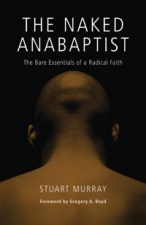
The Naked Anabaptist
Enter Stuart Murray, chair of the Anabaptist Network and PhD in Anabaptist hermeneutics. Stuart is the founder of Urban Expression, a pioneering urban church-planting agency, and has spent the last fourteen years as an urban church planter in East London.
His recent publications include: Post-Christendom: Church and Mission in a Strange New World (2004), Church after Christendom (2005), Changing Mission (2006), and The Naked Anabaptist (2010).
Greg Boyd, pastor of Woodland Hills in St. Paul, has written the forward to The Naked Anabaptist. [It’s worth mentioning that his church is presently considering aligning themselves with an Anabaptist denomination.]
Stuart says that Anabaptism is being (re)discovered by folks from many different traditions. In fact, you might be an Anabaptist and just not know it.
“We believe that the Christendom era has bequeathed a form of Christianity that has marginalized, spiritualized, domesticated, and emasculated Jesus. The teaching of Jesus is watered down, privatized, and explained away. Jesus is worshipped as a remote kingly figure or a romanticized personal savior. In many churches (especially those emerging from the Reformation), Paul’s writings are prioritized over the Gospel accounts of the life of Jesus. And in many Christian traditions, ethical guidelines derived from the Old Testament or pagan philosophy trump Jesus’ call to discipleship.” The Naked Anabaptist p. 55-56
What does Anabaptism look like stripped down to to the bare essentials? Listen to Stuart discuss the core convictions of the Anabaptist Network.
Saturday Night Live has been known for pushing the envelope over its 37 year history with NBC. This past Saturday night (Feb 16th), SNL brought Jesus into a comedic sketch where the carpenter from Nazareth takes his revenge on the Romans.
Christoph Waltz, most notably known for Inglorious Bastards & Django Unchained, hosted SNL this past weekend. Waltz plays Jesus as seen in the movie trailer of a new Quentin Tarantino parody film called “DJesus Uncrossed.” No, Tarantino isn’t really doing a film about Jesus (though that would be interesting), it’s just a bit of SNL humor.
Humor can certainly offend our religious sensibilities, especially if a person thinks that shows like SNL are of the devil. But it also has a way of holding a mirror to the inconsistencies and hypocrisies of our faith, that’s of course if we will let it. It’s time that we start listening to our critics.
I believe that SNL’s portrayal of a “kick ass” Jesus is representative of the bad theology and sloppy biblical hermeneutics that’s so often prevalent among believers who have shaped for themselves an American gun-slinging Jesus—a Jesus that is unlike the Christ revealed in the Gospels.
In fact, I believe SNL has done us a favor. What do you think?
How does this SNL skit about Jesus make you feel? Do you see any inconsistencies with the Jesus of the Gospels and the Jesus that’s often portrayed in the lives of Christians who believe in violence toward enemies? How should Christian’s respond to SNL’s parody of Jesus?
Last week I posted on Creeds & the Local Church. I’ve been giving some thought to the importance, even necessity, of a church doctrinal statement.
I’ve also been thinking about the difference(s) between dogma, doctrine, and opinion. In the pursuit of planting a church, it must be examined and discussed with others who are joining together in community.
I concluded that…
“a healthy church will continue to wrestle with dogma, doctrine, and opinion in every age and culture.”
I wanted to share a few more thoughts I’ve had in light of a couple responses to my last post on the topic.
Why We Need Doctrinal Statements
I admit that a lengthy doctrinal statement can present obstacles for folks. I know that when I see a long doctrinal statement, I honestly anticipate something that’s gonna rub me the wrong way.
I even do this when looking at schools. I almost expect that the longer the statement, the more likely we’re going to clash.
I quickly move off church websites when I see that they believe in a “rapture” pre-millenial/pre-trib theology. That’s of course because I so strongly disagree with it, and I often don’t see why it needs to be stated.
I think… “Can’t we just agree that Christ is returning?”
I think it’s different when there is a statement included that allows for differing views on the matter. It should be clear that people are welcome (and treated that way) even if they disagree with the “official” doctrine of the church. There ought to be an atmosphere of freedom.
But I want to be clear that I don’t see anything wrong with a church saying, “Here’s where we are as a local fellowship.” I would rather they be upfront about it, because it’s there whether visible in a confession or not. This is good and can please the Lord, when it’s done in grace and love.
Contrary to those that think creeds and doctrinal statements are always and only divisive, I think they are helpful for a fellowship and for those who would visit them. We mustn’t jump to such extremes just because we’ve seen examples of churches who did not hold their doctrine with grace, humility, and love. It’s reckless to respond in such a way.
A doctrinal statement captures the heart of the people, and serves as a guide for further growth into Christ.
I think it’s beneficial for visiting Christians to know where a church is in its journey. A doctrinal statement can reveal that to a certain extent. I would like to know where most of the fellowship is at in their walk. Wouldn’t you?
In reality I think it’s unhealthy not to at least hold some distinctives as a local church seeking to express the Christ they know. Where are we theologically as a fellowship? How are we seeking to manifest Christ among our culture and context? How do we feel about issues that often divide the church and the world? These are important questions that should be answered, leaving room for exploration and growth moving forward.
I believe it’s possible to plant your church’s creed, mission, and vision in certain doctrinal ideas while at the same time welcoming everyone who agrees upon the foundation—the mysterious incarnation of Christ.
I don’t think it’s a good idea to enter into any fellowship where doctrine isn’t apart of the church’s life together. That fellowship may have good intentions, but they open themselves up to problems born in the opposite extreme of dogmatism. They imagine that doctrine is inevitably against knowing Christ. They’re wrong. And they’ll be proven wrong.
So, I would say folks will (and should) find union with saints based on their basic confession of something like the Apostles Creed. But I also believe it’s healthy—even necessary—for a church to be upfront and clear about their doctrinal positions, holding them in love, grace, and humility.
It can be done, even if we’re skeptical because of our bad experiences.
What do you think? How have you seen doctrine and church distinctives serve as a healthy guide to growing in Christ? How are you and your church handling doctrinal matters?

 Joshua Casteel (1979-2012) grew up in an evangelical household and was raised as a patriotic Christian. He enlisted in the U.S. Army Reserves at age 17, and later enrolled at West Point.
 Most of my readers know that I grew up a Southern Baptist. I went to a Baptist university for my undergrad, and served in two SBC churches. Seven years later, I can say that I no longer think of myself as a Southern Baptist, for several reasons.
 Last week I posted on
 The Centrality and Supremacy of Jesus Christ